
Differentiating Homes

Screen Shot 2019-09-07 at 9.47.56 AM
Nicole’s Blog & Melissa’s Blog

The following blog was written for a Parent EDU project that Nicole Biscotti (@BiscottiNicole) & Melissa Sidebotham (@MelSideB) are putting together. 


Good educators understand the need to personalize lessons, assignments, and assessments to meet the needs of a diverse population in their classrooms. The educational term for this is differentiation. How many times do educators treat every home as though it were the same as all of the rest? How is it that we see every student as a unique individual, but try to pigeon-hole the homelives into an assumed formula?

Several years ago I began using more technology in the classroom. My district was employing an online teaching component that included lessons and quizzes. With limited classroom time on shaky tech tools, I thought I’d assign some work to be done at home. The day after the very first assignment, I received an email from a single mom who traveled very far for work. My initial thought was defensive. Luckily, although new to teaching, I knew enough not to type what I was feeling. The practice of assigning online HW discontinued, and all was well. 

Last year, I tried sending “Reading Logs” home. I had done this in the past with moderate success. Some parents told me that they liked having their children write a sentence or two about what they had read each day! Of course there was never 100% participation, and as you can imagine, the quality varied greatly. I was floored, however, when I witnessed the vast gap in equity last year. There were some students whose writing was the best I had ever seen. Third graders were composing beautifully written paragraphs every night, after reading impressive texts. Others, however, weren’t even touching a text or scratching out one line on the log. What was I to do? 

Right around this time I was becoming more active on Twitter. Luckily for everyone, I came across many tweets suggesting negative effects of these kinds of blanket assignments. As I reflected on what I was seeing return to school, I realized that these reading logs were really assessing students’ home life more than their ability to read and write. Also, within only a few short weeks, I could see that this continued practice would simply widen the gap between the homes that provided a lot of support and environments that didn’t. What to do? Should I punish the “No-Log-Students”? Instead, I ditched the reading log. I am thankful to my Personal Learning Network (PLN) from Twitter for helping process all of these ideas. 

One thought has continued to burn on my brain, though: How different all of these homes are. During parent-teacher conference season I have some parents who visit my room as couples, arriving early, entering with notes, prepared questions, and goal-setting agendas. There are also parents who never sign up or contact me. We might speak on the phone, but I’m not surprised to learn that there are homes that feel like learning should be done strictly at school. 

Earlier in my teaching career I idealized some home situations and thought that everyone should strive to be like them. Then my daughter Scarlet was born. Scarlet is entering second grade this year. With each new teacher there are new communication styles, formats, and platforms being used. There have been times when I wished my daughter’s teachers communicated the way I did on the same social media platforms that I used. As an educator, though, I know that they have a bunch of students’ families to communicate with, and they should use the vehicle that works best for them. How could a teacher differentiate communication to parents while using the same platform for all? Content; Quantity; and even Quality could be ways to meet parents’ needs. 

Do you type up a newsletter for all families, and then wipe your hands of home communication responsibilities? What if the parents of a youth can’t read, can’t read English, or never receives the letter? Here’s an idea: Find out what families want to know. At the beginning of the year, learn what content would be helpful to each home. The newsletter could still be posted on your website, but you could tailor your communication with the homes of your students to meet the specific needs of each one. It could be a short note, a text, a quick email with a screenshot of scores, etc. You have data on your students. Collect some for your families.

How often do your families want to hear from you? Do you know? How much do they want to read? A parent told me last year that they liked bullet-point-emails. That opened my eyes. I knew my emails were too long. From then on, I had a list at the beginning of what was in each email.

Some parents like getting lots of detail, while others are more interested in simply knowing their kid is doing okay. Which style of parenting is better? Not only is there no good answer to that question, but it is a horrible question to begin with! They are simply different. One thing that has helped me communicate with parents in a tailored way is through providing specific feedback for each student’s writing in Google Classroom. The families that want to know a lot get a lot of text to read. The families that would rather a short blurb get just that.
IMG_7359
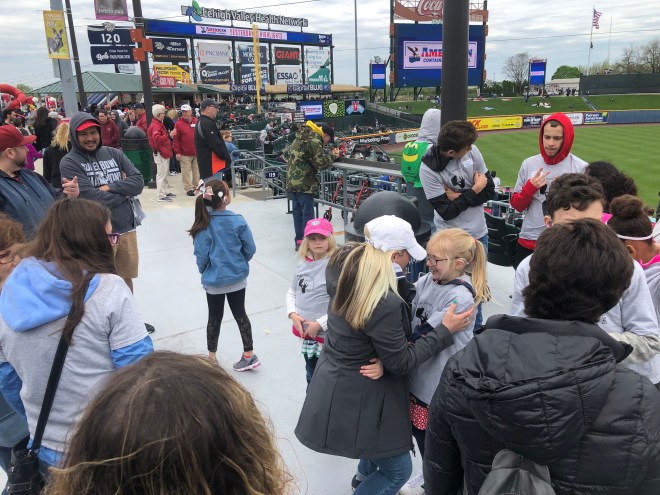
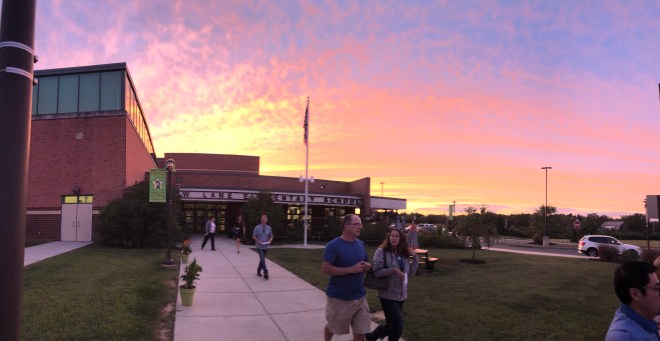
The sky smiled on parents leaving Willow Lane Meet The Teacher Night

Right now I am beginning a new school year. Last night was “Meet the Teacher Night.” Not every student’s parents visited my room, but of the ones that did, one thing that they all had in common was their uniqueness! Everyone was so different! Not just the way they looked; The attitudes shown in facial expressions, the ways they sat or stood to listen to me, their interest in speaking with me before and after my short presentation; These and many more characteristics spoke to me a very valuable lesson: Not only do I need to differentiate instruction in my classroom when teaching my class, but I should be differentiating communication with families. 

Is it my job to get parents who are okay being completely hands-off to change and become more involved? No, but I’m not going to ignore any families, either. My aim is to work at respecting the expectations of homes. Differentiating Homes means the same thing as differentiating instruction: Meeting parents where they are philosophically, psychologically, and physically. If a family thinks education should be confined to school, then I better make it happen in school, while I have their kid! If parents wish weekly reports, I will make sure there is information available about weekly progress. If parents need to feel involved in their child’s education, I will provide opportunities for them to be plugged into classroom activities. If parents don’t have time to read lengthy reports and emails, I will make short videos that can be listened to. My goal for this year is to work at breaking old habits of one-size-fits-all approach to parent-teacher communication. How will you differentiate communication between school and home this year?

Chapter 1: “The Island”

Screen Shot 2019-08-24 at 7.05.40 AM
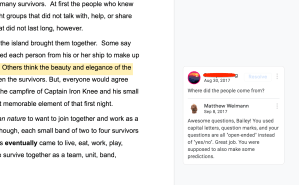
Students wrote comments, connecting to the text, via Google Docs

One of the most important things to establish at the beginning of a school year is comradery among pupils. Several years ago I came up with a story idea that focused on this concept. It introduces my classroom theme of #ThePolitePirates as well as giving us a shared purpose.

The story has grown over the years, as I come up with more themes and invest more time into it. I usually share it with my students in a Google Doc through Google Classroom, so each kid has his/her own copy to practice connecting with the text via leaving comments. This year, for the first time, I plan to publish the chapters in this blog, so anyone can read the story and leave comments.

Feel free to “pirate” my tale. Change and tailor the idea to fit your classroom. I usually read it out loud to the students before having them access it in Google. I try to do a chapter a day for the first week of school. There is a bit of vocab and figurative language to explain, but it is a good tool for introducing all kinds of classroom expectations and future academic tasks.

Without further adieu, are you ready to be shipwrecked?

Chapter 1: “The Island”

Once upon a time there was an island; not any old island; but a special, helpful, resourceful, maybe magical island. This island was home to many plants and animals. However, humans had never set foot upon its shores, until, one day…

There was a massive storm.  It was not a big storm, or a strong storm, or a severe storm, but all three of these adjectives rolled up into one humongous, scary, powerful, and seriously damaging storm. It began so suddenly that several ships were caught off guard.  Some sailing vessels survived the storm, but many were shipwrecked.

The storm may have started suddenly, but it did not end for days.  Wind and rain pounded the water, while sailors, passengers, and pirates bounced like buoys on the sea surface.  

That’s right.  You read that correctly: pirates!  If passengers and sailors were scared of sharks, they were petrified of pirates.

Being shipwrecked at the same time, in the same storm and sea, though, found sailors, passengers, and pirates alike thrown together into the same boat… 

…or… 

…island. 

Did the island sit there passively, while sailors, passengers, and pirates washed up onto its shores? Or, did it, as so many of the survivors came to believe, reach out its long shallow sandbars to save the poor sailors from certain peril?  Either way, people from all walks of life found themselves safely sunning on silky sand when the wind and rain finally ceased. Of their ships, nothing but memories survived.

Two or three persons from each ship made it to the island, so everyone knew at least that many survivors.  At first the people who knew each other formed small, tight groups that did not communicate, help, or share with the other survivors.  But, that did not last long. 

Some will tell you that the island brought them together.  Some say the storm purposefully plucked each person from his or her ship to make up the population of the island.  Others think the beauty and elegance of the island forged a bond between the survivors. But, everyone would agree that the savory smells from the campfire of Captain Iron Knee and his small crew of pirates was the most memorable element of that first night.

IMG_0451
Captain Iron Knee

Perhaps it is just human nature to want to join together and work as a team. Any way you slice it, though, each small band of two to four survivors of five or so ships eventually came to live, eat, work, play, practice, build, and therefore survive together as a team, unit, band, group… 

And eventually

crew.

I hope you enjoyed chapter one. Tune in for chapter two, where we explore some character traits of Captain Iron Knee.

What do you think the message or theme from chapter one might have been? What was the author trying to get across? Why was it written?

A Powerplay of Spontaneity; Is It Classy?

Raise your hand if you’ve ever had something like this happen to you, as a learner.

It’s my freshman year in college. I don’t remember if it was 1st or 2nd semester, but I DO remember that it was 7:30 in the morning, Monday, Wednesday, Friday! [Seriously, who was in charge of that decision: A mandatory, first-year class that early! Clearly, the college was trying to weed out the non-morning-people… with a vengeance.] It was intro to something or other, and I had to take the class as a prerequisite for future necessary courses. So, I’m stuck in this pedagogical prison with what seems to be a brilliant professor who is trying as much as he can to wake us all up with exciting anecdotes. 

The thing is, there is this one rose among us weedy, thorny freshman who has grown beyond the bramble to sing in the early morning sunlight. This student probably already had a higher education, or at the very least was well-read on the topic. I don’t know. I never conversed directly with the guy. He would raise his hand, and the rest of us would lay down our pencils and pens. The lecture was over, as far as the rest of us were concerned. This star student would ask the professor a question. I never even understood the inquiry, let alone the lengthy response the professor clearly loved providing, complete with gigantic vocabulary that drifted like cirrus above our cerebral sleepiness. 

I don’t know how I passed that class. What was I supposed to do in the moment the lecture unexpectedly derailed to plow through the wilderness? Should this naive novice to higher education raise his hand and suggest the conversation steer back toward the original topic, where the rest of us are still stuck in mental mud? …And, while you’re at it, can you use verbiage the rest of us pion-pupils can understand? Should I have left the lecture hall, to go back to the cocoon that was calling me: my bed? It WAS 7:30AM!!! Or, perhaps I should ignore the nonsense (that’s what it was to me), and read the enormous, expensive textbook that I drug around with me, but hadn’t cracked?

That really happened to me. Another thing that happened was my very own participation in derailment, back in highschool. I remember glorying in getting teachers off topic to discuss some random recent event. The class was happy to rest note-taking hands and enjoy some cognitive freetime. 

And, lastly, as a teacher, I have found it fun to discuss something off the cuff that a kid brought up, assuming that he or she was invested in this divergent topic. I’ve thought that the spontaneity of switching gears to something that mattered, personally, to my students would be engaging. It very well could be, for that one student. But, what about the rest!?

IMG_1861
This is a quote of Diana Hess in an Interview with Joan Richardson of Phi Delta Kappan

I’m preparing a collaborative blog post with Mountain Buddha, author of “The Write Inspiration” on the topic of controversy. I was reading an article about using political controversy (oh my!) in a Social Studies classroom, when I came across an idea that stopped me dead in my tracks. 

It may seem classy and fun to allow a spontaneously surfacing idea to infiltrate a lesson, but this can isolate, marginalize, disengage, and feed in to a powergame. 

One of my favorite books is “The 48 Laws of Power” by Robert Greene (2000). Law number 30 (page 245) states “Make Your Accomplishments Seem Effortless”. When a professor or teacher spontaneously expounds on an idea that wasn’t previously advertised, he or she is showing off his or her power. Unbeknownst to the pupils, the teacher has done loads of research, reading, and thinking on the topic. He is older than they and has had some life-experiences that have added to his breadth of knowledge, as well. It may seem like he is speaking off the cuff, but there is a muscular arm of mental muscle under that sleeve. By not explaining how much he prepared for this seemingly surprise question, students are left in awe of his god-like knowledge.

The goal of a classy teacher should be to empower or “put power into” students. 

What would be classier to do, when a student brings up a topic that lies outside the given lesson, is encourage the thoughtfulness by affirming the question; “What a great question. I love how much you are clearly thinking about this topic.”

You could further support her participation in discussion with, “It’s great for you to ask a question that could really further our thinking.”

And, rather than hording the power, share the keys to it by telling the class, “I have read and thought a lot about that, and would be ecstatic to share the information with you. Let’s do that early next week. Why don’t you talk to your parents and peers, and think up some questions that you might have. If you want to really participate, you might want to see if you can find something to read about the topic. Sound like a plan?”

In this way, the classy teacher will pull all of his pupils into the pedagogy, rather than marginalizing most and exclusively speaking to only one or two who share interest and/or experience/knowledge on the spontaneous subject. If there are students who choose to ignore the challenge of preparing for the future discussion, they are electing to disengage from learning. They are rejecting the power of meaningful discussion. For those who are interested, they can fill their coffers with copious particulars for engaging classroom participation. 

This could very well be a controversial subject. I always enjoyed spontaneity in my teaching. I will likely need to work at this classy practice of empowerment. Do you already do this? Do you disagree with my thoughts? Can you suggest an alternative way of handling the questioning student, tempting off-topic discussion? Please share your thoughts.


Works Cited: 

Greene, R., & Elffers, J. (2000). The 48 laws of power.

Richardson, J. (2017). Using controversy as a teaching tool: An interview with Diana Hess. Phi Delta Kappan, 99(4), 15-20. Retrieved November, 2017, from https://www.kappanonline.org/richardson-using-controversy-as-a-teaching-tool-an-interview-with-diana-hess/.


Smooth Sailing is the Enemy

“Snow Plowing” is a term being used for parents who move every obstacle out of the way of their children. It isn’t too hard to imagine the real life consequences of this bad idea. Go ahead and put spotters on the ends of the barbell your child is bench pressing and see how strong he gets “lifting” less than he imagines. Perhaps your kid can say he benched 300 pounds, but put him in a situation where his strength is needed, and…

Page 40 of “The Gift of Failure: How the best parents learn to let go so their children can succeed” by Jessica Lahey shares

IMG_1248…But interesting research shows that smooth sailing isn’t where real, deep learning happens. Small failures when the stakes are relatively low and the potential for emotional and cognitive growth is high, are what psychologists Elizabeth and Robert Bjork call “desirable difficulties.” Learning that comes with challenge is stored more effectively and more durably in the brain than learning that comes easily.
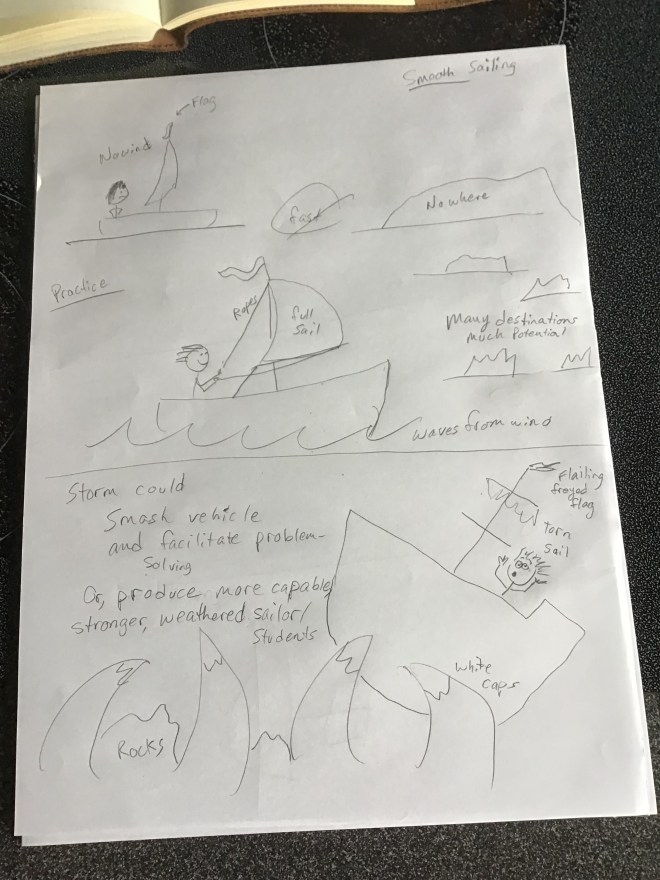

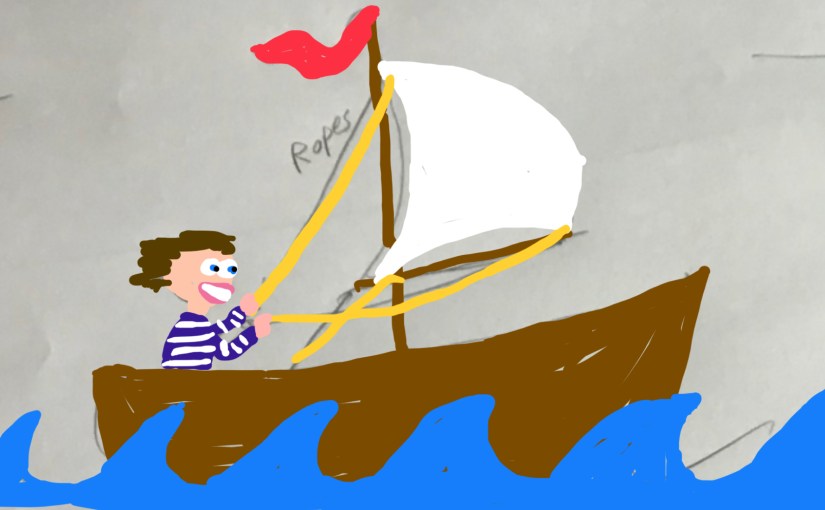
I’ve never tried this, but I feel artsy, so here is an illustration. Don’t judge the art, only the concepts;)IMG_6783

Further explanation:

  1. Smooth waters will get the sailor nowhere fast… not even fast.
  2. The wise parent/teacher provides opportunities for student/sailors to learn with appropriate tasks/difficulties.
  3. Storms will arise. There will be concepts and tasks that can smash a cognitive ship to bits. When this happens, swim to safety, and go buy another ship. Or, even better, find yourself shipwrecked on an deserted island and learn to fend for yourself. Or, build a survival raft from the wreckage. Or… you see where this is headed.
  4. Perhaps the student/sailor had enough practice and/or the concept/ship was built well enough to withstand the storm. Hurray, and good for you!

Hope you enjoyed the metaphor. What can you add to the thinking?IMG_4272

“That’s Okay, I have a Superpower!”

Three of Scarlet’s cousins came to visit this past weekend (July, 2019). We experienced all of the classic summer stuff: swimming in the pool, playgrounds, and s’mores. It was a blast; Especially the swimming. 

IMG_4867Scarlet’s mommy insisted that Scarlet be lathered in a strong sunblock before getting into the pool. That is normal, and all of the kids had to forego the inevitable wait period of letting the lotion dry a little before getting into the pool; Collective “Ugh!”
Additionally, Scarlet needed to have her cochlear implant (CI) equipment changed to waterproof wires and coils. We recently received new pool appropriate boxes to put the CI processor inside to keep it safe from water damage. It takes a while to get all of this situated. 

While everyone was patient enough, no one wants to wait even one extra second when a beautiful refreshing pool is calling your name on a hot summer day! They all waited for Scarlet to finish getting ready before diving in, though, which I thought was very classy.

It was also friendly and kind for Scarlet’s cousins to help her realize that one of her coils was not on her head, but dangling in the pool. This happened constantly throughout the day. Everyone was very patient, another classy trait.

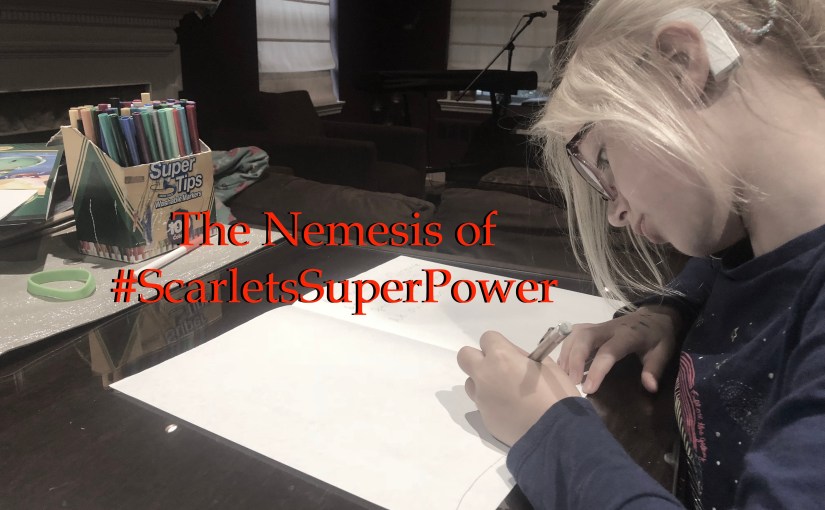
At the end of the day, Scarlet’s mommy Sonia read “Scarlet’s Superpower” to the cousins. Afterward, we discussed the superpower of not being able to hear. Sonia relayed a cute and funny story to me.

This past week Scarlet had a dentist appointment. When the technician was preparing to clean Scarlet’s teeth, he apologized for the loud noise that the air pump was about to make. “A child recently tampered with it, and it broke,” he explained.

Without skipping a beat, Scarlet reached up to her head, and while removing her coils, exclaimed, “That’s alright, I have a Superpower.” I loved the story and was proud of my daughter for taking charge of the situation. Not only was she perfectly comfortable with the fact that she wears CI equipment in order to hear, but Scarlet was proud to display its functionality. How many kids -and adults- are embarrassed of equipment that helps them with a disability? 

This is the message of “Scarlet’s Superpower”: Try to take negative situations and turn them into positive opportunities.

When the kids were waiting for their sunscreen to dry before getting into the pool, Sonia told everyone that Scarlet still has to “waterproof” her CI equipment. The horrible task of waiting turned into an opportunity to learn about water-damage and how to keep water out of things. It also masked the task of buying time. They would have had to stand around waiting, anyway! 

The next time you are tempted to complain about something, see if there is anything positive that could be gleaned from the situation. We can all possess the superpower of seeing the positive. It takes practice, discipline, and sometimes creativity. Good luck!

Screen Shot 2019-07-15 at 6.42.54 AM

Book Information:

Scarlet’s Superpower is available from the Apple Bookstore in digital form for free: https://books.apple.com/us/book/scarlets-superpower/id1461703800

And, it can be purchased for the Kindle App from Amazon for $2.99: https://www.amazon.com/Scarlets-Superpower-Matthew-Weimann-ebook/dp/B07RLFC26K/ref=sr_1_2?keywords=scarlet%27s+superpower&qid=1563187286&s=gateway&sr=8-2

#Playification

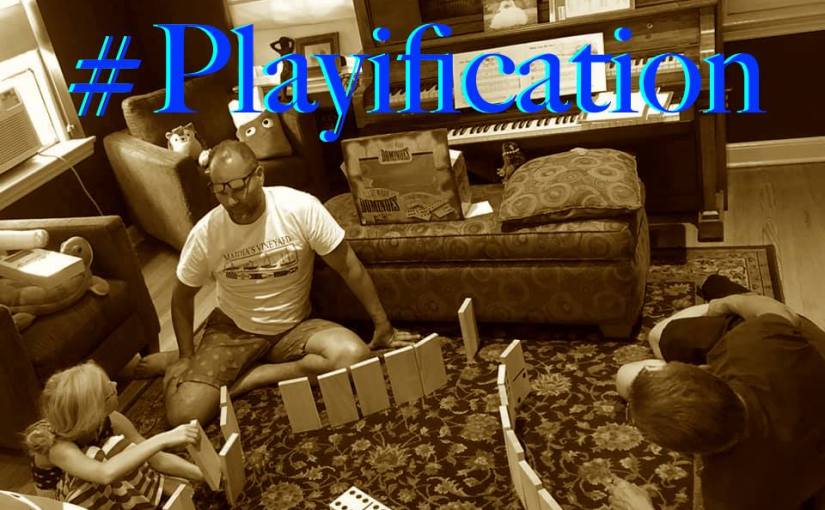
IMG_5629My dad and sister visited over the July 4th weekend. When I was at the grocery store picking up supplies for grilling, I was meandering through the toy aisle searching out things to keep people occupied. We have a pool, and everyone will want to hangout by it, but as great as water is, it gets boring, eventually. My eye was caught by some outdoorsy games; GIANT dice, checkers, and… dominoes. I brought home one of the giant wooden domino sets. There was only 28 pieces in the set, but maybe we could figure out the game, together. 
IMG_5672
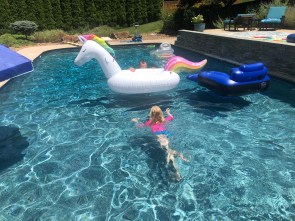
“Playing” with giant inflatable unicorn; Does it get better?

July 4th was a blast… literally, what with all of the fireworks and everything! But, the next day was much slower, and it slowed all the way down to “needing something to do”, so much so that I actually got out the giant domino game. There was the tiniest slip of paper under the huge wooden tiles that had the most basic instructions I have ever read. It was my dad, Scarlet, and I working on playing the game, and after giving it a go, we realized we needed more instruction. Other than setting the pieces up to tumble into one another, I don’t have any experience with dominoes. 

We watched a Youtube video. It introduced some terms, like dominoes can be referred to as “Bones”, and the pile of extras would be the “Boneyard”. The instructions for play were either not elaborate enough or too complex. I thought this was supposed to be a pretty easy game! I had secretly hoped to bring the giant game pieces into my classroom to use instructionally. 


Finally, we found a guy on Youtube who had been in the same boat we found ourselves. He had done some legwork in researching how to play dominoes and put together a very helpful video explaining it for dummies like us. The video is totally awesome, and I recommend you watch it, even if only to see the Weird Al Action Figure play against the videographer! Hilarious.

I’m not going to get into the game of dominoes here. I still need to do more learning and practice. Suffice to say, it seems to supercede all expectations of being able to use in the classroom. You can play with more than just two kids. It is simple enough, combining like numbers, but also strategic: It helps to plan which bones to use in what order. There is a lot of adding and even multiplication/division! But, believe it or not, you don’t actually multiply or divide, so it is perfect for planting the seeds for those future concepts: You have to identify “multiples of five”. 

I leave you with this idea: I have been thinking about using Gamification in my classroom, because “everybody (seems to be) doing it”, and I like making school maximum fun! Through exploring articles and thinking about what I want to get out of the school year, however, it looks like “Playification” is more my speed. When I teach a lesson, I present a problem, and then students use what they know to figure out a solution. We then discuss additional possible solutions and ways to get to them. Finally, I let students “play around” with the ideas. “Try using it in a unique way,” you might hear me say, if you were walking by my classroom. 

So, more than turning everything into a point system or changing pedagogy into games, I am leaning more toward using games to help my students “play more”. You can cheat a game. The only thing you cheat when “playing” is yourself. 

Source:

https://www.smartcompany.com.au/growth/fast-lane-forget-gamification-it-s-all-about-playification/

It Isn’t “Follow The Leader”

I wasn’t sure what to title this blog. There are many ideas swimming around in my head that I want to share. The title I settled on may seem negative, but I chose it to dispel an idea that could hold people back; This misconception might limit people’s experience on Twitter. And so, I hope to help anyone struggling with the question of “who to follow” by offering a couple ideas.

When “following” someone, I am adding them to the influencers of my Twitter feed. Either I’ve seen something that they produced or due to their profile information, I’m interested in seeing more from this person. Immediately after clicking “Follow”, the person’s info will flood enter my feed. I struck out “flood” because it sounded negative; the new info does not push out other things. It just gets added. You do see it right away, if the person has tweeted recently, which is kinda fun.

Due to the information in the previous paragraph, I sometimes WON’T follow profiles that haven’t tweeted at all or who haven’t tweeted in the past couple years. Often authors will create a Twitter account that just sits there. There are some who tweet all of the time, and some even “Like” and “Reply” to you. @JerryPallotta is one of my favorites. He writes the #WhoWouldWin series that I use to teach my third graders nonfiction research skills.

That being said, I will definitely follow people who are using Twitter the way I like to use Twitter, even if they don’t have large numbers in the way of Tweets, Followers, or Following. Hey, I started at 0, 0, and 0 at one time, also. The people who jump in headfirst and immediately begin replying, connecting, sharing, and engaging with me and my PLN are golden on Twitter. These are my kind of people, and I can’t follow them fast enough!

There are a few exceptions. First of all, you will have your own list of parameters for people you follow. For instance, I enjoy the back and forth on Twitter. Therefore, I target following other educators who will talk TO me. Perhaps you would rather use Twitter as a type of news source. People who chatter away (me) may not be perfect for you; Follow me anyway;) (ha ha) Secondly, following isn’t exactly an artform. People who are highly engaged might have succinct algorithms for following. I find that most do not. I’ll tweet to people who are engaged in conversations with my PLN for weeks before that person follows me, sometimes. Other people and even companies will follow me for seemingly little reason. Thirdly, I have a personal philosophy of following certain people, regardless of Twitter behavior, just because. These people include anyone and everyone from my home school district, Eastpenn. I love that Dylan Peters put together a list that helps me find these people. (Make sure that your information is added to the list if you join later in the game!) Another group of parameter-pushing people I follow are tags my PLN suggests. If someone whom I am in close contact with, as in I communicate with them regularly, lists a bunch of people’s handles and says, “Follow these folks”, I do it, no questions asked. You might not have this rule, but I trust my PLN to give me good suggestions.

For example, I just took a break from writing this to check Twitter. Julia Dweck, my good friend, colleague from Willow Lane Elementary, and Twitterer Extraordinaire had tweeted a picture of students holding a project. She was tweeting #Task5 of the #EPSDTwitterChallenge, so Julia included several handles of Tweeple she follows who she suggests others follow as well. Most of them I already followed, but I was pleased to find that there were a couple whom I could add to my feed. I don’t even hover over or look at profiles of people that my close friends suggest I follow. This makes it easy and fast.

I want to end this blog with its title: “It Isn’t Follow The Leader Perhaps to some the word “Follow” leads to negative feelings; As in, “I don’t want to be a follower of anyone.” Also, when you type follow into the GIF search box, you get pictures of little ducklings “following” their mommy. Who wants to be associated with that? I encourage you to NOT think of it that way. There is no leader on Twitter. When you follow people, you DO lend your support to them, but more importantly, you allow yourself the opportunity to learn from them. Not following people is robbing yourself the ability to grow.

Screen Shot 2019-05-26 at 7.29.54 AM

https://help.twitter.com/en/using-twitter/following-faqs

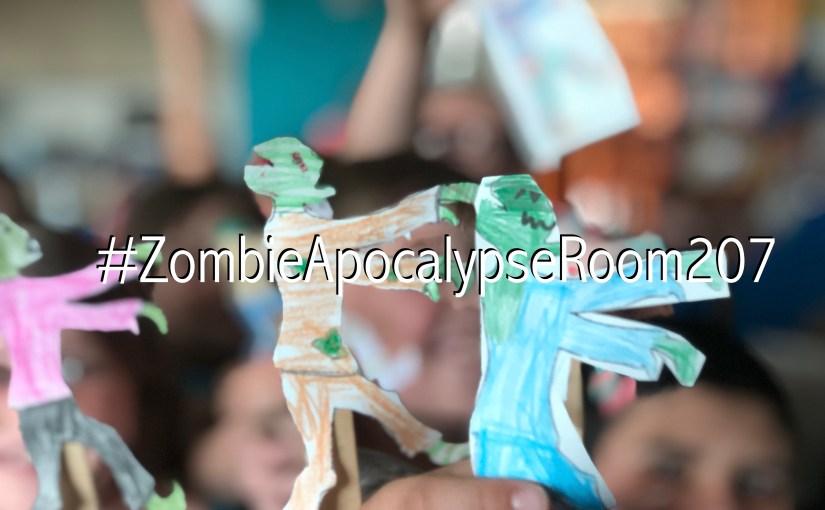
#ZombieApocalypseRoom207

IMG_3248
The Zombies of Room 207

I am NOT against play.

I wish there were more time for it. And, time is my enemy. I have a lot to teach in a very limited amount of time.

Time is against me in another way, as well: I constantly ask myself, “How will this learning stand the test of time? Why would my students remember any of this?”

One answer to this question:

#ZombieApocalypseRoom207

It was the first day of ELA standardized testing. I still had several math concepts to teach IMG_4199before students took the Math PSSAs (Pennsylvania’s standardized tests for elementary schools).

How would I present math when students’ brains were fried?

Serve them up for Zombie hors devours!

I wonder, now, if it was the metaphor of brain-eating, zombie-creating testing that got me on this kick. Either way, everyone loves a good apocalypse theme… And, I delivered. As soon as I got rid of my PSSA tests and dropped my students off at lunch, I recovered my stowed away phone and went to work.

Screen Shot 2019-05-04 at 6.34.16 AM
Problem from ReadyMath that I revamped with zombie theme

Earlier in the year a student had shown me the app Chatterpix. I used this to snap a pic of our classroom spider and make it talk. This spider, EEKK, named after the way students are supposed to sit on the carpet while pair-sharing; Elbow, Elbow, Knee to Knee; has been hanging out in our third grade classroom since his introduction early in the year. I was moving him every now and again, suggesting that he wanted new vantage points from which to witness students’ good behavior/sharing skills. The students love pretending things are alive, and we had fun with it. When I wasn’t moving him for a while students began grumbling and commenting, so I hid him away. Now, 5 min. away from kids, I took a picture of EEKK who was in a cabinet next to the squirt bottle I use to mist the plants. When students watched the video, they exploded in predictions of where EEKK was hidden!

The message of the video was simple: There are zombies lurking, and we need to learn capacity.

IMG_9030
Pic of 2nd day: Review Gallon Guy and workout perimeter problem

Just as I had predicted, my third grade students didn’t care that a toy spider wasn’t alive; that, if it were, it wouldn’t be able to handle a squirt bottle; or that a tiny squirt bottle of water wouldn’t be enough to fend off zombies! They were thrilled to learn about standard liquid measurement and copy my Gallon Guy drawing from the board. I got out containers, and we discussed capacity. 

The next day, was Tuesday, the second day of standardized ELA testing (PSSAs) in the morning. As per law, I put all electronic devices away, until I had rid my room of PSSA materials. While the students were at lunch, I made a new movie. This time, I got fancier. I took a snapshot of EEKK on red tile and used Apple’s Keynote App to erase all of the red background with Instant Alpha. Then I stuck him on top of a pic of a moat.

Chatterpix was used to make EEKK present a new problem of creating a perimeter to protect the classroom spider from zombies while he rested. He couldn’t be on guard 24/7!

With each passing day, I added increasingly difficult problems to EEKK’s predicament. After digging a moat, EEKK had to fill it with water. If it took him 5 minutes to get one gallon, and each linear foot of moat required two gallons, how long would it take to completely fill the moat? Was this question real-world? Well, minus the zombie theme, yeah, I think so;)

img_1572.jpgEEKK wasn’t completely secure, surrounded by only a moat. He decided to build a fort on
MW Teaching
I had to review this several times.

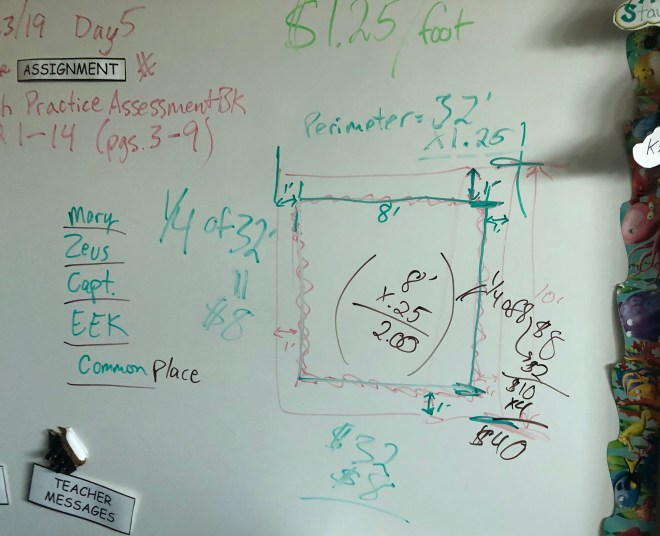
the land he had partitioned from the zombie-infected outside. Luckily Amazon was still going strong and available to drone-drop an order of lumber on EEKK’s land square. But, we needed to figure out how much it would cost us. While the outer perimeter of the moat was a 10′ X 10′ square, the moat took up some of the inside space. If the moat was exactly one foot wide all the way around, what would the perimeter of the inner square be? Students needed some perception help with this one. I even had to break out the clay and make a moat to demonstrate the inside square being smaller than the outside one.

Once we figured out the perimeter of the inner square, which would be the length of fence that EEKK would construct, we had to calculate how much this material would cost. Each foot of lumber was going to require $1.25.

The #ZombieApocalypseRoom207 was so much fun that more characters wanted in on the action! Enter the #PolitePirates. Now, #CaptainIronKnee, Mary (pronounced “muh-ree” for a different story), and Zeus want in on EEKK’s pristine perimeter project. They are a little picky, though. They each want their own space. Now, we must figure out how much more  lumber we will need in order to build walls within our fort to partition individual spaces for each of the four inhabitants. Plus, they need a “Common Place” for all of them to eat and converse together; a shared space.

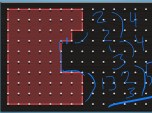
For this part of the project, I had students use the geoboard app on their iPads. They had to make the perimeter of the fort, 8 units by 8 units, with one “rubber band”. Then they could create any size spaces within that for the four characters, leaving an additional, fifth space, for the common space. The only parameter was that all of the corners must

perimeter of 5 spaces
This clever student had the idea of drawing lines on each unit to keep track of counting.

be right angles. (This was so that the linear measurement of perimeter was more accurate. It was enough to figure out the cost and time to construct our forts. I didn’t need to teach the pythagorean theorem on top of everything else!)

Once they designed their fort interiors, they had to figure out how much the materials would cost. “Keeping linear units at the price of $1.25/each, how much money are we looking at spending for your fort?”

One thing that was very difficult to communicate clearly was the fact that you didn’t have to count a unit that functioned as two walls twice: If a room inside the fort shares a wall with the outer perimeter or another room, you only count that structure once. (It is tricky, even, to write about this.)

Self-Reflection: What I would do differently

The apocalypse began in fantastic form. The students loved it. The theme was fun and the problems were challenging and engaging. They quickly became overwhelming, however. There needed to be more teaching. I sat with some struggling students and walked them through the use of geoboard. I had them make the same exact shapes as me, and we figured out the perimeters together. This worked well.

Also, the idea of shared walls was very tricky. Two things could remedy this confusion. Make the parameters so that not walls would be shared, or have kids use popsicle sticks to actually build model forts. I wanted to do this last idea, but Wegmans didn’t have any sticks, and I was out of time. Teams could use clay bases and even fill the moat with water. Manipulative money could be used to “buy” the materials from a Zombie store. Students could earn the money by doing chores or figuring out other problems.


Another lesson-learned: Don’t overdo the theme. I am guilty of this. I tried doing a data lesson using the zombies, and not only did everyone grown, but it didn’t even make that much sense without teaching data-analysis, first. The video is cute, and I’ll use it in the future. Plus, students did love the game of throwing zombies at the school.

Self-Reflection: AWESOMENESS and things to grow

Even though the data lesson was not perfect, it gave us Zombie puppets. I had the students use the puppets for an ELA lesson. They made their own Chatterpix videos where their zombies told stories.

The creativity and open-ended practice was unparalleled.

tricky perimeter
The teaching and creativity seemed endless!

The teaching moments were limitless. I never even got into the cost of carpeting the inside of the fort with different flooring styles! We discussed and figured out area, but it was enough to reteach/learn fractions with four quarters equaling one dollar and division with 12 being broken up into groups of four (quarters) to see the money problem different ways.

drawing
This student began erasing her art because she thought she was in trouble. “NOOOOOOOO!!!” I shouted. She had drawn the Polite Pirates talking over their fort fence with the misunderstood zombies.

And then there is the artwork. In addition to coloring in the zombie puppets, some students drew illustrations for their videos. I had given the class the premise for their zombie stories: The zombies didn’t really want to eat brains. They just wanted to be smart, and they thought that eating brains would help them. The Polite Pirates explained the problem of this misperception to the zombies and everything was fixed. Each student made up his/her own rendition of the story.

The Future of #ZombieApocalypseRoom207

In the future I’d like to incorporate some supplemental reading and ELA components. My friend, Julia Dweck has written a couple of cute kid books about zombies that I would love to incorporate.

Can you recommend others in the comments?

Any other zombie must-dos?

Scarlet’s Hearing Equipment

IMG_8347
Scarlet draws the “thumbs up” from page 11 of her book. (Notice her shirt says, “Be Yourself”.)

It is natural for kids to be narcissistic, thinking mostly about themselves and their personal situations, until they are tweens (10-12). Scarlet, being only 7 at the time of this writing, doesn’t totally understand how different her hearing situation is from most other people.

One difference that Scarlet is well aware of is her hearing equipment. In her book we mention the great advantage to being able to NOT hear when it comes time to go to bed. This is true… not the monster creeping out of the closet, but everything else. When Scarlet wakes up in the morning, she can’t hear anything until she puts her coils onto her head. This means that Scarlet, a 7 year old, is wandering around the house, completely oblivious to any sounds happening around her.

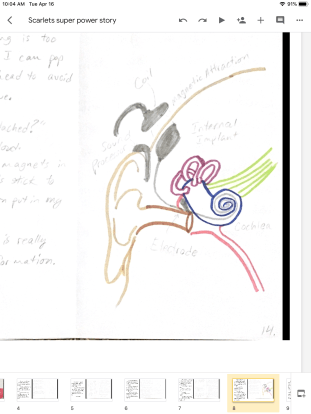
Screen Shot 2019-05-07 at 6.23.25 AM

[As I type this, at 5AM in May with the windows open, I hear birds singing and traffic zooming on a busy road near our house. Scarlet will never know the experience of waking up to birds chirping.]

Thankfully, it is not difficult to equip Scarlet with the tools for hearing. There are several companies that offer cochlear implant equipment. The one our family went with, Advanced Bionics, has a couple of different devices (at the time of this writing; technology is changing all of the time). One of them allows the processor to be clipped to her clothing. This one has a long cord that reaches from the processor to the coil that sticks to Scarlet’s head. A couple nice things about this equipment is that it is easy and fast to put on. It can clip to anything; Sometimes I clip it to Scarlet’s hair! Another great thing about this device is that it is waterproof. Some drawbacks to this one, though, are that its batteries are hard to get to and need to be changed often. Plus, the long cord gets caught on things and pops the coil off a lot.

The other device that Scarlet has for hearing attaches to the back of her ear with double-sided tape. An earlier version of “Scarlet’s Superpower” had the word tear in it on page 4, when it says, “I reach up and slowly, carefully remove one of my sound processors.” We removed this word because we didn’t want the book to be disturbing. That could diminish the message of the text. The truth of the matter is that every night we DO have

IMG_1011
It is common for Scarlet’s hair to get stuck to the double-sided tape.

to rip the processors off of Scarlet’s ears. And, many times it really hurts her, pulling a hair that is stuck in there. Also, I fear for my daughter’s skin behind her ear. Some advantages of these devices are that they are smaller with shorter cords, lighter in weight, the batteries last longer, and they have the ability to attach an additional device that allows her teacher to use an FM speaker system to broadcast directly to her cochleas. (This last feature may be the subject of a future book; one about her bionic abilities.)

IMG_7550
Here is Scarlet’s teacher Mrs. Brans celebrating with Scarlet the day she signed the National Anthem at a baseball game. This was the same day that “Scarlet’s Superpower” was published. We had to leave the game early, because it began to rain.

A serious drawback of this latter device is that it is NOT waterproof. This is where the subject of this blog comes into play. Scarlet has recently begun complaining a little about not being able to go outside for recess if it is drizzling or if rain seems imminent. Having her equipment break is too risky. One thing I didn’t mention about the equipment, and I won’t expand upon, is that it is a hassle and nuisance to have to get any of it replaced. Thank goodness we can and it is possible, but it is FAR from convenient.

So…

Scarlet’s Superpower, albeit totally awesome, and it truly is, came from a desire to help Scarlet feel good about being different. “I might have to stay inside when it is wet out, but I don’t have to hear the fire alarm.” My aim is to empower Scarlet AND kids like her with this new, SUPER attitude or way of looking at their disabilities or special conditions, a positive outlook.

We are already seeing it play out when we hear from children telling us that they are okay with wearing glasses because they now view it as a superpower. Please, share more of these stories with us. And, share “Scarlet’s Superpower” with others, because this is one of those synergistic powers, in that, rather than being depleted, the more it is shared, the greater it becomes. That will be the topic for another blog.

IMG_6010
Planning for page 8 of “Scarlet’s Superpower”

Active Math

IMG_5826I was going to title this blog “The Building Blocks of Math Construction” because I liked the play on building/constructing learning from material things. Really, though, I think the most important thing about this lesson was plain old ACTION. Yes, it was creative and fun, but rather than teachers reproducing the exact lesson, I want to share the philosophy behind it. It is a difference between building a beautiful, popular burger joint that everyone in a region admires and franchising the concept all over the world.

IMG_4095This is what I did. In thinking about teaching money, I was imagining setting up some kind of store in the classroom. In stead, I brought my daughter’s old school, wooden building blocks into the classroom. I thought I would have the students compete to construct the tallest structure while using the least amount of supply: They would stack blocks of value to create vertical towers and add up what it cost them.

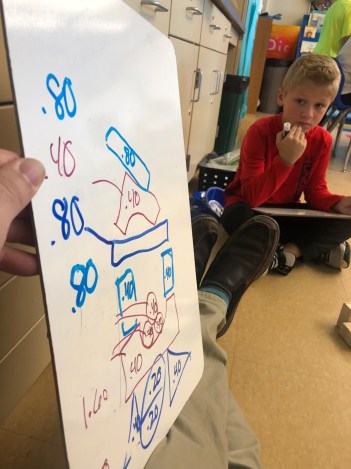
I told the students of my plan. They were ecstatic. I assigned value to the blocks, dividing them into four categories: Many of the blocks were around 14cm. Those would cost 80¢. Any block that was less than 13cm would cost 40¢. (I did less than 13cm, because the 14cm blocks were a tiny bit under 14cm.) Now, the fun part. Many of the blocks had round edges that would make it

IMG_0411
Students took pics with iPads and identified styles/cost of blocks. This is an image from a student iPad.

difficult to construct with; Those were on sale. They were half off. Here the kids would be using their recently acquired fraction skills. Lastly, there were two gigantic 28cm blocks in the box. Those were $2 each. Why? Because that’s the number that popped into my head. Also, these are super valuable because they are so solid and long. The kids can evaluate the price of these versus the others.

IMG_3517
After going over costs, I set students loose!

After talking cost, I started centers and left my top kids to figure out constructing cost-effective building on their own, while I conducted guided reading. The buzz from the back corner was electric. Everyone in the class was dying for their chance to add up the cost of blocks!

Halfway through the first center, I stepped away from my guided reading group to check on my little architects. How were they doing?

Rather than constructing a tall tower, this group of three boys and three girls were designing the most beautiful condominium complex you ever saw. They were finding a way to use every single block they could! At first, I was like, “That wasn’t the objective.” But, I caught myself.

I forgot to mention: I had introduced the whole idea through telling the class that they were going to be designing high rises in an urban area. We would have Lego people rent space in our sky scrapers.

This group was not making a cost-effective creation. Was that wrong? No. No, it wasn’t. “Okay,” I managed to say. “This is going to be pricey,” I told them. “You’ve built a Five-Star resort, here,” I joked. “Let’s add up how much it will cost to construct.” They jumped on taking it apart, putting the blocks into piles, categorizing by the characteristics I had assigned, earlier. I told them that they could reconstruct their building after figuring out the price tag for it. Amazingly, there wasn’t a breath of complaint. I’m pleased to report 100% success, albeit after quite some time.

IMG_8975After this experience I realized that the rest of the groups would probably need some guidance with this project. I decided to use math time to teach how to evaluate constructions. While students did some online work, I brought groups over to the construction corner of the room. I went over the prices of each of the four styles of block. We analyzed similar blocks and categorized them according to cost. Then I built a simple structure with one of each price. Students used dry erase boards to add up the cost. I also had manipulatives (plastic coins) there to help. It took a few tries, and as students showed success, I let them build a four block building. They had to add up the cost before moving on. With each success, they were able to build more.

I grouped students with like abilities to work together. There was a group that did so well so quickly that I let them work in teams with more than four blocks. None of my builders cared too much about making their towers tall, even though the example that I gave them was straight up, as tall as could be with one of each style of block. I did not emphasize this, either.

IMG_3664
Look at this amazing construction!

Students had a blast building their block structures. One group built a road. Why not?

IMG_5928
We double-checked the cost of each creation.

One thing I would change, and I was tempted to change this halfway through the lesson, is the pricing. I didn’t like that half the price of the 80¢ block was the same cost as the smaller one. The smaller blocks should have been 50¢. Then there would have been more variation in the numbers and coins. Kids would be counting with quarters.

This was solved the next day. We revisited our building blocks motif, but this time with the vertical challenge. I explained that they were constructing in the inner city. I had actually looked up the price of the average urban block. “A city block in Manhattan is worth ONE BILLION DOLLARS!”

“What?!” Screamed the class with gasps of horror.

I had them use my vinyl chess mats as city plans. Each block or square would cost them 75¢. The trick is that for every inch of vertical they could collect 25¢. I formed a bunch of groups and spread students out all over the room, dividing up the blocks. In seconds the room was a buzz with builders. It wasn’t about how tall their building was, so much as how much money they could make.

My students were on fire. They had no idea they were even doing math! I am planning on putting together an elaborate assessment involving an urban plan where city block prices vary, depending on proximity to highway exits. I’ll redo the price of blocks. I’m even thinking about including fractions or weight! We love a challenge.

IMG_8633