Hats On To You

My head is swimming in a storm of figurative language, ideas, memories, and desires to share stories right now. Room 207 is a buzz with homonyms. Twitter is popping with robust vocabulary that is inspiring existential, pedagogical philosophies. I have stumbled across a heretofore unknown superpower, asking “Why?” –Soon to be blogged.

And finally, have you ever had the experience of someone seemingly reading your mind? There are those friends who know you so well, or the two of you have shared so many of the same experiences that he/she can tell what you are thinking throughout a conversation. The idea of completing one another’s sentences is the costume for this super power. But, have you ever met someone who simply shares many of the same interests, experiences, life values, and goals; so many in fact that you seem to have known each other far longer than you actually have?

I only just met Kate Lindquist, and that only virtually on Twitter, a few weeks ago. But, the way she is tweeting things that are right up my alley reminds me of the relationship between Rodion Raskolnikov and Porfiry Petrovich from the godfather of dual personality psychology thrillers, “Crime and Punishment” (Dostoevsky, 1927). Petrovich, the local detective, has no idea Raskolnikov committed murder, but the latter feels like Petrovich is on to him through the entire novel. The recent tweet is a perfect example.

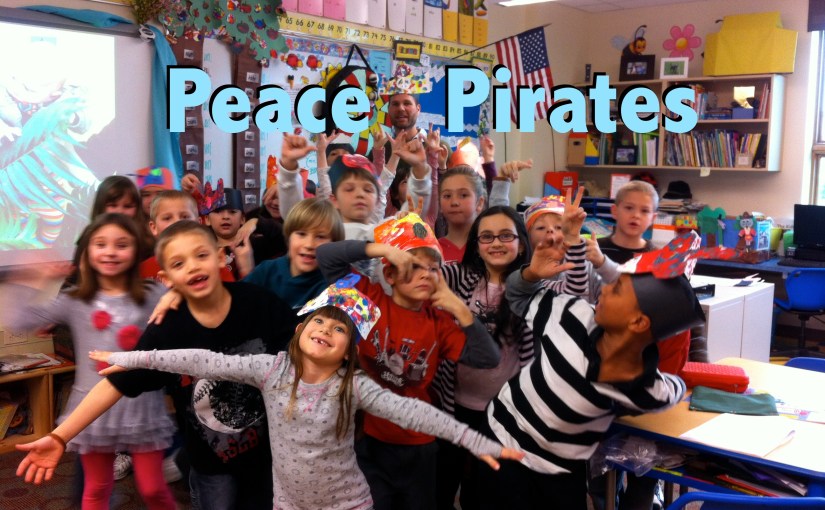
better qualityThe picture at the top of this blog is from my very first year teaching. Those kids are in high school, now. I was doing all kinds of culture-building activities, mixing in art, philosophy, and story-telling. This was the year that I dreamed up “The Polite Pirates”. One of the special days throughout the year was “hat day”. This theme spurred all kinds of ideas, one of which, as you can see by the picture, was making pirate hats that did the opposite of filling strangers with fear and dread; They were to spread cheer and peace. We also came up with new classroom roles: The Peace Pirates.

IMG_1336
The first ever Peace Pirates

One boy and one girl would be chosen each week to be incharge of making sure that the classroom was manageably quiet. They were given a “Peace Tool”, which is a little plastic drum with beads in it. When tilted slightly, the beads spill, simulating a beach-like sound. The class whispers “So peaceful” in chorus. They love it. And, it works.

The next year I added to the theme by making two “Peace Hats” that the Peace Pirates may wear. These were made of gigantic cardstock fronts that every student added some peaceful idea to, decorating the front with color and peaceful symbolism. There were words, pictures, cartoons, etc. I had to readjust the band that held it onto the students’ heads each week, but that was part of the formality of picking new Peace Pirates.

It was the following year, year three of Peace Pirates, that I finally wrote a story for the Peace Hat policy. [This is wear (get it;) Kate’s tweet comes in.] The story is about the power of the hat. I wrote it to bring power to the Peace Hat, but it is about hats having meanings or messages.

While the story was only okay, it took on new life when it was changed into a play to be read during a readers theater for parents. I love engaging top notch students’ help with projects as a way to differentiate through enrichment. The year that I made “The Peaceful Hat Story” into a play I had a student named Brandon help a little. We were learning Google Docs that year, and I had Brandon reformat some of the text, separating paragraphs into speaking parts. Honestly, I did most of the work, and had to fix some of

Brandon’s help, but he felt like a million bucks, having participated in the project. As a reward and payment for his participation in the project, I put his name on the bulletin that I printed out for parents. Of course Brandon was in this play during the readers theaters performance! Some of his crew congratulated him with comments in the shared Google Doc. My favorite thing about this experience, though, was the ending that Brandon gave the play. I have left it just as he typed it all of these years, explaining to future classes that a student wrote that. It cracks me up, and I can’t think of a better way to end the thing!

The Peace Hats are not worn as much anymore. This year’s haven’t even graduated from artwork to hat! But, the Peace Pirates get to sit at our classroom island. Looking out over our classroom from their peaceful perch, they still use the Peace Tool to encourage a quiet environment. In this way, none of my Polite Pirates will need to dawn the invention explained at the end of the Peaceful Hat story.

And, here it is in play form.


A Peaceful Hat Story Readers’ Theater

by Mr. Weimann

CAST:

  • Narrator 1
  • Narrator 2
  • Onomatopoeia
  • Captain Iron Knee
  • Zeus
  • Swashbuckler
  • Sailor

Narrator 1:  (in a gruff old piraty tone)  Behold, ye landlubbers be sittin’ in on the finest collection of courteous kids these here parts have ever known.  We have a tale to share saving shenanigans for silly sailors and piraty persons performing peaceful feats!

Narrator 2:  (in a normal voice.)  Oh, good grief that pirate talk is hard.  And, I’m pretty sure it didn’t make much sense, either.  What my friend meant to say was that this class of students has a story to convey through one last readers’ theater.  And, guess what! It is a polite pirate tale.

Narrator 1:  Yeh, there be some strange personages patroling these planks.  Watch out for the disease. It be catchin’ ye off guard, and shir ta frighten ya.

Narrator 2:  My friend is referring to Onomatopoeia, which is no disease, but rather the literary term defining words that represent sounds.

Onomatopoeia:  Grrrrrr.  Argh!

Narrator 1:  There she is!  That was thee disease.  She roams these waters. Be plenty oh pirates ‘fraid of her.

Narrator 2:  Sure.  If you are unaware of Onomatopoeia, you may be frightened by…

Onomatopoeia:  Wham!!!  Slam!!! Bam!!!

Narrator 2:  But I just told everyone who Onomatopoeia is, so we’re good here.  Let’s get on with our talel.

Narrator 1:  If you insisteds.  You be the boss, with yer fancy talkin’ and profesionalies explainin’.

Onomatopoeia:  Stomp, stomp, stomp, SLAM!  (Door slamming shut)

Iron Knee:  (bursts in on Zeus stirring a pot)  What’s for dinner!? I’m starving!!

Onomatopoeia:  CRASH! (pot falls to the floor) SPLAT! (Sauce lands on Zeus’ hat.)

Zeus:  Oh, no.  Look at my hat.  What a mess. I cannot cook with such a messy hat.

Iron Knee:  I’m so sorry, Zeus.  I did not mean to be such a distraction.  I should have walked quieter and closed the door gentler.

Onomatopoeia:  Sob, sob

IMG_5445
Preparing for performance

Zeus:  I forgive you, captain.  I just don’t know what to do.

Iron Knee:  Well, you could wear my hat, if you must have one.  I’ll have one of the swashbucklers clean up yours.

Onomatopoeia:  Gasp!

Zeus:  I couldn’t possibly!  Your captain’s hat doesn’t belong  in the kitchen.

Iron Knee:  Nonsense.  What does it matter where it is worn?  It will cover yer head. That is all.

Narrator 2:  It did not require much persuasion for Zeus to dawn the captain’s illustrious hat.

Narrator 1:  There was much need, those, for the young piraty cook to be wearin’ many dishtowels on his little roundish head.  For the captain, he be havin’ a rather largish head, so his hat be hugish on top oh the cook’s.

Zeus:  This feels better… pretty good… almost too good… powerful…  Back to that sauce.

Onomatopoeia:  Swish, slosh, splirt… (Zeus stirs the sauce.)

Narrator 1:  Every stir that cook took made the hat-wearin’ rook look…  power caused him to shook…

Narrator 2:  Are you a poet now?  I don’t think shook is even a word.

Narrator 1:  It most certainly is!  The cook shook with might.  And, maybe. Maybe I will be the Poetic Pirate!

Narrator 2:  You might shook with…

Onomatopoeia:  Clank!  (Zeus drops the stirring spoon.)

Zeus:  Sauce, I am tired of stirring you round and round, round and round.  I want you to thicken, and I don’t think that I should have to slave over you to make that happen.

Narrator 2:  As if in answer to the person wearing the captain’s hat, a humungous bubble rose up from the surface of the brown goo.

Narrator 1:  (with gusto, like a professional actor)  Zeus grabbed a knife from the counter, and held it like a cutlass high above his head.

Narrator 2:  Don’t steal the show.  You’re only a narrator.

Zeus:  Insubordinate gelatinous mutineer!  You shall pay dearly for your rebellion.  I will have no rivalries on my ship!

Onomatopoeia:  POP! Splat.

Narrator 1:  (with a flat boring voice)  Zeus removed the captain’s hat.

Onomatopoeia:  Utter silence.

Zeus:  Oh no, what have I done?  Captain’s hat is covered in mutinous muck.

Onomatopoeia:  Creek, click.  (the door opens)

Swashbuckler:  Hey, what are you doing with the captain’s hat?  I have yours right here, all cleaned up and ready to go for you.

Zeus:  What?!  The captain gave this to me!  I did not steal it. You can go stick your nose in someone else’s business!

Narrator 2:  Now, the swashbuckler, who had returned with the chef hat that he just washed as a favor to both the captain who had asked him to, but also as a courtesy for his good friend the chef, could not help but laugh out loud.  Little did the chef realize, but he looked ridiculous with a pile of dishtowels still atop his head. As he yelled, the pile swayed to and fro like something out of a Dr. Seuss book.

Onomatopoeia:  Ha, ha, ha, chuckle, chuckle, chuckle

Narrator 1:  (incredulous)  A Dr. Seuss book?  Really? This story is so far removed from Dr. Seuss, that…

Narrator 2 :  (cutting off the other narrator)  Rather than experience the wrath of his friend, who was turning as red as a beet at this point, the swashbuckler backed out of the kitchen still clutching the chef hat.

Onomatopoeia:  Step, step, step

Swashbuckler:  I wonder what got into him.  Where should I leave Zeus’ hat?  I’ll just wear it until I find a place.

Narrator 1:  (back to a piraty voice)  Well, my mateys, this fine friend of a fellow forgot all about the look shook cook’s hat he took.

Narrator 2:  (to himself)  Oh brother. (to the audience)  Even when another sailor asked him…

Sailor:  What’s cookin’?

Narrator 1:  (piraty)  He be still forgetin’ he be dawning that puffy white hat!

Swashbuckler:  Nuttin’ much.

Sailor:  Tis that a new dish?

Swashbuckler:  Dish?

Sailor:  What we be havin’ for mess mate?

Swashbuckler:  What mess?  I cleaned this deck this morning!  It’s as shiny as your bald head!

Sailor:  (a little hurt)  Hey. I just be wonderin’ what’s the eats we be slavin’ aways fur.

Narrator 1:  (still piraty)  Look here. This sailor fella be thinkin’ that a regular old swashbuckler be the chef o’ the ship.  He be thinkin’ this ‘cause the swashbuckler be keepin’ that chef hat on top of his dare head.

Narrator 2:  Are you going to keep talking that way throughout the entire play?

Narrator 1:  (piraty)  It be startin’ to grow on me.  That there be an idiom, if ye not fir-mill-yaaarrrrrrJ

Swashbuckler:  I can’t take this anymore!  I’m outta here. (throws chef hat on the ground)

IMG_7838

Performed on “International Talk Like a Pirate Day”, September 19th

Onomatopoeia:  Kirr whop!

Sailor:  I wonder if he realized he was wearing the chef’s hat.  I think…

Onomatopoeia:  Churn churn churn

Sailor:  I think I might be able to have a little fun with this.

Onomatopoeia:  Slosh, swish, swoosh,  ring, slosh, swish, swoosh, ring

Swashbuckler:  Hey chef, I’m starved.  What grub we got for supper?

Narrator 1:  (no longer piraty, but kind of confused)  Wait a minute. Is that the same swashbuckler from before…  like two minutes ago?

Narrator 2:  Yeah, that’s right.  We should probably infer that some time has lapsed.  You’re a narrator; why don’t you tell everyone?

Narrator 1:  (still regular voiced)  Could it be that the chef hat has some kind of magical power, so that it transforms the appearance of anyone wearing it?

Narrator 2:  I think you are over-thinking it.  These are pirates. They probably just see a chef hat and assume a chef is wearing it.

Narrator 1:  (a little hurt)  Oh, so pirates are less intelligent than other people, huh.

Narrator 2:  Not this again…  Look, this whole tale is about hats.  I think it is safe to say that there is something going on with the whole who wears a hat, and what hat it is matters business.  Let’s find out how the tale ends.

Narrator 1:  (piraty again)  I be hearin’ correctly?  Somebody mention themselves some grub?

Narrator 2:  Here we go…

Onomatopoeia:  Mmmmmmm

Sailor:  Grub.

Swashbuckler:  You ignorin’ me man?!  What grub we be eatin’?

Onomatopoeia:  Mmmmmmm

Sailor:  Grubs, man.

Swashbuckler:  I asked you what grub.  Why you be askin’ me what grub?  You is bein’ the cook ain’t ya? What you doin’ foolin’ me dis way?

Sailor:  We be eatin’ grub my matey!

Narrator 1:  (normal, and out of piraty character)  Is he saying “grub” like the animal, or grub, as in the slang term for food?

Narrator 2:  Narrators are supposed to supply information, not ask questions.  The sailor is playing a joke on the swashbuckler. The word grub can be used both ways, and he is implying that the swashbuckler will be eating actual insect larvae for lunch.

Onomatopoeia:  Splash!

Narrator 1:  Wow!  The swashbuckler did not seem to appreciate the joke.  He just dumped his whole bucket of dirty water on to the trickster sailor’s head.

Onomatopoeia:  Wham!!!   Bam!!! Slam!!!

Screen Shot 2019-04-07 at 7.06.13 AM
This was the crew that turned the story into a play. 2013

(conversation off stage)

Captain Iron Knee: All hands below deck!  Batten down the hatches.

Zeus: Where did this hale storm come from?

Swashbuckler:  Where is sailor?

Captain Iron Knee:  The sails will be ruined.

Swashbuckler:  No, I mean where is the sailor who I threw a dirty bucket of water on?

Onomatopoeia:  Thwack, thawack, thwack

Sailor:  Attack!  Attack! Someone is attacking the ship!  Man the nine-irons! Jib the sails, or whatever you do with sails.

Narrator 2:  As you may have guessed, the sailor was blind with the bucket on his head.  The dark, combined with the sound of huge hale hitting his bucket head, disconcerted him to the point that he began running around raising sail and preparing for battle.

Narrator 1:  Sailor unknowingly saved the entire ship!

Swashbuckler:  You raised the sails yourself?

Sailor:  I am a sailor.

Zeus:  You had the foresight and extreme intelligence to place a bucket on your head?

Sailor:  Well…

Captain Iron Knee:  You are the hero of the whole ship!  What a brilliant idea! How did you ever think of it?!

Zeus: Yeah how did you come up with that?

Sailor: Well you didn’t let me finish before.

Zeus: Well, then who did it.

Sailor: The Swashbuckler did.

Captain Iron Knee: What?

Zeus: Well then I guess we can congratulate both of them.

Captain Iron Knee: Yeah.

Narrator 1/Narrator 2: And, that’s exactly what happened.

IMG_7822
Piraty Personages;)

To Coddiwomple is Classy

Education is an experience; This is our purpose.

The vision is coming into focus, while it is getting hazier and more illusive.

21st century teaching should less resemble the space race of the 1960’s than take on the attitude of video game designers from the 80’s & 90’s. The space race was meant to show up Russia. Who could touch the moon and return to Earth first? Whomever could cover the distance of the playground, tag the wall, and return to the starting point first, wins. Wins what? Wins the race. For what? Why?

Granted, we learned lots of things through the process of racing to get to the moon. Sometimes it is necessary to have goals. Shooting for the stars will get you off the ground… sometimes. But, what if your goal was to find out what else was out there, other than stars and what we already know? What if your goal was just to explore, in general? There is the whole funding issue.

A friend of mine (Thank you Kate Lindquist@heARTISTatWORK 9h9 hours ago) introduced an incredible vocabulary word to me just yesterday. I was of course flattered that she thought of me, especially in connection with such an interesting locution. A Google search, blog read, and some introspection lead to some seriously fun philosophy gymnastics.

Screen Shot 2019-04-04 at 4.39.15 AMThe word was coddiwomple. It means to “travel with purpose to an as-of-yet unknown destination”. If you were to boil Western Civilization down to just a handful of concepts, one of the most poignant, I believe, would be “goals”. We are obsessed with them. There have been countless coaches and seminars selling the necessity of setting good ones. A contemporary wave of self-help is focused on washing away the stress of not meeting them; failure.

A recently published blog by  Mar 28 about hiking presented a paradigm-shift away from being goal-oriented. It provided the etymology of the word saunter; coming from the word saint. A portion of text from John Muir explains the origin coming from people pilgrimaging to the Holy Land. Now, these travelers had destination goals, but clearly they understood the importance of the process as an experience. Touching down in the center of a holy place in a helicopter so that you can check it off of a list of todos, hardly seems like the end of a pilgrimage. And yet, this is exactly what some educators are teaching their students to do.


“Your mission is to figure out a way to get the robot to deliver something to the cup,” is not an awful way to get kids thinking, tinkering, toying, and trying. What if you said, “Others have gotten this robot to place this ball inside of this cup. What can you have it do?” Now the student will be coddiwomple-ing.

This term takes the goal and shifts it forward. So many times we keep pushing ahead. We have reached the moon. What’s next? Explorers kept pushing on until every square foot of planet Earth had been touched by human toes. I propose playing on the plains, rather than hurrying over hills.

As I prepared to deliver the definition of coddiwomple I was tempted to write some of my own words: I came up with this fun prose, “Meander with meaning.” I erased it, though, because it is inaccurate. To coddiwomple does not mean mess around. There definitely is a purpose to the play. We should teach students to love the wrestling of ideas in addition to showing them how to pin down a problem.

Sources:

The Adventure Diary. (2016, November 4). Why You Should Coddiwomple Your Way Through Life…. Retrieved April 3, 2019, from https://adventurediary.co/coddiwomple-definition/

Mountain Buddha. (2019, March 28). The Simple Joy of Walking in the Woods. Retrieved March 29, 2019, from https://journeyofathousandmiles.blog/2019/03/28/the-simple-joy-of-walking-in-the-woods/

“The Mysterious Mess” –An Elapsed Time Adventure

IMG_3501
I used my morning routine as a warmup for the mysterious assessment.

Wednesday morning I woke up at my usual 4:55AM with an idea in my head. I had been planning to assess elapsed time in math class (3rd grade) this week, but hadn’t decided on how. All kinds of ways to quiz my students’ understanding abounded, but none were optimal for this subject… or situation.

During the previous week, out of the blue, Laughlin came up with an astounding; an outrageous; a formidable goal. If all of the students in the class get a 100%, we should have a party. Immediately, I softened this to “between 90% and 100%–If everyone earns an A.” Through this suggestion, I was admonishing my acquiescence. And, I told them all that “If everyone received an A, I’ll bring in ice cream sandwiches for the whole class; except the two who are allergic–they would get something super special; I don’t know yet, but it will be awesome!”

Now, I know that grades are perceived negatively in some circles of pedagogical thought (Don’t hate me, @MaireCervenak), and there will be blow back from the start of this concept, but I am writing about it anyway, because I am looking for some help. My students and parents are used to grades from previous years and I have (yes, I’ll admit it) handed out grades, this year. What I am looking for is a way for every student to get to the A (mastery of the subject), while I can still assess each one’s understanding through standards-based assessment. I think that I am almost there, but I would like your feedback and help.

This is what my brain cooked up: I came up with a story where students would have to use elapsed time to solve a mystery. Rather than there being several questions that students answered right or wrong, I would have them wrestle with timed events to figure out the conclusion to one massive mystery.

Here is the premise: A parent comes home; it could be a mom or it could be a dad; late from work. The parent usually gets home at 5:15PM, but today he/she had a meeting that was two hours long. So, immediately, students are working out an elapsed time problem. What time did the parent actually arrive home? [When I introduced the story to them, I gave them this one. They all knew anyway, that the parent walked through the door at 7:15PM. I tell them, “This is just an appetizer; Wait until we get to the meat of the problem!”] After working hard all day, the parent is not too happy to find the house in disarray. There is a huge mess! And, here is the ONE question for the whole quiz: “Who dun it?” (Here is a link to the Google slideshow containing the story. Feel free to use!)

I explained to my class that the kids are all guilty unless they can prove that they were so busy the whole time that they couldn’t possibly have had time to make a mess. It was my students’ job to figure out if the kids filled up the time from getting out of school to the time that the parent arrived home with activities. If there was any missing or unaccounted-for time, then that kid was a suspect. My class liked the idea, but they hadn’t fully bought into it, yet. “So, we are like detectives…” Avery offered.

IMG_3508
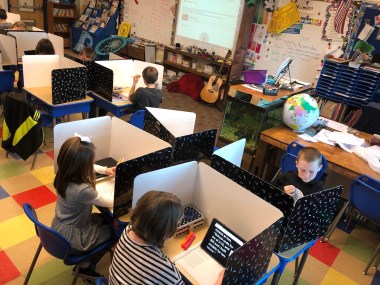
Students were more engaged during this assessment than during lessons.

“No, you are not like detectives. You ARE detectives,” I countered. Huge smiles of glee infected the room. Not only was this going to be fun, but don’t forget that we are working for As, so that the whole class (minus a couple, who are going to get something super special) can receive ice cream sandwiches. Now, they understood that all they had to do was figure out the answer to one question: “Who made the mess?”

Okay, I have to backup a little, here. While all of this may sound awesome, it would be too much for third graders to just throw a long tale full of times at

IMG_3507
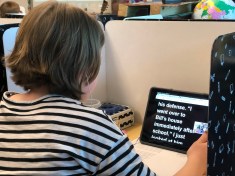
Students wouldn’t HAVE to watch the video, but it would be available to them.

them, no matter how well I prep their minds. First of all, this story, which I wrote from start to finish between 4:55 and 9AM that morning, was three long pages full of text! If I were truly assessing only the math concept of elapsed time, I would have to find a way around the students who need help reading and comprehending text. I have read test questions to my class in the past, but this is a long story that was full of information and nuance. Keeping everyone together would be too much. I decided to record myself reading the story.

I had just recently found an online, free teleprompter program that I was planning on having my students read from when video-recording themselves to use picture-in-picture within iMovie for a research project. I had already mentioned this to my students, but hadn’t shown them how to use it, yet. I decided I would take my math assessment story and use it to show them how the teleprompter program worked. At 10:30AM I got the equipment ready, and projected my computer screen onto the wall so students could see exactly how it all works. I copied the text from the slideshow that I had typed it in and pasted it into the teleprompter program, all the while explaining what I was doing. Then I tried different speeds available for reading. I was learning how to use this software right in front of my entire class. (I also had a student videotaping this whole process. See video below: Warning, it’s a little shaky:)


Video of reading

We had some fun with the different speeds.

Finally, I did record my reading of the first section of text, right in front of my class. We have an early lunch, 10:45AM, so we had to pause the project, so I could bring the class to the cafeteria. When I got back to my room, Ms. Bee’s student teacher was waiting for me. He said that he had a question about how to get a Word document into an email. I hadn’t freaked out, yet, but I was teetering on the verge. I smiled at him and told him that I would like to help, but “I have a test that I still have to make, and I am planning on administering it in 30 minutes… I would be happy to help you, but I can’t right now. I recommend using Google Docs and sharing a link with your professor. Good luck, and stop back later, okay?” He assured me that he had time, and we agreed to get together after school. Alright, it was go time!

Not only did I have to make my video so that kids could listen to it, but I still had to print out the papers that I wanted them to record their work on!!!

As I write this, I honestly don’t remember the exact order that I did things; It is all a blur in my memory. I’ll tell you the outcomes, though. I screen-casted the teleprompter scrolling through the script that I had already recorded myself reading. Then I prepared the teleprompter with the next section of text. I screen-casted that as it scrolled. I videotaped myself reading the text. I then airdropped the screencasts to my iPad. Using iMovie, I created a movie with the screencasts. I put the videos of myself reading out loud into the movie as a picture-in-picture. This way my students would see, but more importantly, hear the text being read to them. I thought about providing some voiceover of instructions on how to use the movie, but I didn’t have time. I just got the raw footage ready, edited it a tiny bit, making sure the PIP wasn’t covering any of, or very little fo the scrolling text, and double-checked that all of the volumes were appropriate (I even stuck background music in; Thank you Bensound.com. You are awesome.) Then I exported it.

While my iPad was uploading the video to Youtube, I got the story ready for printing. I was able to at least type my instructions into the top right hand corner of the first page of my story. My district has begun using ReadyMath this year. ReadyMath has a very specific way of having kids proceed through problems. I am supposed to be using this curriculum with fidelity, and I have been, for the most part. But, this story-quiz was all me. Here I had the opportunity to merge my assessment with the ReadyMath way of teaching.

Now, we back up even more. I had come up with an idea a couple of days earlier that I thought would help the class all get As. They would not take this quiz as though it were a standardized test, with desks spread out and stress prevailing. Rather, I would have them work the way they were used to:

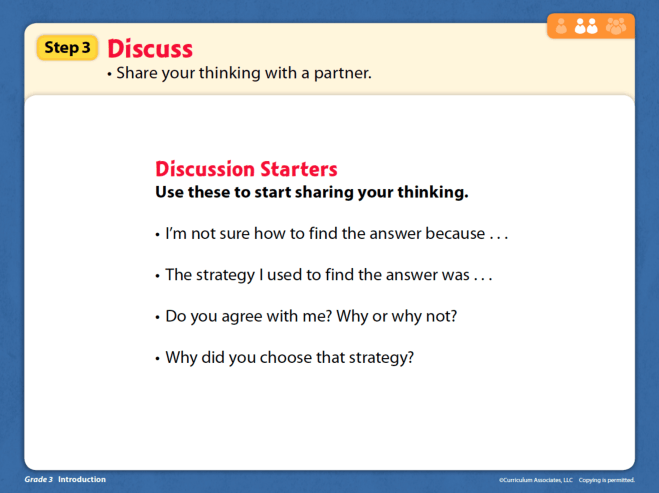
Step 1Step 2Step 3 Discuss

And, now for the secret weapon: After solving the problem multiple ways, they would discuss what they had figured out with their turn and talk partners. In order for this to work, they must “Record their process”, so that they can more easily and accurately communicate their work their partners. (Of course, I wanted to see what they did, also, but I didn’t even have to say the most heard phrase in all of math, “Show your work.”)

Back to my lunch. I was sneaking bites of a tuna sandwich, while typing, formating (I needed students to have plenty of space next to the text to record their work.), and printing the papers. Before collecting the papers from the printer to bring to the photocopier, I (virtually;) grabbed  the link of my movie from Youtube, threw (again, virtually;) it into Google Classroom as a “Question” and punched keys (literally at this point) to provide a minimal outline of expectations. I pushed this out to my math class. iPads were ding-ing acceptance of their new assignment as I rushed out the door to print the paper versions of the assessment.

With thirty copies of my story/quiz in hand, I met my students as they entered the building, from recess. After walking them up to the classroom, I sat them all down on the carpet. Before launching the assessment that I had just barely managed to pull together, I told the students a different story.

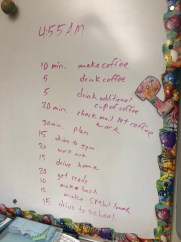
I wrote times on the board, as I explained all of the things that I had done that morning prior to arriving at school, starting at waking up at 4:55AM. Other than being inspired with this great idea of a math story/assessment, it was a pretty typical morning, so it was easy to rattle off all of the stuff and times. They were in awe of an adult life’s responsibilities. I ended with “What time did I get to school? –Go!” They rushed to their desks to get Math Spiral notebooks. No two students figured it out the same way. Most everyone got the same answer. After discussing it a little, I told them that this was the hors d’oeuvres for their assessment.

On the fly, I decided to separate the first page of the story from the other two and administer it independently. The papers hadn’t been stapled, so it was easy. Before handing it out, I displayed the page on the screen and went over the directions. They still didn’t know that they would be “discussing” their findings with their neighbors. I told them that when they read the text, they should highlight the important information. Then, as I read, we made high-pitched, inquisitive sounds of marvel at each mention of a time. This was hilarious and reinforced picking out the necessary numbers.

Finally, it was time to set them loose. I explained the video available in Google Classroom. A student asked, “Do we have to watch/listen to the video?” It hadn’t occurred to me that they might not want to.

“No, you definitely do NOT have to watch the video,” I answered. I knew that several would need it. But, it started to sink in that the video could very well be just a distraction for strong readers. As I handed papers to students, they went to their desks to begin figuring out whether or not the first-born child of the parent in the story might have made the mess.

All the papers being handed out, students either watching the video or reading intently, the classroom was as silent as the morning after an evening snowfall. I finished my tuna sandwich and took some pictures and video. I dragged teachers in from the hall to witness my class. I was so proud of how hard they were working and what I had put together for them.

This might be hard to believe, but when I was writing this story, I was adding the times of all of the different activities that each kid was using as an excuse up in my head. I didn’t even know if I had done the math accurately, or which kid was really responsible! I know this seems crazy, but it made it extra fun for all of us. I ended up having to figure it out with the students when they had questions, or told me they were done.

As it turned out, Angela, the oldest of the three kids and first to provide the parent with her excuses, had provided times adding right up to the minute that the parent came home. Only a handful of my students were not accurate in their calculations. I encouraged them to try solving the mystery through using a different mathematical strategy. Everyone recorded more than one way to solve Angela’s elapsed time. This brought us to the end of our math hour, and I collected everyone’s paper.

IMG_8309
Scanning Station

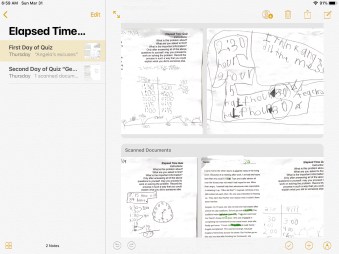
Overnight, I scanned everyone’s papers using the Notes App on my iPad. I was insecure about students changing their work when they discussed with partners. In this way, I would be able to see how well each student understood what he/she was doing. How well did they meet the standard?

At the very beginning of math the next day, the class revisited the premise of the assessment. “What are we trying to find out?”

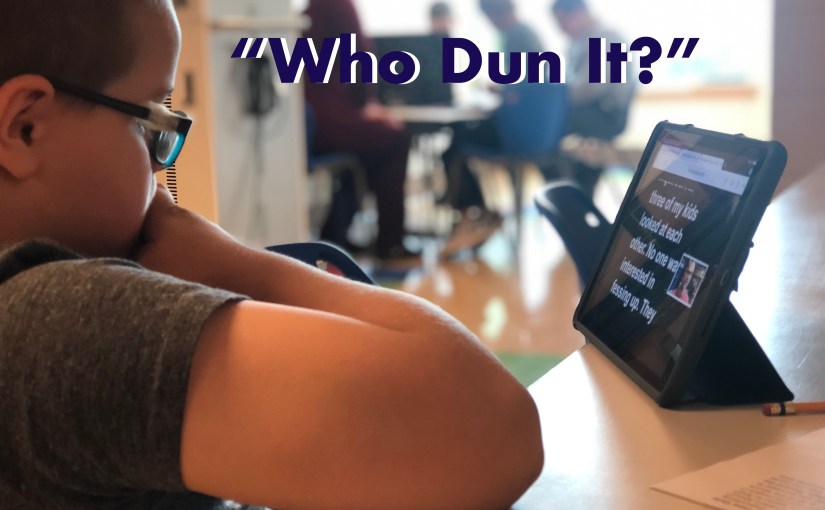
IMG_1286“Who dun it?” –Who made the mess?

In order to solve this mystery we were calculating the times of the kids’ excuses to see which, if any, had any unaccounted for time that might mean they might have used this time to make a mess. With all of my students on board with the mission of our mystery, I handed back the paper they had worked on the day before. They were instructed to discuss with their partner what they had done. I was explicit in that they were not to erase anything. I told them that they could add to their notes if, in discussing with their partners, new ideas or information came to light. I told them I had scanned the papers, so they were not going to be tricking me at all if they decided to break the rules. I don’t think anyone did. The discussion was lively. Everyone was energetic about figuring out “Who dun it?”

I then handed out the second page of the story. This one had Angela’s brother, George providing excuses. This part of the story has a lot of dialogue between the kid and the parent. Students were again able to access the video to listen to the text being read aloud. Many did. They were told to highlight the important information: the times. After students had ample time to complete their calculations, providing more than one strategy for solving the elapsed time, I had them again discuss their work with their partners.

It was now time to work on the third and last page of the story. This was a kid with a slightly different name. Rowan was a relief. His times were just half hours. There were six of them, so students could try using multiplication or repeated addition or skip counting. The timeline method seemed to work best. Once they had finished this and discussed their work with partners, I explained that it was time to provide answers. Students were to use the work that they had diligently recorded on their papers to provide explanation for their choice of who they think made the mess. They were to revisit the Google classroom and type the name(s) of the culprit(s) (another vocabulary word stemming from the experience), along with why they think that these children might be guilty.

When finished typing, they were permitted to read each other’s answer and comment within the Google Classroom on each other’s answers. The room was pin-drop-quiet for fifteen minutes. You could smell the neurons firing.


They loved interacting with each other within Google Classroom.

And, now it is Sunday morning. I have a pile of papers and a Google Classroom full of answers. Did everyone get an A? Did every student display mastery? They were all present for the assessment. One student left her grandmother at the airport to not miss school!

The work looks very impressive, but I will have to comb through it all. I don’t think everyone got everything perfectly accurate. As far as the mystery being solved, the story ends with the parent saying that he/she trusts the kids’ stories and just wants some help cleaning up the mess. In the end, as long as everything is straightened up, it does not matter “Who dun it”.

Planning a Party, Pirate-Style

IMG_3446Over the weekend I finally experienced “Teach Like a Pirate”. I listened to the recently produced (Jan. 2019) audio book, read by the author, Dave Burgess. There were tons of great take aways, some of which immediately developed in the first math lesson, Monday morning!

First of all, if you haven’t already gathered, I am one of the “freaks” that Dave mentions at the outset of his book: I bubble with passion, naturally and eternally. I live for teaching and love “bringing it” every day in every way. In addition to this, possibly because of this–There is definitely some cause and effect, here–I am quite creative find it easy to come up with new, innovative ideas. I left my accidental slip of type in the last sentence because it reminded me of one of my favorite points from “Teach Like a Pirate”: The six worst words that Dave Burgess has ever heard (loved that chapter!)

Monday morning, I was getting ready for the day and week, when an idea hit me: Have students learn time through using it to plan a party. We have been working on elapsed time for a couple days, and there are lots of ways to use real-life scenarios, but are any of them more fun than planning a party? Definitely not. I’m pretty good at hook-development, but it certainly didn’t hurt me to hear Burgess talk about it in “Teach Like a Pirate”! No more hook was necessary than “Today we will be planning a party.” I didn’t have to count to get kids on the carpet. They came ready to contribute… to their own learning!

IMG_3456
When Math Time = Party Time

Through discussion, I let the hook sink deeper and deeper, so that the students were mesmerized with math. I refused to answer the question, “Are we actually going to do this party?” I upped the ante when a student suggested that rather than include “Set Up/Clean Up” in our 60 minute time window, “We should just set up before the party and clean up when it is all over.” This sounded perfectly reasonable to everyone, but I told the class that “We will be renting a ballroom that costs $250 an hour. We don’t get the room until noon, and if we go over our time, the price doubles. So, we have to squeeze all of our activities within this 60 minute window.” And then I added, “Also, we have to include plenty of time for clean up, because the hotel will charge us extra if we leave it a mess… plus, that wouldn’t be classy.”

Boy, were they hooked. I mean I have never seen a group of students more engaged in discussion and riveted to each utterance! Every hand was shooting up with ideas. Who doesn’t want a party? The first thing I did was facilitate brainstorming of ideas of things to do at our “Math Party”–That’s what I called it; This wasn’t just any ol’ party; It was math-time, and that’s what we are doing; Make no mistake about it; You will learn math by the end of this. Many students were sharing themes. I praised “Pajama Day” and “Electronic Day”, but redirected to coming up with events that actually take up time. “We can make crafts wearing pajamas or with electronics, but it is the building-of-the-craft that takes up time,” I explained. So that the students felt heard, I wrote the theme ideas on the side.

IMG_3458During the brainstorming time I was building rapport. Not between myself and the students–that happened in September, and I had plenty of it–but between my students and the subject matter. Remember, I am teaching them math through all of this! The way I see brainstorming, it is like student ability: Every kid can do the math, some faster, some easier, some needing patience, help, and additional explaining. In my brainstorming sessions, every idea is acceptable. This makes it fun and funny, also. When a kid suggests a water event, I say, “Did you just say No-holds-bar-water-balloon-war!?” The classroom erupted… and the ideas poured in like the water filling those metaphorical balloons. Just as a teacher needs to redirect thought to shape learning, I rephrased student ideas to write a list of potential party events on the whiteboard.
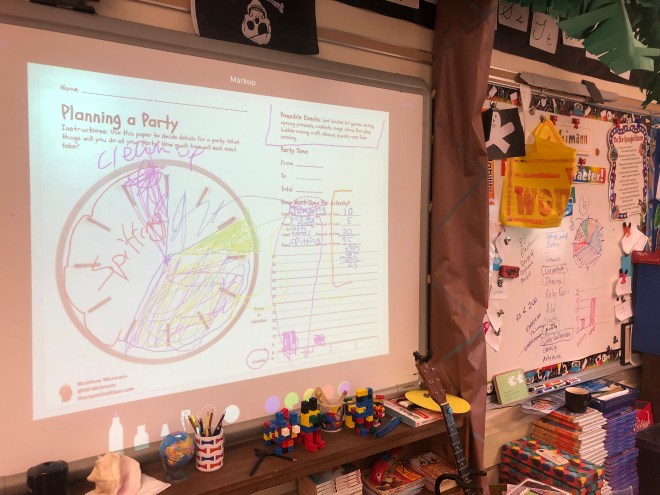
Next, I drew a circle with ticks or lines that made the circle look like a clock. But, I didn’t write any numbers. I pointed out that there were 12 increments. Students mentioned that it resembled a clock. I agreed, but told them that this was a measurement tool, instead. I asked how much each segment was worth, reviewing our fraction sense: one increment was a unit fraction of 1/12. “If the circle represented 60 minutes, how much was each segment worth?”

“Five minutes.”

That being established, we worked together, discussing how long the events might take. Students made suggestions as to which events we would want to have in our party. As students shared ideas, I filled in the pie graph. (I didn’t tell them that this is what the circle was, until afterward.) “Wait a minute, we have a lot of fun things planned, but what about set up/clean up time?” I inquired. “It’ll take some time to fill up enough water balloons to have a 20 minute war! And, we better plan on cleaning up all of the debris.”

As I filled the pie graph I asked questions like, “How much time do we have left?” And, “What fraction of all of our time have we used up?” Here is a tough one: “Of the time that we have planned, what fraction is eating?” This forced them to come up with a new denominator. You better believe we reduced our fractions to their simplest form each time, as well!

When done, I had students analyze our pie chart with questions like “Which two events equal the same amount of time as Water Balloon War?” After several of these, and Turn & Talk partner sharing, I modeled taking the information and turning it into a bar graph. First, I asked, “Why don’t we have to bring the (y axis) all the way up to 60 minutes?” Students knew to only go as high as the greatest amount of the events. After making the graph we did some more analysis: “How much more time will we be soaking each other with water balloons than eating?”

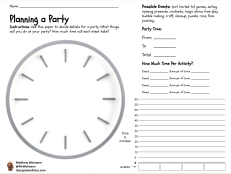
IMG_3459Finally, it was their turn. I showed the class the graphic organizer that I had made for them. They gasped when they saw that it was exactly like what we had just made. Because I presented it screen mirroring my iPad, I could quickly draw all over it. I showed them how they would plan events, fill in the pie graph, and make a bar graph. I told them that they weren’t allowed to use the same exact ideas that we had come up with together. They could have “eating”, but not the same amount of time. In other words, don’t copy, create. They were all cool with that. I stimulated this by writing crazy ideas on the graphic shown on the board: “Picking nose for 5 minutes, followed by washing hands for 20 minutes… because that was gross!” They loved it.

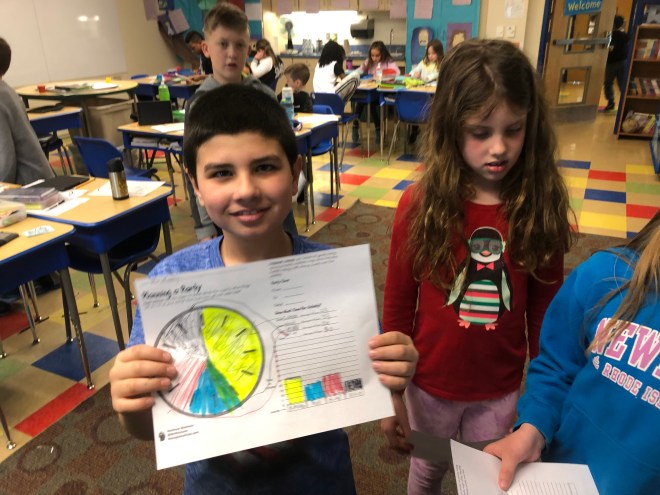
When everyone had their paper the room was abuzz with feaverish creativity. No one, not even my “I can’t think of anything to write” students, was stumped for ideas of things to do at a party, albeit “Math Party.” As students brought me their papers, they continued to ask, “Are we really going to do this?” All I did was raise my piraty eyebrows.

IMG_3461
Proud Work

Google slide with graphic organizer for convenient printing and reproduction. Please pirate this to use as much as you like:)Screen Shot 2019-03-29 at 6.00.50 AM

Burgess, Dave. (2012) Teach like a pirate :increase student engagement, boost your creativity, and transform your life as an educator San Diego, Calif. : Dave Burgess Consulting, Inc.,

Seamless Simple iMovie Integration

IMG_3324iMovie 1.o

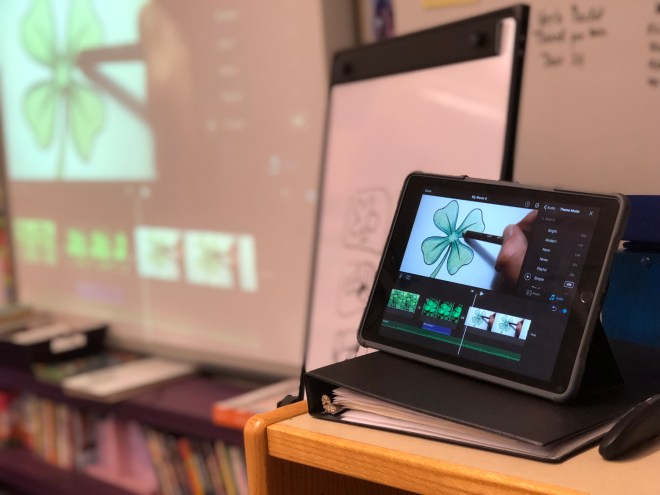
I finally introduced iMovie to my students this past week. We’ve had our iPads since Christmas, but we’ve been busy. Last week my students read text and watched videos about St. Patrick’s Day from a Google slideshow (1). They took notes as they learned.

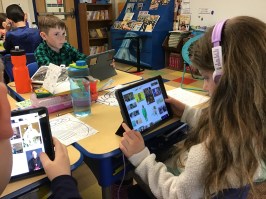
When they concluded the slideshow/I told them time was up (2), they began making their iMovies. Before opening the app, they acquired four images (3) to import into iMovie. IMG_1218After making the first image a title slide (4) with information about themselves and their project, the students produced voiceovers for each of the remaining three pictures. They recorded themselves reading their notes. To finish off the project, students added background music. “How would the students share these videos with me and each other?” I wondered. Without skipping a cognitive beat, I thought of importing them into Flipgrid. This worked without a hitch. I made a new topic in my classroom Flipgrid, and kids figured out how to import their movies. They loved being able to watch each other’s movies and comment on the pictures and information.

iMovie 2.o

IMG_1298
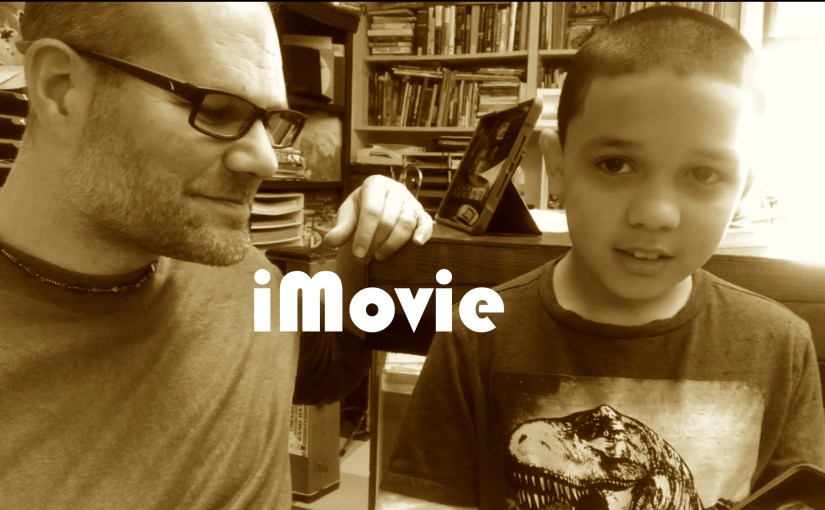
Mr. Weimann teaching iMovie to a combined rooms 205 and 207

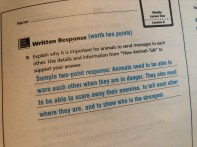
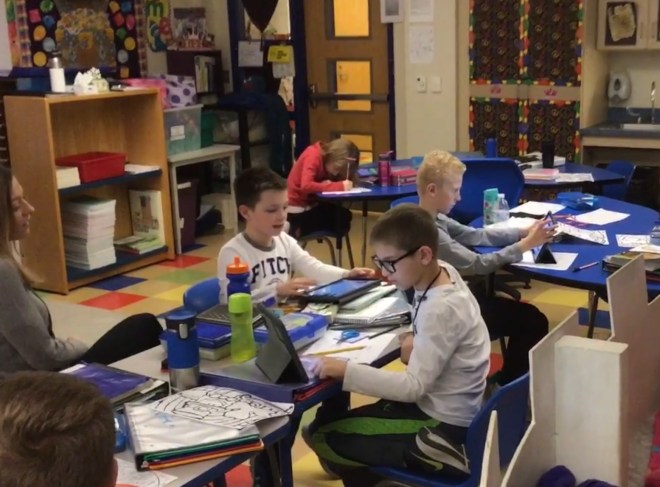
Immediately following the St. Patrick’s Day project, I had my class begin a new iMovie. This one was going to be about how animals communicate. There is a “Photo Essay” in the STORYtown textbook that I frequent for lessons called “How Animals Talk”. The How Animals Talk written responseaccompanying assessment for this text has a written response asking students to explain why it is important for animals to communicate. I thought it would be fun for my students to publish movies about this, rather than simply writing about it. Using pictures would reinforce the nature of the “Photo Essay” genre that STORYtown was presenting.

Building on the introduction to iMovie students just experienced, I added the element of picture in picture (PIP) to students’ production tool knowledge. This time students would have more images, and instead of using voiceover, they would videotape themselves reading a script. This video would be added to their movies as a frame on top of the slideshow of images. Additionally, students would use an iMovie built-in theme: I had them use the News theme because they were reporting on animals. Also, this theme has awesome text graphics! We used the News theme music, as well.

This time students would collect specific images. They had to find pictures that illustrated their animal communicating. There should be three or four per animal. And, students were to report on three or more animals in their movies. The notes about animals “talking” to each other should be written as a script. The script could be typed into an online teleprompter program (5) or app. This is neat because it makes the font big and easy to read, plus moves so kids can keep a reasonable pace. IMG_1236

After students acquire their images and record their videos, they are ready to make their movies. Just like last time, they import all of the pictures, first. They move the pics around, stretch them out, adjust the Ken Burns, if they like. Then students add the theme effects. Next, they insert the PIP. At this point students should include text on some of the images. I had my students provide sources for the information that they shared. They could tell the name of the animal, also. Kids will need to resize and position the PIP so that it doesn’t cover any of the image that is important, and so that it does not get covered by the text.

iMovie 3.o will involve showing students how to fine-tune volume, fading, and generally polishing their productions. I want them to understand the importance of quality before moving on to greater and greater quantity.

iMovie 4.o will teach detaching audio. This is neat, because watching someone talk for too long is boring. You can videotape yourself speaking, and break up the video by inserting pictures, all the while keeping the audio track playing in the background. (It is important to learn all about adjusting volume before this lesson, because when you detach audio iMovie automatically makes it louder.)

Notes:

  1. Obviously, this kind of project could be conducted on any topic. St. Patrick’s Day just happened to be the event that corresponded with me finally being ready to have my students use this tool. The main thing to consider is having the students only wrestle with one thing at a time. I recommend already having information compiled for them. Don’t have them research, conducting all kinds of steps before ever getting to making their iMovie. Then they won’t remember how to make one. My students had a one-stop shop of a trough of info about one topic within the Google slideshow.
  2. I gave them plenty of time, but stopped everyone at the same time, regardless of finishing the slideshow. (Honestly, it had too much information in it, anyway.) This way I could help everyone with iMovie at the same time. They were all on the same page. They could go back to the slideshow to learn more when they finished their movie.
  3. Here is where digital citizenry comes into play. Kids are already familiar with Google Images. Because we are going to be making  movies using the pictures, and we plan to published them, images that are copyrighted are a no go. Kids can use “advanced search” in Google Images to find usable images,
    or Richard Byrne provides a list of 9 websites that have images available for “reuse”:
    https://www.freetech4teachers.com/2011/06/9-places-to-find-creative-commons.html
  4. “Slide”–I called the images in the iMovie app slides because my students are used to Google Slides, and the pics look like lined up slides. “You can stretch each slide so that it takes up more time in your movie, for a longer voiceover. You can rearrange, delete and add more slides. Also, you can add text to your slides.”
  5. A teleprompter program I found through a grad class at Kutztown University is https://cueprompter.com/

IMG_1246

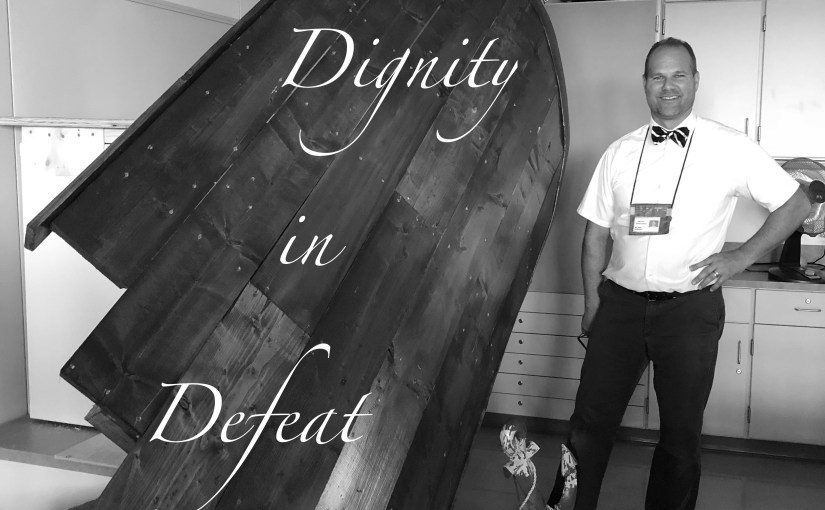
Dignity in Defeat

There is lots of talk about how great failure is… in books, articles… all over the Twitterverse people are praising the merits of accepting failure. How great is it, really? When was the last time you experienced a real, core-shaking, devastating defeat? It’s pretty painful.

A couple of years ago it was popular to make compilations of videos of people “failing” at tasks that made them look silly. Guys with skateboards fumbling  rail-slides down handrails; girls messing up gymnastics; trucks miscalculating the height of overpasses; and more. I fell into the trap of watching several of these. Is there something therapeutic in watching others fail? Laughter is definitely a healing salve, and these short clips will cause you to chuckle, for sure. But, many of these videos are bloopers of people attempting to do amazing feats. Where are the compilation videos of successes? Also, the seemingly therapeutic laughter is achieved at a cost, albeit difficult to measure, to the person whose failed feat will live on in infamy forever captured by video shared so that the public can laugh at his or her embarrassment. Make no mistake about it. We are laughing at others’ misfortune.

To be sure there is therapy in laughing at one’s own misfortune. Additionally, there is a trend spreading where embracing failure is being given value. TED (n.d.) has a collection of talks; over 17; on this topic. I have preached the positivity of negative results to science experiments for years. Failure breeds future discoveries and unforeseen understanding. While this very well may be noble, what about the person relying on results to bolster claims necessary for earning a grant to fund more failures? Companies and governments are probably going to be less likely to give money to projects that prove unsuccessful. Defeat can be incredibly disappointing.

Ss with catepillar in front of ship
Students found a caterpillar crawling around the room.

I experienced a deeply depressing defeat at the beginning of this school year. The fact that it has taken me several months to share it illustrates the emotional impact. I wasn’t sure how I wanted to frame it. The story is a little embarrassing and revealing. I had to throw away something that had taken me many hours to build. Money had been spent on constructing something that in the end needed to be thrown out. Were these hours and this experience wasted? Yes… and no.

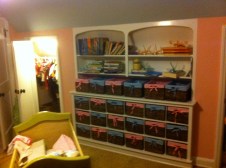
Cubbies in Nursery
I made these cubbies for my daughter’s nursery, 8 years ago.

Many teachers and parents (Hampton, 2015) experience a sort of nesting phase, similar to a woman about to give birth, prior to the school year. They buy more school supplies than they need, arrange, rearrange, and re-rearrange their rooms over and over, making everything just right, perfect for the new class. Maybe it is a guy thing, or perhaps it’s just “my” thing, but I like to build stuff to get ready for the school year.

The very first item that I ever made was a couple of bookshelves. I love books, and I wanted to have a room full of them. So, I made homes for them. An idea of what I wanted the shelves to look like, how I wanted them to function, and the ease of making them grew in my mind throughout the summer. In between Professional Development sessions and team planning meetings I was drawing, measuring, sawing, hammering, etc. my bookshelves. They came out great, functioned flawlessly, and are still being used… But, the middle shelf was accidentally placed the exact height of the outlet the construction was to hide. It was impossible to plug anything in with the shelves against the wall. This was easy enough to fix. I simply cut a notch out of the unit so plugs had a space to stick out of the wall. From planning to constructing to fixing this problem, the experience prepared as much my pedagogical psyche as it provided a home for my classroom library.

Bookshelves
The shelves are still in use, today!
IMG_3215
You can see the cut away of the shelf behind this crazy pirate guy.

In the next few years I built a classroom island, a castle, a workbench, fish tank stand/hood, and conference table, among other smaller projects. The classroom island was something I obsessed over the summer prior to making it. The cubbies that I purchased for housing the plunder of books I had been pillaging from second hand bookstores were unattractive and sat flush with the floor. My island has a platform that raises the cubbies off of the ground. I made a countertop that covers the ugly cubby roofs and extends backward to allow students to sit under it. With stools it functions just like the kitchen islands that most students have in their homes.

The castle deserves its own blog.

My workbench was really neat. I didn’t like the way the teacher desk quarantined me behind it, cutting me off from the action of learning. One year I took it all apart and lined it up. The parts included the desk that a teacher’s chair can pull under, a similar table/desk with space under it, and two giant filing cabinets. I placed one of the filing cabinets under the table to hold it up; It had been attached to the teacher desk for support. The other filing cabinet was placed at the end of the twelve foot long line of equipment. Similarly to the classroom island, I built a frame of two by fours to attach one by eights, hanging the creation over one of the long sides and the end so that kids could pull up to it like a gigantic table. Because it was slightly higher than their little student desks, most kids stood to work at it. In my pirate-themed room this came to be known affectionately as “The Plank”.

I learned something new each time I constructed something, and many of the lessons involved solving problems. Every creation proved to be incredibly useful, fun, and loved… Until…

This past summer I got an idea in my head that I could not shake off. It consumed my thoughts. I was picturing building a sunken pirate ship, using planks from the classroom workbench. The workbench had served its purpose, and I wanted to do something different with that space in the room. Plus, I needed lumber for this new obsession–Make no doubt about it–I thought about this project constantly June, July, and August of 2018. Each beginning of the year construction project has been a sort of puzzle. My mind bends ideas and works out how I can form structures quickly and use as little funds as possible. The structure is always something that you can’t simply buy, either. Lastly, it has to be both functional and cool looking. The sunken pirate ship was going to be my masterpiece.

First of all it would be almost completely constructed of wood that I already had, making it virtually free of funds. Second of all, what I pictured in my mind did not exist anywhere but the bottom of the ocean. Thirdly, and most importantly, this new project was going to be the most beautiful, complex, impossible to reproduce, no-one-else-could-possibly-make-this-creation the pedagogical world has ever known! And, it was.

Frame
The frame was a puzzle in my mind.

I began by taking a part the beloved workbench and planing each edge of the one by eights so that the angle was 70ish degrees, rather than square. After doing this to all of my planks, I took four foot by four foot pieces of plywood that I brought from home, and I cut out a curve that would serve as the hull of the ship. This was one of the trickiest parts of the project. I brought the plywood up to my room and looked at it for a long time. I wanted the sunken ship to show the curved bottom of the boat, but also come up from the floor at an angle. This meant that I needed a few curved pieces, but different sizes. Additionally, I wanted the model to be the front of a ship, so I had to have the frame graduate from a large curve to a smaller and smaller one. It is almost as hard to write about this as it was to ponder it in my brain. This puzzle took me a long time to solve. Even after I had constructed a frame, it was tricky to figure out how to attach the planks. Should I build the whole thing outside, or piece it together right in my room?

First Plank
The first plank


I decided to assemble the ship in my room, rather than run up and down the stairs over and over. I figured out what angle to cut the bottom of each plank, ending at the floor, and attached my first one. It was beautiful, already! Just the success of figuring out how it could work was exhilarating.

I kept adding planks, alternating lengths and looks. I wanted it to look like the front of a pirate ship that had broken in half, so I left some of the boards ending at varying lengths. The front would be cut in an arching round curve, or so I hoped. This was still a little fuzzy in my head.

Partial completionThe top part of the ship would be flat or vertical, having no curve, to show that this was more than just a rowboat. It had been a tall mast ship. I continued the framework and attached more planks. curved front creation
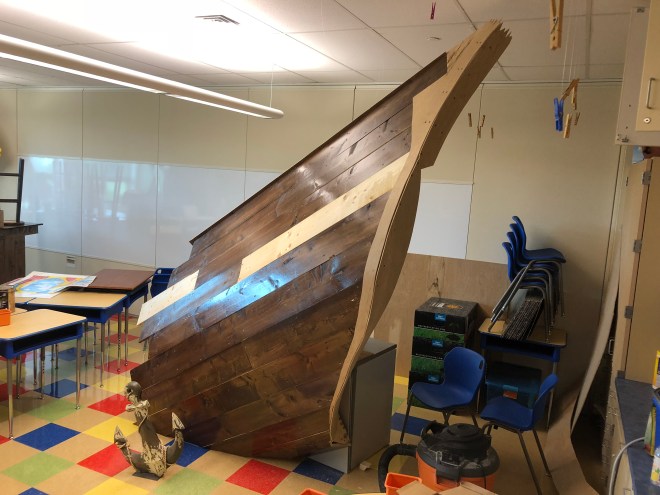
As you can see, from these images, the ship was a work in progress. Much like a sculpture, I was cutting, shaping, adding, removing, and attaching pieces to adjust the art as it evolved. (Through constant formative assessment I made adjustments.)

Some of the shape of the ship would be produced simply through optics. I would position it at such an angle as to make the front of the boat look like it not only curved up, but also came to a seam with the opposite side (which obviously did not exist). One final extremely difficult, mind-bending trick was figuring out what to do with the front of the ship. I wanted it to look like a beam running the spine of the hull. Luan is a very thin wood that comes in sheets and is used for subflooring. You use it to make an otherwise uneven or bumpy floor smooth before laying tile. Because it is so thin, it is very pliable. It was very difficult to bend, hold, mark, and cut, but I got a piece that curved with my boat’s bow pretty well. I tossed around having a spear like staff sticking off the front, also, but the monstrous beast was already nearly touching the ceiling! A broken off point seemed to fit the theme of disaster.

Little did I know the disaster that was about to befall my creation, next.

Fellow teachers from my building visited my room, having heard the commotion or news of my creation. They were increasingly impressed as the structure was developed and took on shape. I remember wanting the boat to have a certain semblance to a ship before inviting my principal, Dr. Moyer, up to see my masterpiece’s progress. When I did finally invite him, I didn’t receive an enthusiastic response. In fact, it took a day before I even heard from him. At the time I was happy to have more minutes to get the ship that much closer to completion. When Dr. Moyer did finally join me in my room, he brought bad news.

Clearly, it pained my principal to inform me that after all of the work that I had put into this beautiful masterpiece, it was going to have to go. It wasn’t his decision. He shared with me an email from maintenance that he had received. The message explained that “The pirate ship being built in room 207 had to be removed, immediately” due to several violations and concerns. Dr. Moyer didn’t see any way around it, but suggested that I talk to the head of maintenance.

The pirate ship was just about done at this point. I called my school district’s head of maintenance several times before we finally connected. Over the phone I told the person who is in charge of not only maintaining all of the district’s facilities, but also responsible for students’ safety that I understood every point that he was making in his email to my principal. I explained that some of the concerns could be remediated and I asked for a chance to make some adjustments to my creation. This saint of a man told me that he would consider my changes and take another look at my project.

This was it. I had to move the ship away from the sprinkler head in the ceiling, make sure the structure was secure, and smooth rough edges as much as possible. I put last minute, finishing touches on the ship to make it look as good as it could… And then, I waited for a verdict.

I am not listing every concern that my masterpiece had raised in the mind of the head of maintenance, but suffice to say, I was unable to completely rectify enough of them to satisfy the justification of leaving the heap of wood in my room, permanently. It was honestly touching how obviously moved this understanding and caring individual was when he told me that, “Unfortunately, the pirate ship still had to be removed from the classroom.”

I had worked feverishly with an obsessed passion to complete this project before school began. I wanted to have this amazing, awe-inspiring, gigantic addition to my pirate-themed room ready for students to appear Monday morning. I couldn’t wait for them to feel the presence of the sunken pirate ship looming in the back of the room. Removing it would be like losing a limb.

Ella and ship
Although temporary, the pirate ship made an impression.

Hesitatingly, I inquired if I could just keep it long enough for students to see it. After a pause, my savior said that he needed the ship removed, but that he wasn’t planning to do a walk through of my building on the first day of school. It was understood that if anything negative happened, it was on me. Having constructed the creation myself, I knew that it was perfectly safe. And, I was very confident in my classroom management, so I took the chance of letting my students at least view the craziest creation I had ever attempted.

Dignified Defeat

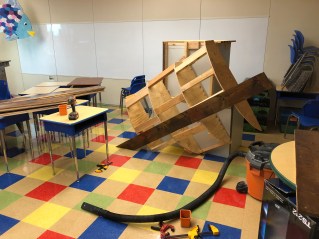
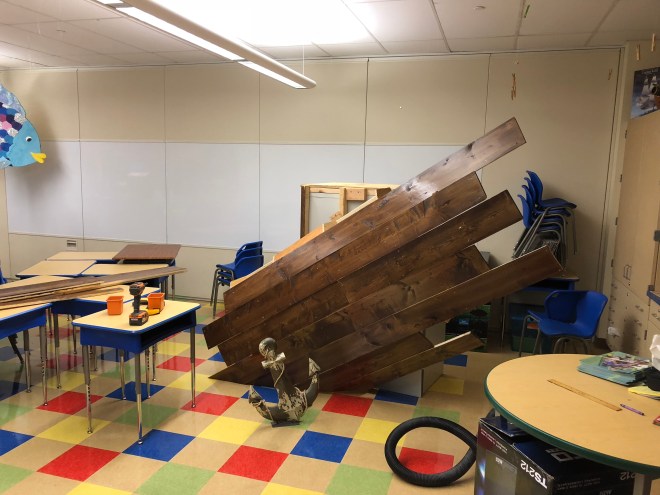
I took the pirate ship down. I was okay with this decision because it was made with the safety of students in mind. But, make no mistake about it, this was a defeat, a loss, a failure. As I said earlier in this text, I struggled to publish any information about the pirate ship. I never tweeted images of it or talked about it publicly on Facebook. Was I simply embarrassed? Yes, but even more than that, my dream was defeated.

…Or, was it?

I told the head of maintenance that I had envisioned this creation over the summer, and I felt like I just HAD to make it. He suggested that I speak to the people who produce plays at the high school to help with making their sets. There was a respect for my creativity. I’m not sure that he ever completely understood, but I could not NOT construct this pirate ship. I had to see if I could do it. I had to see if my vision would work. I had to see if I could puzzle out the angles and curves. I had to see what it would look like. Could it become anything even close to what I envisioned? As it turned out, yes, I could. Yes, I did. Yes, it was… beautiful. And, now it is gone.

I eased myself into my defeat by thinking I would reconstruct the ship down by my pool. But, I’d have to build a whole new frame, and I didn’t think that the low-quality wood would hold up outside. In the end I let the thing get moldy and threw it all away.

A chess tournament training I attended recently shared what kids must master before attending their first match. They have to know how to checkmate or win a game. They IMG_1708should know how to operate a chess clock. There are a couple other elements, but what stood out the most to me was the idea that kids must learn to lose. At the time I pictured my 7 year old daughter who hates losing. She has melted down to tears when she loses. But, since then, I have mulled this concept over. At both the beginning of a chess match and at the end you shake hands. It is different from other sports. You don’t jump into competition and then slap hands carelessly at the end, chanting, “Good game, good game, good game,” while never looking the victor in the eyes. A dignified defeat is thankful for the opportunity to learn through this match. I was able to try out my skills, make some good decisions, show my stuff, prove myself to myself and perhaps others, and I am now a better stronger person having competed against you. Maybe, like a match I played against someone better than I, the outcome will be a feeling of “At least I held my own.” There is dignity in that attitude. Dignity is an attitude.

In conclusion, I am pleased to profess that although my room does not dawn a disaster of a sunken pirate ship, it does house one classy educator who has learned the lesson of dignified defeat.

What defeats have you dignified?


Sources:

Hampton, K. (2015, August). THE ART OF AUGUST NESTING. Retrieved March 16, 2019, from https://kellehampton.com/2015/08/the-art-of-august-nesting/


TED. (n.d.). A collection of TED Talks (and more) on the topic of Failure. Retrieved March 17, 2019, from https://www.ted.com/topics/failure


10 Things to Keep in Mind When Collaborating With Others

I’ve recently begun communicating with a couple of teachers from the other side of the world. This has been very exciting, but also attitude-altering in several ways. I wanted to share some of the things I’ve learned at the outset of attempting to foster these new relationships with international colleagues.

ONE. Compromise

I begin with the most basic and obvious. Clearly, for any collaboration to get off the ground, there must be give and take. An airplane needs both aerodynamic wing design AND speed. Without the one it is a very fast weird-looking car, and without the other it is little more than a model of a plane. Speed pushes the air around the wings so that the craft lifts off of the ground. Hopefully, you get the picture, but if you want to go down that rabbit-hole, enjoy. I’ll see you later:)


TWO. Active Listening

This means seeking to understand. Because we are only using text, and my collaborative partner comes from a totally different *everything from me, I must be a super sleuth to find context for concepts. One thing I try to do is “un-think” much of my expectations, as well as not assume that my partner knows American educational habits. This past week I had Monday off due to snow. Then, Friday there wasn’t school for students because of Professional Development. Do my international teaching friends experience these conundrums?

*In addition to all of the concrete differences and experiential differences, there are the attitudes and mindsets that will be different. Are days off considered “off” to people in other countries? Perhaps time away from school is full of more work than being in school.


THREE. Give Up Google

Don’t have a stroke Alice Keeler, but not everyone in the world uses Google. I do, and I love it. In fact, I spend more time in my G suite than my house. (Right now, I’m typing this in Google Doc, planning to copy and paste it into WordPress.)

This may be hard to imagine for some, but what if there were something better than Google? Right now, America is the most powerful and largest tech market, but it isn’t the biggest. China and India dwarf the U.S.A. Were those countries to develop a system that worked better and was even more easily accessible, Google would be Lincoln Logs next to Legos. As collaborators and educators, we would do well to have an open mind and try out whatever our partner wants to use.

All that being said, there is the whole if you set it free and it comes back to you business. I did suggest Google to my pen pals. One person is familiar with Google, and her students use Drive. Another person’s students don’t. With this second collaborator I will be using ePals program to connect my students with hers. We will see how it goes.


FOUR. Swallow Pride

This will read funny after what I just said, but when I found out a collaborating partner from another side of the world didn’t use Google very much, I thought, “Great! An opportunity to show you how awesome, useful, and helpful it its!” I did not email this sentiment, however. Instead, I thought about what the goal of our collaboration should be. Did this person sign up to have her students pen pal with mine, only to have me preach at her about the benefits of Google? We both expect to grow and learn through the experience, but I don’t want to turn off my partner by acting or even dreaming of tech superiority.

IMG_9964
Scarlet and Sonia on vacation.

You arrange to hangout with someone. The new friend suggests riding bikes to a park for a picnic lunch. Do you insist that the two of you drive? “It’ll be faster. The lunch won’t spill or cool off. It’s more convenient…” For you, maybe. If you insist on driving, you could drive your friend away. Even if the new acquaintance agrees to be driven, and the lunch doesn’t spill or cool off, your fragile new relationship could.

3319673304_53ea643fedPerhaps your partner has driven a car before–Maybe they have a Ferrari sitting in the garage that you’ll be able to experience if you allow the friendship to blossom naturally.


FIVE. Keep it Consistent: “Rotisserie Relationship”

Keep it moving. Try to stay on top of communication. Maybe even agree on frequency. Do you expect to hear from each other once a week, every other day. Might you be setting yourself up for failure hoping to correspond every day? Take turns and practice a comfortable, reliable back and forth.


SIX. Adjust the Temperature

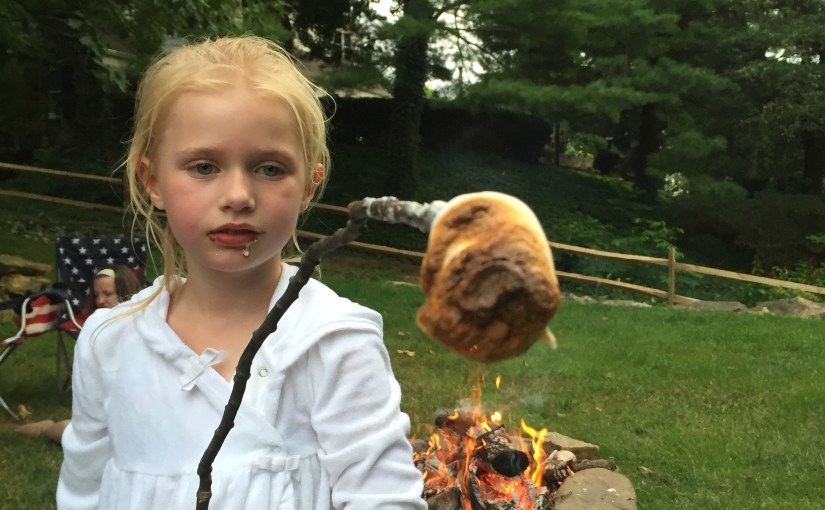
When cooking marshmallows over a fire, there are three ways to do it.

  1. Grab a raw marshmallow from the bag and plop it in your mouth. You might be too impatient to wait. Or, maybe you just prefer raw marshmallows to gooey, sticky ones.
  2. Thrust the marshmallow right into the flames of the fire. It will light up like a torch. Let it burn for a few seconds. After blowing out the flames, you plop the carcinogen-crusted half-melted marshmallow in your mouth. These have some yummy melted marshmallow, but the papery skin sticks to the roof of your mouth and tastes burnt, which it is. And, the center is still raw.
  3. You know how this one goes. The experienced, patient person waits for the fire to burn to red-hot embers. He finds just the right stick and wittles the end while he waits. Once the cooking conditions are just right, the master marshmallow melter delicately develops a rich brown color on all sides by slowly spinning the fat white column over the heat… checking often for discoloration. The most important thing to know is that it isn’t the flame that cooks the marshmallow; It’s the heat. Embers are hotter than flames, but they take time to develop.

SEVEN. Don’t Pile On

Personally, I have too much to say, in general, clearly;)

I have to work at taming myself to 1 or 2 ideas per communiqué. This is not my strong suit, but I have found that too many ideas can smother a relationship. If you put too many sticks on a fire, do you know what happens? It dies out. (I’m still thinking about those marshmallows.) Fire needs to breath. It is best to add just a few sticks at a time. Let them catch. Then add more. Or, when adding a lot of wood to a fire, be sure that there is an air vent; a place where oxygen can reach the heart of the fire.

When participating in a conversation, try to be masterful about it. Add thoughts that have to do with what other people are talking about. Only tell one story and limit the details. Give listeners the opportunity to ask to hear more. Don’t hog the mic. And, never drop it. Inevitably, it will definitely land on your metaphorical foot.


EIGHT. Be Humble

This may exist as “Eight” in the list, but can be woven in and out of every sentence of this blog. In other words, it is every number.

Humility can be your savior. Back to the “Driving to the picnic” analogy: How would your partner feel if he or she only owned a bicycle, and you show up in a Ferrari? You may as well rev your engine and run over the partner’s pet dog on your way to your picnic. Hubris is killer.


NINE. Questions Show You Care

Always include questions. Again, only a couple; don’t make your correspondent feel like he is taking a survey. It might work well to volunteer your own answer to the question that you asked your new friend. I recently told my pen pal about having to take a “snow day” because of inclement weather. Then I asked if it snows where she lives. A better question, now that I think about it, would have been, “What kinds of things might cause you and your students to close up shop and not have school for a day or more?” Yeah, I think I’m going to go type that into my next correspondence.

Screen Shot 2019-03-10 at 7.21.01 AM
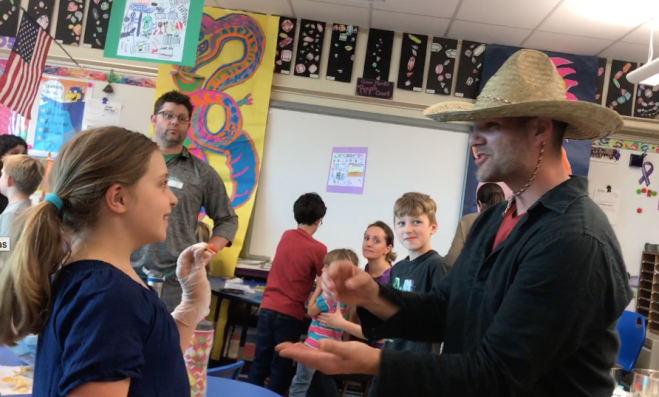
I am asking a student questions about her salsa during our annual 3rd grade salsa taste-testing event.

And, now that my list is just about over and you have come to the end of this blog, I will practice what I preach by asking you:

  • Which of these ideas resonated with you and why?
  • What experience have you had communicating with people from other countries?
  • How did you get in touch with these individuals? (Others might be interested in starting a collaborative project, so provide some specifics, including links, please.)
  • What do you plan to do with the information that you just read?

I ask you these questions because I care; more than caring that you read this blog, I care about people collaborating effectively. I care about people making friends, working together, growing as humans. I care for humanity…  evolving to be better.


TEN. Distance


This is related to “Don’t Pile On” (no. 7). Make sure that there is enough space for your partner to provide suggestions.

Relationships are like a simple game of catch. Is it fun to toss a ball to someone who is 2 feet from you? No. The further away, the better.

You start off close, but with mastery, you move further from one another. There will come a point when the distance becomes too challenging or ineffective. And then, you make adjustments. This space can be applied to time, proximity (you are not going to email the person sitting next to you), and ideas (tossing the same thought back and forth gets boring).


Okay. All done. Now, back to “Questions Show You Care”, I’d love to hear your thoughts on all of this… Well, on part of this… Okay, just tell me nice things… No, really, I want to read your thoughts, whatever they are. Just frame them nicely, please. Thank you.


Unsolicited Criticism is NOT Classy

“How do you tell someone that they shouldn’t bring a lot of toys to school… but, nicely?”

IMG_7591
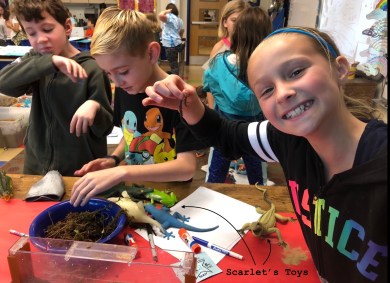
Scarlet writes the rules for playing with the beany toys that she is sending with me to my school.

On the way home from daycare my daughter asked me this question, and by the way she told me the story, I could tell that she was really asking, “Did I do this right?”

I had to laugh at my crafty daughter. She was working at justifying something that she did that probably made a peer feel badly. She may have well asked, “Why didn’t he take my criticism better?” In fact, as we began to talk about it, Scarlet even suggested a very soothing tone, and modeled for me the way a kid might tell another kid that they shouldn’t do something, and it be respectable. She sounded like an adult explaining something painful to a child.

My initial reaction was, “No”.

“Daddy, how do I tell someone that he is doing something wrong?”

“No. You don’t.” I didn’t realize that she already had. When this concept dawned my cognition, I began to walk Scarlet back. She had explained that a friend who she sat next to on the bus had opened his backpack to show Scarlet all of the toys that he was bringing to school. It seems like this is when my daughter tried as much as she could to classily tell him that he was ridiculous for doing exactly what she would have done if her mommy and daddy let her.

As Scarlet provided more and more details, I could tell that she was actually envious of her friend. The word “fair” surfaces every five sentences, these days. This was definitely one of those times. I explained to Scarlet that it wasn’t her place to tell her friends what to do, how to do it, or not to do certain things. “If someone breaks the rules, you can remind him or her of the rules, and you can let an adult know. But, if someone does something that bothers you, it is your job to deal with it. Let’s say someone says something mean to you. You should tell the person that those words hurt your feelings, and you didn’t appreciate it…”

Scarlet is an only child. She has a bit of a bossy streak in her. When I told her to tell someone something, she was all about that! We discussed how to do this classily. Then she prompted, “And, you tell the teacher!”

I told her that classy kids don’t bother the teacher with every little thing that bothers them. “If someone hurts your feelings, you address this. Perhaps the person apologizes and you remain playing partners and friends. It is possible, though, that the person does not behave politely. And then you just stay away from that individual. You only go talk to the teacher if someone is breaking the rules.”

This bit of news–Rules News–was eye-widening. Someone has experienced this before! Scarlet gave me all kinds of examples of this happening at school. I explained that the rules are set up to help students be safe and not hurt others. Scarlet mentioned punishments for kids who break the rules. I didn’t want her to focus on that. “What happens to students who break the rules is up to the teacher to decide. That is none of your business. And, don’t tell on someone, so that he or she gets into trouble. Your job in communicating rule-breaking is to help your friends and yourself be as safe as possible. Don’t worry about punishments.”

“When grownups break rules, they go to prison,” Scarlet offered.

IMG_3072
Scarlet sent her toys with me to school last year. She also sent a list of rules.

“Sometimes they do. There are a few different kinds of punishments for adults who break the law. Rules for adults are called laws,” I explained.

“What are grownup rules?”

When I began thinking about what laws my 7-year old would understand, my mind went to the classroom. I told her that just like kids, adults shouldn’t take other people’s things. I explained that if someone took daddy’s truck, we would have a difficult time getting around. Now, if someone asked to borrow it, that would be different. Then I would know where it is, or at least who had it. I told her that taking someone else’s things without asking is called stealing. Before letting Scarlet go to school and accuse anyone and everyone of this crime, I explained that sometimes a neighbor will borrow something, like a pencil or crayon without asking. If they need one, and you aren’t using yours, someone could choose to use yours for a minute. This is not “stealing”. As long as it does not hurt anything, that is permissible, and you should classily allow friends to use your things. If they didn’t return it, or if he/she broke it and didn’t replace it, there would be a problem. That is not nice. “Then I tell the person, ‘You did something not nice’,” Scarlet practiced.

I smiled. “Do you have to tell the teacher about that?” I inquired.

IMG_7592
Just some of Scarlet’s rules for playing with her beany toys.

“You don’t have to, but you can,” Scarlet regurgitated.

I also told Scarlet that another law for adults to live by is not hurting others, physically. “When adults have disagreements, they use words to sort things out,” I told her. “They do not attack someone with their hands or feet and hurt the person’s body.” I wasn’t sure Scarlet knew the word “physical”, yet. I’m not sure that this idea was communicated clearly enough, but the seed was planted. Those two laws seemed like good ones to begin with. We didn’t need to get into driving, taxes, or copyright infringement just yet.

Going back to the backpack full of toys that Scarlet’s neighbor on the bus had shown her, I wanted to communicate to my daughter that sometimes we need to simply deal with our own feelings. “Just because you think that boy shouldn’t bring all of those toys to school, doesn’t mean that you should tell him. You’re not his mommy. You’re not his teacher.”

When I asked her how she would feel if someone told her what to do, Scarlet said, “You’re not the boss of me.” I laughed.

Open-Ended Questions Are Classy

Screen Shot 2019-02-23 at 7.30.02 AM
ePals is a great way to meet teachers from around the world

I am extremely excited to announce that I have connected with a teacher from another country whose students will be collaborating with mine on a project or two and potentially pen palling each other. I found this class and teacher through the use of ePals. The country that my new colleague is from is very far from mine in both distance and culture. I thought that it would be fun to play the game 20 questions between the two classes to guess where each is located. My new pen pal has never heard of this classic American game. In thinking about how to communicate the rules and strategy of the simple game to my foreign friend, I came up with a use for playing it with my WIN class.

Research Questions

Friday’s WIN class found me teaching research questions. My students are progressing in their “Who Would WIN?” projects. We have decided on animals, checked books out of the library, and are getting ready to learn about our topics. What should we learn, though? And, how do we find the information? We search for it using research questions.

These are open-ended questions that begin with words and phrases like…

When… ?

IMG_3014
Students are finding books about their animals

What type or kind… ?

How… ?

Where… ?

Why… ?

Why are these open-ended questions better than yes/no questions?

I decided to play 20 Questions to show the students the limitations of yes/no ?s.

Rules/Strategies:

You get 20 questions.

Each question must be a yes/no question. It can only receive a yes/no answer. If you accidentally ask an open-ended question, it will still be answered with a “Yes” or a “No”. For instance, someone may ask, “What color is it?” That person would get the reply, “No,” which obviously does not make any sense and is not helpful. Do not waste your questions.

One question per person. And, since we have more than 20 kids in the class, not everyone will get to ask one. Sorry, maybe next time. But, definitely no one will get to ask more than one. If you do get a chance to ask a question, make sure it is a good one. You must remember all of the answers of previous questions, so that you do not repeat any of those and waste your turn and one of the group’s precious questions!

Also, you want to pay close attention to answers, so that you can build on information that’s already been learned.

You want your question to continue trains of thought that seem to be leading down information paths that could end up revealing something that would give away what the answer is. For example, perhaps someone asked if the thing being guessed is alive. If the answer was no, it wouldn’t make any sense to ask a question about something living! You would want to find out where this inanimate thing is located or what it is used for. In this way, your questions will be working together. You must think of yourselves as a team.

When it comes time to guess what the thing is, that counts as one of your questions. You may make this inquiry at any time during the game, but keep in mind that you would be using up one of the 20 questions. It would be wasteful to ask, “Is it Superman?” when you don’t have any information suggesting that it could be. Narrow down the options with your questions.

Now that you understand the game, let’s play. I’m thinking of an animal. It is a wild animal that is not featured in any of the “Who Would Win” books by Jerry Pallota. No one in the class has chosen to research this animal. What is it?

Ways to narrow the field of information include focusing on the following:

Size–Is it smaller than this chair? Yes. Is it smaller than my hand? No. Now you know that it is somewhere between a hand and chair. Don’t guess any more size questions. Focus on another feature.

Habitat–Does it live in the water? Sometimes. (It is at the discretion of the interviewee to answer the questions however he/she thinks best. There may be times when the question, even though it be an appropriate yes/no question cannot be answered with only one of those two answers, satisfactorily. My animal is an amphibian. I didn’t want to kill all chance of my guessers for figuring it out. Also, the person being questioned may provide hints if it seems like the answer is too hard. You may want to steer the guessers in the right direction. Remember, it is just a game.)

Habits–Is it a carnivore? Sort of. So, does it eat meat and plants? Yes. Okay, does it eat bugs? Yes, it loves bugs. (Notice, I am giving them a hint, here.)

Location–Does it exist here in our town? Yes.

Looks–Is it furry? No. Is it scaly? No. Is it a hot color? No. Does it have long legs? Yes, most definitely, for its size, its legs are enormous!

Me: You have many clues as to what it is, are you ready to guess what it is? No. We want to narrow it down a little more.

The students continued to ask more and more detailed questions until they were stumped. They had begun discussing with each other the fact that the animal had to be a frog, but those were usually smaller than a hand. “Is it a frog that is bigger than a hand?”

“Do you want to use one of your questions to ask that?” (They only had a couple left, and I wanted them to be successful.)

“No.” More classroom discussion.

“What do you know about frogs? Are there any that are larger than a hand?”

As if no one had thought of that, surprise lit up faces throughout the room. Finally, someone blurted out, “Is it a bullfrog?”

“Yes.”amphibian-aquatic-animal-close-416206

The Power of Open-Ended Questions

I then prompted more classroom discussion, “What question or questions would have gotten you to the answer faster, if you were not limited to yes/no options?”

Students shared with their turn/talk partners.

After listening to a few ideas, we concluded that the fastest was “What animal are you thinking about?” We also discussed better ways to dig up information about your animal. What does it eat? How does it eat that? Where does it get its food? When does it eat? How often does it eat? Before students’ minds exploded, I had them type some sample research questions in the Notes App on their iPads.atlas-close-up-dark-592753

What Country Are You From?

While that would be much easier a question to ask and get answered, my favorite part of teaching is making things difficult and challenging for my students. So, we will play 20 questions with our pen pals. Hopefully we will learn more than just the name of their country. That’s the idea, anyway.

Have you had interesting experiences playing 20 Questions? Oh no! That was a lame yes/no question;(

What interesting experiences have you had playing 20 Questions? Explain.

When have you played the game? I used to play with my sister on long car rides when we were growing up. It helped to pass the time.

What was the best answer or question that you remember someone using?

14324116700_b1d3438834
Research Questions send you on a QUEST.

Must Mention

I always point out the root word in “Research” and discuss that this term means “searching deeper.” It is like you didn’t find all of the information, so you “Re-Search”.

An extremely creative and bright student pointed out a root word in the word “Question”. Research is like going on a “Quest”. I was blown away. This is the classiest group of kids, I tell ya!

earth-1990298_960_720

Cognomens Are Classy

“Excuse me.”

I like to listen to books while I work. I was wearing earbuds when this person was speaking to me, and couldn’t hear what she was saying.

“Excuse me.”

I thought I heard something, so I turned to look. The woman who was housesitting was talking to me. She had been saying, “Excuse me.”

“How long are you staying?” she asked me. “I’m not rushing you… I just wanted an idea.”

We were the only two people in the house, and she was looking right at me. There was no question who she was talking to. It was me. But, there was something missing. What was it? I couldn’t place my finger on it, but there was a feeling.

She hadn’t used my name.

A Confession

I have a confession to make. I am not good at remembering names. I wish I was. I have worked on it. When I was in highschool, I actually read a book about how to remember names. I still remember most of its points, but I can’t remember who wrote it. Too often, I will come across someone whom I had already met, and their name completely escapes me. So, there it is: My concession of unclassy behavior prior to proposing you do what eludes me.

Back to the Tale

The encounter with the housesitter happened yesterday. This was probably the thirtieth time I had met her. Earlier in the day, I was surprised to find I already had her phone number saved. At that time I learned the name that she normally goes by. I programmed that into my phone, as well.

The feeling materialized into a thought: This woman either didn’t know my name or chose not to use it. Why would someone decide another person’s name was not worth saying? In the past, I have witnessed people speak to hired help differently. More than the words they used, it was the way they said them. They spoke down to the person whom they believed was beneath them. Sometimes the way they do this is through the words they do NOT use. I have experienced people who think that their status elevates them so high above me that they try not to talk to me, as if speaking with a worker will somehow drag them down. Now, I bet that this lady did not feel this way. But, by not using my name, it felt like I was less human; a less person than she.

Earlier that Week

Contrast this feeling with a story from earlier in the week. I was picking up my daughter from daycare, when another parent told her child to, “Stand to the side, and let Mr. Weimann through.” At first, I was surprised that she knew who I was. And then, I thought it classy that she used my cognomen. It made me feel special; important.

A person’s name is precious to him (Schultz, 2017). Dale Carnegie famously suggested a person’s name is the sweetest sound to him. The very first word that anyone types on a keyboard is his name. The first thing we learn to write is our name. It is our label. It’s who we are. There is an art to using other people’s names in conversation. It attracts the listener’s attention (Russell, 2014).

Luke Davis (2017) points out plot lines containing a search for characters’ names in “The Power of Using Someone’s Name”. A name in fantasy stories is sometimes magical. When the miller’s daughter learns Rumplestiltskin’s name, she saves her first born’s fate. Davis suggests that people give permission when they offer their name. They are communicating how you may address them. I remember a few years ago, an adult visited the classroom. He wore a nametag that showed both his first and last name. A kid read it and pronounced the adult’s first name. This adult could have handled this better. He said, “It is Mr. __ to you” to the student. He hadn’t given that student permission to use his first name.

Classics

I love classics. Some have been rewritten, made into movies, talked about so often that reading the original work is like looking at a primary source. There are times I feel like an archaeologist dusting off the first few words a master wordsmith penned. This is the feeling every fall when I get out “The Legend of Sleepy Hollow” by Washington Irving.  

29bd75fffbd860f9116b782fee7b4f5fWith sentences longer than the paragraphs my third graders write, this text presents descriptive writing that transforms the 21st century classroom into a one-room schoolhouse in a comfortably lazy, quiet, rural town. Incidentally, Sleepy Hollow is an actual town. If you cross the Tappan Zee Bridge, a word Irving includes in his text, you will see signs for it.
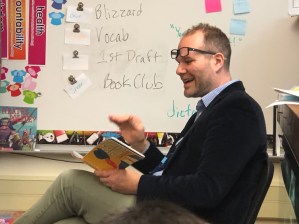
Remember my mentioning that I listen to texts? I have heard “The Legend of Sleepy Hollow” on audio several times. When you listen to the story, you don’t have the ability to look up the words that you don’t know. You just use context clues or allow the meaning to escape, and move on with the plot. The robust vocabulary is part of the allure of the classic. The enchantment of Irving’s learned lexicon is lost, however, when I read the text to/with my third graders. Rather than bump down a bubbling brook, we get caught with confusion at every turn.

As it turns out, I have never gotten all the way through the classic with my students. I begin reading it close to the start of the year, looking toward Halloween. Everyone has heard the story. Many students tell me they have seen “the” movie. (There are several.) None have ever heard a sentence of the original classic. Even though it takes weeks to get through the first chapter, I find it fun and beneficial for students to experience. We eventually peruse the rewrites and end up comparing/contrasting them with what we have witnessed of the original.

How Does Sleepy Hollow Fit?

What on earth does “The Legend of Sleepy Hollow” have to do with the story that began this blog? When we are first introduced to the main character of Irving’s tale, there is a sentence that I like to present to my students as a riddle: “The cognomen of Crane was not inapplicable to his person.” In addition to the vocabulary word, cognomen, the double-negative throws 8 & 9 year olds for a loop. We had already learned Ichabod Crane’s name, so we could use context clues to figure out that cognomen meant last or surname. The double-negative is harder to explain.

Cognomen

Cognomen is one of the vocabulary words that my brain glossed over when listening to the book on audio. Because it didn’t affect the plot of the story, I didn’t worry myself about it. When reading the text with students, however, it became a curiosity. We looked it up in a collegiate dictionary. (Our elementary dictionaries couldn’t handle it. This makes third graders feel awesome!) In addition to surname, cognomen also means alias or nickname. So, Irving could be saying that he is adorning this character with this name because he wants you to picture him with a beak of a nose. Ichabod’s creator/father, the man bestowing him a surname, Washington Irving, is making this surname a nickname, a cognomen. Of course, I don’t get into all of this with my third graders. We are simply happy to learn the term, surname.

Cognomens Are Classy

Nowadays, we are not reading about Sleepy Hollow. We are looking at manners from a book about being polite. This happens everyday after recess and before math. Last week, 2bookone of our lessons was to use Mr., Mrs., Miss, or Ms. along with the last name (cognomen) when speaking with adults, or find out how the adult would like to be addressed.

As always, we had plenty of discussion, full of stories. I told the students about a neighbor, when I was a kid. He was elderly, and his family did not live close. He loved company, and we would visit him regularly. Rather than calling him Mr. Vinton, he insisted we say “Grampa Vinton”. He turned out to be one of my best friends, growing up. Even though I visited him nearly everyday and we shot rubber bands at each other in his breezeway, I always called him Grampa Vinton. Placing the respectful title before the cognomen helped me remember this was not another kid.

When I was growing up, I had friends who referred to adults as ma’am and sir. This seemed respectful, but never felt quite right to me. Looking back, I now know why. Sir and ma’am denotes mastery. The kid was suggesting servitude. This is not the same as respect.

Mr. Smith

In my classroom I use kids’ last names all of the time. I do this because it is weird and to help me learn/remember their last names, but I have noticed an interesting byproduct: Kids love it. You should see them light up when I call them Mr. Smith. Their faces look like they just won the lottery. Being called the same thing as your mom or dad is winning a lottery of respect. I place the kid on the same title plane as myself. Why don’t they refer to me as Matt? That would be unheard of, but why? By using their last name, I elevate them to the same status.

When the lady refused to use my cognomen or even my first name, yesterday, I was left with a feeling opposite my students’ when I use their last name.

Black History Month: Race

I have one more disclaimer: The text that I was listening to when the housesitter began talking to me was “The Lies My Teacher Told Me: Everything Your American History Textbook Got Wrong” by James W. Loewen. I’m sure you guessed it from the title, but this is one of those truly eye-opening books. I was just listening to Chapter 5, “Gone With the Wind: The Invisibility of Racism in American History Textbooks,” when I heard, “Excuse me.”IMG_8396

Loewen’s text taught me that there are subtle ways that opinions about race are woven throughout most history textbooks. The concepts are thin, and the weave is tight. You don’t even notice it, but there is a thread of attitude here, and a fragment of thought there. Many times, it is what the textbooks do NOT include. They never tell about the laws that demanded black people not look white people in the eye. There were many laws like this that trained race relation deterioration during “equalization” after emancipation that I had never heard. 

I am not about to march into my third grade classroom and dump all of this information onto my students. It has, however, caused me to think about omission as a bad thing. Although it might feel awkward to bring up race, NOT doing so could be damaging. Perhaps, it is like addressing someone without using his name.  

Sources

Davis, L. (2017, August 10). The Power of Using Someone’s Name. Retrieved February 17, 2019, from https://goodmenproject.com/featured-content/the-power-of-using-someones-name-ldvs/
Irving, Washington, 1783-1859. (1963). Rip Van Winkle, and The legend of Sleepy Hollow. New York :Macmillan,
Loewen, James W. (1996). Lies my teacher told me : everything your American history textbook got wrong. New York :Simon & Schuster,
Schulz, J. (2017, January 12). Using a person’s name in conversation. Retrieved February 17, 2019, from https://www.canr.msu.edu/news/using_a_persons_name_in_conversation