
 I have a new trust metaphor for you: String.
When you meet someone for the first time, you might find that you have some things in common. These similarities tie the two of you together. They are usually thin threads of thought that help you relate to one another. “I also have a dog. What kind of dog do you have?” … “Does your dog chew things, too?” Connection, connection, connection= thread, braided-thread, forming string.
If there was something uniquely interesting about the acquaintance; This is a person whom you’d like to meet and spend time with again, you may choose to firmly attach a stronger string to the person, tying it to their garment before parting ways. Then, as you swim through the cave of your life, you may follow that string back to the person.
Perhaps you saved his/her information as a contact in your phone. Maybe you got a business card that you put in a special place. People who spelunk, especially in  underwater caves, know that there are two paths of every caving expedition (Bernstein, 2017). The one from the entrance of the cave into the earth is the first. And then, there is the path from the end returning to the place you entered. Cave divers will often have a bright nylon string attached secularly to something outside of the cave and to themselves. Legendary cave diver Thomas Iliffe explains that in addition to losing the path to the exit by forgetting the turns one has made through a maze of tunnels, it is possible to kick up sediment that will blind a diver (Grundhauser, 2015). With the multitude of distractions of life swirling around us, how could we ever find our way back to conversing with an interesting person whom we connected with? Sometimes we must carve out; forming our own cavern of time in our schedules. Even if we do, will that person be able to meet you? Pull them in by reminding him/her of all the many connections that you had formed when initially speaking. You may have to string them along a little, but how much will they thank you when you get together and realize that those threads were the beginnings of relational ropes that you can count on?

While the trust forged in an informal meeting is thin, a measure of how deep it is felt could be found in how many threads there are. You are both human. That is a teeny weeny thread. Perhaps you’d trust this person more than the house plant next to him, but it is very limited trust. Were you to learn that, although you now live hundreds of miles away, you both grew up in the same town, and then you begin remembering with the new acquaintance all sorts of things that the both of you independent of one another experienced that are the same! The shared location of growing up is the source of the threads, but now many are shooting out and attaching, some weaving, some solo, and some loose, maybe even unattached (an experience that only one of you had that doesn’t make a mark on the other). You both frequented the same bookstore. The same memorable clerk sold the two of you books. There was a place in the bookstore where you liked to sit and read; You both did this! It’s possible you sat across from each other at some point in what feels like a parallel universe. What?! Wild. I may not have this person babysit for me, but I’d definitely check out a book that he/she recommended. I would trust their opinion over a person whom I’ve known for years, but does not share my affinity for reading.
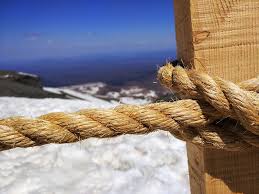 How can we make this metaphor useful?
When forging relationships, look for and celebrate similarities. Rope is a bundle of flexible fibers (How Products Are Made, n.d.). If you want a student to trust you, tie him or her to you as you lead them through a windy, dark cave of learning. Make sure that the rope of trust is tight and strong. If you dive into teaching with an un-secure knot, the kid could come loose and drift away. They may need constant reminders to find the rope, hold onto the rope, don’t lose the rope… If the rope is not strong enough, the student could get snagged on an idea and the tension could cause the string to snap. Do not assume that a teacher-to-student relationship automatically forms and ties knots of strong string. That is merely a thread, and the end is stapled to the student. If you don’t work on it, the thread will slip right through that staple.


A mountain climber will have safety lines attached to him/her when scaling the side of a cliff. If a rope breaks or comes loose, the secondary string keeps the climber safe. He/she reattaches the primary rope and continues. When building trust with students, have many lines. Attach them all over your pedagogical pinnacle. Make connections between lessons, and connect those to the backgrounds of your kiddos. Weave a whole safety net of trust so that students feel comfortable performing trapeze tricks of practicing newly learned skills, swinging from concept to concept. They should behave as if they will just bounce if they were to fall. Falling (failing) could very well be even more fun than completing a trick! But, if they stick that tough trick, the whole world will know, because friends will shout from the mountain sides.


Perhaps there’s a pupil whom you have a hard time making connections with. There just doesn’t seem to be much that the two of you have in common, or maybe he is not interested in forging a bond with you. Find one thing that you can hold onto; one thread; and coat it with additional flexible fibers of support every time you see the student. If they play a sport, learn everything you can about the sport and mention one thing each time you see this person. Don’t over do it: That could strain the thread and it could snap. If the student feels like you are stringing him along, he could pull away, breaking the thin thread of trust. Add a new fiber, one at a time, and eventually you’ll have a colorful, strong mountain-climbing rope attached to that student. When he finally realizes all of the work that you put into researching the thing that matters most to him, he’ll know how much you care about him.
 In a previous blog about trust (“Super Highway”) I had mentioned the connection
between neurons. Myelin coats the axon that sends information between connected neurons. The myelin acts as an insulator. The more there is the faster the information travels between the two brain cells. Your brain wants to send information speedily. That helps you think successfully. It can’t coat every connection with extra myelin, and you wouldn’t want it to. The best is for the brain

to choose the most helpful pathways of thinking and coats those with extra myelin. It’s your job as a communicator in the classroom to figure out the best connections to have with students and coat those connections with extra attention, understanding, and interest. If you do this, you will be able to communicate learning experiences more clearly and quickly with your students.
Before I end this analogy, I want to mention the problem of misplaced and broken trust. First of all, the thickest rope has its limits. In fact, mountain-climbing rope has many styles, gauges, and types (REI co-op). Is it possible that you were putting too much trust in a connection? Were you counting on a shared similarity with a student too much? Perhaps you need to attach some safety lines. Here’s another idea: When mountain climbing, you DO want strong rope, but you don’t want to have to carry a million pounds. You have to balance being trustworthy without burdensome.
I like the metaphor of rope for trust, because it has a lot of give. It takes quite a lot of force for even a little thread to break. The trust can snap, but it withstands pressure. One thing that will cause a string to break is when it wears down. This would happen if it were rubbing on a sharp edge. Trust will wear down if there is too much friction, also. Keep this in mind; The heavier the weight, the more friction and faster decay of the line of trust.
This thread/string/rope analogy for trust can go on and on. I would love to hear what you think of it. Please, add to it by commenting below. Share personal experiences, insights, additional metaphors and symbolism, and also diverging thoughts.
Sources:
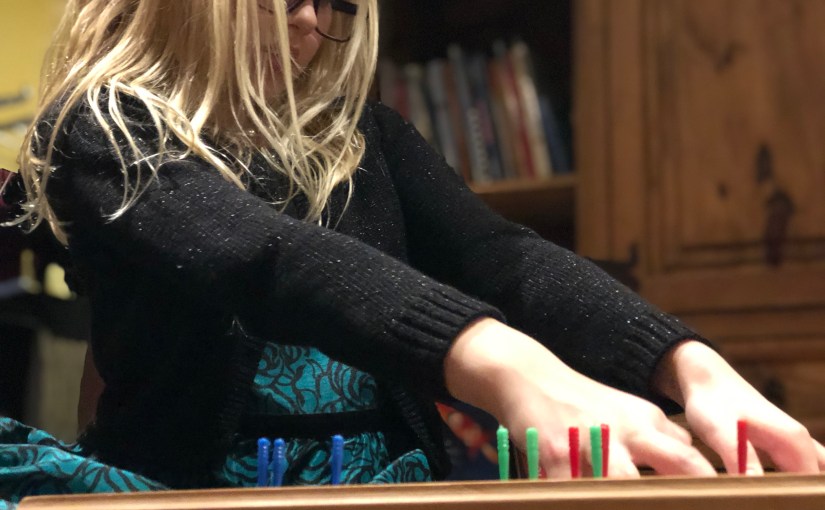
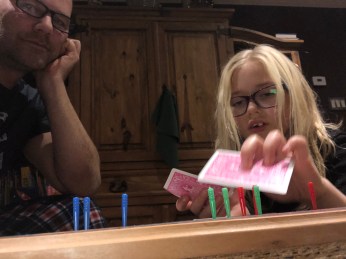


 So, it’s Thanksgiving. The dinner is cooked, consumed, and cleaned up. I’m watching my daughter wrestle with the cards in her hand. Of the five she is holding, which should she throw in the crib for someone else to use?
  It’s extra hard when you have to add the numbers to make fifteen. Let’s say the five cards that you are dealt are 4, 5, 6, 3, & Ace, and the starter is an 8. You have to discard one of those cards to someone else’s crib.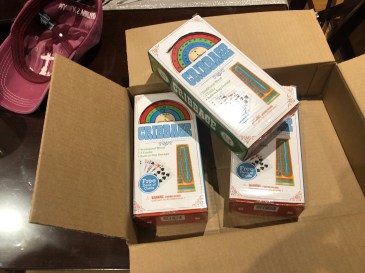

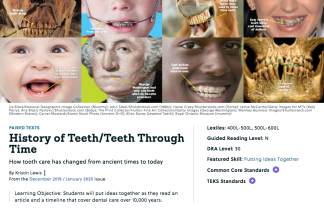 Just this week, I was preparing to have my students read an article about teeth from a brand new
 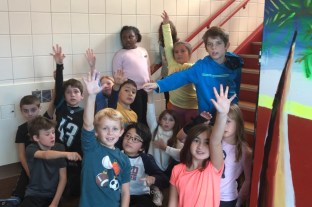 When we regrouped as a whole class after only ten minutes of controversial competition preparation, I used Siri to “flip a coin”. One team “called it” and won the toss. I asked, “Who is going to present?” Hands were raised and fingers were pointed; Several students were interested in presenting. I told them, “You can only speak once, so decide if you want to go now, or hold onto your argument for later in the debate.”
  The teeth team was presenting first, and the boy they had chosen to headline their position was confident. He communicated to me that, rather than wait, they wanted to come out strong–He literally told me this! I laughed, as I gestured for him to begin. “This is a true fact,” he began, “That once your teeth rot, it will affect your gums, and go down to your heart, and you will die.”
  Next came the argument that if your teeth did rot and fall out, you wouldn’t be able to eat anything. Again, it boiled down to not brushing your teeth leading to certain death!
 See, I was thinking about relationships being analogous to the connections between neurons in the brain. Neurons or brain cells communicate with one another through
  Tom Murray attributes the success of collaboration, leadership, transformation, and even progress to the “speed of trust” (2019). With the popular warning of trust being easily broken, after taking so long to make, I’ve been guilty of thinking of it as a Ming Vase. The tiniest slip up could shatter the whole thing. Murray does not suggest that trust is anything like this, but it is what I have imagined for years; A once and done breaking of trust.
  Before we get too excited about our trust highway, you should know that there are some pains in making it. If you want a really fast thoroughfare, it needs to be straight and level. Hills and sharp turns will slow down transportation. Believe it or not, there is something even more troubling than blasting or tunneling through mountains and building bridges over valleys. While that will be a lot of work, you first have to come up with the land to make your highway.


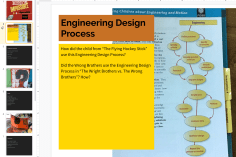





 Before leaving the carpet, I showed the students how the block-coding in the Sphero app worked. I drew the “Roll” command on the board with labels explaining/reminding what each bubble was for: Direction, speed, and duration (time).


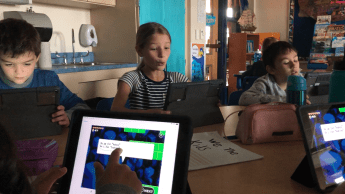
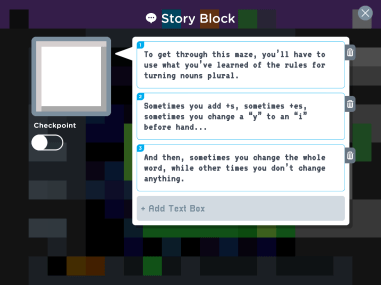


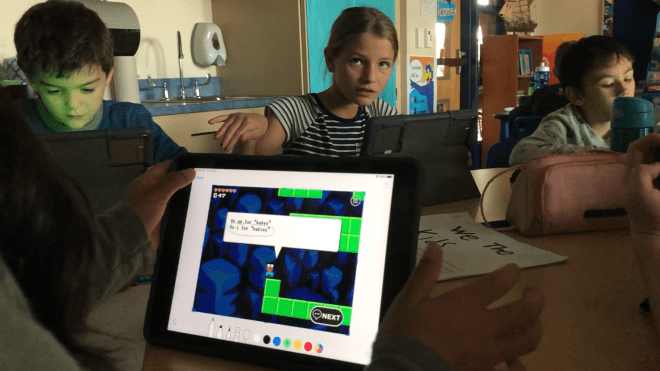 Before disguising the blocks, I first created all of the questions and answers that would guide students through the maze. I varied the nouns and the way they were presented. Some questions had fill in the blanks, while others presented a singular noun, but asked what the plural version would be. After planting all of the questions and directions, I played the game, to make sure that the player would not have any hangups. This showed me places where I ought to spread out the path of the maze. There were places where it folded too close to itself. I didn’t want players to accidentally skip questions by stumbling into the correct channel through a mishap.



 This question made me feel like a latecomer to a party. Wait, what’s that expression?
  I think every educator would do well to read this book. When we differentiate our instruction, we work hard to enrich students who need to be challenged right now, but what about the students who will eventually grow into shining stars?


