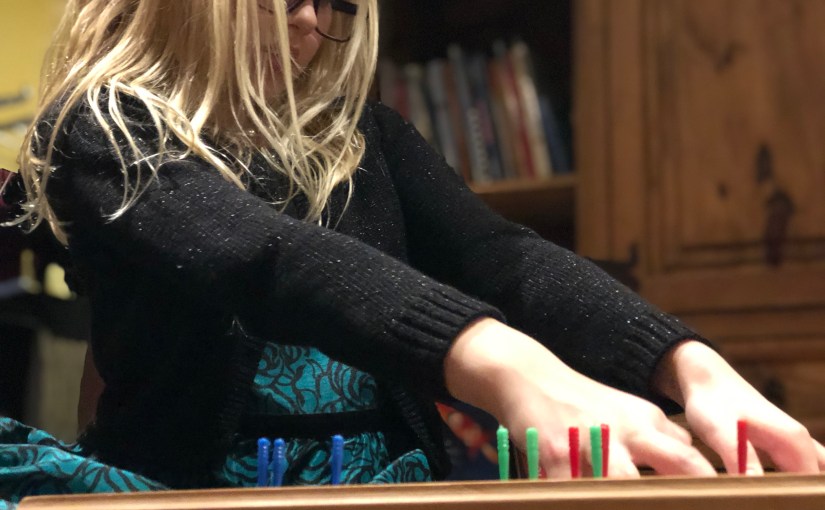
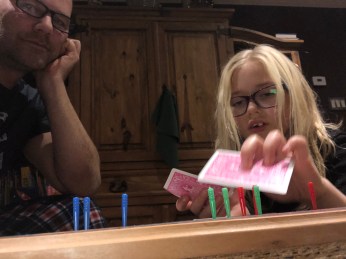
Thanksgiving night 2019 my daughter Scarlet, wife Sonia, and I all sat down to play a game together. Scarlet was interested in learning Cribbage. This is a card game where players move tiny pegs that stand in holes drilled into a wooden board. Each players’ line of holes goes to 150 points. You leapfrog the pegs, so that one keeps the place of the previous accumulation of points, while the other counts out the new total. The player to get her pegs to the finish first, wins.
I wasn’t sure how Scarlet would do with this game of many rules. There were many firsts: I taught Scarlet how to shuffle the deck. She did pretty good. I showed her how to deal the cards. Then there were the instructions of how to play.


Cribbage is all about points, and there are many ways to earn them. One of the ways to earn points is to form groupings of cards whose combined value total 15. When I witnessed Scarlet, who just turned 8 one week ago, working out the different combinations of 15, I was not only impressed with her math skills. It hit me that she was analyzing the cards and evaluating the future potential they held.
This is a little tricky to communicate via text. Without describing the entire game, let me try to convey what Scarlet had to think about when it came to the 15s. It takes several rounds to accumulate 150 points and win a game of Cribbage. Each round begins with all of the (3) players getting 5 cards. The first thing that you do is try to decide which 4 cards you keep, for you are to give up one of them. It can be a challenging decision to make.
See, you don’t just record the points represented in your hand. You play your cards against opponents’ cards. And then, there is a starter card that you use over and over, too. Finally, there is a crib that goes to the dealer. This is what you contribute to when you discard a card at the beginning of the round. If you’re not the dealer, you don’t want to place cards into the crib that will easily form combinations of 15, giving your opponent more points.
 So, it’s Thanksgiving. The dinner is cooked, consumed, and cleaned up. I’m watching my daughter wrestle with the cards in her hand. Of the five she is holding, which should she throw in the crib for someone else to use?
Sometimes it is simple. The starter is a five, and you have three face cards (valued at 10, each), a five, and a four. Throwing the four into someone else’s crib is a no-brainer. It won’t make any points for you. How many different combinations of 15 are you looking at without the four? Try working it out.
The answer is six different combinations of 15 can be formed (3 combinations using your “5” + 3 face cards & 3 combinations using the starter card which is a “5” + your 3 face cards). What if rather than a five, you had an Ace (valued at one in Cribbage)? Now you have 3 face cards worth ten each, an Ace, and a four. And, don’t forget the starter, which is a five. If you give away one of your face cards, you would have four combinations of 15. If you gave away the four this time, you would only have three fifteens: Your 3 face cards, combined with the starter.
 It’s extra hard when you have to add the numbers to make fifteen. Let’s say the five cards that you are dealt are 4, 5, 6, 3, & Ace, and the starter is an 8. You have to discard one of those cards to someone else’s crib.
- Ace, 3, 6, 5 = 15
- 4, 6, 5 = 15
- Ace, 6, 8 = 15
- 3, 4, 8 = 15
Am I missing any? It takes time and is pretty tricky finding all of the combinations. You can’t overlap any, using the same grouping in a different order.
As I’m sure you can imagine, this is great for developing number sense. It also helps grow critical thinking skills. Scarlet was doing all of this math in her head. Once in a while, she would ask for some help. We worked through all of the different combinations to make the best decision possible. She ended up winning, surprise/surprise!
What struck me most about this experience was the inner conflict centered on deciding which card you would choose to relinquish to the crib each round. I knew this to be an important part of the game, but watching my daughter wrestle with the decision, round after round, brought new light to the fact. With practice, she got better and more confident at choosing the card that she would let go.
The inner conflict of choosing the best cards to keep and which to get rid of reminded me of using controversy in the classroom. Making topics controversial by providing students with opposing, nearly equal in value concepts that they must analyze and evaluate to decide which is better or more appropriate for a given situation would develop the skill of critical thinking. Cribbage could be a great way to grow this higher order thinking skill, while also developing number sense.
This got me thinking about other card games. How might a teaching style be analogous to these card games:
“Go Fish” — Students ask for information. If you know it, you hand it over. If you don’t, the students fish for it online (ask Siri). What are students learning when you use this style of teaching? Education is a take/receive, skill-less process. During the card game, only conflict comes in deciding how honest you want to be;) The controversy lies solely in morals.
“Rummy” — Players work at making connections between like cards. They collect as many pairs, three & four of a kind, and make runs. The player who has accumulated the greatest value in cards at the end of play, wins. Analogy to teaching: Making connections is great! Each time you find two like ideas, you group them in your head. You categorize thoughts and store them away. Furthering this game’s message, however; If you’ve played this game much, you’ve probably learned that runs are where the play is. You can play one of your cards off of someone else’s run. You only get the points that your card is valued, but at least you get to play it! This symbolizes a group or team-learning approach. Students must decide which information they want to keep, and which to discard. This decision will be based on how valuable it could be in the future or how useful it is right now. A potential drawback to this approach is that it teaches students that the kid with the most knowledge in the end wins at life.
“Poker” — Kids play this when they try to get away with not completing assignments that they think won’t be checked or graded. The lesson students learn from this teaching style: Life is all about tricking people into thinking you are smarter than you really are, have more knowledge about something than you really do, and/or are able so do something when really you are truly incompetent.
“War” — Without consciously choosing, each player places the top card from their pile face up. Highest card value wins all. When there are ties, War ensues, and only one winner gets tons of cards. This is the opposite of equitable teaching. You teach everyone the same, period; Zero differentiation. Some kids greatly benefit. Everyone else plays along, losing in the end. It should be stated that early on in War, one person begins accumulating the aces and face cards. The other player(s) know that they are going to lose… Unless, they cheat. And, even then, it is hard to come back when you don’t know what card your opponent is playing.
“Solitaire” — “Go practice what I taught you.” Players become familiar with the cards and some relationships between them. They may practice shuffling. An element of racing a time could make this game more challenging, but you might as well be marooned on a literal island!
The thing is, we use each of these styles in our teaching. As teachers, we cannot assess everything, and sometimes we have to use a poker face. Sometimes we need to have students play quietly on their own, and there are times when it is good for a kid to repeat the same action over and over, in solitary practice. When a student does not know the definition of a vocabulary word in the middle of a lesson, it is appropriate for them to
ask, and there are other times when we tell them to “go fish” for it in their text. Everyday, all day long, students are making connections, building relationships between concepts and accumulating knowledge. Hopefully, there isn’t too much “Rummy” being called out in your classroom;)
When the profession of teaching seems to be swimming in data and everything seems like a numbers game, I suggest injecting life into it by making a topic controversial: Give it an element of inner conflict through pitting two or more opposing ideas against one another. This will require some creative thinking on your part, but the critical thinking through cognitive productive struggle that students will be engaged in will far outweigh the work you put into it. Good luck, and let me know what you do and how it goes through tagging me and my research partner James Norman on Twitter and/or using #ControversyCanBeClassy when posting. Also, feel free to leave a comment, here;)

 Just this week, I was preparing to have my students read an article about teeth from a brand new
 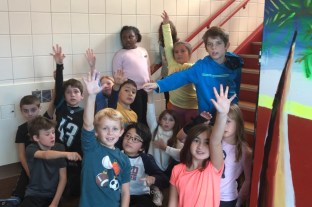 When we regrouped as a whole class after only ten minutes of controversial competition preparation, I used Siri to “flip a coin”. One team “called it” and won the toss. I asked, “Who is going to present?” Hands were raised and fingers were pointed; Several students were interested in presenting. I told them, “You can only speak once, so decide if you want to go now, or hold onto your argument for later in the debate.”
  The teeth team was presenting first, and the boy they had chosen to headline their position was confident. He communicated to me that, rather than wait, they wanted to come out strong–He literally told me this! I laughed, as I gestured for him to begin. “This is a true fact,” he began, “That once your teeth rot, it will affect your gums, and go down to your heart, and you will die.”
  Next came the argument that if your teeth did rot and fall out, you wouldn’t be able to eat anything. Again, it boiled down to not brushing your teeth leading to certain death!
 See, I was thinking about relationships being analogous to the connections between neurons in the brain. Neurons or brain cells communicate with one another through
  While you and the person you are building this relationship with forge an increasingly strong, resilient, efficient means of communication, the two of you insulate the bonds between you. This happens a hundred ways, and it causes you to feel more safe around the person, because they know where you are coming from. You feel like they understand your feelings. They are less likely than a stranger to inadvertently do or say something that could hurt you.
  Tom Murray attributes the success of collaboration, leadership, transformation, and even progress to the “speed of trust” (2019). With the popular warning of trust being easily broken, after taking so long to make, I’ve been guilty of thinking of it as a Ming Vase. The tiniest slip up could shatter the whole thing. Murray does not suggest that trust is anything like this, but it is what I have imagined for years; A once and done breaking of trust.
  Before we get too excited about our trust highway, you should know that there are some pains in making it. If you want a really fast thoroughfare, it needs to be straight and level. Hills and sharp turns will slow down transportation. Believe it or not, there is something even more troubling than blasting or tunneling through mountains and building bridges over valleys. While that will be a lot of work, you first have to come up with the land to make your highway.


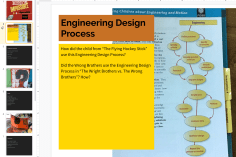





 Before leaving the carpet, I showed the students how the block-coding in the Sphero app worked. I drew the “Roll” command on the board with labels explaining/reminding what each bubble was for: Direction, speed, and duration (time).



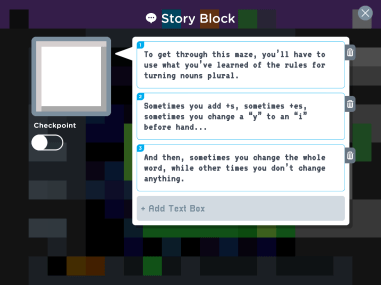


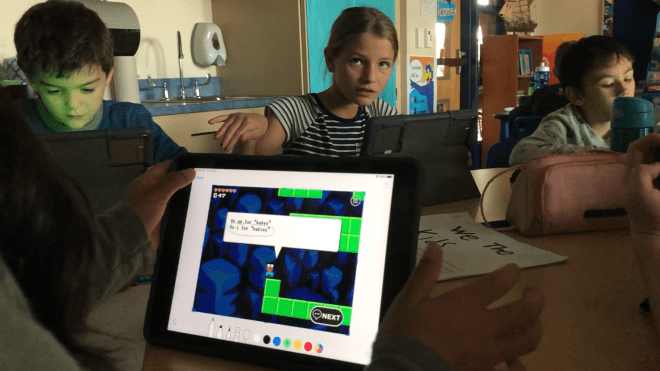 Before disguising the blocks, I first created all of the questions and answers that would guide students through the maze. I varied the nouns and the way they were presented. Some questions had fill in the blanks, while others presented a singular noun, but asked what the plural version would be. After planting all of the questions and directions, I played the game, to make sure that the player would not have any hangups. This showed me places where I ought to spread out the path of the maze. There were places where it folded too close to itself. I didn’t want players to accidentally skip questions by stumbling into the correct channel through a mishap.



 This question made me feel like a latecomer to a party. Wait, what’s that expression?
  I think every educator would do well to read this book. When we differentiate our instruction, we work hard to enrich students who need to be challenged right now, but what about the students who will eventually grow into shining stars?





 The Captain of Class