We all know that selective word-choice can enrich writing (Academy, 2021). It will lend clarity to a story, deepen emotional attachment to a character, and broaden the understanding of a topic. Contrastingly, misused vocabulary can harm the message of a text. And, weak words will water down its substance. Therefore, building a thorough understanding of a wide array of words will prepare students for increasingly effective communication. As it turns out, I have a game that will make your learners crave vocabulary-building.
Would you like your students to beg you to learn new robust vocabulary? Try Balderdash.
I call the game “Balderdash.” (There is a board game version, but I’ve never used it. From the description, it seems to contain the gist of what I present here.) The name is unique enough to spark interest and be memorable. It also lends itself to the core of the game; Playing with unknown words.
I’ve used Balderdash to introduce vocabulary, deepen background knowledge, and explore literature concepts for years.
This is how I introduce the game to my students. I start off by explaining that this is a game of definitions.
“How many times have you been reading an entertaining story, and really enjoying yourself; Then you come across a word that trips you up? All of a sudden, you don’t know what is happening. Why are the characters acting so weird? What did you miss? They aren’t always big words, but misinterpreting the meaning of a word can turn a heretofore simple tale on its head (irony in italics;).
“In this game, you will be presented with a word that you probably don’t know. That is okay. You aren’t supposed to know what the word means. If you DO know what it means, or if you think you know what it means, that is okay, too. But, don’t tell anyone. You can earn points by writing down a definition that is really close to accurate.”
Here’s how it works
Sometimes, the game originates organically. In the middle of conversation with my students, I might use a word that they don’t know. Rather than simply telling the Polite Pirates what it means, we break out Balderdash to have fun learning its definition.
Have a list of your students handy.
Hand out index cards or sticky notes. Tell students to keep the papers UNFOLDED. Also, do not write on the cards until instructed. (They must look the same.)
Have your students write their names on the top. Everyone should use pencil, and don’t do anything to your card to make it appear unique. (You will understand why in a minute.)
Next, come up with a word that students will not know. You could begin with “balderdash.” This would make the game that much more memorable! You could use a vocabulary word from a list of words you want the class to learn. You could even flip through the dictionary, looking for tough words.
Write the word on the board, so that everyone spells it correctly. You may want to write down some phonetic tips. I will sometimes explain what part of speech it is; perhaps even a hint. (i.e. This is a noun; and although this game might be named “Balderdash,” that isn’t what it means.)
Tell the students to make up a definition for the word. Explain to them that their peers are going to vote on which definition sounds most likely to be true or accurate.
While the students are writing their definitions, you look up the true definition of the word. (I don’t recommend relying on your own interpretation. Even if you do understand the word, it is best to deliver the scholarly definition first.) You will need to put the definition into kid-friendly language. Your definition will need to match the ones that students hand in.
Walk around and collect everyone’s index card. I recommend using a bucket or top hat for this.
Read through the definitions to yourself, making sure that you understand what they say and are able to read them fluidly. You don’t want to supply any “tells” that one is NOT the accurate definition. If there are any that are similar to the actual definition, provide that student a point and remove the definition from the pile. (Reading 2 of the same definitions would let them know they are the true definition.)
Next, place them back into the hat or bucket. Pull one at a time and read it. Do this once through without any voting.
Then, repeat the process, but after each reading, have students raise their hands if they think it is the correct definition. You can only vote once, and you can’t vote for your own definition.
Give the pupil who produced the phony definition a point for each vote. Whoever votes for the true definition also gets a point.
After each round, share who earned the most points and the real definition.
In the same way a serious athlete might take creatine supplements to boost muscle-building ability in the body during intense exercise (Creatine, 2021), using games to increase enthusiasm for definition development can motivate kids to grow their vocabularies. Rather than get fatigued when faced with unknown words in texts, your students will view these as opportunities for growth.
An athlete takes creatine supplements to prepare their body for doing a little bit extra in each exercise, making the workout that much more beneficial. Balderdash is a reason for collecting large, complex, unfamiliar words, and tucking their meanings into memory banks for future use. Plus, it’s a lot of fun! game
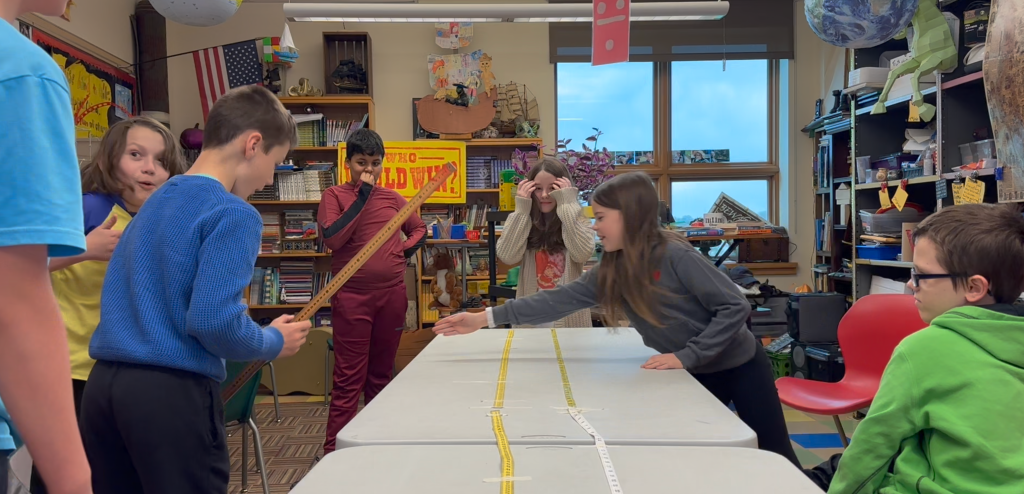
Driving question: What is the perfect length of a paper football field? We are talking, one that allows some paper footballs to score goals, but not every “kick.”
Goal: Students will create and use a line plot to categorize data in a way that makes it easy to interpret. They will analyze the data to determine the best measurement for flicking a paper football accurately.
Prep: I folded a paper football out of an ordinary,letter-sized piece of paper (8 ½ by 11 inches). You fold it the same way you fold an American Flag. Have one pre-folded, but this could be part of the lesson, if you have time. (I didn’t have X.)
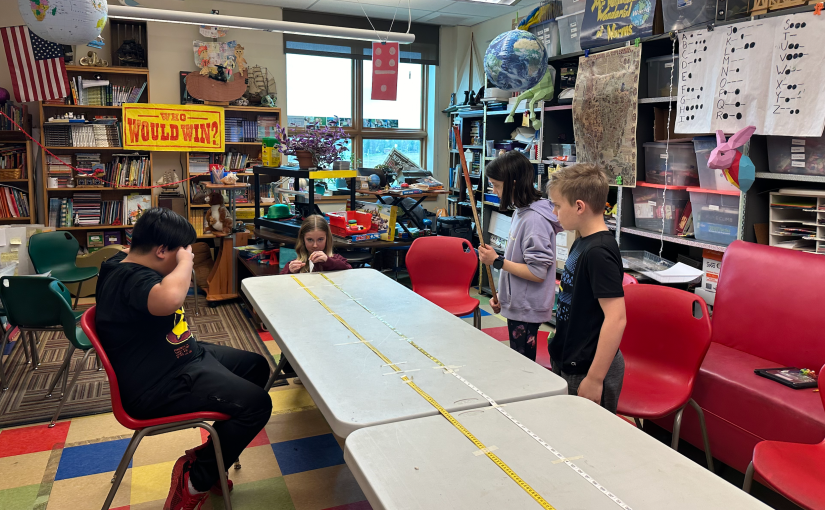
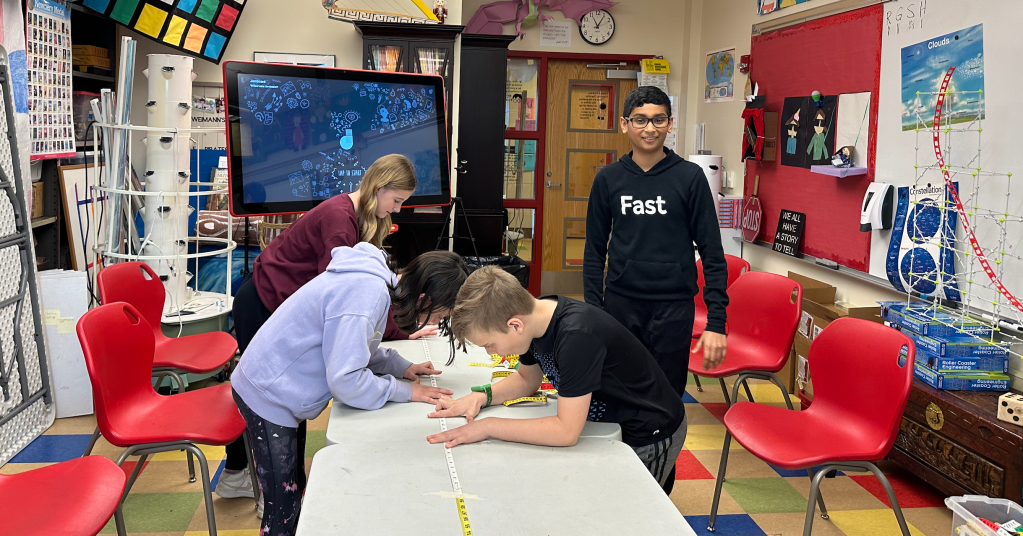
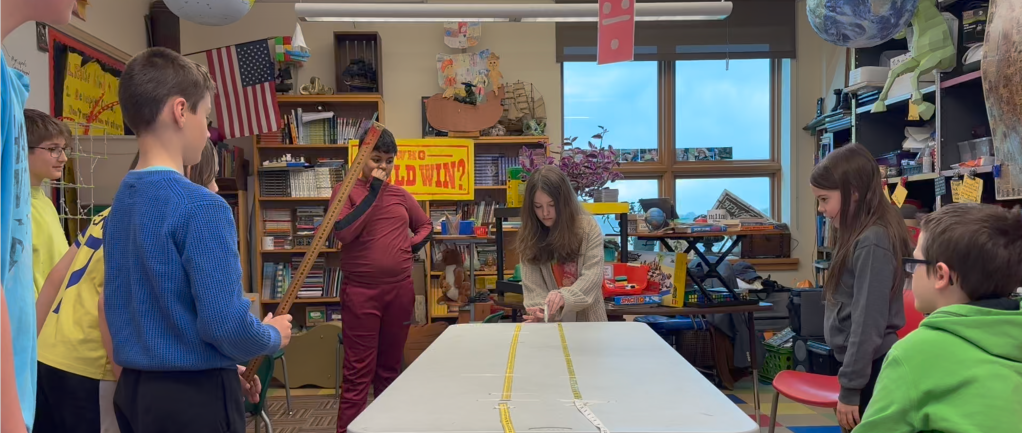
I placed two tables end to end, creating a lengthy runway for measuring. Before students arrived, I taped rulers to the table top the entire length of the two tables, about 3 inches away from the center. I put pieces of tape at each foot so that it would be faster and easier to locate the increment.
Lesson: I told the students the object of the lesson was to determine the “goldilocks length” of a paper football field for this group of students. Another group may be better or worse at flicking the paper football. We are going to collect data that will help us tailor our “field” to our group.
“We don’t want the field goal too close, or every single flick will score a point. We also don’t want the field goal too far away. Then no one will score! There will be a window where some will score, but some won’t. We will use data to find that sweet spot. And, we will use a line plot to help us read the data.”
The first thing we did was figure out the width of the field goal, so that we could finish constructing our mock field. I had each student form right angles with their thumbs and index fingers. Then, touching thumb-tips, they placed their finger field goals on the measuring tape (ruler) I had already taped to the tables. As students shared the measurements of their finger field goals, I wrote them on the dry erase board. We had 6, 6, 5, 5 inches.
I had taught my students how to average numbers earlier in the year. They were bouncing with the information, now. “It’s 5.5,” a girl offered.
“How do you know?” I queried.
A boy suggested that it was right in the middle of the numbers. I affirmed this by circling the middle four and five. The girl who had provided the original answer shared what she did to get it, and what one should do to find the average of several numbers. “You add all of the numbers, and then divide by the number of numbers.” We discussed dividing 22 by four in order to review fractions and decimals, and to double-check our answer.
Next, we used mini (six inch) rulers to measure five and a half inches distance between the already taped down ruler and a new one. I had the students tape it down. Now, we had a runway that was the average field goal width, running about ten feet long.
I demonstrated how to flick the paper football. Each student got three tries. If any of them were duds (didn’t fly), we conducted a retry. There were a few very short flicks, but all in all we collected some valuable data.
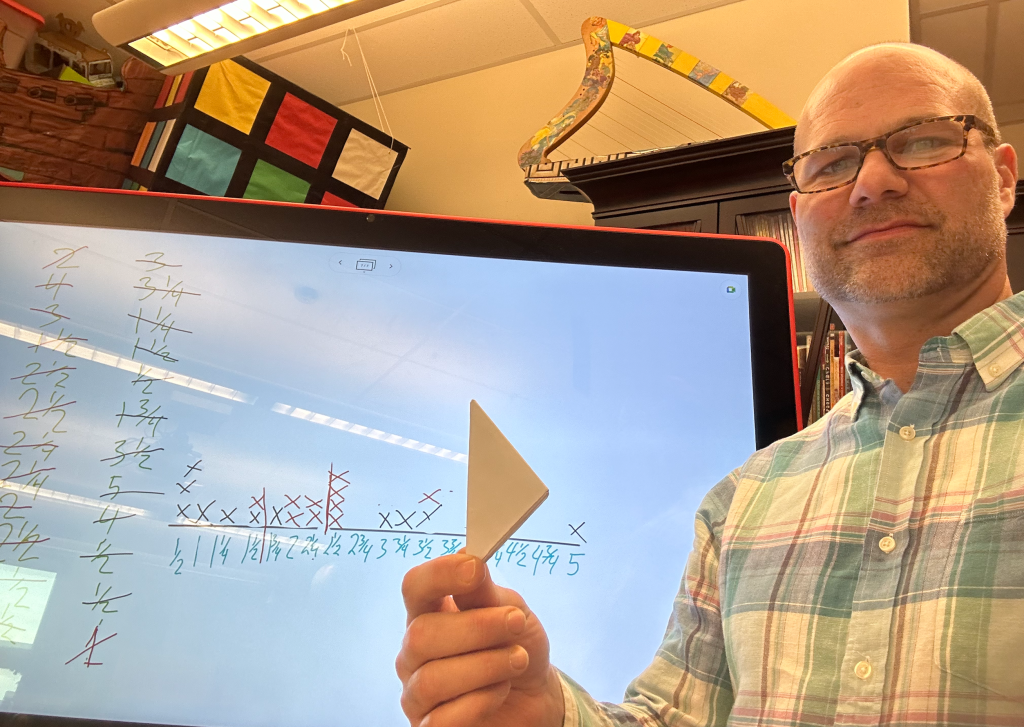
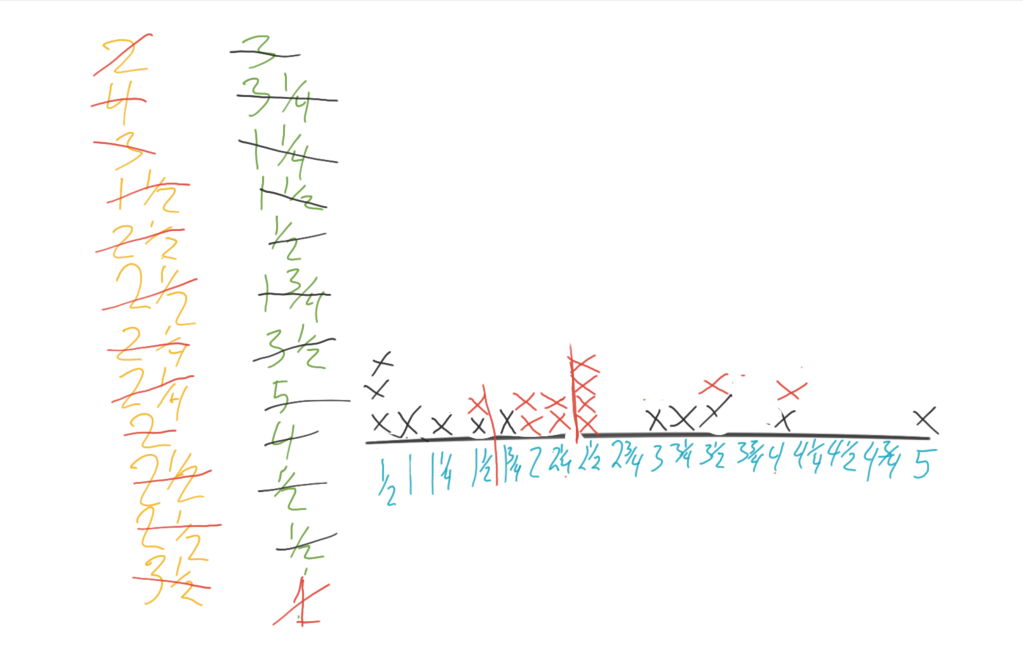
This line plot is not great because the line is not accurate. There ought to be measurements that do not have Xs. Every 1/3 foot should be labeled.
About half of the flicks landed between the two rulers; within the field goal range. These measurements were written on the board in one color. The flicks that did not land between the rulers were recorded in a different color. All of the measurements were recorded to the nearest ⅓ of a foot, in order to use mixed numbers on our line plot.
Once the line plot was finished, it was easy to see the window where the field goal ought to be erected. There was a collection of accurately-flicked colored Xs up to a point. Then the other color, the color of missed flicks began to move in. At a certain point there were no longer any accurate flicks. The brackish space containing both colors contained the available distances.
Some students wanted to place the field goal at the first measurement that recorded a miss. I explained that, were we to place it there, nearly every flick would score a point. Even the misses that went far could pass between the goal posts before veering off to the side. I drew a picture illustrating what I meant.
We drew lines at measurements that we thought the field goal would work best. Then we discussed pros and cons referencing the data.
One student wanted the goal posts erected right before the very last successful data point; The last one to land between the two rulers. I told him that “This would guarantee that only one person would get one point for one flick out of… How many did we do? That might be too frustrating, and not very fun.”
We ended the lesson without deciding on the perfect distance. Basically, the thing to do was to use the data that we collected to try out some reasonable distances, and see which ones were more fun. The beauty of the paper football field goal game is that the field is so malleable. It is all about fun, and that’s what I hoped the line plot lesson would generate. If nothing else, it was memorable.
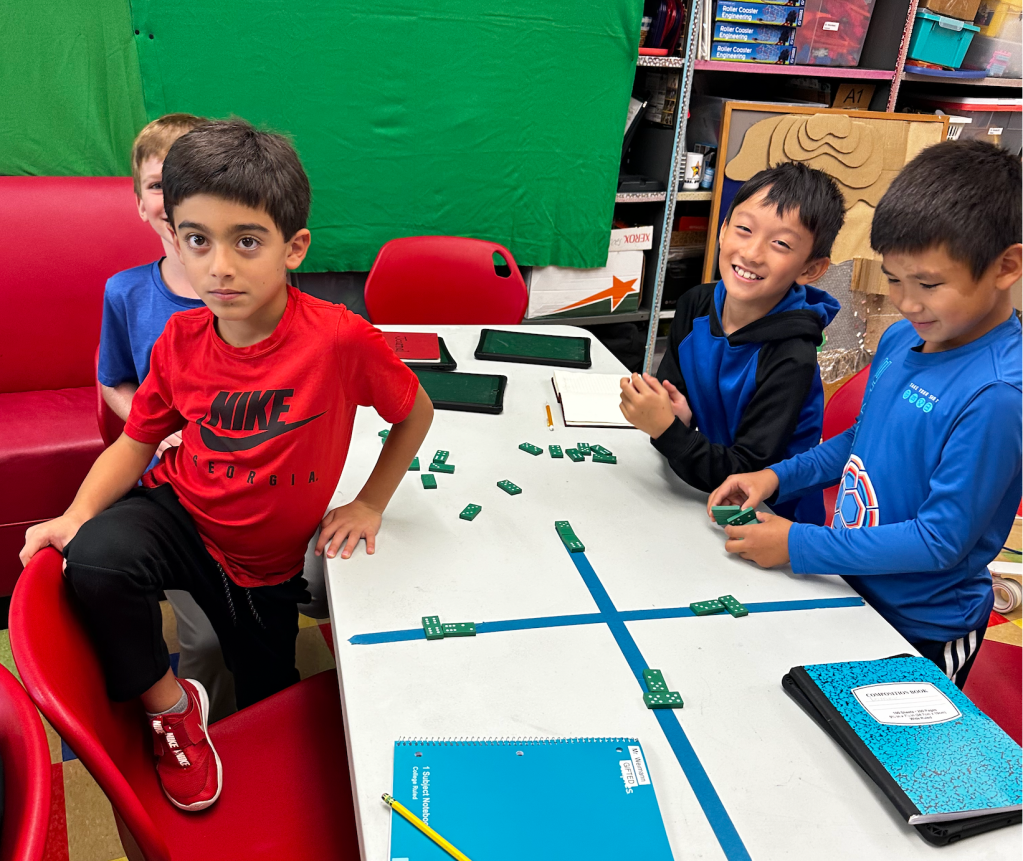
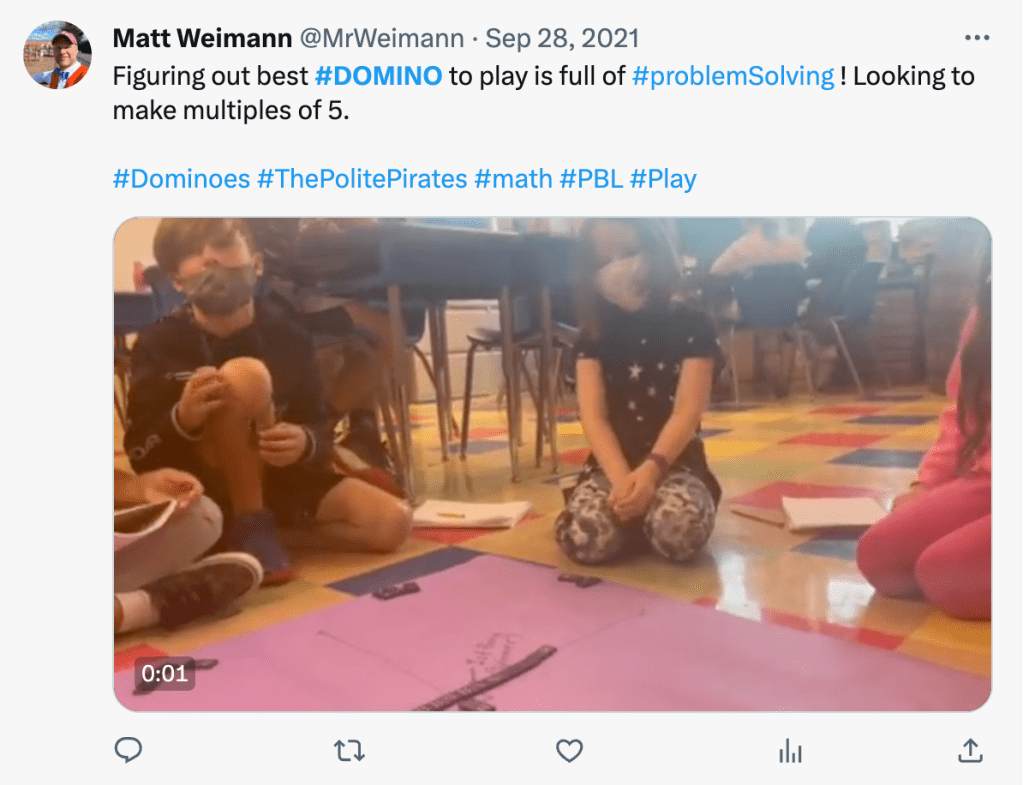
My 5th grade gifted class revisited the game of Dominoes last week. It took some review, but they enjoyed playing the game. I told them that one of the reasons I had taught them the game was because it is a classic that they could play with grandparents and other elderly people, bridging the gap between generations. The game has been in existence for over 900 years!
In addition to the game being old, it also presents an opportunity to practice strategic thinking. In an effort to prove this to my 5th graders, I have begun dreaming up scenarios where a player might use analytic skills to make a counter-intuitive move that would benefit them in the long run.
There are times during a game when you have more than one Bone (Domino) that you can play, but none of the plays will give you points. Sometimes, it does not matter which one you put down, but other times you can plan ahead. Much like you would in chess, you can set up future moves by arranging the Bones to meet your needs. Playing them in a particular order would benefit you more.
I planned on showing my 5th graders what I meant by setting up scenarios of games and taking pictures. I have done that many times to teach the problem-solving aspect of Dominoes.
Using photos as teaching tools works great on interactive devices.
Then I thought, Why not have my gifted students make up the puzzles themselves? I will give them the parameters, and they have to try to figure out how to show the need for strategic thinking through constructing an image of a hypothetical game.
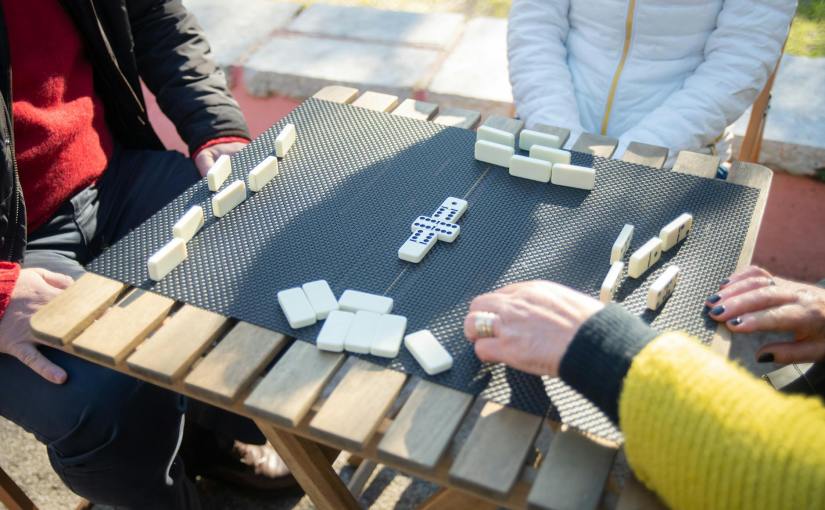
The puzzle would be an image showing Bones (Dominoes) already played, Bones available to a player (standing up so Pips or dots were showing), blank sides of the opponent’s Bones, and maybe a Boneyard (unused Dominoes).
If you are a novice Dominoes player, some of this vocabulary might be new to you. Bones are the game pieces, named after what they were originally made out of; Ivory or elephant tusks (bones). The Boneyard is made up of the unused Bones lying face down. Face down means that the Pips or dots on the bones are not showing. All you can see is a blank Bone or the uniform design that is printed/carved on every one of the 28 Bones of the set. Bones often have something decorative on the side without Pips, so that players can identify the 0-0 Bone more easily. Every Bone has two numbers on it. There are two ends of the number side of a Bone. No two Bones have the same combination of numbers. Beginning at 0-0, the Bones go up to 6-6.
The Plan: In order to demonstrate strategies for play, I am going to have my 5th graders come up with puzzles that point to weighted plays. In other words there will be better moves than others. People trying to solve the puzzles will have to analyze the potential moves. Which one is better and why? Puzzle-solvers will be required to explain the move they chose.
The Work: Arrange Bones as though they had been played in a game. This means matching the ends of Bones; Six is connected to six, three to three, etc. There ought to be four lines of play that a player can connect a Bone to.
Each player has Bones left to play. One set of Bones is standing up, with the number of Pips showing. These are the Bones that the puzzle-solver has to work with. (Normally, when I am teaching Dominoes to students, I have them lay all of the Bones down, so that every student can see all of the Pips. This is so that every single play is a lesson on problem-solving. When one plays a real game, you do not show your Bones to your opponent.)
The Bones that the puzzle-solver has to work with (the ones showing Pips in the image) should have numbers that can be played. They contain the number that is present at the ends of the lines of play. One of the Bones that can be played would cause the sum of all four ends of the lines of play to add up to a multiple of five, which is how one acquires points in Dominoes. This would seem like the best choice to complete the puzzle.
Because we want this to be a puzzle that causes Domino players to grow in their understanding of the game and not just an illustration modeling how to play, we aren’t going to make the correct answer to our puzzle be an obvious choice. A good head-scratcher will require a player to look beyond the obvious play.
If four Bones with the same number have already been played, and the puzzle-solver has two of the remaining Bones with that same number, how likely is it that the opponent of the puzzle-solver has any Bones with that number?
Here is your task: Make it so that playing the Bone that does NOT create a multiple of five is the better play.
I’ll have to share this lesson with my 4th graders, as well!
How could this happen? If the opponent of the puzzle-solver is forced to draw a Bone from the Boneyard, rather than playing a Bone, not only will they not earn any points, but they will be growing the number of points that the puzzle-solver will get at the end of the round; The round that the puzzle-solver is now more likely to win because they have fewer Bones left than their opponent.
At the end of each round the player who uses up all of their Bones first gets points from the Pips that are on their opponent’s remaining Bones. In order for the play that did not make a multiple of five in the first place (at the beginning of the puzzle-solving exercise) to be the better play, the final play must provide more points than the potential multiple of five.
If the multiple of five would have been fifteen, and there is no way, given the Bones that are left, for the puzzle-solver’s opponent to have a total of Pips greater than fifteen (you always round up, so sixteen would go up to twenty), then not playing the multiple of five during play would not necessarily be a winning strategy. Typically, you would play the multiple of five, get the points, and hope for the best. This exercise is designed to show my 5th graders that if you plan ahead, the delay of point acquisition could very well bring a windfall of greater point tallies. Not only is this a good life lesson, but it can help them play the game better in the future.
Now, if you want to try to figure out how to create a puzzle that fulfills these requirements on your own, without any help, go for it. You can return to this writing when/if you get stuck and need some guidance. The next section provides some helpful hints.
If you aren’t sure where to start, or you have hit a mental block, check out these ideas.
Some Helpful Hints:
Limit the available Bones. You can do this several different ways. One is to only give the puzzle-solver two bones to choose from.
Another way to limit the potential outcomes is to make the lines of play long. Have most of the Bones from the set showing in the lines of play, so that the potential Bones of the opponent is narrowed to only a few possible numbers. The puzzle-solver can reverse-engineer the game to figure out what Bones are left to be played. It’s like “card-counting,” but legal;)
A very effective strategy for creating a doable puzzle is to limit the numbers in play. Idea: Make the ends of the line of play all the same number, and the puzzle-solver has the remaining Bones that contain that number. For example, there is a one at the end of all four lines of play. There are only seven Bones that have a one in them. If four of these are played, and the puzzle-solver has the remaining three, then the opponent cannot possibly play any of their Bones.
But, the puzzle has the puzzle-solver making the next play. How can the puzzle-solver cause their opponent to have to draw from the Boneyard? See if you can figure it out.
There are a couple of ways to solve this problem. One answer is to provide the puzzle-solver with a double. A double has the same number on both sides. When this is played at the end of a line of play, it keeps that number going!
Another solution requires more work, and could therefore be trickier for the puzzle-solver to find. Make it so that all of the Bones that the puzzle-solver possesses have numbers on them that can’t be played. You have to position every bone that has any of the other numbers on them within the lines of play. No need to worry about your puzzle-solver using up their Bones because every one of theirs contains the same number as the ends of the lines of play.
Stack the Pips. Create lines of play that have low numbers, thus ensuring that the Bones that the opponent possesses are more likely to have higher Pip counts. In this way, even if the puzzle-solver would make a fifteen or twenty with the false-solution-Bone (the one that would make a multiple of five and seems to be the better choice for the puzzle-solver to choose), the total Pips that the opponent would have must be greater than the multiple of five. This number work is truly statistical thinking. Out of all of the Bones still available, how likely is it for the opponent to have a high enough number of Pips for the counterintuitive play to benefit the puzzle-solver more?
This puzzle would allow for the opponent to make a play or two before the puzzle-solver is out of Bones. My student would have to work through all of the possible outcomes to ensure that the puzzle-solver would come out on top.
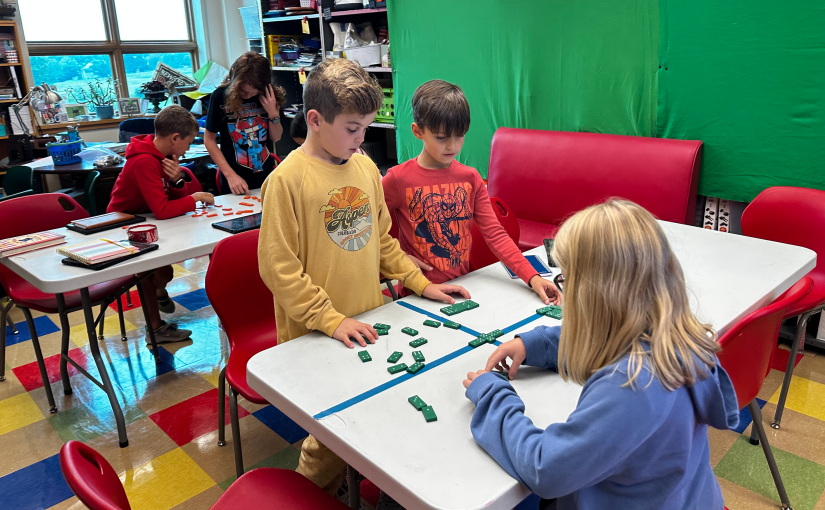
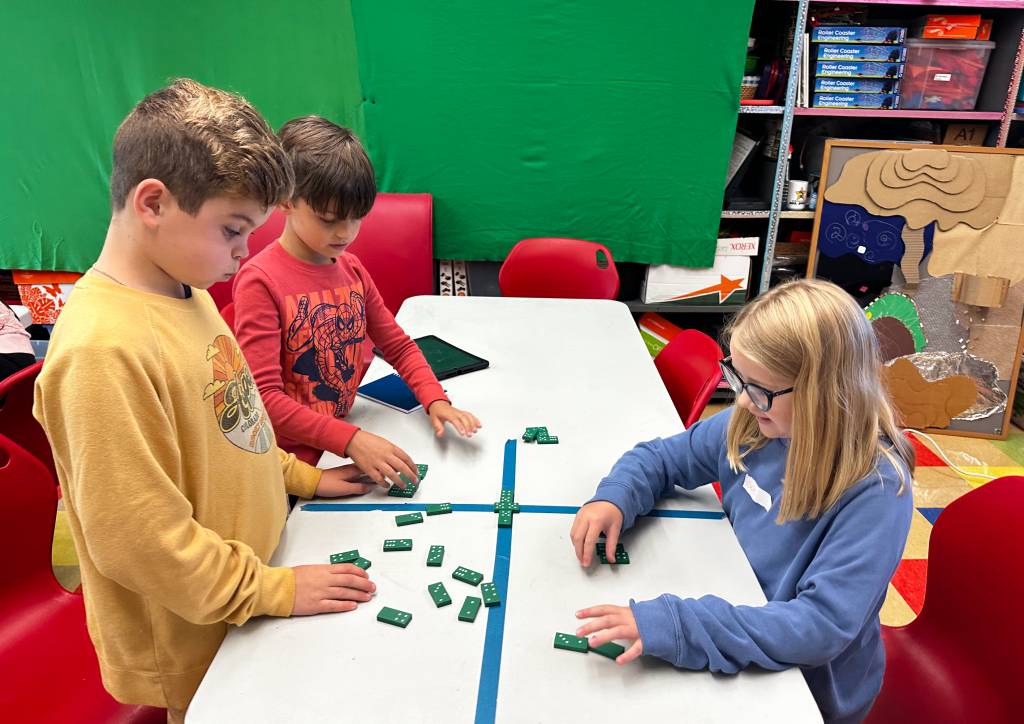
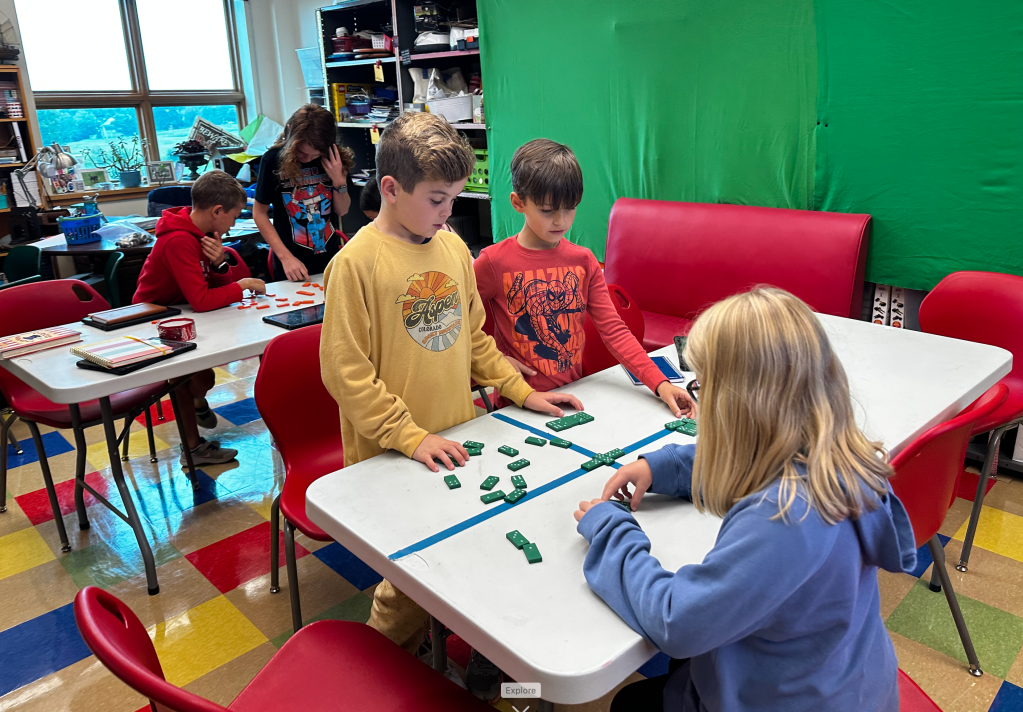
3rd graders learn to play Dominoes
Try it out, and make the puzzle fool-proof. When making the puzzle, turn all of the Bones over so that the Pips are showing. Create a model of lines of play. Give the puzzle-solver the Bones they will work with. Now, look at the Bones that the opponent could have. Adjust the lines of play, so that there is no possible way for the opponent to have a way of winning. You also have to double-check that there are only Bones that would cause the opponent to have more Pips than the false-solution. Then turn over the Bones that form the Boneyard, and stand up a couple that represent the unknown opponent’s Bones.
Conclusion:
Normally, I will do a lesson like this, and then write a blog about it. This is different. I have used my writing to think through what I want to have my 5th graders do.
My aim is to have them build their understanding of the game of Dominoes and learn statistical analysis through the process of constructing their own puzzles, rather than just solving mine. Hopefully it will be successful, and I can write a follow up blog about how wonderful it went… or the lessons I learned through its execution, pun intended;)
If you try this idea or one like it, please share your results. I’d love to learn feedback and improve future teaching.
What if you could produce a dessert packed with protein and healthy nutrients; I’m talking even more beneficial than a typical meal. Would you serve this delectable dish for dinner every day? My conclusion may surprise you.
Last week was Parent-Teacher-conference-week at my school. Students had half-days, and families either visited the building or used virtual conferencing tools to converse face to face with educators. This was the very first time that I bounced around from teacher to teacher, visiting the conferences of my gifted students’ parents. While there are many ideas that I could comment on, the one that stands out most was from the parent of one of my math enrichment students.
The family has a third grader who is gifted, and that is why I was attending the conference. But, his little sister, who is in first grade, attends my math enrichment lessons, and it was something that she said that got me thinking. Her parents told me that they asked their daughter what she did in math enrichment class, and she told them, “We play games.”
“Is that all?” I imagine them pressing, being the good communicative parents they are. Yup, is the first-grade answer:)
This is a recent pic of 2nd grade learning to play Dominos.
I laughed when I heard their tale. I explained to the parents that I was teaching the first graders Dominos. After defending the fact that there is a lot of mental math and problem-solving, there was some light banter between parents and the regular ed teacher about only knowing the stacking and tumbling side of Dominos.
Because their gifted third grader had already experienced lessons showing the critical thinking development of Dominos, it wasn’t necessary to get too defensive. They were “on board” with my use of games for strengthening math skills. But, the idea of my lessons being categorized definitively as nothing more than games gave me pause. Initially, I was perfectly okay with tricking students into learning through having fun. What teacher would turn down that strategy? “Can we have some more math enrichment, please!” the students whine. “Um… Yes!” every math teacher in the world would utter.
Then I thought about the idea of turning everything into a game. Wouldn’t that be wonderful for the students? But, would it be healthy? Hmm…
This is where the thought experiment at the top of this blog originated. I was musing over my math lessons being perceived as games, and I dreamed up the analogy of only eating dessert. Prepare to enter a rabbit hole of research. I’ll try to keep it palatable😉
History of Dessert
Asking “Why does dessert even exist?” feels a little like questioning the purpose of gold or jewels. Isn’t it obvious? It’s awesome!
Believe it or not, dessert did not always exist, however. Similarly to gold and jewelry, it was discovered, and has evolved over time. The French are responsible for turning entremets into dessert (Gerson, 2019). Before there were sweets to end a meal, entremets were served as “interval” dishes, literally “between-foods” courses (Teppen, 2015). They were meant to cleanse the palate. They may be sweet, but not necessarily.
Eventually, a final course of fruit, called le fruit, was formalized (Gerson, 2019). Only, before serving it, the table must be completely cleared. This cleaning of the table was called desservir, the French verb for “to clear.” More than tasting wonderful, the original final course of fruit developed into something lovely to gaze upon. Some desserts even consisted of “Elegant metal and glass structures holding whole apples or plums. Other times, meticulously crafted sugar figures became the center of dessert displays, and might not be eaten at all. Dessert specialists in the eighteenth century were supposed to understand architectural design and be capable of replicating it in sugar paste” (Gerson, 2019).
These creators of dessert, as it came to be known around the time of the French Revolution, when the Bourgeois assimilated the term, were originally more like artists than chefs. Maryann Teppen (2015) writes of an entire battle scene, complete with tiny sugary soldiers with guns and canons, that told the story of Louis XV’s demise crafted out of sugar. It is hard to imagine your dinner table being cleared; plates, napkins, silverware, and foods being “dessert-ed” away; only to be replaced by an elaborate, sugary scene of violence that you feast your eyes upon but don’t touch!
Modern dessert serves a different purpose. BreezeMaxWeb (2022) suggests it psychologically signals the end of eating. Consuming a small, sweet treat at the conclusion of a meal might communicate to the body and brain that we are all done, and there is no need to nibble superfluous snacks. The End.
A practice that I began a couple of years ago has helped me lose some weight and become more healthy; I will eat an apple at the end of every lunch. Many years ago I heard that apples help clean your teeth, and apparently there is some truth to that (Apples: Dental Hygiene Facts, 2017). Once I’ve eaten my apple, I cannot/will not eat anything else. I don’t want to undo my teeth cleansing. This has helped me de-snack my afternoons.
Let me reintroduce the concept of math games, here. Could a game be used to transition from one course of subject matter to another? Would playing a game cleanse the cognitive palate, and prepare students for something completely different? Of course! Would this be an appropriate way to signify we are done with the subject? I think so.
Delayed Gratification (Deferred Satisfaction)
How many parents use dessert as a reward for finishing a well-balanced meal? That treat is the ribbon at the end of a race. Some contests require more work and take longer, but when getting to the game of a lesson is the goal, students may trudge longer, work harder, and persist through all kinds of problems. Those students who finish first might learn patience through having to wait for their peers to catch up with them before the whole group can consume the dessert of a lesson together.
Self control. Training. Conditioning. “If I let you eat this piece of cake, do you promise to gobble up all of your peas and carrots without complaining?” doesn’t just sound silly. I probably don’t have to tell you that this is an ineffective reward model;)
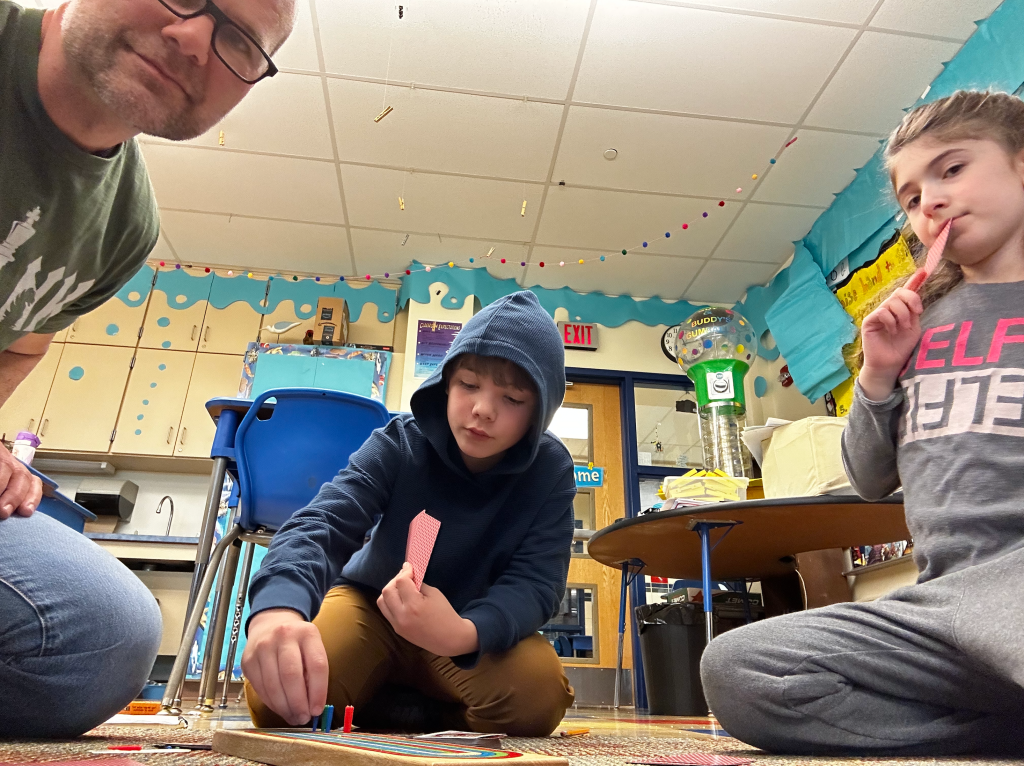
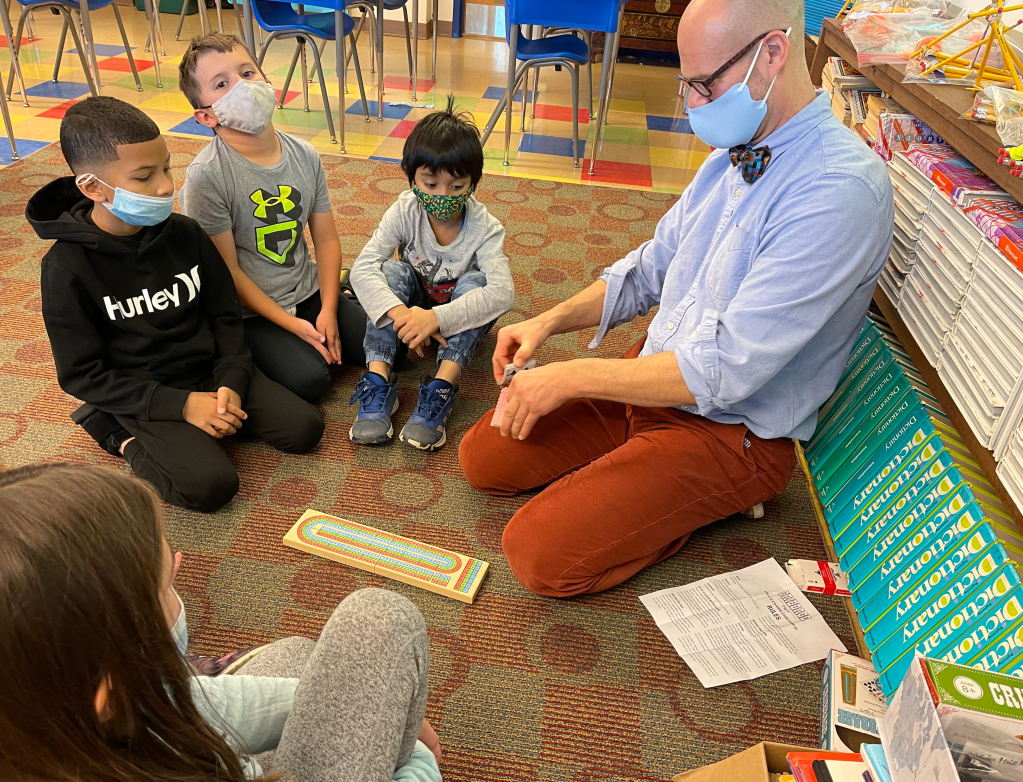
These are this year’s 3rd graders (math enrichment), learning the game, Cribbage.
But, what if the dessert is carrot cake? What if the dessert is healthier than the dinner? Then what? “Eat all of your cake, or you won’t be given any peas…” Wait, what?!
Is there something to be said for learning to crunch through cardboard in order to earn cake? According to a longitudinal study spanning 40 years (Casey et al., 2011), learning and practicing self control early on in life can lead to better academic performance, less behavior problems, and even higher SAT scores. Casey and company (2011) describe in their paper, “Behavioral and neural correlates of delay of gratification 40 years later,” some ways kids can curb the pull of stimuli by learning cognitive control. There are mental strategies and tricks that people can use to provide buffers, dampeners, and walls to contain and maintain self sovereignty. Students may never learn or develop these important skills if they are never asked to wait for anything.
Through reading this research I wondered if teachers, themselves, are bypassing the delay of gratification when they jump right into games to teach. What educator looks forward to grumblings from their students? I propose that most would prefer praise of pupils happy with pedagogical practices over the squabbling of scholars required to earn a fun activity. Are we educators partaking in dessert before dinner when we teach with games?
Before we beat ourselves up too much, let’s bring our metaphor along with us as we explore a couple of Jamarillo’s fun list of 11 Reasons to Eat Dessert First (2023). This may initially seem like a self-serving exercise, justification, or defensive maneuver, but hold on. Jamarillo raises the point that food can sometimes be a serious psychological hangup. “When we have disordered eating, we can often develop food or meal fixation. Dessert is one of the most common food items restricted. This can lead to binge restrict cycles and disruption of hunger cues” (2023).
Is it possible for students to develop “learning disorders” by experiencing “binge-playing” with learning games after enduring unnecessarily long restrictions? Just as Jamarillo (2023) suggests that dessert-first-eating can help overcome eating disorders through stimulating hunger, tapping into nostalgic memories, practicing navigation of bodily needs versus wants, and learning to respect cravings, beginning a lesson with a learning game can help students who struggle academically to open up to pedagogy.
One thing more, and this might be a great way to end this blog, Jamarillo (2023) ends her short article with the fact that dessert is an ambiguous course. It can be a sweet, but doesn’t have to be. Fresh, raw fruit could serve as dessert. Pies, pastries, a tiny chocolate or candy, sweetened veggies, and yes, of course cake can all constitute desserts, whether eaten at the beginning of a meal, middle, or end.
In conclusion, my first grade student may imagine all she does is play games during math enrichment time, but this learning dessert is rich with problem-solving proteins, mental math nutrition, and healthy higher-order thinking! With the short amount of time I have with my students, I have to make my challenges tasty. And, I’m okay with that;)
John Burger, second grade teacher extraordinaire (2012)
When I first began teaching, I had a mentor who was amazing. He taught second grade, and it was a calling more than a career. His name was John Burger. Rather than do Social Emotional Learning (SEL) lessons, he was SEL. Everything he taught had emotional and social lessons woven throughout it. Like myself, education was a second career for John. He had been an engineer before becoming a primary school teacher. More than the money, he was doing this because he believed in it.
In addition to John’s unique way of teaching, he used some teaching tools that I liked so much that I adapted them into my own repertoire. One was readers theaters. I have shared a few blogs about those in the past. Another was mental math games.
The mental math games were designed to make math fun and exciting. They are a great tool to use on the fly, because students don’t use paper or pencils. They should do it all in their head. Some of the games require critical thinking. Some rely on short-term memory and problem-solving. Others practice rote memory math facts.
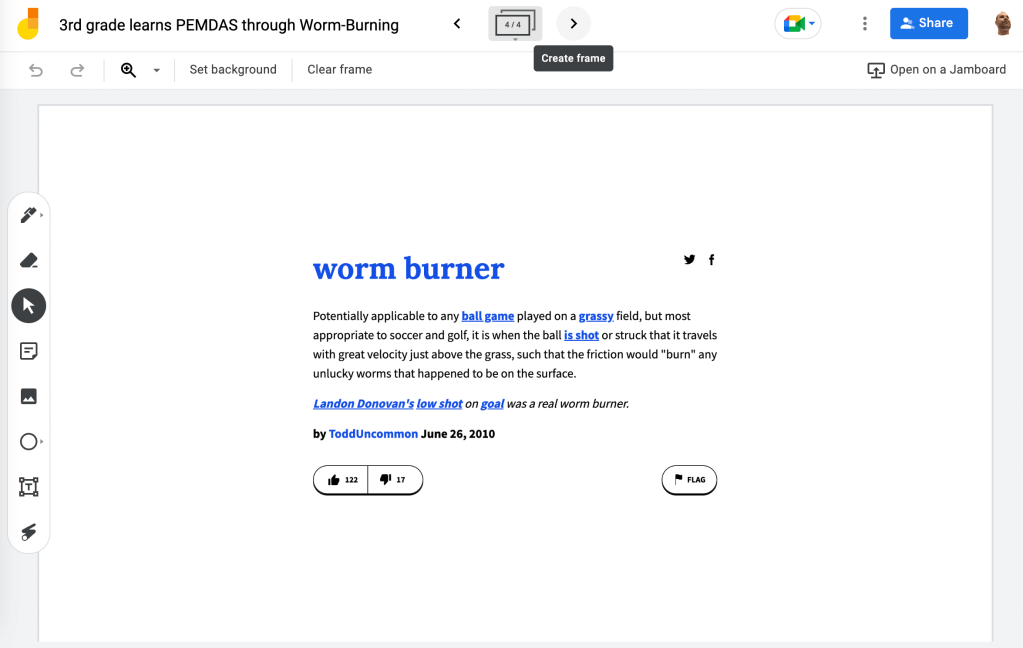
One of my favorites comes with a story. John liked baseball, and each year, when he introduced this game to his second graders, he would tell them, “When a baseball is hit really hard, and instead of it going up into the air, it is a line drive, straight over the grass… If a worm were to stick his head up out of his hole just at that moment, it would get its head burned by that cruising missile of a baseball! This is called worm burning.” There would be all kinds of gasps as kids pictured a worm being scalped by a wizzing baseball. Then, in his soft, understanding style of sharing, John would explain how the game works. “I’m going to say a bunch of numbers, and I will tell you what to do with them in between. You have to try your best to keep up. I’ll go slow in the beginning, but then I will begin to speed things up. When I stop, you tell me the answer that’s in your head.”
“You have to keep the answer at the front of your brain.” Sometimes I lose it and have to stop.
The mental math game is fast. The teacher will use single digit numbers and a variety of operations, keeping track of the answer until the worm burner has run its course. When the teacher stops saying numbers and operations, students have to raise their hands with whatever answer they are left with. I have my students show me their answers with fingers; They raise the number of fingers that they think is the answer. The teacher (or student; I’ll have kids try it when they get good at it) who is sharing the math must keep the final answer under 10.
I often teach students this game at the beginning of the year and use it during whole-group bathroom breaks or times I need to keep students quiet. We get really excited when we know the answer and/or get it right, so it is hard to be completely silent. I remind students that they ought to only raise the accurate number of fingers. I praise students who do this well.
You change up the difficulty of the digits and speed by which you say them to adjust so that more students can participate. The students who are more fluent with their facts are affirmed as math whizzes, and that’s just the way it is. “Good for them. The rest of you can study and memorize your facts just the same.” I have witnessed students work on learning their facts and gradually move up the ranks in Worm Burning, until they became competitive with the best of the burners.
I usually try to do a few that everyone and anyone can get. You can weave in a couple of tricks, like multiplying the whole thing by zero. Then everyone gets in on the answer. It gets everyone to at least pay attention and listen. Also, the Polite Pirates perk right up when they hear me say, “subtract 99 or 98” because they know the going answer before that was probably 100, and we are back to only 1 or 2, respectfully. I’ve had lost souls jump back into the game at that point. It’s fun to see them grab ahold of confidence as they celebrate success.
Sometimes, but not always, I will go back and walk the class through the Worm Burn. I’ll demonstrate keeping the answer right there at the front of your mind. Often, the Worm Burn is so fast or long that I can’t remember all of the steps. The successful students are usually proud to help me remember, though.
Later on in the year I will introduce larger numbers that can be tricky. For example, I will have students multiply 25 by 4. “I don’t know that!” they’ll cry out.
“How many quarters are in a dollar?” I’ll ask them.
“Oh…” They get it, and then I will do a bunch of worm burners incorporating twenty-fives.
Another number I’ll throw in at some point is fifteen. “Three fifteens is the same thing as three quarters past the hour. How many minutes is that?” I’ll explain after stumping my students. Sometimes I’ll use alternative words like “dozen” or “double that” to keep things interesting.
By the end of third grade I would be throwing fractions into the mix. It’s a great way to cement the understanding of denominators dividing numerators. I will get the Worm Burn to the number 24, and then say, “What is a third of that?” Or, maybe I’ll start off with “Three fifths of fifteen (9), plus three quarters of four (3), divided by six…” and so on. Pause just enough so some students can get it, but not so much that others blurt out the answer. And, don’t make it so hard that no one gets it!
Gifted
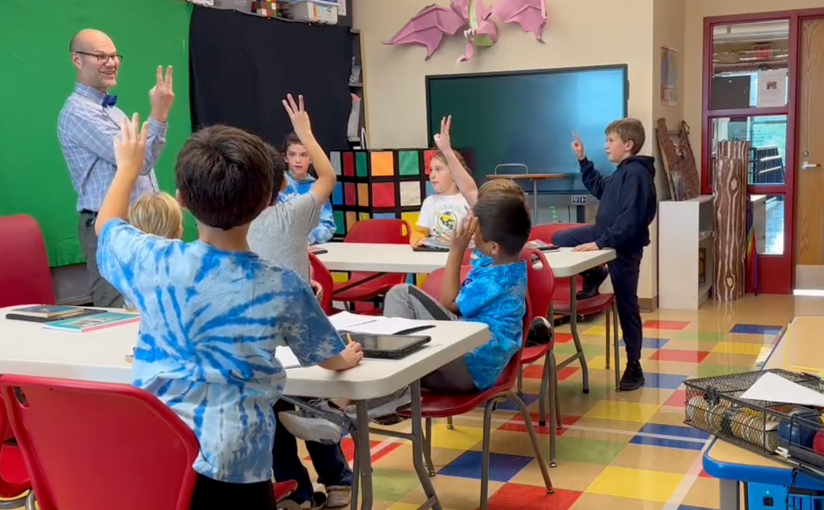
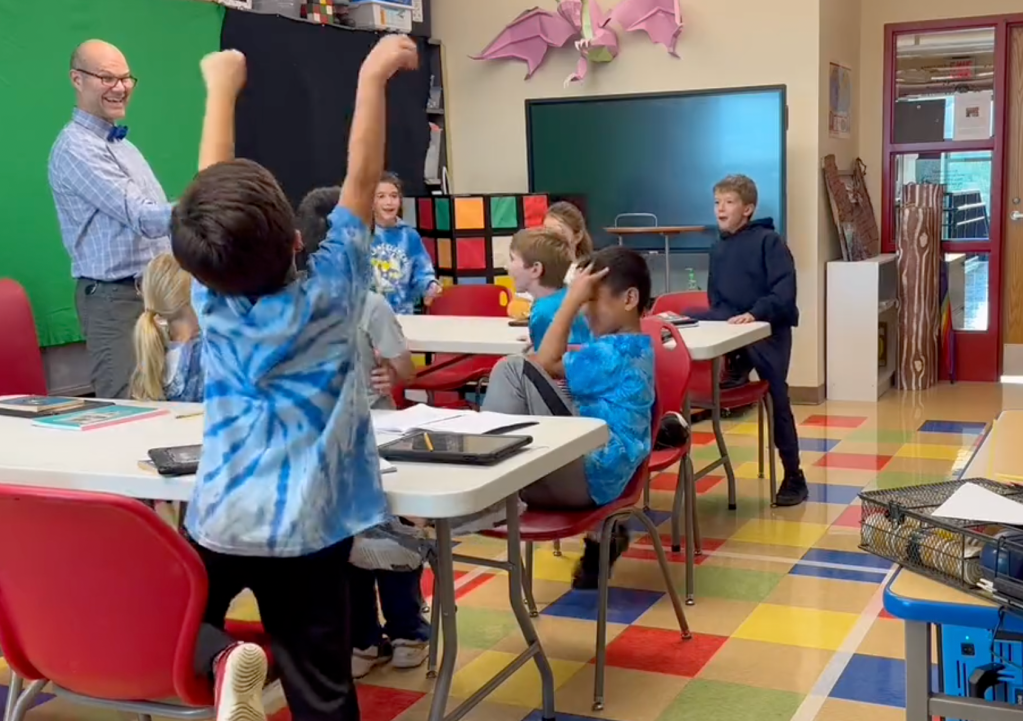
This year I have transitioned from being strictly a third grade teacher to the gifted support teacher for kindergarten through fifth grade of my school. I was sharing the game of Worm Burning with my third grade gifted students, when I saw an opportunity to bring the math to the next level… and then some.
I never write the Worm Burn on the board. But I foresaw a unique teaching opportunity here.
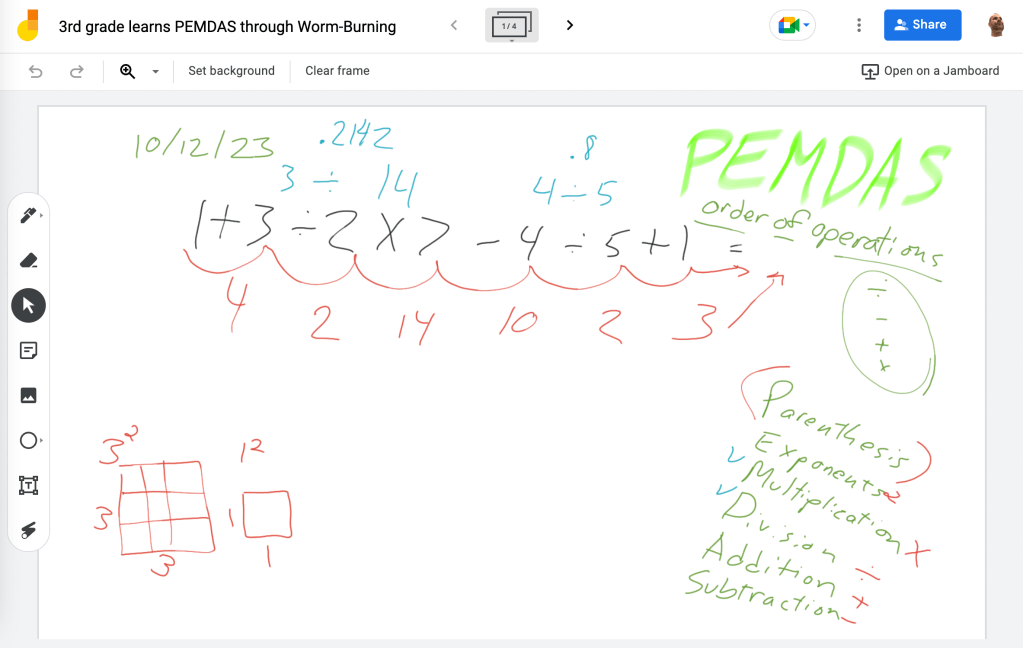
I told my third graders about a trick that I often use in order to keep the numbers straight and maintain a going answer in my mind; I will use the answer in the next operation. For example, “Two times three, plus six…” I added the six to reinforce in my own mind that the product of two and three was six. I never write the Worm Burn on the board, but in going back to show this trick further, I wrote out the sequence of operations from a previous Worm Burn. This introduced the idea of squaring a number, which then lead to teaching exponents.
Then I thought about how different Worm Burning was from using Order of Operations. And, out comes PEMDAS! We were already talking about exponents!
I started out with a simple Worm Burn, “One plus three, divided by two, times seven, minus four, divided by five, plus one…” The answer is three. I wrote the burn on a Google Jamboard and showed the sequence of math. Then I told my students that if I were to do this math properly, the answer would be completely different. They were intrigued. “What do you mean, properly?” they wondered. I wrote the acronym PEMDAS on the board.
When we followed the rules for order of operations, our answer was much more complicated. With the help of Siri, we were able to divide numbers that didn’t have obvious answers. How do you divide three by fourteen? Is that even possible? Well, if you have three boxes of cereal, can fourteen people have some? How much of all of the cereal would each person get? Ask Siri.
The final answer came out to -.5858, which was really weird. They were unfamiliar with decimal points, let alone negatives. It was an eye-opening adventure.
From Worm Burning to diving down a rabbit hole of increasingly complex math concepts, my gifted third graders were happy to transition to reading about everyone’s favorite vampire rabbit, “Bunnicula,” and take a break from arithmetic.
This is a screenshot of the last paragraph + picture from my last blog, with the question of the day above it. I presented this on our Google Jamboard at the beginning of gifted teaching time for students to wrestle with.
I’m back with some more Dominoes word problem work. At the end of my last blog about Dominoes I dreamed up what I thought would be a good problem to get students thinking. It seemed not only doable to me, but I worried that it might be too easy. Not so.
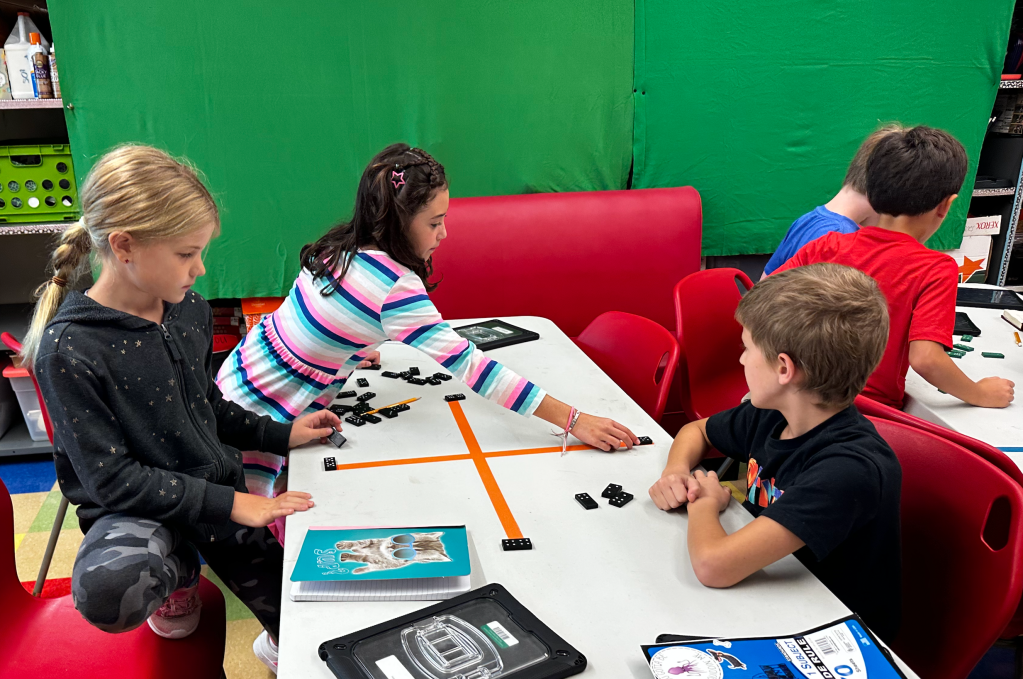
I asked my students, “What is the highest score possible in one play of Dominoes?” I put 28 bones (one whole set) on each table, and encouraged students to move them around looking for the best combination.
This is a screenshot of photos that I used to show students how to connect Bones, adding up all of the ends, and analyzing which Bone would make the best play.
A game of Dominoes proceeds until one player or team acquires 150 points. It takes several rounds to accumulate that many points. During each round the players add Bones (Domino pieces or tiles) to an existing cross of Bones. You have to connect the same numbers, so a 6-4 Bone could not be added to a 5-1 Bone. It could be added to a 4-4 or a 6-6 Bone. When you connect a new Bone to the Line of Play, you add the last number from each end. Your goal is to have a sum that is a multiple of five. Only multiples of five get recorded as points, pushing you closer to the goal of 150; victory.
The first group that I met with are 5th graders. They are still learning the game. I thought that providing the question of figuring out the very best play would create a goal; “This is what I can aim for.” Instead, my students began building towers with the bones and grumbled, “Why don’t we just play Math 24?” Upon self-reflection, I now realize that my word problem was like asking someone who is just beginning to learn how to construct an airplane to calculate how fast it will go. “Dude, let me get the wings on this thing, already!” Ha, ha. Sorry, students.
Before wasting too much time, fostering further frustration, I decided to scrap the 5th graders’ warm up and move on. I made a mental note on the idea of a Math 24 preference, though. This gave me much to think about; More to come on that, soon.
My 4th graders were at their wits’ end.
I didn’t even try the problem with my 2nd graders, who are also novice Domino players. I thought I’d wait and see how my experienced 4th graders, the students whom I taught to play the game last year, would do. These guys would love the challenge, and should have all of the conceptual tools necessary to tackle this problem. They’re the ones in the picture on the Google Jamboard, for crying out loud!
My 4th graders jumped into “Problem-Solving” mode right away. Their biggest hangup was trying to play the game from the beginning. They kept trying to build the arms from the center of the game, forming a cross they way they always do. That won’t work when attempting to find the highest possible score, though. They would have already used the Bones with the greatest number of Pips (that is the technical term for the dots on the Dominoes) on them. Those need to be saved for the ends.
Finally, success!Frustration.Start over, and over, and over, again.
I must have told them to, “Focus on the ends of all four arms. Don’t play a whole game. You don’t need the center of the cross in order to calculate the largest point accumulation possible,” a dozen times. I began to feel like a broken record.
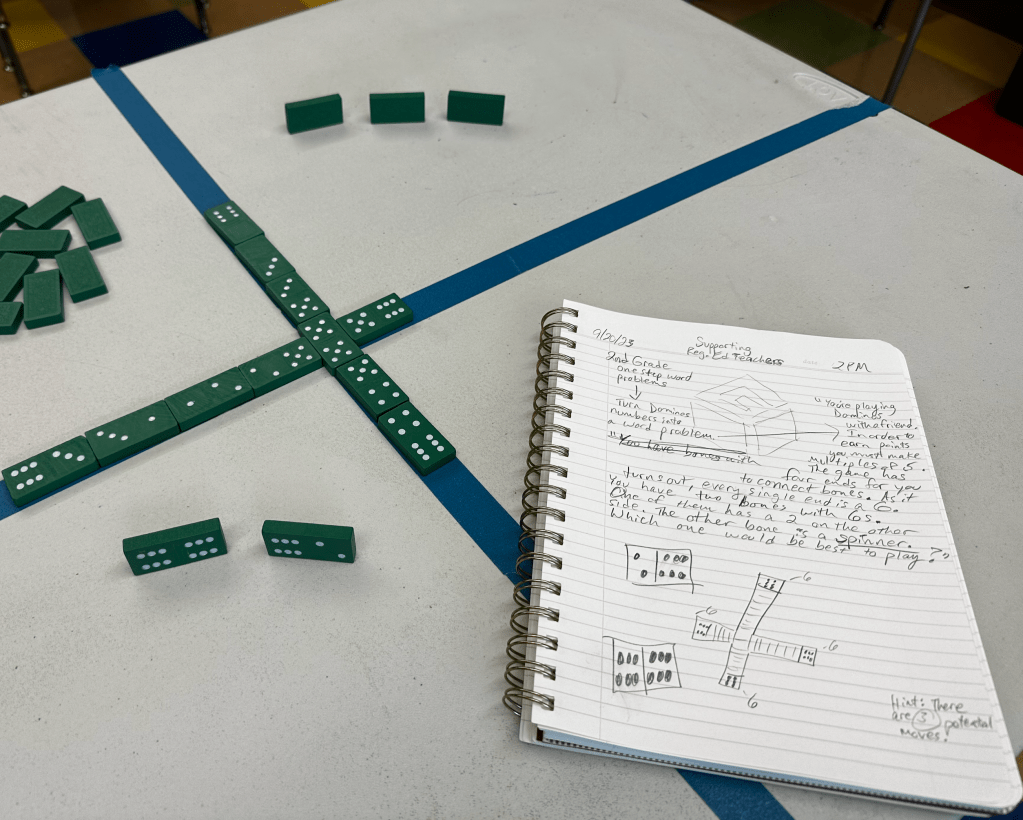
This is a picture of the notes from my journal that led to this “Wonderful Word Problem.” I only focused on the ends of the Line of Play. I’d hoped that this is what my gifted students would do.
Finally, I stopped them and taught them a new vocabulary word: Hypothetical. “This is a hypothetical situation. If you could have the ideal play; The absolute best play ever, what would it be? Don’t worry about what was already played. What Bones would give you the very highest points?”
This is truly Out-of-the-Box Thinking. I wanted my gifted students to leave the box of the game and imagine only the very last play. All previous plays are fog. They don’t matter. You can only see the tips of the Lines of Play, and they have huge Bones… Doubles, every one of them; The highest Doubles, even! Eventually, I had to just tell them the answer.
I had one last group to try out my wonderful word problem. I started the Domino difficulty by sharing with my 3rd graders that the 4th graders could not do this. That got their competitive juices flowing! Next, I did not allow them to put any Bones in the center of the cross. “We are NOT playing Dominoes,” I explained. We are figuring out a hypothetical question: “What if you had an opportunity to make a play that gave you an enormous amount of points? How many points would be the greatest possible in one play of Dominoes?”
Believe it or not, the 5-5 Bone is worth more than the 6-5 Bone, because it can be played differently.
I guided their thinking toward the Bones that represent the greatest numbers. Even though a 6-5 Bone has more Pips than a 5-5 Bone, it does not present the greatest value when played at the end of a line. Why? Because, you don’t add the 5 and the 6 from the 5-6 Bone. Only one of the numbers would be available for adding. However, if you played the 5-5 Bone sideways, you’d have ten. Gasps, sighs, intake of breaths… Doubles were explored. I forced them to put the Doubles at the ends of the lines of tape I’d stuck on the tables to guide Lines of Play.
“Place the Doubles at the ends of Lines of Play.”Afterward, we explored what Bones may have been played previously, working backward from our hypothetical best play.
Letting the 3rd graders figure out answers to my guiding questions, I led them through Out-of-the-Box Thinking. In the end, they felt like they had solved the problem, and they had (with a little guidance from their teacher). Lesson: People can be taught to Think Outside of the Box. It is not necessarily natural.
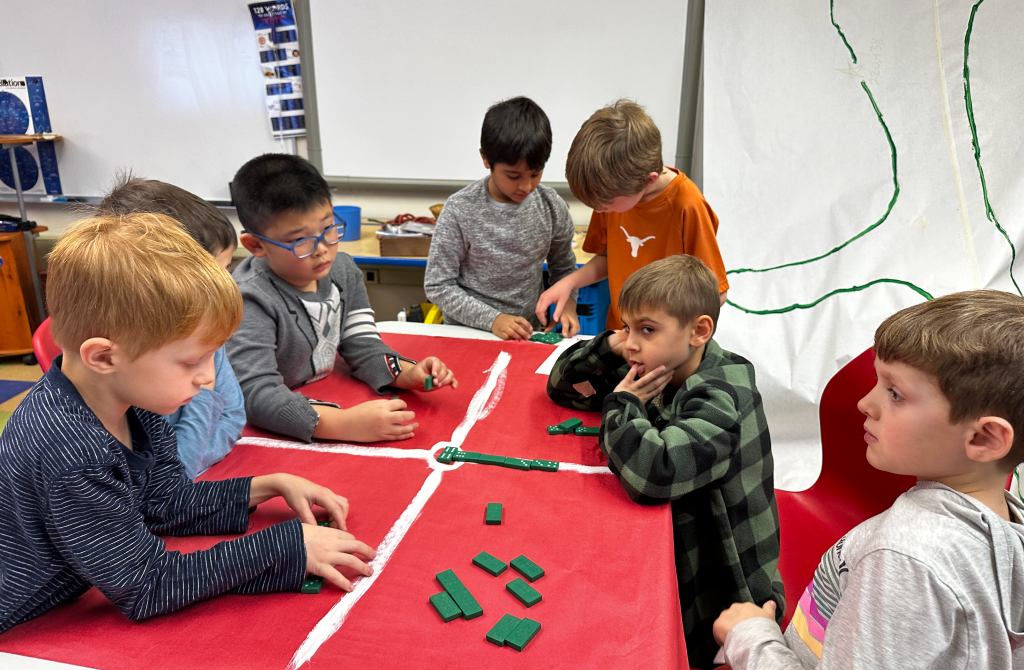
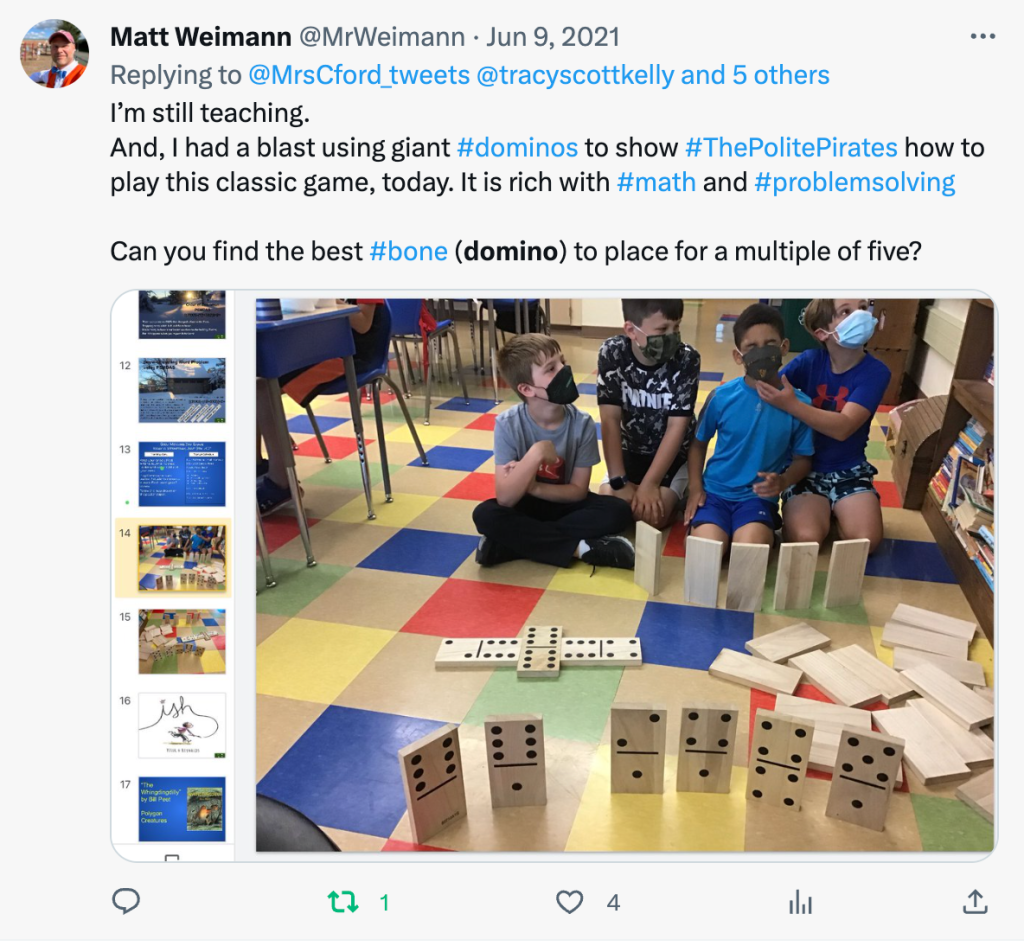
I used to use a giant set of Dominoes to introduce the game to The Polite Pirates (my 3rd graders).
Playing the game of Dominoes is an excellent way to introduce and practice problem solving. I’ve used this game for several years in my 3rd grade classroom, and now I am introducing it to my gifted students.
This past week was the first week that I met with my elementary (K-5) gifted students. Obviously, the various grade levels were in different places when it came to math concepts. Second grade is working with word problems. Third grade will be tackling multiplication soon. Fourth grade is focused on geometry right now. And, 5th grade is preparing to use formulas to solve for volume.
Dominoes can be used to introduce multiplication, using cumulative property, strengthening mental math, not to mention strategic thinking.
Tuesday morning’s second grade gifted lesson began with my typical introduction to Dominoes. I told the students that each tile is called a “Bone” and the pile of unused tiles is the “Boneyard.” They learned that there are always 28 Bones in a game, and that every single Bone is different. Each one has two numbers on it, even the ones that look empty! “What number is on this side?” I asked holding up a Bone with a six on one side while the opposite was blank. They didn’t skip a beat in guessing “Zero.”
It took a little longer to explain adding the ends of each Line of Play. “You add up any number that is at the tip of an arm, no matter how long or short the line is,” I told them. We practiced some play. The adding wasn’t a problem. We discussed using the cumulative property to switch up the order of numbers, so that the mental math was easier. “Look for combinations that create ten,” I told them. “Rather than adding 4 + 5 + 4 +2 equals fifteen, combine the 4, 4, 2, first. Then you instantly know that the five makes fifteen.”
I let students draw and write on the Google Jamboard to show and explain their thinking.
“Points are only awarded when the sum is a multiple of five. The ends of all of the lines of play add up to ten. Is that a multiple of five?” They knew that ten was made up of two fives. “How many fives are in 15? 20? 50? 500?” Flawless computation… Multiplication, here we come!
“Whenever you earn points, you say, ‘Give me ten…’ or however many points you earned.” I learned this from a fun video that taught me how to play ages ago, and elementary students LOVE this aphorism.
“Give me ten!” one of my second graders beckoned. I put 10 on the board, and we played a couple more sets before moving on to our Self Portrait project. Even though I only have my gifted students for 40 minutes at a time, I found doing more than one mini lesson to be helpful in keeping their interest.
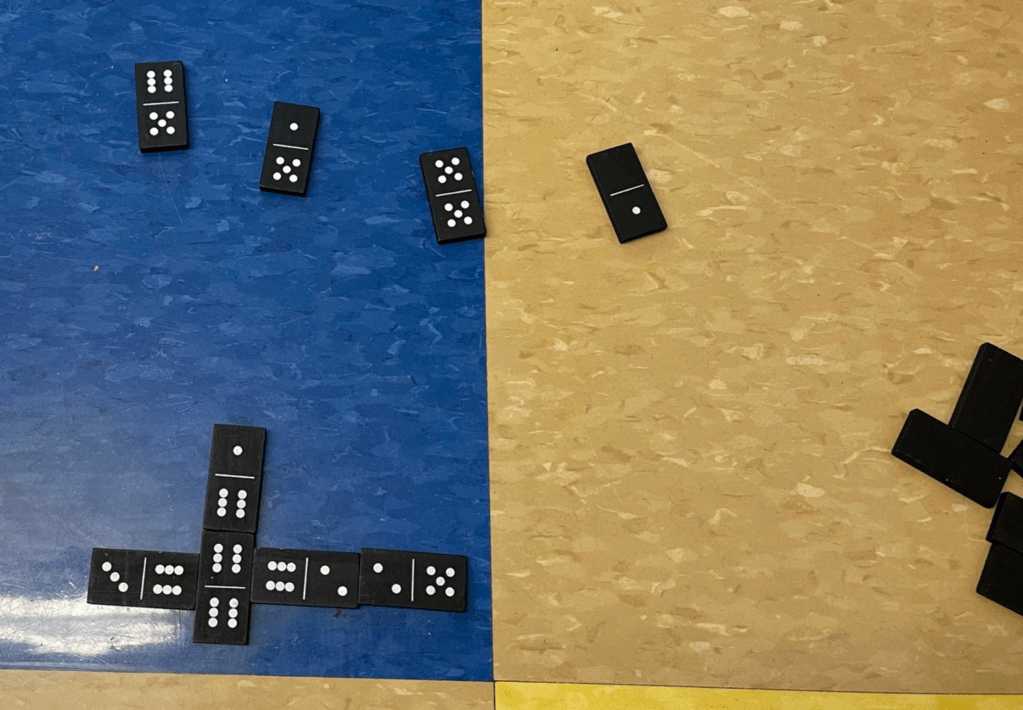
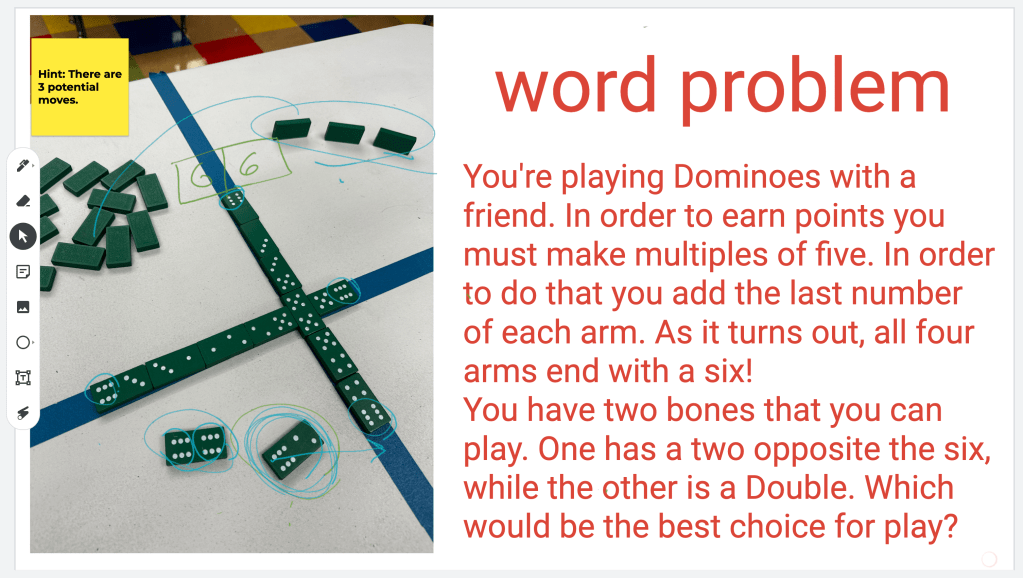
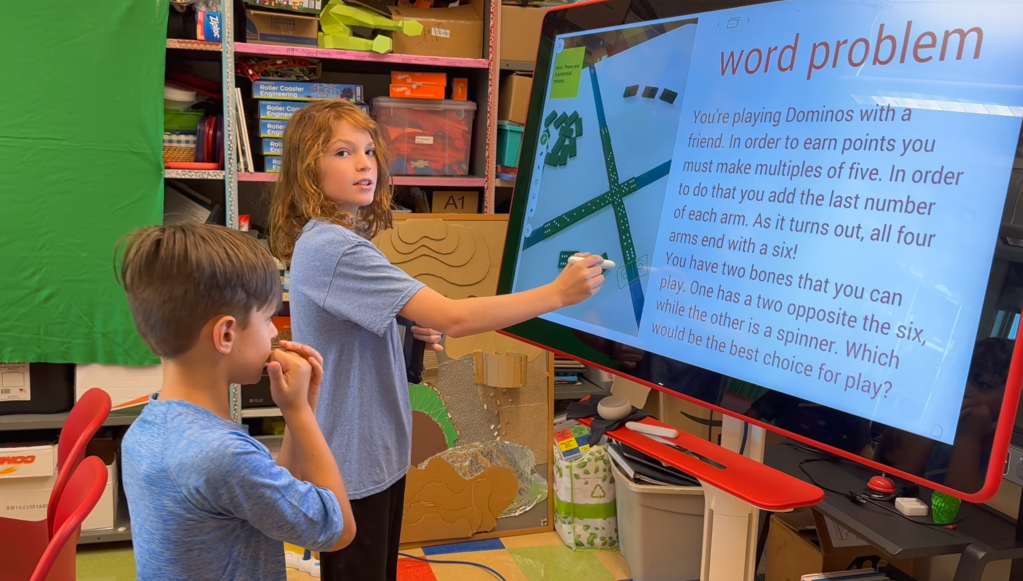
After school, I came up with a word problem for Wednesday using Dominoes. I typed it into a Jamboard. Even though I tried to word it in such a way that you could visualize the game in your mind, I went ahead and used Domino tiles (Bones;) to make a model of the hypothetical game on a table and took a photo. I imported the picture on the Jamboard slide with the word problem text.
I snapped this pic, so that I could show my students the thinking behind their word problem. I am hoping to inspire them to use their “Gifted Journals” to jot down ideas through drawing diagrams and writing notes just like this.
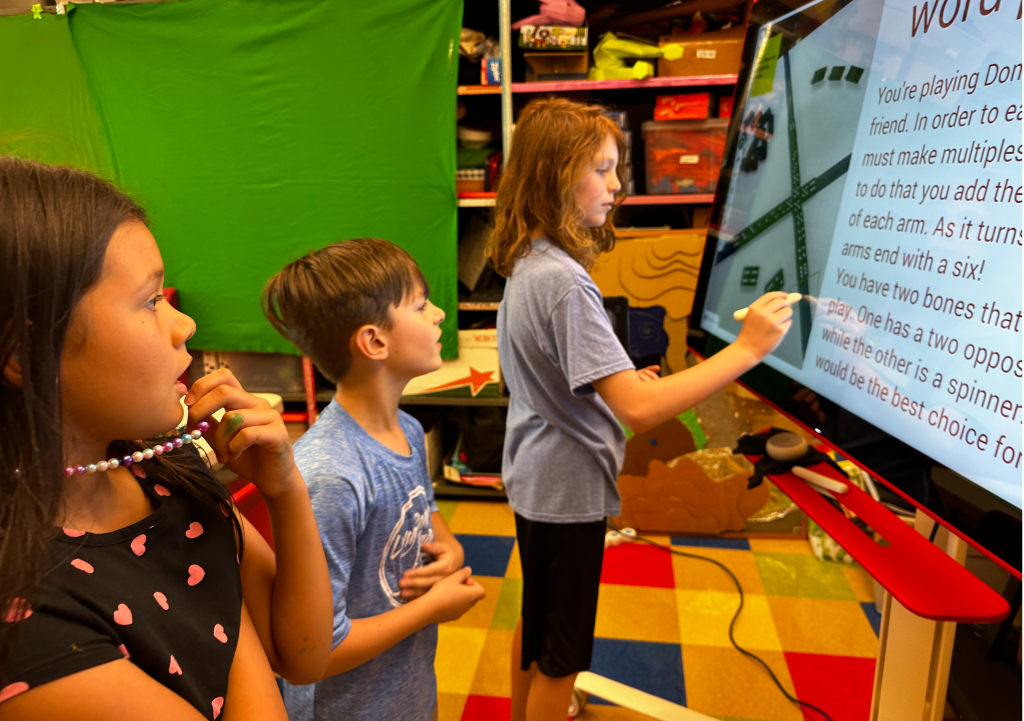
When Wednesday arrived I was excited to try out my word problem. The first group of students that I met with was 5th graders. Because I do car duty, I get to my room at the same time as my students. This morning I had placed a note on the open door, instructing them to try to work out the answer to this problem while they waited for me to show up. The word problem was presented on a giant Google Jamboard that I’d rolled in front of the entrance to the room.
The group was crowded around the screen when I got to my room. I enjoyed listening to their discussion of possible moves. From what I heard, a couple students were aware of the general concept of matching numbers. They didn’t quite understand adding all of the numbers from the end of each line of play, but that was okay.
When one of the students decided the trick to solving the problem was to simply take a new Bone from the Boneyard, I invited the 5th graders into the room. Before talking Dominoes, I praised their persistence and told them that I was proud of how hard they worked. I purposefully pointed out the failure to solve the problem as an example that not everything will come easily to them. It is my job to come up with challenges that stretch their thinking, and I intend to make not only their intellects but also grit grow.
My 5th grade gifted students experienced something new this morning: bewilderment.
As I explained the solution to the puzzle, I used it as a teaching tool. When I informed them on how the points work, they noticed that placing the Bone with the two on one side at the end of one of the lines of play would bring the total sum of all of the arms to 20, a multiple of five, and thereby an opportunity to earn points. “Good. But, there is a third and less obvious option,” I told them. “This one,” I said, pointing to the Double that had a six on both sides, “Is a Double. It is special. Not only can you play it with one six touching the line of play (also a six), but you can set it perpendicular to the line, thereby creating an extra arm.” I waited for someone in the group to notice the new sum.
It didn’t take long for a fifth grader to notice that all of the sixes add up to 30 points. “Turning the Double on its side, created a fifth number to add. Since all of the numbers were the same, you can’t help but have a multiple of five! It is literally five of the same number.”
I tried the word problem on my daughter Scarlet who had a brilliant reason for using the Double instead of the 2-6. In addition to the points, you would cause your opponent to have to take from the Boneyard, because chances are they won’t have a six. Limiting their options was very strategic thinking. I shared this strategy with my 4th graders who already knew the game well.
Next, it was 2nd grade’s turn. These kiddos had just learned how to play the game for the first time the day before. I used the word problem to reteach some of the ideas. More than focusing on problem-solving, I walked my second graders through the mechanics of writing a word problem. We discussed the details of Dominoes that I included in my little story. “Why did I mention multiples of five?” I prompted. “The goal is to earn points.”
I had toyed around with the idea of only having words. When I originally crafted the word problem, I didn’t have the Dominoes laid out on a table. I tried to provide just the right amount of text for students to be able to visualize all of the details necessary for solving the problem in their heads. At the last minute I decided to include a photo with the problem. This was only the third day I was teaching these students! Watch out, though. Word problems, here we come!
Pride flooded my person when fourth grade arrived in my room and crushed this problem within seconds. I’d taught all but two of these students how to play Dominoes last year. When I saw how quickly they solved the puzzle, I wished I’d hidden the photo.
I pointed out the verbiage at the end of the word problem. “Why is it okay that I didn’t say what numbers were on the Double in the word problem?” I asked them. I had left out this vital information on purpose, and I wanted to see if they could find the puzzle within the puzzle. I did this kind of trick with them all last year. They understood that it had to be two sixes because the word problem stated that “You have two bones that you can play.” If the double were any number other than six, you couldn’t play it.
Here’s a question I failed to float: “Is it possible that the player has more than two Bones?” And, this is where a photo is limiting. Because you can see only two Bones on the table, it is difficult to imagine there being more than two. But, yes, the parameters of the problem leave that detail open. You have two that are “able to play,” but you may have more. I’ll have to work that riddle into a future problem!
My last group of the day was third grade. Here, I used the word problem differently. After exploring the numbers and solving the puzzle, plus revisiting how to play the game, I drew their attention to the structure of the word problem. It was a story, providing characters (you and a friend), a setting (a game of Dominoes), and a conflict. “This word problem has a plot,” I pointed out. (Plot is the language arts concept that third graders are learning right now.)
The problem of which Bone to play is the climax of our story. The resolution is a mystery. You could use either Bone. Which one is better? What is the third, less obvious option? How will the story end?
And, this is the end of my blog about this amazing word problem. But, is it? Through the process of fleshing out the many lessons that coated these Bones, I have come up with some additional puzzles. Here is a taste: “What is the highest score that can be collected in one play of Dominoes? What would the Bones look like at the ends of each line of play?” I think I’ll provide manipulatives; Bones; for pupils to push around when solving this. Good luck!
At the beginning of each school year I introduce a few fun games that encourage number sense and problem solving. Dominoes are great for mental math, recognizing patterns, and teaching multiples of five (Playification). Another favorite is Cribbage (First “How-To” on Cribbage).
Polite Pirates problem-solve in pairs
Cribbage is a card game that has two parts. I’ve written about the first part, the one that requires players to analyze their hands and decide which cards to keep and which to place into a crib.
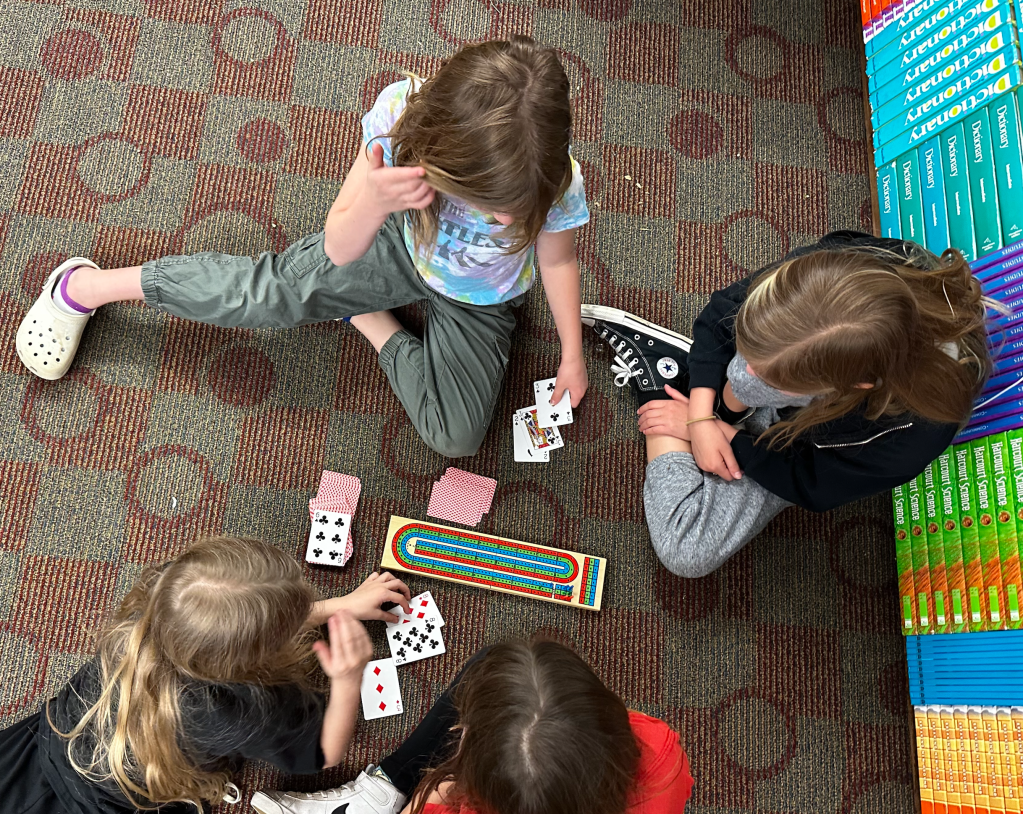
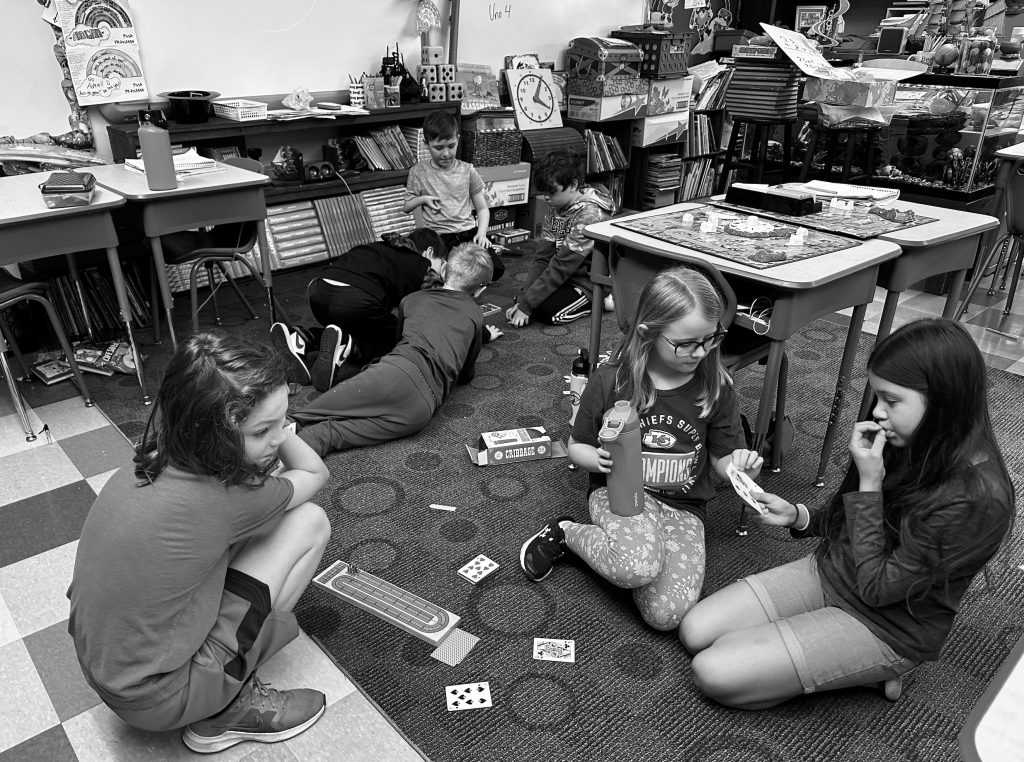
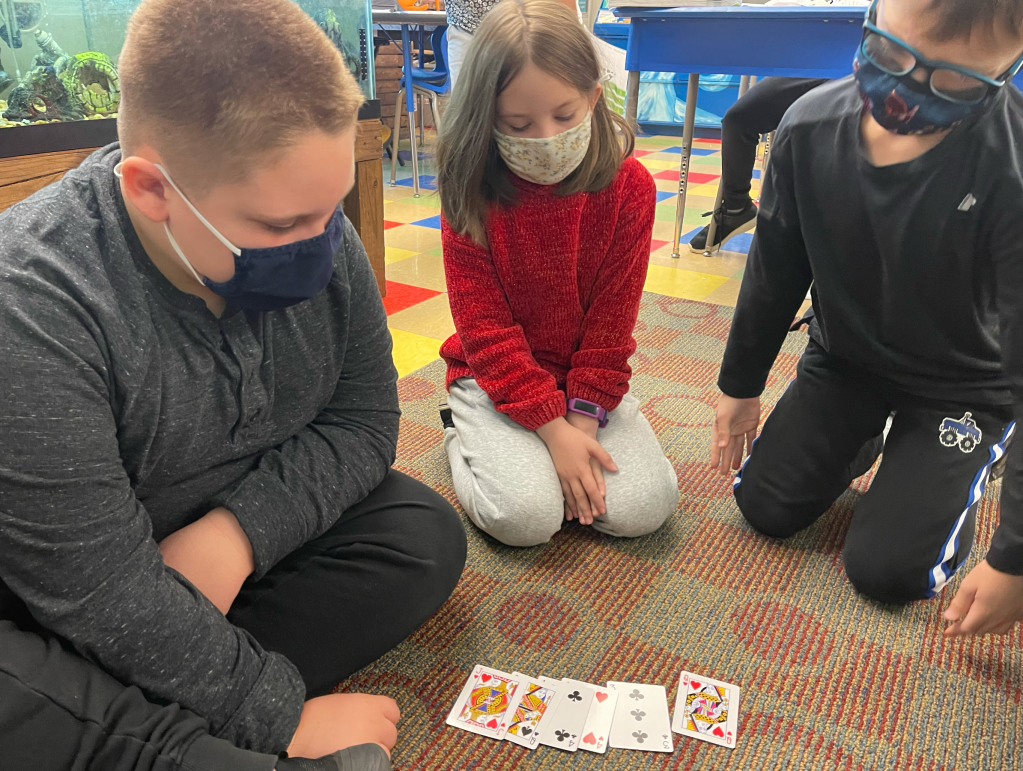
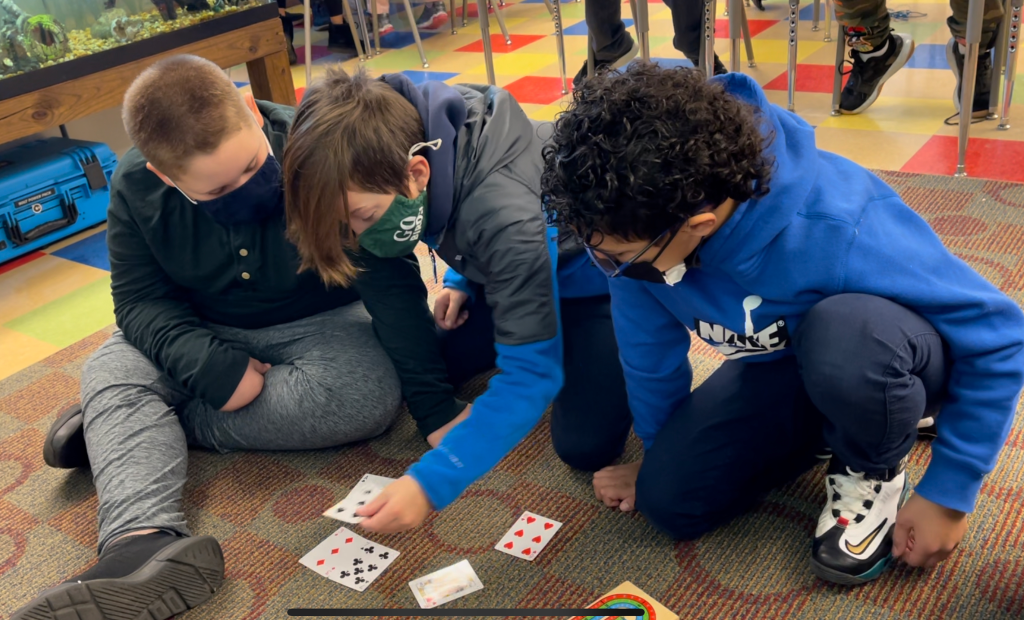
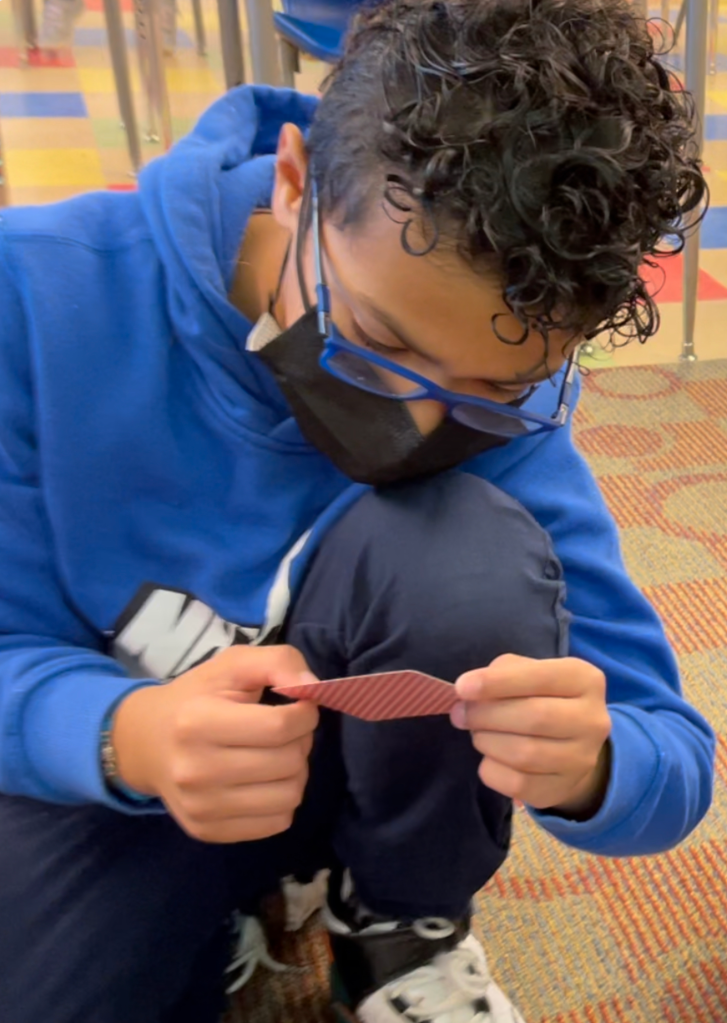
During Math Centers, I have students work in teams of two or three to figure out which four cards of a six-card hand will generate the most points. Every student is very attentive, because if a team misses any combinations that provide points, and a student from another team can articulate the potential point-producing combination, this other student gets to claim the points, virtually stealing points from one another. They love that!
The “Starter” is placed face up on top of the deck and shared by everyone.
After a little practice with this, I explain cutting the deck to provide a “Starter” card. This card gets placed face up on top of the reassembled deck and is also used for making point-producing combinations at the end of each round. The Starter is shared by every team and the crib. Now, when students decide which cards to “lay away” for the crib, they should keep in mind the idea of collecting those points later, if the crib is theirs, or potentially providing points for opponents. Students practice mental math and problem solving for a few more Math Centers.
Once my students are well-versed in how to choose the best cards to keep, it is time to learn how to actually “Play” the game. There are loads of rules to learn and remember, but what makes it fun is that nearly everything you do gets you points! When teaching the Play, be sure to peg points. The kids get super excited with each and every point.
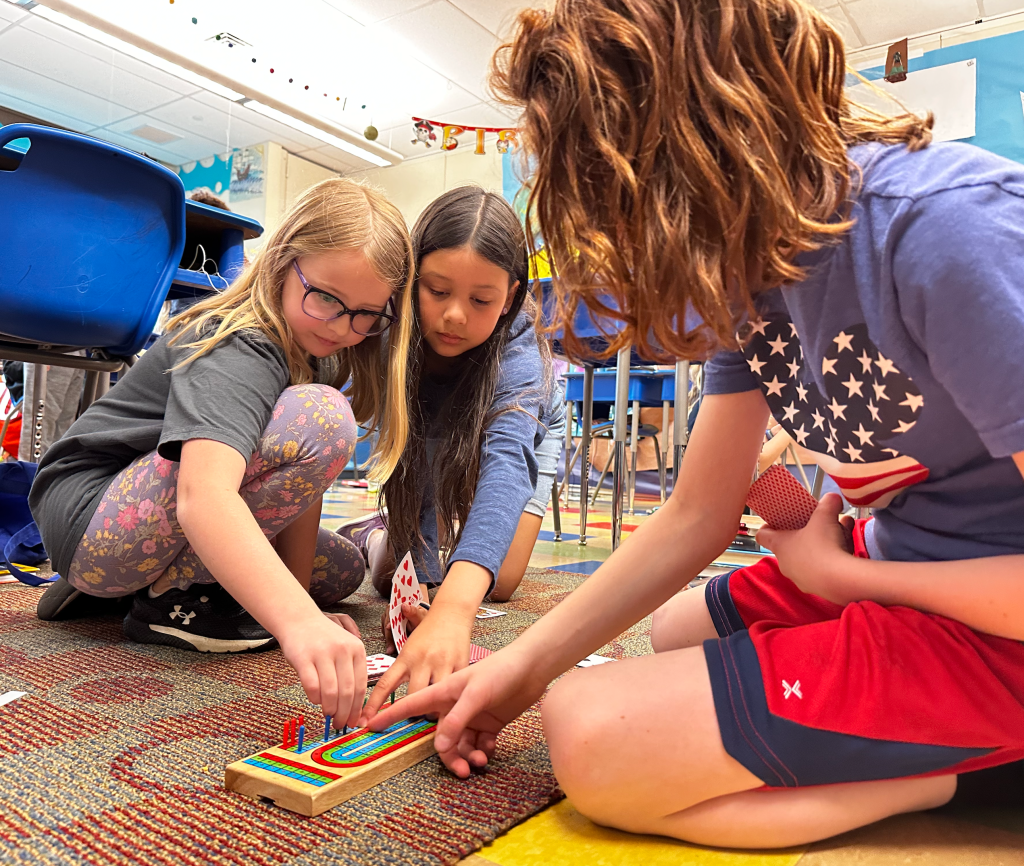
Polite Pirates help one another count points. The holes are marked in increments of five, so math can be used even while pegging your points!
The first thing I show students is how to hold their Hand. This is new to some nine-year-olds. They have to hold the cards they’ve kept because we place one down on the table or floor at a time, and you don’t want to get them mixed up.
Something unique to cribbage is that players (teams) will recollect their cards in order to calculate the points their hand is worth when Play is over. For this reason, have students place the cards that they are playing right in front of them; separate from other players/teams.
Next, I explain that, during Play, we add up a running tally of “Pips.” Pips are the symbols on the playing cards. A “Five of Hearts” has five pips or hearts on it. Each face card (Jack, Queen, and King) are worth ten pips in cribbage. An Ace is valued at only one pip in this game. It is very useful; Hang on to those! (Here is a very interesting blog explaining pips and the symbolism of cards.) As students place one of their cards face up on the table or floor, they don’t say the number on the card. They announce the new sum of all of the face up cards. So, if a King had already been played, and that player (team) voiced “Ten,” and then I play a Two, I will say “Twelve” out loud. If the next player (team) places a Three face up, they will say “Fifteen” out loud, keeping a running tab on the growing tally of pips.
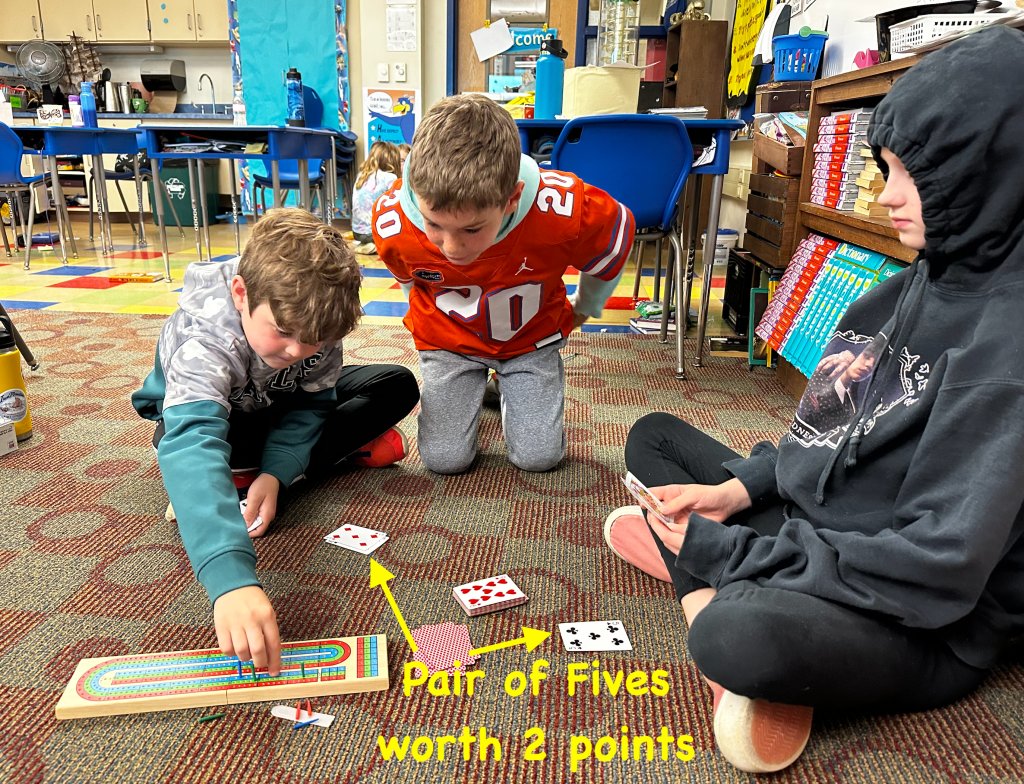
The player or team that plays the Fifteen is rewarded Two Points on the cribbage board. You get points during Play whenever you form a combination of Fifteen, a pair, three or four of a kind, and/or a run. These point-producing combinations are similar to what students were looking for when deciding which cards to place in the crib and which to keep. But now, students are forming them with the help of their opponents’ cards.
Let’s say two Queens have been played. The player who placed the second Queen on the table or floor will be rewarded two points. If a third Queen gets played, the person (team) that played it will get six points, because it forms three pairs.
Similarly, when a run of three or more cards in consecutive ascending order are played in a row, the player (team) gets the number of points that represents the number of cards. In other words, if a Ten, then a Jack, and lastly a Queen were played in a row, the person (team) that played the Queen would get three points.
During “Play” the pips can never exceed 31. This is the magic number of cribbage play. As players are placing cards face up and voicing the running sum of pips, they are mindful of what cards they have left to play. The closest to 31, without going over, gets a point. If you can play a card to make the Play value exactly 31 pips, you get two points. As the Play gets close to 31, if a player (team) does not have any card to play that would keep the play under 31, they say “Go.” This is when the other team gets a point. That team must play any cards that they can, keeping the tally under 31. They can collect points from pairs, runs, and even score two points for making exactly 31.
At this point, all of the cards that have been played get turned over (facedown), so that they don’t confuse the players during the next Play. The player (team) who said “Go” during the last play starts off the new play.
Once all of the cards have been played, and a point was awarded to the player (team) who plays the “Last Card,” it is time for each player (team) to gather up all four of their cards and get points for their individual hands. (Here is a website to reference for points.)
This we do one team at a time. The dealer goes last. The crib is counted separately, and that is the very last thing to be tallied. It’s important to count in this order, because whoever reaches the end of the cribbage board first, regardless of how many points are in a hand, wins. In this way, you may not want to be the dealer if a tight game is nearing the end!
I hope this blog is helpful for learning how to teach cribbage to students. One of the many benefits of learning this game is the cross-generational play it opens up. It was one of the first games that I was able to play with the “grownups” during holiday celebrations and vacations. My dad told me about a league he played at his Senior Center in Massachusetts. One thing that he complained about was how fast those games were. It was too much pressure.
That being said, you might want to put timers on for students, in order to keep the game moving. Also, you could have a timer for the whole game; Whoever has the most points when the timer goes off wins! Have fun!
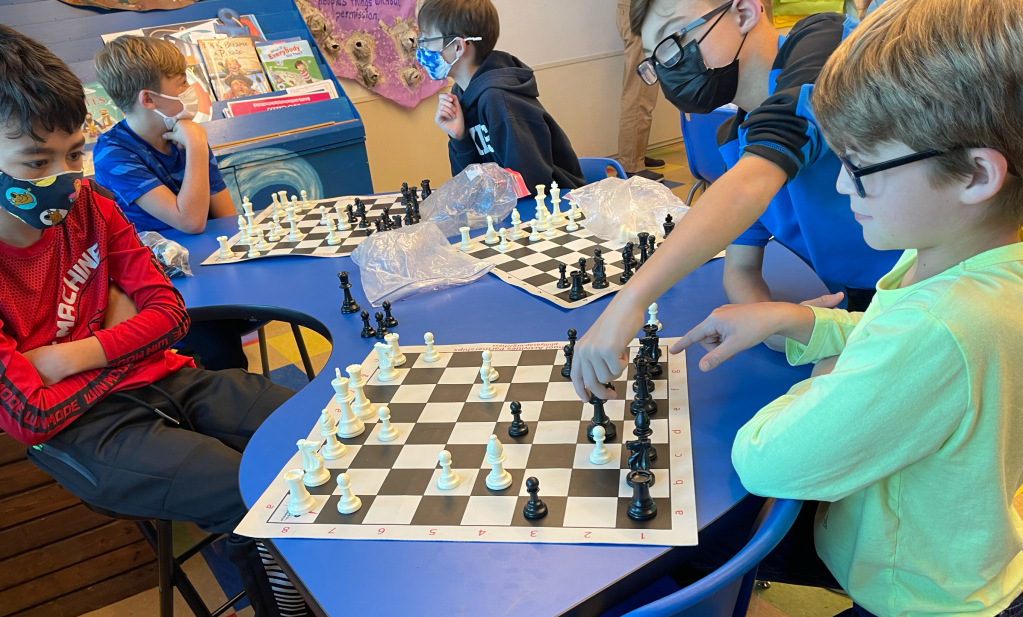
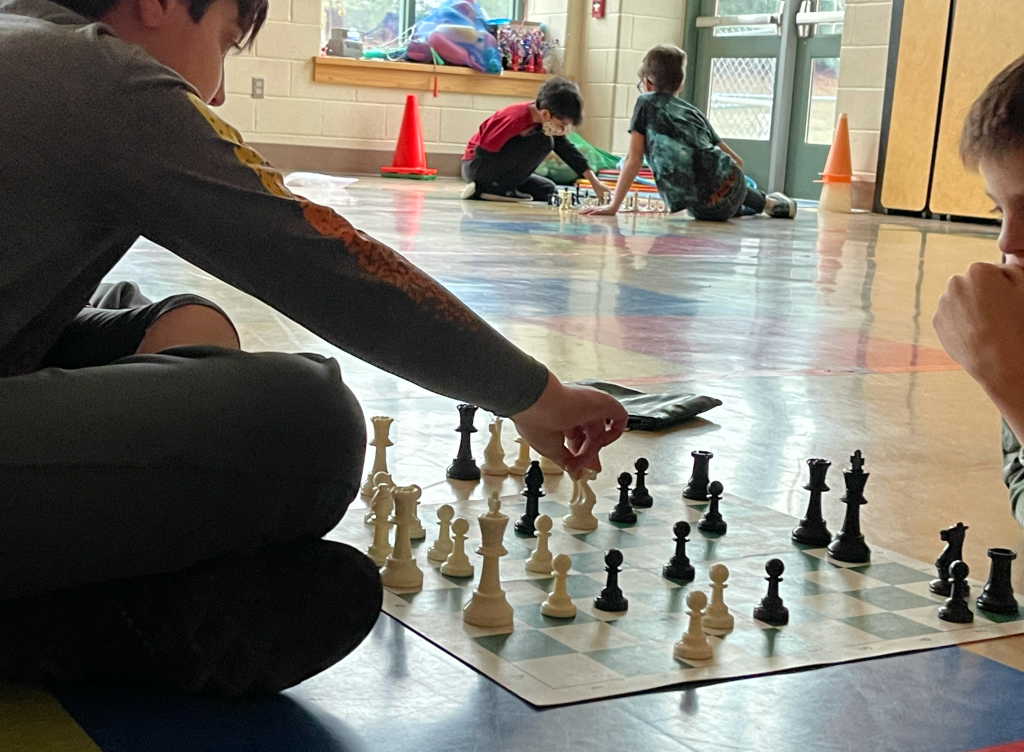
I’d like to invite you to join the Willow Lane Chess Club kids for a game or two of chess. “But, I’m not good at chess,” you may say. This might sound weird, but you are exactly what we are looking for! The purpose of this event is for the Willow Lane Chess Club to show off its skills. We want to impress you with our knowledge of the game and ability playing it. The less you know of the game, the more impressed you will be when witnessing our skills. Also, as discussed in a previous blog, playing and losing to children is empowering (for them;).
This event is the very first of its kind. Grownups are being invited to join the chess club from an elementary school; these are 9 to 12 year olds; during their regularly scheduled last club meeting. We have been meeting every other Tuesday all year. Students have learned how to move the pieces, win the game with checkmate, use tactics like skewering, pinning, and forking, as well as practicing with game after game. Each club member has played nearly every other one, and it is time to put our skills to a new test.
Parents who attend will view not only their own child’s chess-playing ability, but that of their peers. The adult who is willing to sit down with a preteen and potentially lose at a strategic game like chess is a giant in humility and a god of empowerment. Students will become giant killers of fear, apprehension, and insecurity when they survive a chess match with people they view as all-powerful. Even if a child does not win, being able to play with dignity and hold one’s own against an adult will help raise a child up in their own perceived self-worth.
If you think that you are too good at chess to join us for this day of play, I have two things to say to you. 1. Let’s see. And, 2. Please share. First of all, we have some pretty competitive kiddos in our Willow Lane Chess Club. If you are game, come on down and show us your stuff. Perhaps you crush our top players. Good. That will teach them some humility and show them how much they have yet to learn. If they give you a run for your money, all the better. Growth through challenge is strength. Secondly, we would greatly benefit from experiencing high-quality play. You could show our students some playing techniques and strategy that will help them in the future. The model of your play will give them something to strive for.
With the simple goal of showing off our skills, this ought to be a fun afternoon of gaming. Adults will be able to play a few kids. The winners of matches will NOT be recorded. This is NOT a tournament where only a few players sift to the top of a pyramid. Rather, it is going to be an hour of playing a FIFTEEN-HUNDRED-year-old game, minus the stress of game clocks, notation, or elimination. Even if you don’t know how to play at all, come and learn. If you have well-behaved children you are responsible for, bring them. They may be inspired. Don’t let anything hold you back from this extraordinary event.
Mark May 24th down on your calendars. Sign up on signup genius. Invite other grownups. And, prepare to be wowed by the students of Willow Lane.
(Part 1 of obviously more than 1, but not sure how many just yet;)
With the winter holidays approaching, I wanted to prepare The Polite Pirates (my students) for being stuck in the house with “nothing to do.” While I’m not against video games, I think it’s wise to have some alternatives.
Hands-on games that promote thinking and problem solving are my favorite to teach and play. Chess and Dominoes are begun early on in the year. Now, it’s time to break out the Cribbage board.
The fact that there are tiny pieces that could easily get lost makes the unpackaging mysterious and exciting. The board looks interesting, and young students can’t wait to get their little fingers on those tiny pegs! This affords a concrete reward for paying close attention and practicing the game well.
Teaching Cribbage to children requires a scaffolding approach. There are many rules and ways to acquire points. They must learn all of these before earning theprivilege of placing pegs on the board. This motivation helps keep them interested and focused.
Analyzing combinations to find potential points.
After showing and modeling the board just enough to wet their appetite, I explain that the first part of the game is all about analyzing your cards. You must decide which cards to keep and which ones to discard (They go in what is called a “Crib,” but we don’t worry about that at first). First, I model, looking closely at 6 cards. Leaving out the idea of runs, I explain that we are looking for pairs and combinations that make 15. With only these 2 criteria, we work on adding up card values and counting potential points.
[A couple of things to keep in mind: Aces are always valued at 1 in Cribbage, and face cards are all 10. Also, and this is fun for teaching the point system/using combinations, three-of-a-kind is 3 separate pairs, totaling 6 points (2 points per pair).]
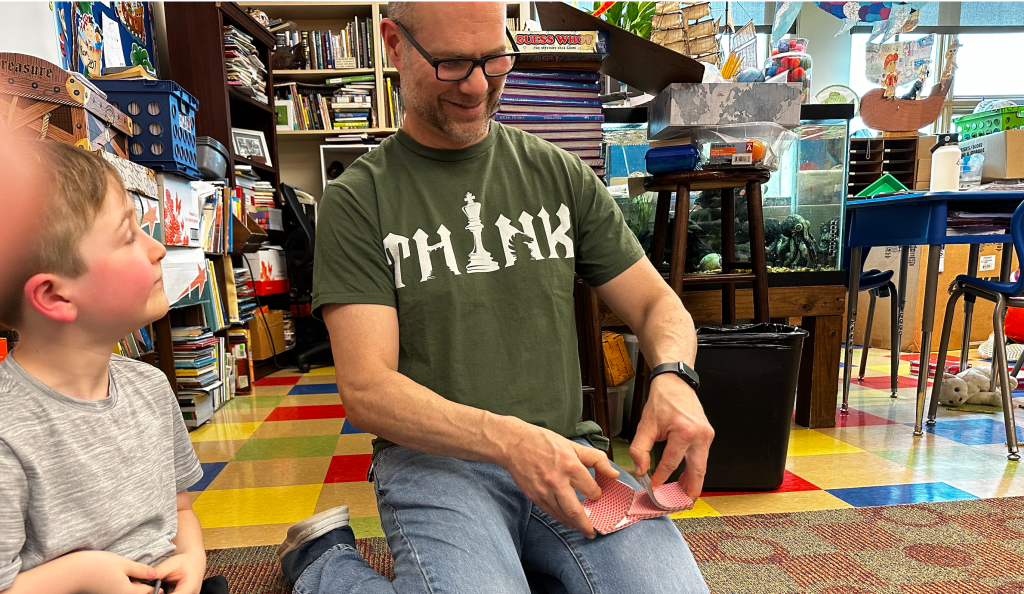
Shuffling between rounds makes it feel more like a card game than math practice.
After modeling making wise decisions regarding which card combinations make the most points, I have students try. In groups of 3, I give kids 6 cards to puzzle over. I always shuffle the deck between every “round.” This makes it feel more like a card game and less like math practice.
If interest wanes at all, you could move the pegs on the board. That will get kids into looking for as many points as possible. Also, you could suggest that if one team sees points in another team’s cards that were not discovered and therefore not counted, the team that discovered the missing points gets them!
In other words, you have Team A and Team B. Each team gets 6 cards. If Team A only found ways to earn 4 points, but when they show their combinations, a player from Team B notices an additional way to make a combination of 15 that Team A failed to see or mention, the sly individual from Team B who uncovered the extra points gets them for their team (B, not A). This keeps everyone on the alert.
Notice that the students have to use “math discourse” to share what their cards provide. They do this to prove that they deserve the points they are claiming. It allows every player to perform backup mental math.
This exercise of looking for combinations of 15 will continue in this way for a week or two. Once students have grasped all of the ins and outs, you can introduce “The Starter.” This card is pulled from the middle of the deck after the cards have been dealt. It is placed face up on top of the pile of leftover cards. Students now have one more card to consider when choosing the 4 cards that they will keep. The Starter is static, staying on top of the deck and being used by all teams.
If you are interested in enriching the decision making process, tell the students that one team will actually get the cards that you discard. The two cards that each team gets rid of go into a “Crib” that the dealer uses to make points at the end of each round. This means that, in addition to trying to figure out what combinations of cards will afford you the most points, you want to keep points out of the hands of others. Don’t gift the dealer with good combinations. Or, if you are the dealer, you can feel comfortable placing a pair or good combination into the Crib.
Students practice skip counting by twos.
A way to differentiate for your students who are continuing to make progress but could use some help is providing a chart of addends that form 15. You could also have manipulatives or base-ten boards/charts for students to make 15. Make a lesson of looking for tens and fives in number combinations.
In #Cribbage you start with 6 #cards Keep 4; place 2 in “The Crib.”
Combinations of 15 get 2 points, each. And, pairs get #points.
After teaching #ThePolitePirates this, students analyzed hands, deciding which 4 to keep.
Just as I would have The Polite Pirates practice for a while before introducing further ideas, I will end this blog right here. Playing with numbers, considering the value of combinations, analyzing which cards should stay and which ones should go, students will enjoy the randomness of shuffled hands. “Cribbage affords players both the anticipation of the luck of the deal as well as ample opportunity to exercise their skills in discarding and play” (Bicycle blog).



























 The Captain of Class