“Nine, ten, jack… Who’s ready for their next cribbage hack?
“Seven, six, five… The run has arrived.
“One, two, three… That many points are for me.
“Three, two, ace… No need to race.
“Pairs, fifteens, runs… Let’s have some funs.”
Each of the preceding phrases, I utter in a sing-song, performative cadence for my students. The next one begins with the same lilt, but ends flatly on purpose. I’m poking fun at my awful poetry. “Okay, enough of that… (And then, in a flat tone) Everyone get out something to write with.”
Before proceeding, I have my students prepare to take notes. “Not only am I going to teach you a new way to earn points in cribbage, I’m going to introduce you to some valuable vocabulary,” I tell them. “Some of you may even be inspired to make up your own rhymes before we are done.”
While I’m waiting for students to ready themselves, I might write the three underlined words in the following sentence on a display board.
“Three or more cards in consecutive order, regardless of suit, constitutes a run, and is worth the number of cards you have in the run.”
Before getting into the vocabulary, I explain, “The new way to earn points is called a run. Many card games include this way of combining cards. Cribbage has some unique attributes (characteristics) that I want to explain. Let’s go over the definition of a run that I shared with you. I want to make sure that you understand some vocabulary. And then, I have one more for you…
“The word consecutive means one right after the other, in order. Here are some examples: January, February, March… a, b, c, d, e, f… Tuesday, Wednesday, Thursday, Friday… 3.1415926535…
“What is the opposite of consecutive order?” I quiz my students.
“When you miss or skip something,” someone offers.
“That’s right,” I affirm. “In cribbage, you get points for every card that you can line up in order, as long as it is a collection of three or more. This is called a run. It can go forwards or backwards; one, two, three; or three, two, one.” To sum up I tell them, “Consecutive means continuous order.”
Next vocabulary word. “Some games require all of the cards in a run to have the same suit; They all have to be of the same symbol. Every card in the run has to be hearts, diamonds, clubs, or spades in order to earn any points. Not cribbage. I told you, ‘Regardless of the suit,’ if the values flow in order without skipping a card, it’s a run.
“What does regardless mean?”
This question may or may not generate accurate answers. Students have most likely heard the word before, but it might be hard to put into words.
“A good way to figure out the meaning of a word is to try replacing it with other words or phrases that you do know. It’s almost like playing your own fill-in-the-blank game.”
It could work well to have the original definition of a run available to read, as I reshare it. It might be printed on papers that students can use to take notes. Or, it could be projected onto a wall.
“Three or more cards that don’t skip order; that replaces the word consecutive; even if they don’t share the same suit, make a run.
“To regard someone or something means to pay attention to them/it; to consider or think about them/it. To hold someone in high regard means that you admire them. Someone telling you, ‘Pay no regard to the person hiding behind the curtain’ would be suggesting that you pay no attention to the hidden individual.
“Unlike some other games, cribbage does not limit runs to consecutive cards sharing the same suit. In fact, you can disregard the suit altogether.
“The main thing is that the cards flow in consecutive order. The suits do not matter.
“The last vocabulary word within our definition of a run is the word constitutes. Honestly, this word is too formal for our purpose, but I like it; maybe because it rhymes with suits.
“Does anyone hear a word within or related to constitutes when I say it?”
I’m aiming at my students connecting the word constitution to this new vocabulary term.
“To constitute something means to create, initiate, develop it; like establishing a law. If you wrote a list of laws down on paper, had several important persons agree to them, and had said personages sign their names to the collection, it very well may be considered a constitution.
“In summation, a group of three or more cards that flow in order consecutively, no matter what suit they have, would be considered a run and will earn you the same number of points as the number of cards in the run. Everybody got it?”
Yup.
“Let’s practice. Say you have a hand of ace, two, three, and four.” I purposefully show students an image or actual cards of varying suits. “Is this a run?” I wait for confirmation. “Good. How many points?” Four. Easy. “Good. What if the starter is an ace? Now, how many points do you have?” They may say eight, which makes sense, because you have two runs of the same number of cards; four times two equals eight. However, you now have a pair of aces!
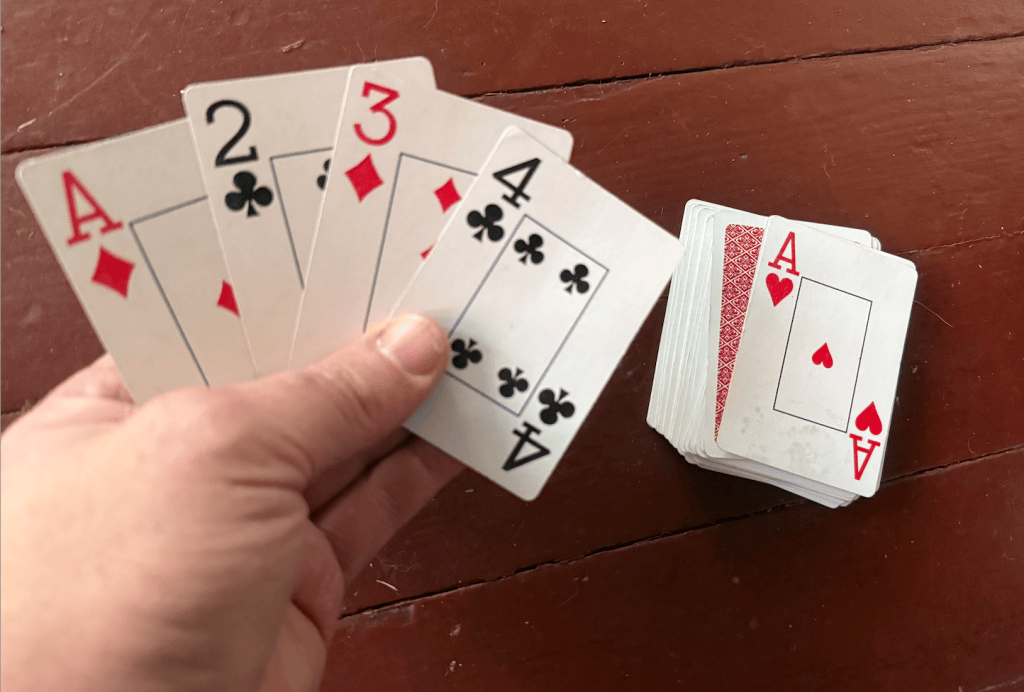
“If you thought that your hand now constitutes eight points, you would be mistaken.” Guys and gals ought to guffaw at this. “What about the pair of aces? Someone ought to call, ‘Muggins for two’ on you!” Polite laughter at my rhyming and legitimate entertainment at the idea of stealing two points.
“Remember your muggins?” Yes. “What if, instead of an ace as a starter, you have a five? Look closely. How many points are represented in your hand?”
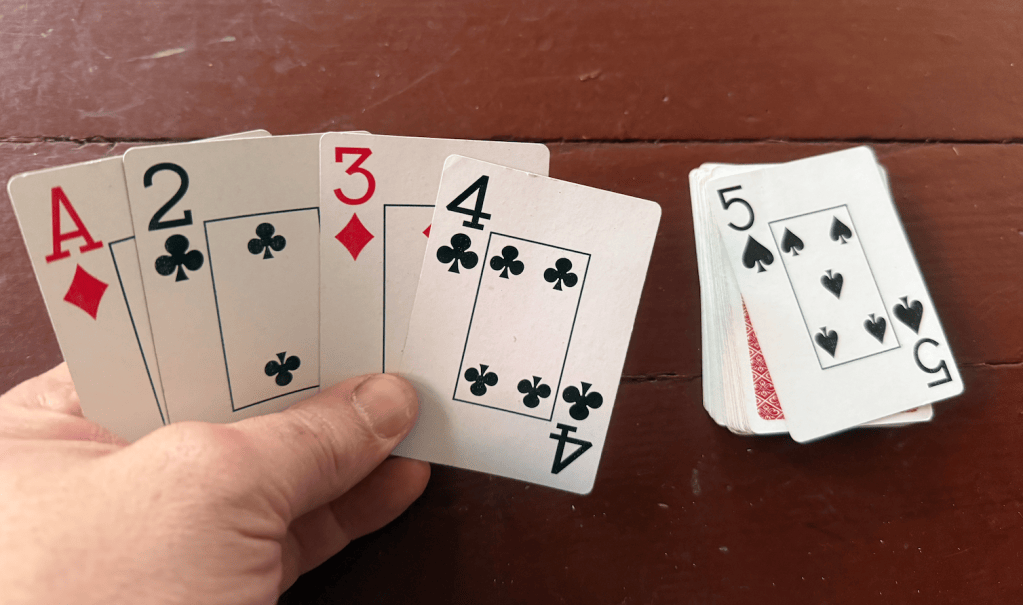
The correct answer is seven. “There aren’t any pairs this time, but there is a… fifteen for two! The run totals five points, so you say, ‘run for five.’ Then you add up, ‘Three and four equals seven, plus the ace and two which is another three, equals ten. That, plus the starter five makes fifteen… for seven.” This is how a person playing legitimate cribbage would count out points. Personally, I like doing the even numbered skip counting before adding odd numbered runs, but when there’s only one two, it doesn’t matter. Both ways are legal play. It’s just a matter of making sure you don’t miss anything.
Practice
At this point I will have students practice identifying runs, pairs, and fifteens with a little game I made up. Each student in a small group is dealt the same number of cards. A starter card is placed on top of the deck for everyone to share. Students take turns figuring out the maximum amount of points their hands can produce. Everyone else watches the counting very carefully. As soon as the points are written on a dry erase board or a piece of paper, anyone who sees a missed point can call muggins.
This is great practice and a lot of fun. You can adapt it as you wish, and you can add the concept of choosing a card for the crib down the road after you teach that.
I played this the other day with a group of kids, and I got caught calling an inaccurate muggins for six! It was truly an honest mistake. I thought that I saw two sixes, but they were nines. I graciously took the minus points, modeling for my students that mistakes happen sometimes, and we need to be good sports.
The very next round landed me the most outrageous hand ever. Using the rules of cribbage that you know by now, how many points can you count with the following cards?
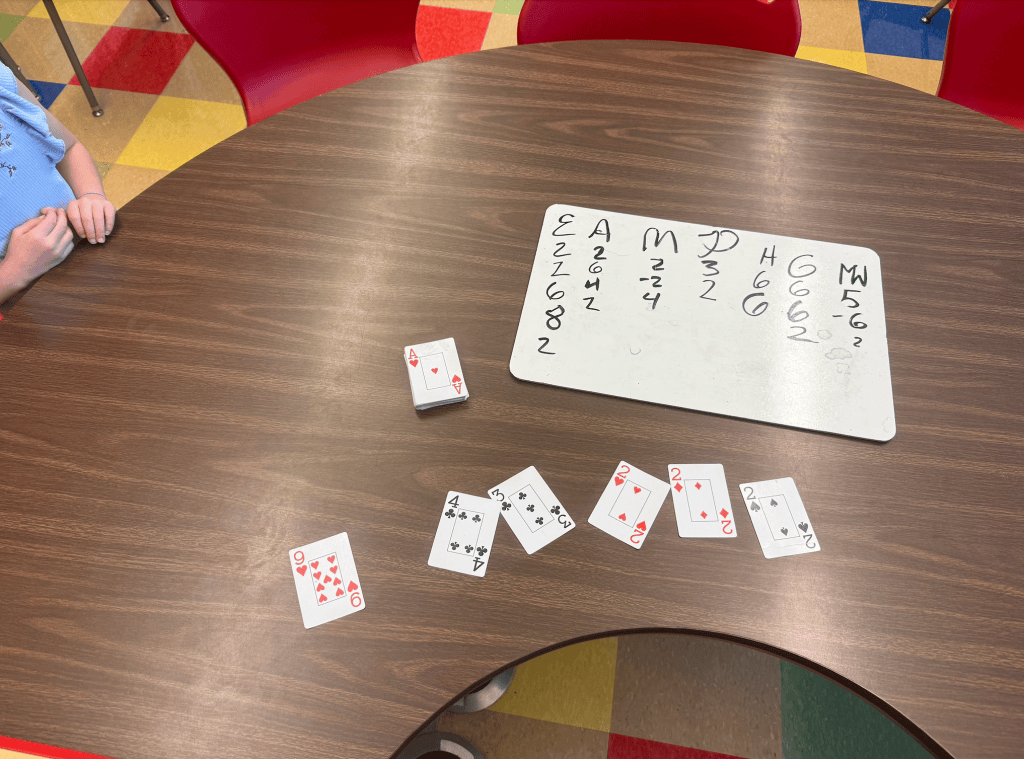
The ace of hearts was the starter card. During this practice round we were dealing six cards. I got a nine, a four, a three, and three twos. After claiming the three of a kind for six, and the three separate runs for four points each, my opponents didn’t even want to hear about all of the different fifteens I could make! They threw in their towels and we moved on to a new lesson. It was fun while it lasted.
Bonus Vocabulary: Meld
I promised you an additional vocabulary word, and if you made it this far, you deserve it. Here is a word that means a particular set of cards: Meld. It is not a typical cribbage term, but you could use it when referring to a run, your entire hand, or any combination of cards that scores points. “What a phenomenal meld! It was full of pairs, fifteens, and runs.”
It can also be used as a verb. To meld is to lay down your cards. This is used more in games like rummy and poker. In cribbage, the counting of cards… The Show… is a more involved process.
One More Practice Round
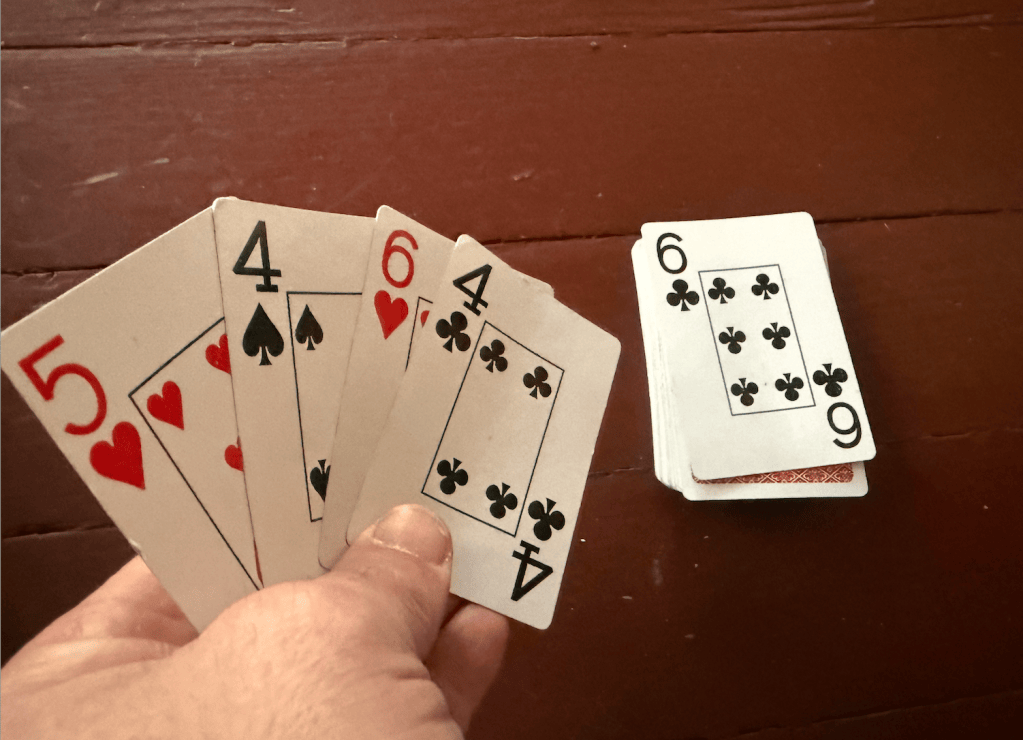
Practice systematic scoring with this one.
4, 4, 5, 6, with a six for a starter. How many points?
Start off with the runs.
The pairs are obvious.
Don’t forget about looking for fifteens!
Good luck.

