Out-of-the-Box Thinking w/ Dominoes

This is a screenshot of the last paragraph + picture from my last blog, with the question of the day above it. I presented this on our Google Jamboard at the beginning of gifted teaching time for students to wrestle with.

I’m back with some more Dominoes word problem work. At the end of my last blog about Dominoes I dreamed up what I thought would be a good problem to get students thinking. It seemed not only doable to me, but I worried that it might be too easy. Not so.

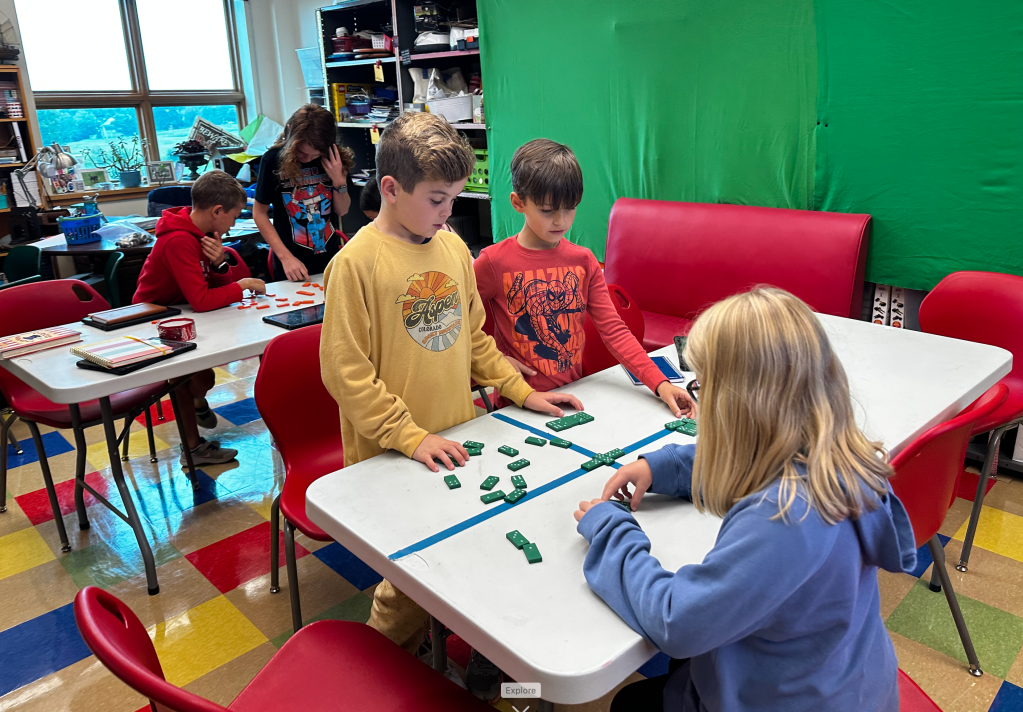
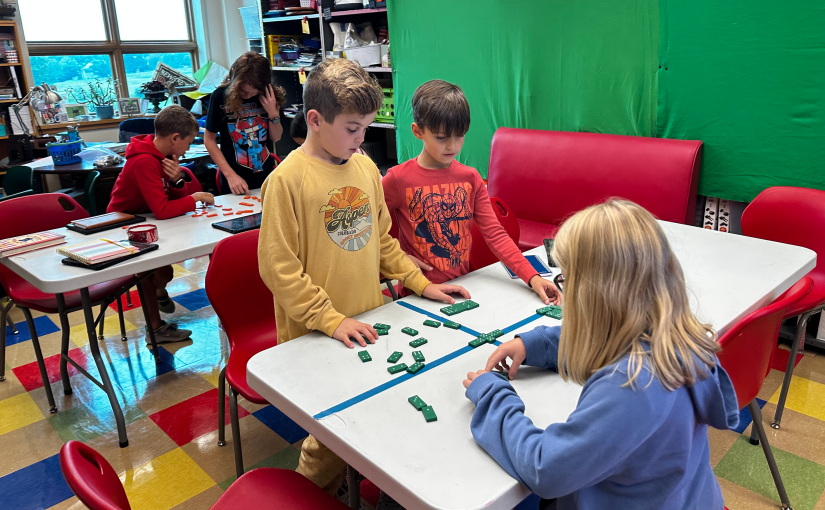
I asked my students, “What is the highest score possible in one play of Dominoes?” I put 28 bones (one whole set) on each table, and encouraged students to move them around looking for the best combination.

This is a screenshot of photos that I used to show students how to connect Bones, adding up all of the ends, and analyzing which Bone would make the best play.

A game of Dominoes proceeds until one player or team acquires 150 points. It takes several rounds to accumulate that many points. During each round the players add Bones (Domino pieces or tiles) to an existing cross of Bones. You have to connect the same numbers, so a 6-4 Bone could not be added to a 5-1 Bone. It could be added to a 4-4 or a 6-6 Bone. When you connect a new Bone to the Line of Play, you add the last number from each end. Your goal is to have a sum that is a multiple of five. Only multiples of five get recorded as points, pushing you closer to the goal of 150; victory.

The first group that I met with are 5th graders. They are still learning the game. I thought that providing the question of figuring out the very best play would create a goal; “This is what I can aim for.” Instead, my students began building towers with the bones and grumbled, “Why don’t we just play Math 24?” Upon self-reflection, I now realize that my word problem was like asking someone who is just beginning to learn how to construct an airplane to calculate how fast it will go. “Dude, let me get the wings on this thing, already!” Ha, ha. Sorry, students.

Before wasting too much time, fostering further frustration, I decided to scrap the 5th graders’ warm up and move on. I made a mental note on the idea of a Math 24 preference, though. This gave me much to think about; More to come on that, soon.

My 4th graders were at their wits’ end.

I didn’t even try the problem with my 2nd graders, who are also novice Domino players. I thought I’d wait and see how my experienced 4th graders, the students whom I taught to play the game last year, would do. These guys would love the challenge, and should have all of the conceptual tools necessary to tackle this problem. They’re the ones in the picture on the Google Jamboard, for crying out loud!

My 4th graders jumped into “Problem-Solving” mode right away. Their biggest hangup was trying to play the game from the beginning. They kept trying to build the arms from the center of the game, forming a cross they way they always do. That won’t work when attempting to find the highest possible score, though. They would have already used the Bones with the greatest number of Pips (that is the technical term for the dots on the Dominoes) on them. Those need to be saved for the ends.

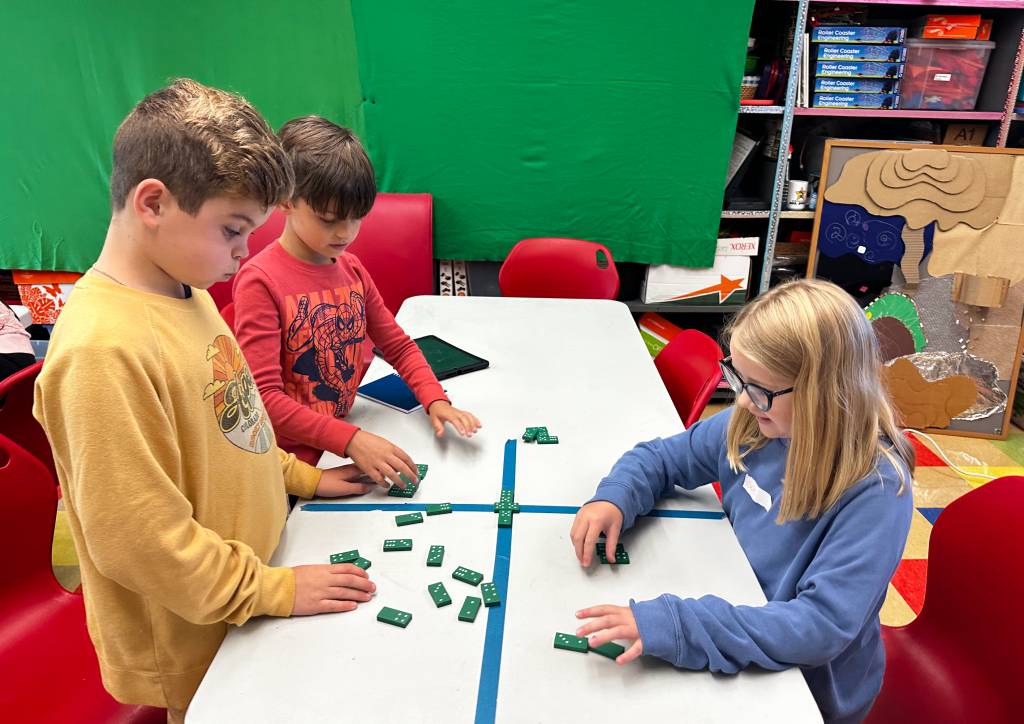
I must have told them to, “Focus on the ends of all four arms. Don’t play a whole game. You don’t need the center of the cross in order to calculate the largest point accumulation possible,” a dozen times. I began to feel like a broken record.

This is a picture of the notes from my journal that led to this “Wonderful Word Problem.” I only focused on the ends of the Line of Play. I’d hoped that this is what my gifted students would do.

Finally, I stopped them and taught them a new vocabulary word: Hypothetical. “This is a hypothetical situation. If you could have the ideal play; The absolute best play ever, what would it be? Don’t worry about what was already played. What Bones would give you the very highest points?”

This is truly Out-of-the-Box Thinking. I wanted my gifted students to leave the box of the game and imagine only the very last play. All previous plays are fog. They don’t matter. You can only see the tips of the Lines of Play, and they have huge Bones… Doubles, every one of them; The highest Doubles, even! Eventually, I had to just tell them the answer.

I had one last group to try out my wonderful word problem. I started the Domino difficulty by sharing with my 3rd graders that the 4th graders could not do this. That got their competitive juices flowing! Next, I did not allow them to put any Bones in the center of the cross. “We are NOT playing Dominoes,” I explained. We are figuring out a hypothetical question: “What if you had an opportunity to make a play that gave you an enormous amount of points? How many points would be the greatest possible in one play of Dominoes?”
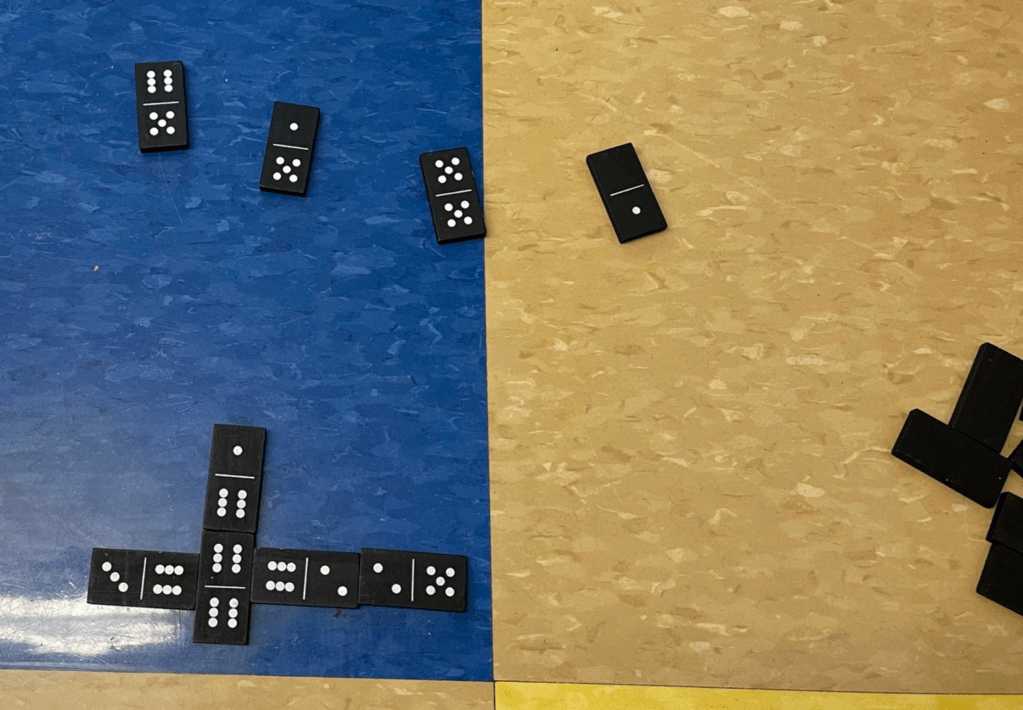
Believe it or not, the 5-5 Bone is worth more than the 6-5 Bone, because it can be played differently.

I guided their thinking toward the Bones that represent the greatest numbers. Even though a 6-5 Bone has more Pips than a 5-5 Bone, it does not present the greatest value when played at the end of a line. Why? Because, you don’t add the 5 and the 6 from the 5-6 Bone. Only one of the numbers would be available for adding. However, if you played the 5-5 Bone sideways, you’d have ten. Gasps, sighs, intake of breaths… Doubles were explored. I forced them to put the Doubles at the ends of the lines of tape I’d stuck on the tables to guide Lines of Play.
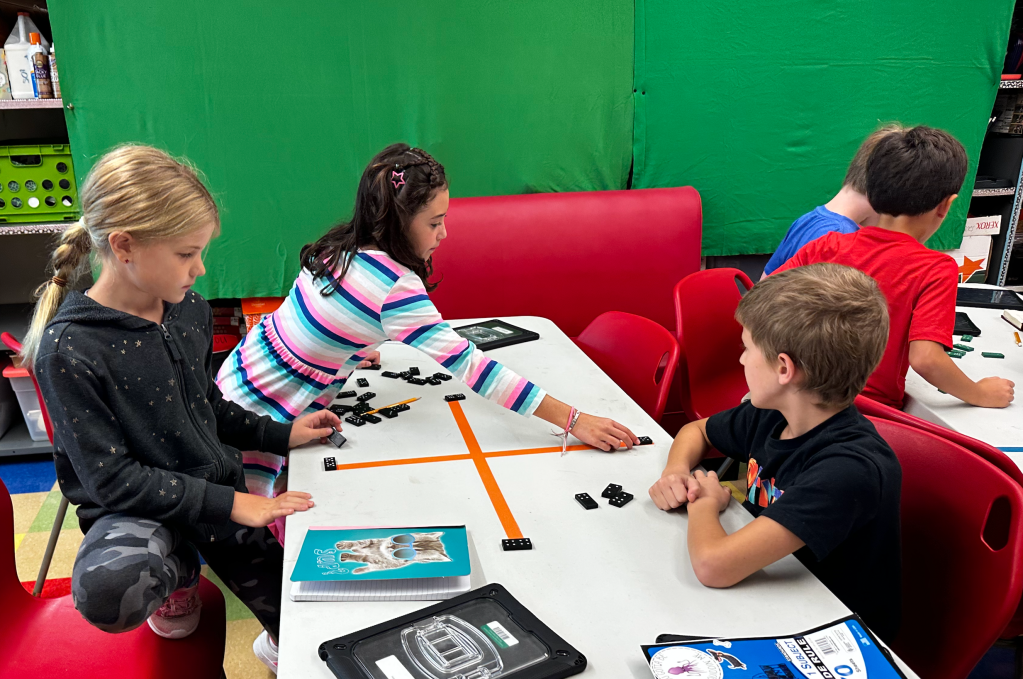
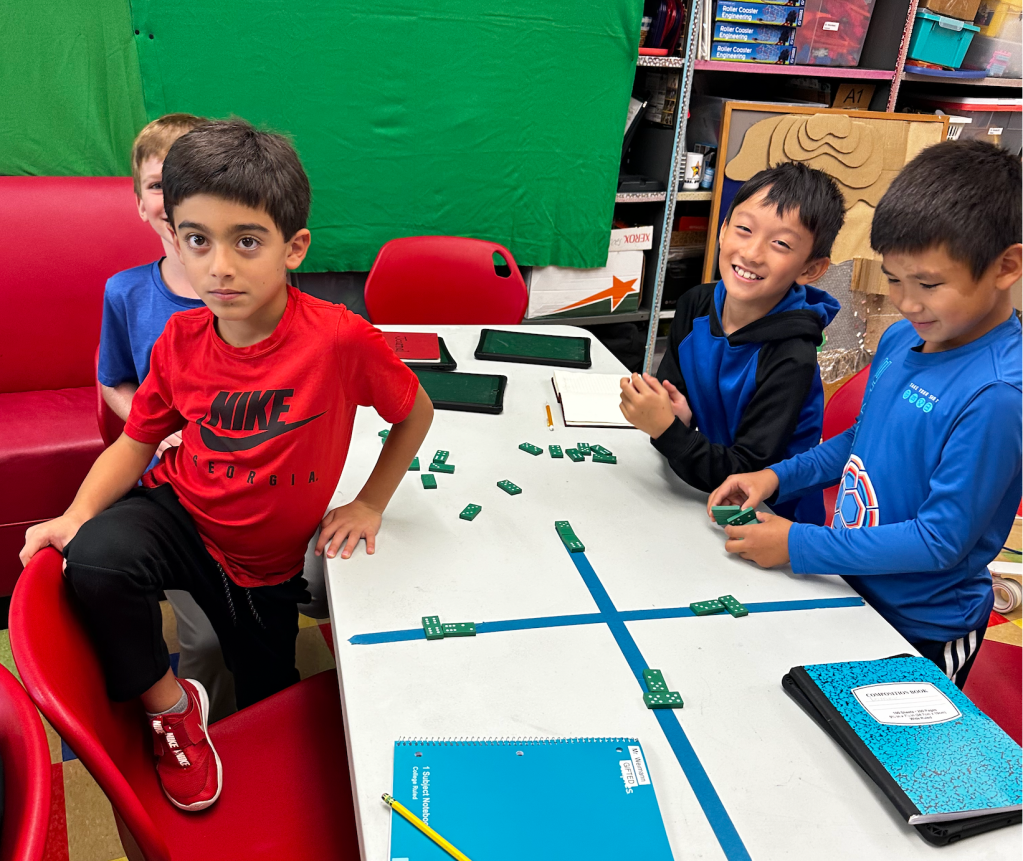
Letting the 3rd graders figure out answers to my guiding questions, I led them through Out-of-the-Box Thinking. In the end, they felt like they had solved the problem, and they had (with a little guidance from their teacher). Lesson: People can be taught to Think Outside of the Box. It is not necessarily natural.
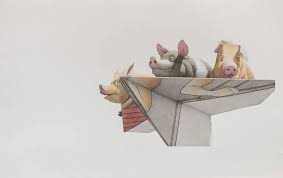
Off-The-Page Artwork by Caldecott Winner, David Wiesner


Screen Shot 2020-02-17 at 6.17.43 AM.png
The thought that he was implying violence to a naturalist by drawing glasses lying on the ground near open cages and free crickets made illustrator David Wiesner smile.

“That makes me smile. David Wiesner explained the effect of critics in a blog, “The Beginning“(Wiesner, 2020). 

This account is left right there. That is all Wiesner has to say about it. “That makes me smile”; a four-word phrase that implies quite the opposite of violence…

Unless, the implication was to stimulate a “violence of thought”; Not “violent thoughts”; But, thinking so transformative, so life-altering, so paradigm-shifting as to be jarring–to clash with the cognitive systems already set up, that are comfortable and familiar. 

The beauty, the magic of Wiesner’s work is that it raises more questions than answers. Why does the criticism of his very first professional art assignment cause him to smile? Did David Wiesner smile the moment he learned of people’s misgivings about his illustration? This statement is written in the first person present. Is he still smiling? Is this a constant source of laughter? What kind of smile is it? Condescending? Amusement? Bemusement? I can picture Wiesner’s emotions evolving through many smiles.

David_Wiesner_2011.jpg
David Wiesner
Author/Illustrator

Why do we smile? We are told to smile. I tell my students to smile. My thinking has been that a reason for smiling will surface once you have begun. If we wait for a reason, it may never arrive. Jumpstart the happiness by raising the corners of your mouth. Smiling can be an act of violence, especially, when you don’t feel like it. You are waging war on your soul. 

David Wiesner’s smile is a metaphor for this picture, drawn in 1979 for the table of contents of the September Cricket Magazine of that year. It was his first commissioned artwork. He had all summer to produce it. I bet at the end, after Trina Schart Hyman praised his work, he removed his spectacles, free to smile at his accomplishment. Having just graduated art school the spring before, David didn’t plan to enter the world of children’s literature. Like a cricket, chirping in the corner of the room, it beckoned him.


I first stumbled across David Wiesner when my daughter Scarlet became enamored with frogs. We found the book “Tuesday” (1991) in a used book store. We were drawn to the text by the beautiful cover. This tale of frogs flying through town, managing mayhem and inspiring mystery, was an instant favorite. We “read” it over and over. The word read is in quotes because this is a wordless book. 

bef4859ec8b61e61257b341891c27f98.jpgAt first Scarlet and I were attracted to the artwork and frogs, but as we reread it, many more meaningful lessons were uncovered. How do you “read” a wordless book? I spoke to my emergent reader about what was happening in the images. We took turns asking each other questions and pointing out phenomena. We celebrated one another’s surprises: “Did you see this?!” How many “Oh my goodness-es” were uttered?

The “goodness” is that each reading was a goldmine of conversation between a daddy and his daughter. The lack of text makes the illustrations more open to reader-interpretation. The artwork lies somewhere between realistic and animation, just like the story line. Scarlet and I discussed how plausible it was for frogs to fly. The frog faces show expressions. How much do frogs feel or think? They seem to operate a remote control for a television in one picture. Do you think frogs could do that? Would they want to? 

I use “Tuesday” in my third grade classroom to introduce the reading strategy, Questioning. It is the second day, and I have students write down questions while I page through the illustrations. We discuss the students’ questions along with how important “questioning” is, as a reading strategy. I am still finding details in the artwork that I hadn’t noticed before.

  • BIBLIO: Reprint, 2011, Clarion Books, $6.54
  • REVIEWER: Matt Weimann
  • FORMAT: Picture Book
  • ISBN-10: 0395870828
  • ISBN-13: 978-0395870822

Three_little_pigs_-_the_wolf_lands_in_the_cooking_pot_-_Project_Gutenberg_eText_15661.jpg
A 1905 illustration of the pigs doing away with the wolf makes it look like one of the pig’s feet is stepping out of the story.

A book that I use later in the year that David Wiesner also wrote/illustrated is “The Three Pigs” (2001). This one may have text, but the storyline is much more dependent on the artwork, thus awarding it the Caldecott Medal of Honor. The three pigs discover a way to escape the mean wolf through completely exiting their story altogether! They then explore a parallel universe of nursery rhymes where they find a few other lost souls. The three pigs help extricate the characters in peril from their tales. 

How do you explain “Out-of-the-box thinking” to youths? Share with them this “Out-of-the-book story” by David Wiesner. Practice the art of thinking this way by “rescuing” a character from a different book. Students could draw comics to illustrate what could happen if a character stepped out of their story to explore the outer world. 

Another use of this thinking is to teach the uses of literary parameters. An author sets up “givens” that help readers interpret actions in a story. Readers won’t be happy if halfway through a story, the historical fiction narrative completely changes to science fiction, with aliens visiting from outer space. Even with our three little fugitive pigs, the illustrations and ideas are consistent throughout the book. They can visit other stories, but they don’t become microscopic and fall through the atoms of matter. In order for there to be “Out-of-the-box thinking” there must actually be a box

Information about other texts by award-winning author/illustrator, David Wiesner can be found on the “Bookshelf” page of his website. 

  • “I Got It!” (2018)
  • “Fish Girl” (2017)
  • “Spot” (2015)
  • “Mr. Wuffles!” (2013)
  • “Art & Max” (2010)
  • “Flotsam” (2006)
  • “Sector 7” (1999)
  • “June 29, 1999” (1992)
  • “Hurricane” (1990)
  • “Night of the Gargoyles” written by Eve Bunting, illustrated by David Wiesner (1994)
  • “Free Fall” (1988)
  • “The Loathsome Dragon” retold by David Wiesner and Kim Kahng (1987)


Screen Shot 2020-02-17 at 6.20.34 AM.png
Take off the artificial lenses and see the world through cricket eyes.

I leave you with this thought: The more mature a writer becomes, the less drawing fills his/her pages. A five-year-old only draws. Teachers instruct youths to add text. We get children to provide words to describe the settings they see in their minds. Develop character traits through actions. What word choice will perfectly convey the mood and theme of your story? Are we capturing and boxing up these young minds by teaching away the artwork? Perhaps the cages from David Wiesner’s illustrations at the start of this blog were setting the crickets free. Artwork is the music for text penned and sung. Let’s help our crickets sing their song.


Sources

Wiesner, D. (2020). Bookshelf. Retrieved February 17, 2020, from https://www.hmhbooks.com/wiesner/bookshelf.html 

Wiesner, D. (2020). The Beginning. Retrieved February 17, 2020, from http://www.davidwiesner.com/work/the-beginning/ 


Classy Appearances

I’m not one to put too much weight in appearances; I’d say I am even opposed to “Lookism”; however, caring about the way others perceive you is classy. I wrote a blog about “Standing Out” in a crowd through modeling classy behavior. This focused on several specific ways to appear classy. This time I want to dig deeper. Where does the behavior come from?

Lunch Count
More than behavior management, I attempt “Behavior Inspiration”.

We, as parents and educators, care about our kids’ futures, but most kids are living in the here and now. It is difficult to get a nine-year-old to care about what an employer will think about him or her ten or twenty years from now. Then there is the whole, “We have no idea what 2030 will bring and what the world/job market will even be like” (thanks, Tom Murray/Eric Sheninger! 😉

IMG_0449
Having pride in one’s work is classy.

People, want to be respected. They want to be taken “seriously”. A child expects to be able to speak to an adult and have the grown up believe him/her. Here is a concept to help kids, and we mature humans must model and explain it to them: The classier a person appears, the more believable he or she seems. I am not advocating that kids not be kids. By all means, be silly, have fun, act out, even, but have dignity doing it.

[I wrote and rewrote the previous paragraph ten times. It was very difficult to say what I wanted to communicate. It feels wrong to teach confidence and self-assurance on the one hand, and then put weight in paying attention to what others think of you, on the other. We want our kids to “be themselves” and not worry about how others may judge them. There should be a balance. I’ve said before, “Out of the box thinking requires a box.” Poetry is a good example. A poet will finegal words, mixing the order, reinventing phrases, dice up spellings, and disobey the laws of grammar. In order to appreciate what the poet has accomplished, one must actually know the laws that were broken. Modern artists have gotten a bad rap by producing works of art that layfolk interpret with the phrase, “Even I could do that!” But, these artists have studied the Masters, the laws, the intricacies of color, line, texture, feeling, mood, etc. What they provide is an idea outside of the box of classical art. A person who splashes paint onto canvas and calls it “Modern Art” without understanding these aforementioned attributes, is “sitting on the box that true artists are thinking outside”. Although kids should “be their own persons”, they should, at the very least, be mindful of the “box” of respectable behavior and not stray too far. A bunch of letters scattered all over the floor isn’t a poem anymore than it is art. It’s just a mess, unless an artist or poet can show “the box” that the scattered letters “came from”.]

Back to Elementary Education: More than behavior management, I attempt “Behavior Inspiration”. I am not seeking to control my class. I want to lead it. In the same way that a good teacher facilitates learning, rather than shoveling information down students’ throats, teachers can positively reinforce the behaviors that model dignity, self-respect, confidence… class.

HoodyOne silly example I have for this is the way students hold their coats. It is that time of year when kids need coats for recess. The thing is, kids get warm when they run around, and they will take their coats off. Upon entering the school building, they have not cooled down completely, so they don’t want to put their coats back on. What many are inclined to do is place the hood of their coat on their head and let the rest hang behind them. They see peers doing this; Maybe they feel like it is a cape. Kids love doing this. It isn’t that I think that there is anything inherently “wrong” with wearing a coat this way. However, what I do each year is show my students the contrast of draping a coat over the arm and carrying it like a butler’s towel up to the room. It seems to me that students who walk with their coat draped over their arm stand more strait with their chins higher. They do not shuffle into the building. They parade with purpose. I told you that this was a silly example. It is simply an appearance thing, but it really works!

One more simple example is when students are working on classroom projects. Our school recently had a fundraiser where parents pledged money for laps that kids ran around a loop. In order to get students motivated, the company hosting the fundraiser, Boosterthon, issued classroom flags for kids to decorate. I always enjoy having my students draw and color the flags, but inevitably there will be some kids who are inclined to just scribble or throw color all over it. While I want the flag to be colorful, it is important to me that our classroom flag be something that we are proud of. (They get hung up in the gym in the end.) Coloring the flag is more than just an experience. It is producing a work of art. I want the students to care about what it looks like. This attitude can be applied to all classroom projects.

Last example: A person shuffles up to you. The individual’s appearance is disheveled. The eyes are shifty and not making contact. How likely are you to trust this person? In contrast, a student with coat draped across his arm, walking straight with good posture and an ere of determination, approaches you and makes eye contact. Aren’t you more likely to take the message of this last individual more seriously.

I, by no means, am advocating that teachers show less respect to students who wear their coats on their head. In fact, I allow it. I simply teach and model the better way to present yourself. If you want to be respected, command it; Look like a commander, act like a commander, speak like a commander, feel like a commander… a Commander of Class.

Feature Image

7 Powerful Ways Classy People ‘Stand Out’

From ‘Control’ to Classy

Out-of-the-Box Thinking Requires a Box