“Today I’m going to teach you how to play a new game,” I tell my students as I pull out a typical deck of 52 playing cards. If the word game doesn’t get them fired up, the cards do.
Unable to contain their excitement, few students burst with questions. “Is it poker?” someone asks. Inevitably one of my students will have a cool uncle who’s talked to them about the gambling game. Or they’ve seen it in a movie or show.
“No. Sorry,” I tell them. Or, I dodge the topic altogether by reminding them all to raise their hands and don’t interrupt.
“This game has a funny looking board that displays the points,” I share as I unfold the cribbage board. It’s so small. Students always want to get a closer look, and they crowd around or lean forward.
They nearly fall over one another when I turn the board as I share, “Every cribbage board I’ve ever seen has a secret compartment on the back; a little sliding door that hides the pieces used to play the game.” I make a show of being very careful when I remove the pegs.
“These tiny thin lines are called pegs,” I tell them. “Their purpose is to show how many points you have. You use them to count your points as you play the game.” I hold the pegs in my hand, illustrating the small size. They are different colors. There are two red ones and two blue ones.
“Sometimes they are wooden. Sometimes they are plastic. But they are always teeny tiny and very easy to lose. It is very important that you are extremely careful to keep track of the pegs.” After everyone gets a good look at the pegs, I put them back into their hiding place. “We won’t use the pegs or keep track of our points until after I explain some of the basics of the game.”
There is always a sigh of disappointment at this point, but students are motivated to do whatever it takes to get their greedy little digits on those tiny little pegs at any cost. The price is points. They have to learn how to make points before we can keep track of them. “In cribbage you get points for everything. You practically get points for breathing,” I tell students. I always start out this way, because everyone always wants to earn points. Students think they ought to earn points for everything.
“I wrote my name on my paper! Do I get a point?”
“No. You’re supposed to. How else will I know whose paper it is?” Some teachers award points for putting your name on your paper. Some students earn nothing more than the points for their name.
The idea of easily earning points is appealing. It keeps the current of cribbage curiosity alive and well as I prepare to share a lot of rules which can be dry and boring.
“One of the main ways to earn points is by making combinations of fifteen,” I tell the students. Before getting into having hands, selecting cards to put into the crib, or playing rounds, I introduce using several cards to make various fifteens.
I already pulled out a few number cards to work with. I display a 2 of clubs, 3 of spades, 5 of diamonds, 3 of hearts, and 9 of clubs. Then, I place a ten of hearts on top of the remaining stack of cards. “How many different fifteens can you make using these cards?” I ask my students.
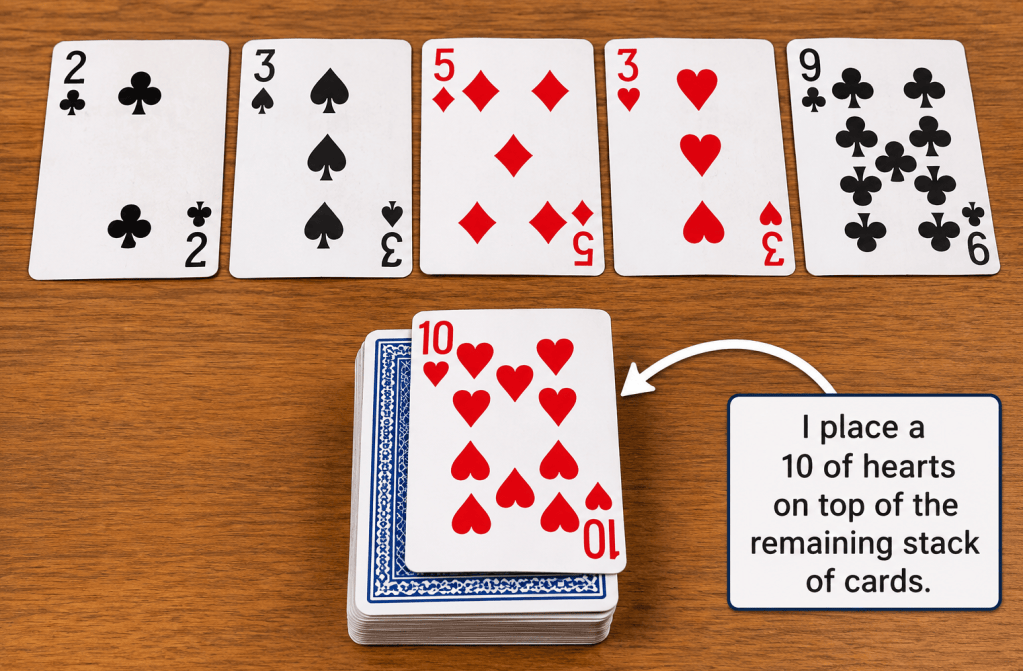
Everyone instantly sees the five and ten combination. Hands shoot into the air. If I have access to a dry erase board, I might draw the two cards on the board. After their illustrated, I explain, “Now that we have used the ten of hearts and five of diamonds together, we can’t use them as a team to make fifteen again. They are done. Even though we know that the commutative property tells us that you can change the order and add them, ten plus five, to get the same sum of fifteen, they are spent.”
This principle will have to be taught several times, because when you get into using many cards to make fifteen, it is tempting to simply move the cars around in order to get a different fifteen.
Additionally, it gets hairy when you show them that you can swap just one of a set of three or four cards with a card of the same value to make a totally different combination of fifteen! The teaching becomes a bit of a balancing act.
“Even though we have used the five and ten together to make fifteen, they are not all used up. We can use them with other cards to make fifteen again.Can anyone find a way to make fifteen using the ten and any of the other cards?”
Some smarty should see that you can add the two of clubs and one of the threes to the ten for fifteen. “Nice, and I have news for you.” I shroud my message in mystery as I take away the three and hold up the other three. “This presents a whole new way of making fifteen!” Gasps from the crowd.
“That’s right. We can’t move the cards around, so that they are in a different order to make a different fifteen, but if you introduce a new card, and it totals fifteen, you get two more points.”
I drop my hands and change my countenance as I rhetorically ask, “Did someone say points?” Then I answer the question that I just planted inside everyone’s skull. “That’s right. Every time you make a new combination of fifteen, you get two points.”
Oprah-style, I dramatically say, “You get two points! You get two points! You get two points!” pointing out the ten and five, the first combination of 2, 3, and ten, and finishing with the most recent combination of two, ten, and a new three.
“What is it called when you take the same numbers, and you change the order of adding them together?” I quiz my students.
If no one remembers, I remind them that it is the associative property. “Unfortunately, the associative property, like the commutative property, doesn’t help us earn extra points in cribbage.”
Drawing everyone’s attention back to the cards, I ask my students if there are any other ways of making fifteen that we haven’t identified yet. “What about that nine of clubs? Can we do anything with that?”
After letting them struggle for a minute, I share, “If you have trouble doing the mental math in your head, you can count the pips on the cards.” This is most likely a new vocabulary word for students, so I might write it on the board. It might help to draw a card, illustrating the pips.
“There are four different suits in a typical deck of cards,” I instruct. “There’s hearts and diamonds, which are typically red. Then there are spades and clubs which are black.” I draw the symbols on the board. “The nice thing about playing cards is that, in addition to the number shown in the top left hand corner, each number card displays its value by providing that many symbols on its face. These symbols are called pips.”
At this point, I lay down a four and a six. “You all know that four and six make ten,” I affirm. “But, let’s say that you are playing cribbage with a younger sibling, and they don’t believe you when you tell them four and six make ten. You can show them the truth by counting out the pips with them.” I might model this, depending on the audience and amount of time available.
While I am sharing this information about pips, someone has inevitably found the combination of the two threes and the nine. “Nine, three, and three!” they shout out.
“What’s that,” I feign ignorance. “How do those numbers make fifteen?”
“Three plus three is six. And, six plus nine equals fifteen,” the rambunctious student points out.
“Are you sure?” I tease. “How can you prove it?” The student has no idea what I’m talking about since he wasn’t listening when I was teaching the word pips. “What’s the name of the symbols that I can count to double-check this scholar’s math?” I ask the group.
If no one wants to answer the silly question, I point to the word pips that I have written on the board. Or, I reiterate the question. “What are these symbols called again?”
Altogether, we chorus-share the word pips.
(When I am teaching younger ages or students who struggle with addition, I have them point to and count the pips out loud. Another idea to consider is using this practice to slow down play. When someone identifies a combination that makes fifteen, everyone has to double-check by counting the pips.)
“I don’t see any other ways to make fifteen with this group of cards,” I say in order to move the lesson along. Often someone wants to explore further, but this will cause others to lose interest. This hand is spent.
“Typically, when playing cribbage, you won’t have this many cards,” I tell the students as I model shuffling the deck. This is always attractive to students. Everyone has stories of how a parent or uncle can do it differently.
“Before we begin actually playing cribbage, we need to learn all about how to earn points,” I reiterate. “You found out that making fifteen will get you points. There are other ways, as well. Remember, I told you that you can get points for breathing.” I laugh. “Well that may have been a little bit hyperbolic. But, there are quite a few more ways to get points.
“We actually missed collecting some points with that last hand!” Collective groan. “There was a pair of two 3s. And, pairs will earn you two points.” I will then pull three fives out of the deck. “How many points do we have here?”
After hearing a variety of answers, I tell them, “The answer is eight. Eight points. Take a look.” Moving the cards around, I show them, “The five of clubs and the five of hearts is a pair for two. The five of clubs and the five of diamonds is a different pair for four.
“…That’s how you count your points. You say what earns them as you add the new amount to your growing tally…
“We haven’t made a pair out of the five of clubs and the five of diamonds yet, so that gives us six points total. But, wait. I said that these earned you eight points. Does anyone see it?”
If they don’t, I’ll point out the fact that all three fives add up to fifteen. This is fun for illustrating how easy it is to get points.
“Whenever you have three of a kind, you earn six points.” I rifle through the deck of cards to locate the last five. “This is going to blow your mind,” I warn my students. “When you have four of a kind, which is very rare, you will earn…” I hold the new five up to each of the previous fives and continue the skip-counting out loud. “Eight, ten, twelve! Twelve points!” I breathlessly communicate.
If the audience isn’t sufficiently awed, I will then flip a face card onto the top of the pile of cards and pretend that it was the starter card. “Wait. What do I see here? It looks like the starter is a face card. Face cards or court cards are the royalty that doesn’t have pips. They are the kings, queens, and jacks. Each one of them has a value of ten. Even though they are worth ten, you can’t put a Queen with a ten and say that it is a pair. It has to be two Queens to be a pair.
“…So, how many points do we have now?”
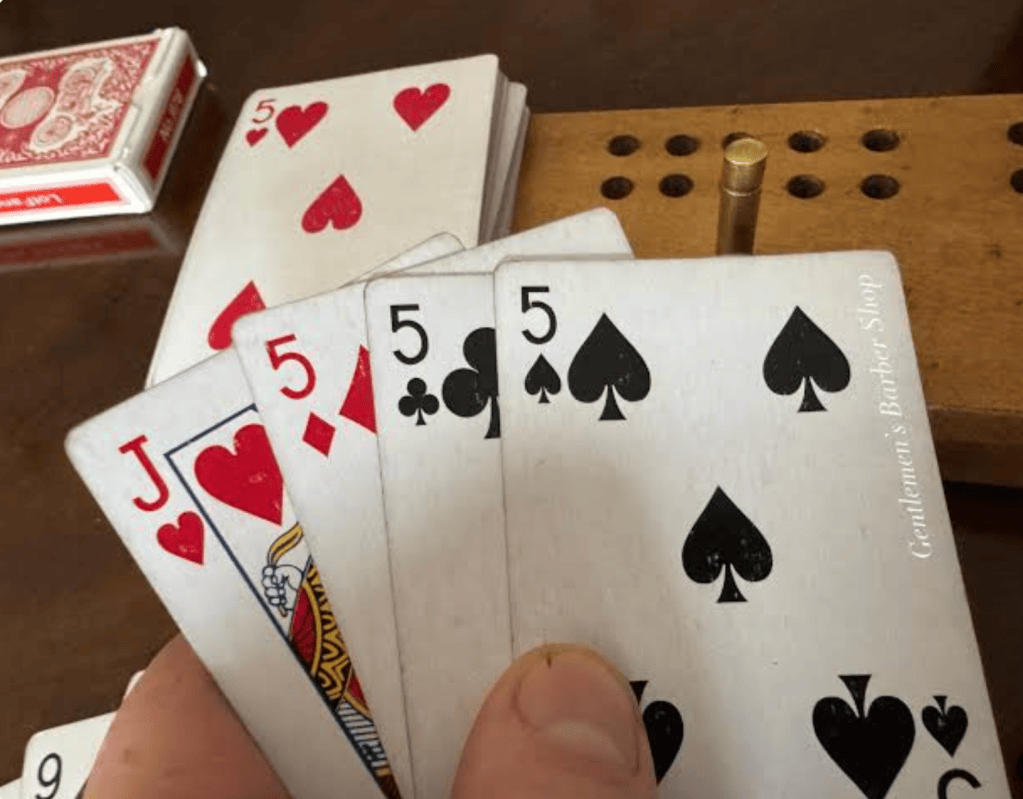
“Who thinks that you have twenty points?” A few hands might go up. This makes sense because we just established that four of a kind would generate twelve points. Then each five could be combined with the face card to make a fifteen which is worth another two points each. That would be an extra eight points.
“Good,” I affirm. “You recognized that each five can be combined with the face card worth ten to make a total of fifteen which will give you two, points, each!” Holding the face card up to each five, I continue counting on, “Fourteen, sixteen, eighteen, twenty.”
After a dramatic pause, I suggest, “But, there’s more.” This sets them on fire. Kids are calling out. They are verbally walking on one another to be first to figure out the answer.
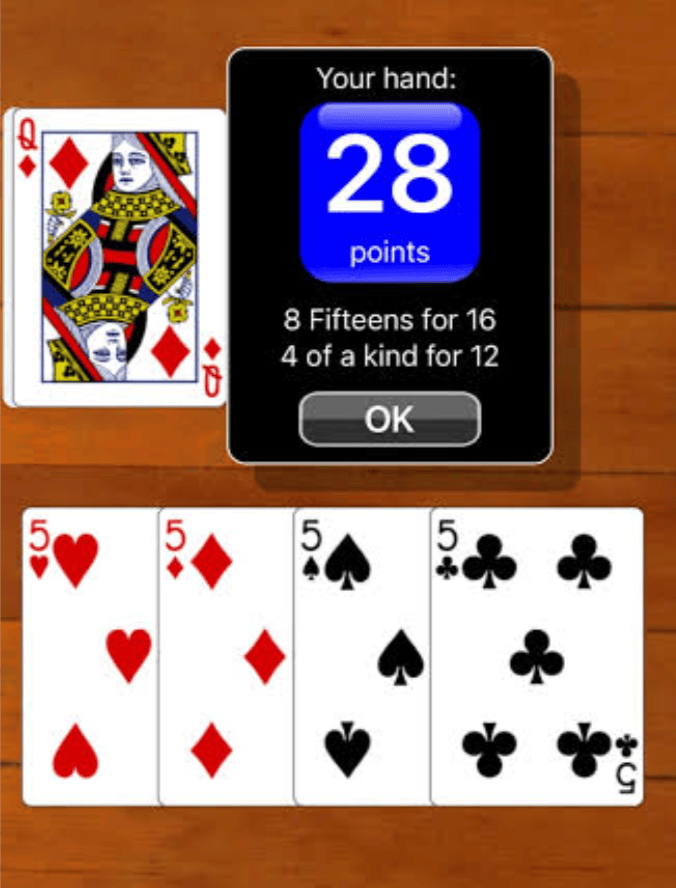
“Who thinks the total points could be twenty-two? If you remember, these three fives added up to fifteen all on their own.” Heads are beginning to explode.
“What about the new five that we just introduced?”
After they try to figure it out in their heads for a few seconds, I race through demonstrating all of the fifteens, all of the pairs, and write a big 28 on the board. This is done quickly, so that it seems like magic, students remain fascinated instead of flabbergasted, and everyone is excited to earn tons of points playing.
“That’s all we have time for today. Pretty exciting, huh?”
As I place all of the cards back into the deck, I remind students about what they learned during the lesson. “Fifteens and pairs earn you points. You can either add the numbers, or you can count the pips, which are?…”
“…The symbols on the cards.
“Although you can use the same card more than once, you can’t earn extra points by simply changing the order of cards. You have to actually change at least one of the cards to make a new combination.
“And, finally, there are tiny pegs hidden in the back of the cribbage board that you will earn the right to use by paying close attention to these beginner lessons, and proving that you have listened and learned the principles of cribbage.
“…Until next time… Bye-bye.”


