Balderdash: Gamify Vocabulary

We all know that selective word-choice can enrich writing (Academy, 2021). It will lend clarity to a story, deepen emotional attachment to a character, and broaden the understanding of a topic. Contrastingly, misused vocabulary can harm the message of a text. And, weak words will water down its substance. Therefore, building a thorough understanding of a wide array of words will prepare students for increasingly effective communication. As it turns out, I have a game that will make your learners crave vocabulary-building. 

Would you like your students to beg you to learn new robust vocabulary? Try Balderdash.

I call the game “Balderdash.” (There is a board game version, but I’ve never used it. From the description, it seems to contain the gist of what I present here.) The name is unique enough to spark interest and be memorable. It also lends itself to the core of the game; Playing with unknown words. 

I’ve used Balderdash to introduce vocabulary, deepen background knowledge, and explore literature concepts for years.

This is how I introduce the game to my students. I start off by explaining that this is a game of definitions

“How many times have you been reading an entertaining story, and really enjoying yourself; Then you come across a word that trips you up? All of a sudden, you don’t know what is happening. Why are the characters acting so weird? What did you miss? They aren’t always big words, but misinterpreting the meaning of a word can turn a heretofore simple tale on its head (irony in italics;)

“In this game, you will be presented with a word that you probably don’t know. That is okay. You aren’t supposed to know what the word means. If you DO know what it means, or if you think you know what it means, that is okay, too. But, don’t tell anyone. You can earn points by writing down a definition that is really close to accurate.”

Here’s how it works

Sometimes, the game originates organically. In the middle of conversation with my students, I might use a word that they don’t know. Rather than simply telling the Polite Pirates what it means, we break out Balderdash to have fun learning its definition.
  1. Have a list of your students handy.
  2. Hand out index cards or sticky notes. Tell students to keep the papers UNFOLDED. Also, do not write on the cards until instructed. (They must look the same.)
  3. Have your students write their names on the top. Everyone should use pencil, and don’t do anything to your card to make it appear unique. (You will understand why in a minute.)
  4. Next, come up with a word that students will not know. You could begin with “balderdash.” This would make the game that much more memorable! You could use a vocabulary word from a list of words you want the class to learn. You could even flip through the dictionary, looking for tough words.
  5. Write the word on the board, so that everyone spells it correctly. You may want to write down some phonetic tips. I will sometimes explain what part of speech it is; perhaps even a hint. (i.e. This is a noun; and although this game might be named “Balderdash,” that isn’t what it means.)
  6. Tell the students to make up a definition for the word. Explain to them that their peers are going to vote on which definition sounds most likely to be true or accurate. 
  7. While the students are writing their definitions, you look up the true definition of the word. (I don’t recommend relying on your own interpretation. Even if you do understand the word, it is best to deliver the scholarly definition first.) You will need to put the definition into kid-friendly language. Your definition will need to match the ones that students hand in.
  8. Walk around and collect everyone’s index card. I recommend using a bucket or top hat for this. 
  9. Read through the definitions to yourself, making sure that you understand what they say and are able to read them fluidly. You don’t want to supply any “tells” that one is NOT the accurate definition. If there are any that are similar to the actual definition, provide that student a point and remove the definition from the pile. (Reading 2 of the same definitions would let them know they are the true definition.)
  10. Next, place them back into the hat or bucket. Pull one at a time and read it. Do this once through without any voting. 
  11. Then, repeat the process, but after each reading, have students raise their hands if they think it is the correct definition. You can only vote once, and you can’t vote for your own definition. 
  12. Give the pupil who produced the phony definition a point for each vote. Whoever votes for the true definition also gets a point. 
  13. After each round, share who earned the most points and the real definition.

In the same way a serious athlete might take creatine supplements to boost muscle-building ability in the body during intense exercise (Creatine, 2021), using games to increase enthusiasm for definition development can motivate kids to grow their vocabularies. Rather than get fatigued when faced with unknown words in texts, your students will view these as opportunities for growth. 

An athlete takes creatine supplements to prepare their body for doing a little bit extra in each exercise, making the workout that much more beneficial. Balderdash is a reason for collecting large, complex, unfamiliar words, and tucking their meanings into memory banks for future use. Plus, it’s a lot of fun! game

Sources

Academy, E. (2021, November 12). Word Choice in Academic Writing: Tips to Avoid Common Problems. Enago Academy. https://www.enago.com/academy/word-choice-in-academic-writing-tips-to-avoid-common-problems/ 

Balderdash Board Game – the Game Of Twisting Truths. (n.d.). Mattel Shop. https://shop.mattel.com/products/balderdash-cfx43 

Creatine. (2021, February 9). Mayo Clinic. https://www.mayoclinic.org/drugs-supplements-creatine/art-20347591 

This 4th grader got to wear the “Balderdash hat” for our photo as prize for collecting the most tally marks.

To Coddiwomple is Classy

Education is an experience; This is our purpose.

The vision is coming into focus, while it is getting hazier and more illusive.

21st century teaching should less resemble the space race of the 1960’s than take on the attitude of video game designers from the 80’s & 90’s. The space race was meant to show up Russia. Who could touch the moon and return to Earth first? Whomever could cover the distance of the playground, tag the wall, and return to the starting point first, wins. Wins what? Wins the race. For what? Why?

Granted, we learned lots of things through the process of racing to get to the moon. Sometimes it is necessary to have goals. Shooting for the stars will get you off the ground… sometimes. But, what if your goal was to find out what else was out there, other than stars and what we already know? What if your goal was just to explore, in general? There is the whole funding issue.

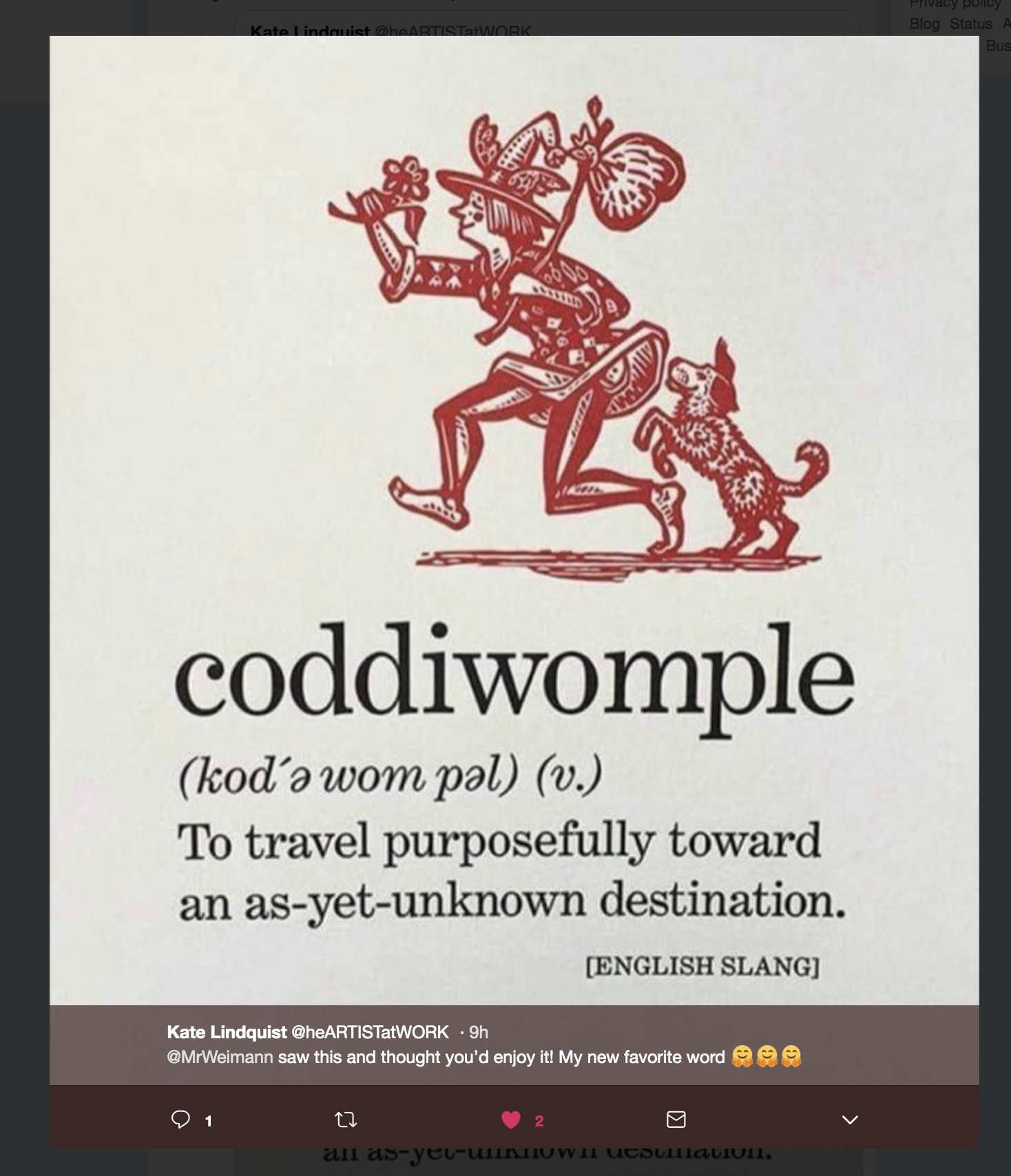
A friend of mine (Thank you Kate Lindquist@heARTISTatWORK 9h9 hours ago) introduced an incredible vocabulary word to me just yesterday. I was of course flattered that she thought of me, especially in connection with such an interesting locution. A Google search, blog read, and some introspection lead to some seriously fun philosophy gymnastics.

Screen Shot 2019-04-04 at 4.39.15 AMThe word was coddiwomple. It means to “travel with purpose to an as-of-yet unknown destination”. If you were to boil Western Civilization down to just a handful of concepts, one of the most poignant, I believe, would be “goals”. We are obsessed with them. There have been countless coaches and seminars selling the necessity of setting good ones. A contemporary wave of self-help is focused on washing away the stress of not meeting them; failure.

A recently published blog by  Mar 28 about hiking presented a paradigm-shift away from being goal-oriented. It provided the etymology of the word saunter; coming from the word saint. A portion of text from John Muir explains the origin coming from people pilgrimaging to the Holy Land. Now, these travelers had destination goals, but clearly they understood the importance of the process as an experience. Touching down in the center of a holy place in a helicopter so that you can check it off of a list of todos, hardly seems like the end of a pilgrimage. And yet, this is exactly what some educators are teaching their students to do.


“Your mission is to figure out a way to get the robot to deliver something to the cup,” is not an awful way to get kids thinking, tinkering, toying, and trying. What if you said, “Others have gotten this robot to place this ball inside of this cup. What can you have it do?” Now the student will be coddiwomple-ing.

This term takes the goal and shifts it forward. So many times we keep pushing ahead. We have reached the moon. What’s next? Explorers kept pushing on until every square foot of planet Earth had been touched by human toes. I propose playing on the plains, rather than hurrying over hills.

As I prepared to deliver the definition of coddiwomple I was tempted to write some of my own words: I came up with this fun prose, “Meander with meaning.” I erased it, though, because it is inaccurate. To coddiwomple does not mean mess around. There definitely is a purpose to the play. We should teach students to love the wrestling of ideas in addition to showing them how to pin down a problem.

Sources:

The Adventure Diary. (2016, November 4). Why You Should Coddiwomple Your Way Through Life…. Retrieved April 3, 2019, from https://adventurediary.co/coddiwomple-definition/

Mountain Buddha. (2019, March 28). The Simple Joy of Walking in the Woods. Retrieved March 29, 2019, from https://journeyofathousandmiles.blog/2019/03/28/the-simple-joy-of-walking-in-the-woods/

Cognomens Are Classy

“Excuse me.”

I like to listen to books while I work. I was wearing earbuds when this person was speaking to me, and couldn’t hear what she was saying.

“Excuse me.”

I thought I heard something, so I turned to look. The woman who was housesitting was talking to me. She had been saying, “Excuse me.”

“How long are you staying?” she asked me. “I’m not rushing you… I just wanted an idea.”

We were the only two people in the house, and she was looking right at me. There was no question who she was talking to. It was me. But, there was something missing. What was it? I couldn’t place my finger on it, but there was a feeling.

She hadn’t used my name.

A Confession

I have a confession to make. I am not good at remembering names. I wish I was. I have worked on it. When I was in highschool, I actually read a book about how to remember names. I still remember most of its points, but I can’t remember who wrote it. Too often, I will come across someone whom I had already met, and their name completely escapes me. So, there it is: My concession of unclassy behavior prior to proposing you do what eludes me.

Back to the Tale

The encounter with the housesitter happened yesterday. This was probably the thirtieth time I had met her. Earlier in the day, I was surprised to find I already had her phone number saved. At that time I learned the name that she normally goes by. I programmed that into my phone, as well.

The feeling materialized into a thought: This woman either didn’t know my name or chose not to use it. Why would someone decide another person’s name was not worth saying? In the past, I have witnessed people speak to hired help differently. More than the words they used, it was the way they said them. They spoke down to the person whom they believed was beneath them. Sometimes the way they do this is through the words they do NOT use. I have experienced people who think that their status elevates them so high above me that they try not to talk to me, as if speaking with a worker will somehow drag them down. Now, I bet that this lady did not feel this way. But, by not using my name, it felt like I was less human; a less person than she.

Earlier that Week

Contrast this feeling with a story from earlier in the week. I was picking up my daughter from daycare, when another parent told her child to, “Stand to the side, and let Mr. Weimann through.” At first, I was surprised that she knew who I was. And then, I thought it classy that she used my cognomen. It made me feel special; important.

A person’s name is precious to him (Schultz, 2017). Dale Carnegie famously suggested a person’s name is the sweetest sound to him. The very first word that anyone types on a keyboard is his name. The first thing we learn to write is our name. It is our label. It’s who we are. There is an art to using other people’s names in conversation. It attracts the listener’s attention (Russell, 2014).

Luke Davis (2017) points out plot lines containing a search for characters’ names in “The Power of Using Someone’s Name”. A name in fantasy stories is sometimes magical. When the miller’s daughter learns Rumplestiltskin’s name, she saves her first born’s fate. Davis suggests that people give permission when they offer their name. They are communicating how you may address them. I remember a few years ago, an adult visited the classroom. He wore a nametag that showed both his first and last name. A kid read it and pronounced the adult’s first name. This adult could have handled this better. He said, “It is Mr. __ to you” to the student. He hadn’t given that student permission to use his first name.

Classics

I love classics. Some have been rewritten, made into movies, talked about so often that reading the original work is like looking at a primary source. There are times I feel like an archaeologist dusting off the first few words a master wordsmith penned. This is the feeling every fall when I get out “The Legend of Sleepy Hollow” by Washington Irving.  

29bd75fffbd860f9116b782fee7b4f5fWith sentences longer than the paragraphs my third graders write, this text presents descriptive writing that transforms the 21st century classroom into a one-room schoolhouse in a comfortably lazy, quiet, rural town. Incidentally, Sleepy Hollow is an actual town. If you cross the Tappan Zee Bridge, a word Irving includes in his text, you will see signs for it.

Remember my mentioning that I listen to texts? I have heard “The Legend of Sleepy Hollow” on audio several times. When you listen to the story, you don’t have the ability to look up the words that you don’t know. You just use context clues or allow the meaning to escape, and move on with the plot. The robust vocabulary is part of the allure of the classic. The enchantment of Irving’s learned lexicon is lost, however, when I read the text to/with my third graders. Rather than bump down a bubbling brook, we get caught with confusion at every turn.

As it turns out, I have never gotten all the way through the classic with my students. I begin reading it close to the start of the year, looking toward Halloween. Everyone has heard the story. Many students tell me they have seen “the” movie. (There are several.) None have ever heard a sentence of the original classic. Even though it takes weeks to get through the first chapter, I find it fun and beneficial for students to experience. We eventually peruse the rewrites and end up comparing/contrasting them with what we have witnessed of the original.

How Does Sleepy Hollow Fit?

What on earth does “The Legend of Sleepy Hollow” have to do with the story that began this blog? When we are first introduced to the main character of Irving’s tale, there is a sentence that I like to present to my students as a riddle: “The cognomen of Crane was not inapplicable to his person.” In addition to the vocabulary word, cognomen, the double-negative throws 8 & 9 year olds for a loop. We had already learned Ichabod Crane’s name, so we could use context clues to figure out that cognomen meant last or surname. The double-negative is harder to explain.

Cognomen

Cognomen is one of the vocabulary words that my brain glossed over when listening to the book on audio. Because it didn’t affect the plot of the story, I didn’t worry myself about it. When reading the text with students, however, it became a curiosity. We looked it up in a collegiate dictionary. (Our elementary dictionaries couldn’t handle it. This makes third graders feel awesome!) In addition to surname, cognomen also means alias or nickname. So, Irving could be saying that he is adorning this character with this name because he wants you to picture him with a beak of a nose. Ichabod’s creator/father, the man bestowing him a surname, Washington Irving, is making this surname a nickname, a cognomen. Of course, I don’t get into all of this with my third graders. We are simply happy to learn the term, surname.

Cognomens Are Classy

Nowadays, we are not reading about Sleepy Hollow. We are looking at manners from a book about being polite. This happens everyday after recess and before math. Last week, 2bookone of our lessons was to use Mr., Mrs., Miss, or Ms. along with the last name (cognomen) when speaking with adults, or find out how the adult would like to be addressed.

As always, we had plenty of discussion, full of stories. I told the students about a neighbor, when I was a kid. He was elderly, and his family did not live close. He loved company, and we would visit him regularly. Rather than calling him Mr. Vinton, he insisted we say “Grampa Vinton”. He turned out to be one of my best friends, growing up. Even though I visited him nearly everyday and we shot rubber bands at each other in his breezeway, I always called him Grampa Vinton. Placing the respectful title before the cognomen helped me remember this was not another kid.

When I was growing up, I had friends who referred to adults as ma’am and sir. This seemed respectful, but never felt quite right to me. Looking back, I now know why. Sir and ma’am denotes mastery. The kid was suggesting servitude. This is not the same as respect.

Mr. Smith

In my classroom I use kids’ last names all of the time. I do this because it is weird and to help me learn/remember their last names, but I have noticed an interesting byproduct: Kids love it. You should see them light up when I call them Mr. Smith. Their faces look like they just won the lottery. Being called the same thing as your mom or dad is winning a lottery of respect. I place the kid on the same title plane as myself. Why don’t they refer to me as Matt? That would be unheard of, but why? By using their last name, I elevate them to the same status.

When the lady refused to use my cognomen or even my first name, yesterday, I was left with a feeling opposite my students’ when I use their last name.

Black History Month: Race

I have one more disclaimer: The text that I was listening to when the housesitter began talking to me was “The Lies My Teacher Told Me: Everything Your American History Textbook Got Wrong” by James W. Loewen. I’m sure you guessed it from the title, but this is one of those truly eye-opening books. I was just listening to Chapter 5, “Gone With the Wind: The Invisibility of Racism in American History Textbooks,” when I heard, “Excuse me.”IMG_8396

Loewen’s text taught me that there are subtle ways that opinions about race are woven throughout most history textbooks. The concepts are thin, and the weave is tight. You don’t even notice it, but there is a thread of attitude here, and a fragment of thought there. Many times, it is what the textbooks do NOT include. They never tell about the laws that demanded black people not look white people in the eye. There were many laws like this that trained race relation deterioration during “equalization” after emancipation that I had never heard. 

I am not about to march into my third grade classroom and dump all of this information onto my students. It has, however, caused me to think about omission as a bad thing. Although it might feel awkward to bring up race, NOT doing so could be damaging. Perhaps, it is like addressing someone without using his name.  

Sources

Davis, L. (2017, August 10). The Power of Using Someone’s Name. Retrieved February 17, 2019, from https://goodmenproject.com/featured-content/the-power-of-using-someones-name-ldvs/
Irving, Washington, 1783-1859. (1963). Rip Van Winkle, and The legend of Sleepy Hollow. New York :Macmillan,
Loewen, James W. (1996). Lies my teacher told me : everything your American history textbook got wrong. New York :Simon & Schuster,
Schulz, J. (2017, January 12). Using a person’s name in conversation. Retrieved February 17, 2019, from https://www.canr.msu.edu/news/using_a_persons_name_in_conversation