Paper Football Field Goal Line Plot Lesson

Driving question: What is the perfect length of a paper football field? We are talking, one that allows some paper footballs to score goals, but not every “kick.”
Goal: Students will create and use a line plot to categorize data in a way that makes it easy to interpret. They will analyze the data to determine the best measurement for flicking a paper football accurately.

Prep: I folded a paper football out of an ordinary,letter-sized piece of paper (8 ½ by 11 inches). You fold it the same way you fold an American Flag. Have one pre-folded, but this could be part of the lesson, if you have time. (I didn’t have X.) 

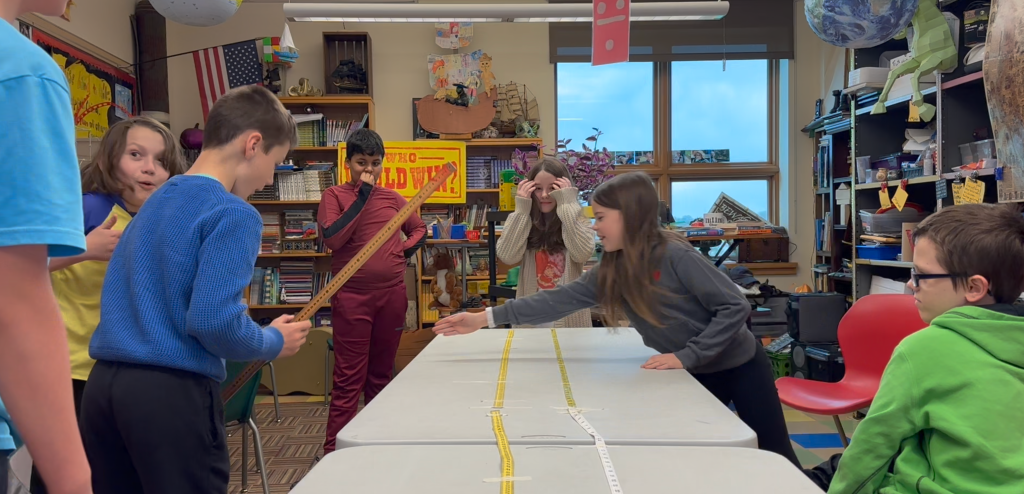
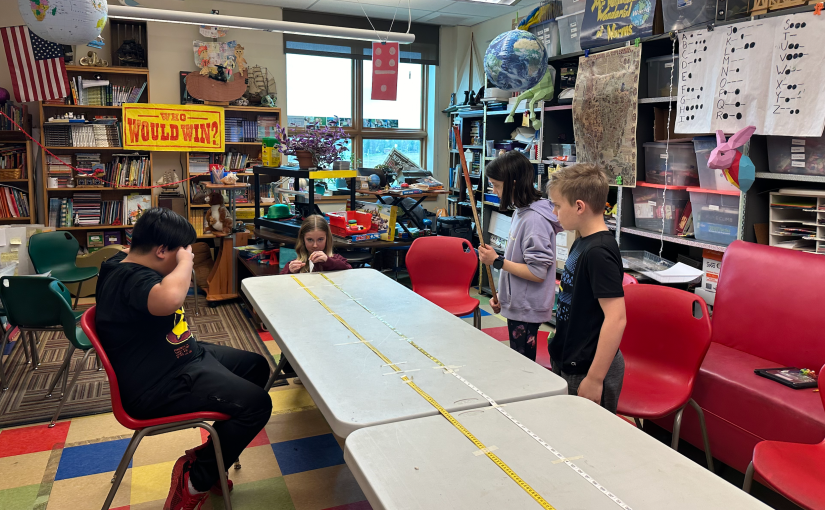
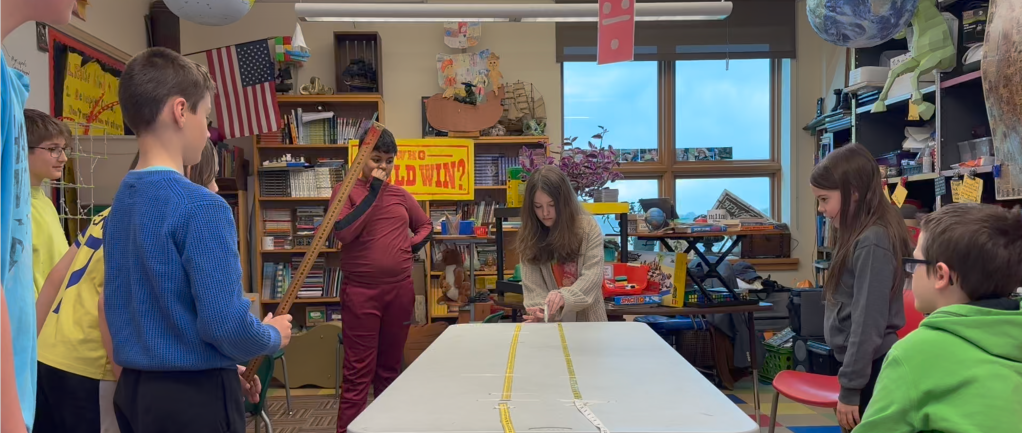
I placed two tables end to end, creating a lengthy runway for measuring. Before students arrived, I taped rulers to the table top the entire length of the two tables, about 3 inches away from the center. I put pieces of tape at each foot so that it would be faster and easier to locate the increment. 

Lesson: I told the students the object of the lesson was to determine the “goldilocks length” of a paper football field for this group of students. Another group may be better or worse at flicking the paper football. We are going to collect data that will help us tailor our “field” to our group. 

“We don’t want the field goal too close, or every single flick will score a point. We also don’t want the field goal too far away. Then no one will score! There will be a window where some will score, but some won’t. We will use data to find that sweet spot. And, we will use a line plot to help us read the data.” 
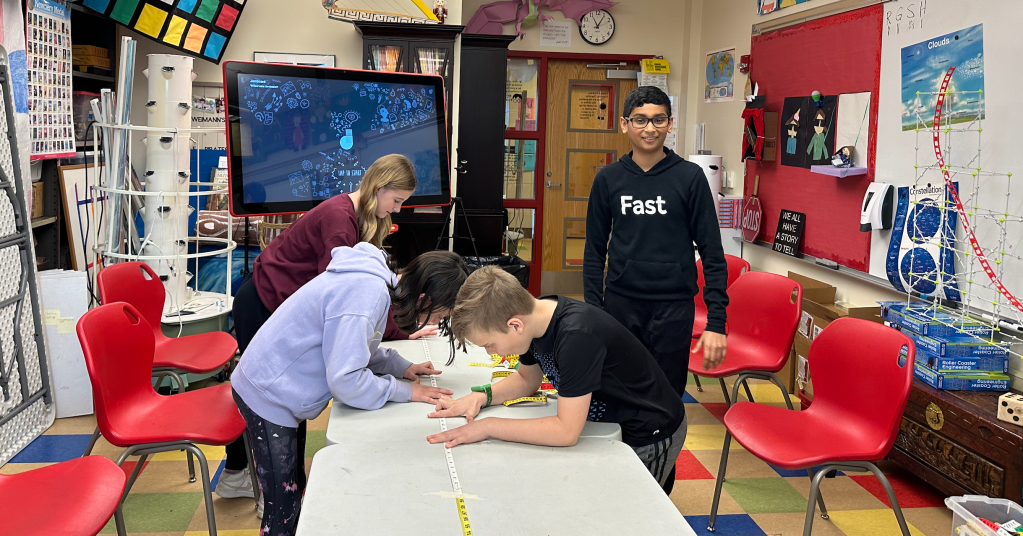
The first thing we did was figure out the width of the field goal, so that we could finish constructing our mock field. I had each student form right angles with their thumbs and index fingers. Then, touching thumb-tips, they placed their finger field goals on the measuring tape (ruler) I had already taped to the tables. As students shared the measurements of their finger field goals, I wrote them on the dry erase board. We had 6, 6, 5, 5 inches. 

I had taught my students how to average numbers earlier in the year. They were bouncing with the information, now. “It’s 5.5,” a girl offered. 

“How do you know?” I queried.

A boy suggested that it was right in the middle of the numbers. I affirmed this by circling the middle four and five. The girl who had provided the original answer shared what she did to get it, and what one should do to find the average of several numbers. “You add all of the numbers, and then divide by the number of numbers.” We discussed dividing 22 by four in order to review fractions and decimals, and to double-check our answer.

Next, we used mini (six inch) rulers to measure five and a half inches distance between the already taped down ruler and a new one. I had the students tape it down. Now, we had a runway that was the average field goal width, running about ten feet long. 

I demonstrated how to flick the paper football. Each student got three tries. If any of them were duds (didn’t fly), we conducted a retry. There were a few very short flicks, but all in all we collected some valuable data. 

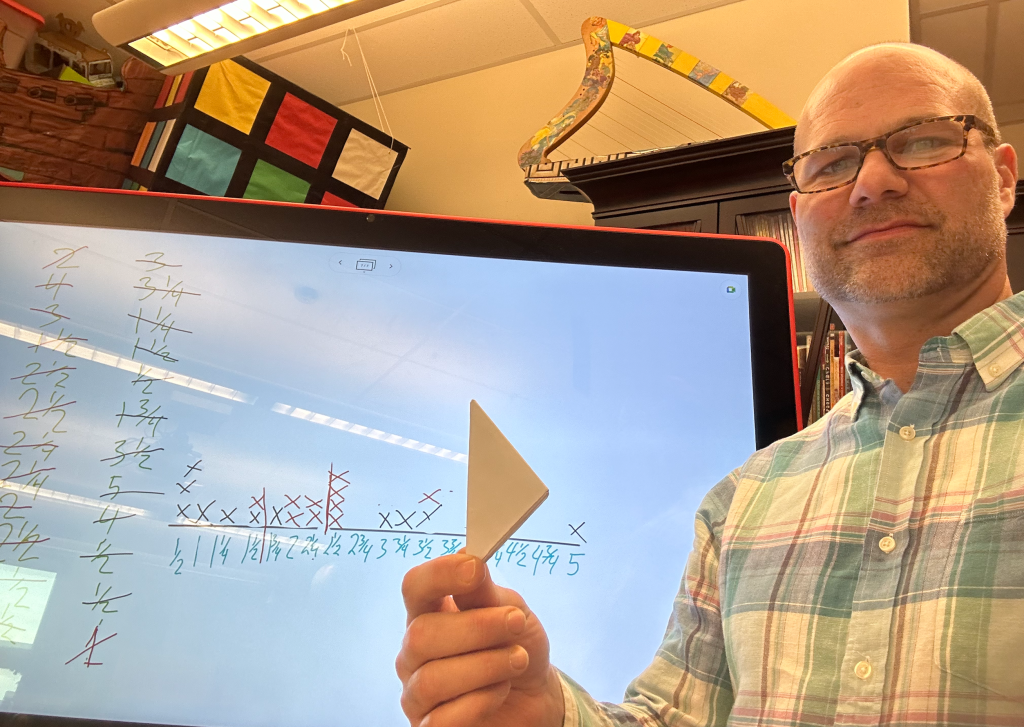
This line plot is not great because the line is not accurate. There ought to be measurements that do not have Xs. Every 1/3 foot should be labeled.

About half of the flicks landed between the two rulers; within the field goal range. These measurements were written on the board in one color. The flicks that did not land between the rulers were recorded in a different color. All of the measurements were recorded to the nearest ⅓ of a foot, in order to use mixed numbers on our line plot. 
Once the line plot was finished, it was easy to see the window where the field goal ought to be erected. There was a collection of accurately-flicked colored Xs up to a point. Then the other color, the color of missed flicks began to move in. At a certain point there were no longer any accurate flicks. The brackish space containing both colors contained the available distances. 

Some students wanted to place the field goal at the first measurement that recorded a miss. I explained that, were we to place it there, nearly every flick would score a point. Even the misses that went far could pass between the goal posts before veering off to the side. I drew a picture illustrating what I meant. 
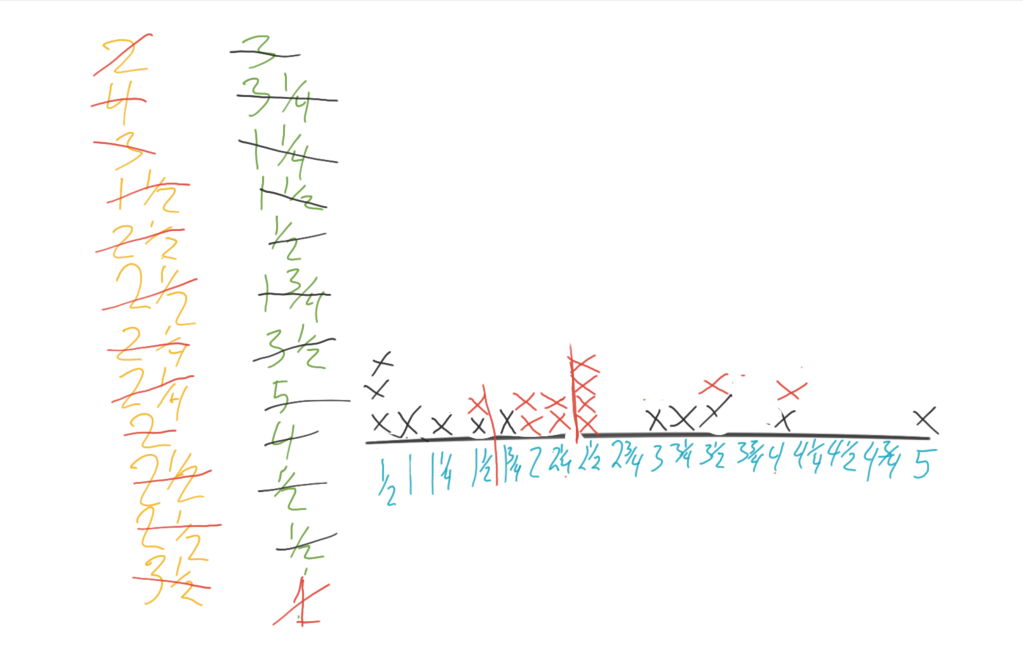
We drew lines at measurements that we thought the field goal would work best. Then we discussed pros and cons referencing the data.

One student wanted the goal posts erected right before the very last successful data point; The last one to land between the two rulers. I told him that “This would guarantee that only one person would get one point for one flick out of… How many did we do? That might be too frustrating, and not very fun.” 

We ended the lesson without deciding on the perfect distance. Basically, the thing to do was to use the data that we collected to try out some reasonable distances, and see which ones were more fun. The beauty of the paper football field goal game is that the field is so malleable. It is all about fun, and that’s what I hoped the line plot lesson would generate. If nothing else, it was memorable. 

Nemesis Brings Balance: A Story

In preparation for teaching my 4th and 5th graders about conflict in literature, I did some research that uncovered something novel. I had always thought that someone’s nemesis was the antagonist of the story, the enemy, the ultra-bad guy, the anti-hero. This isn’t exactly the case. Before I share what I learned, I have a story for you.


Photo by Steshka Willems on Pexels.com

There once was a baseball player born with a natural affinity for the game. It was more than that. He had a gift. His parents knew he would be great, and they gave him everything he would need to fulfill his destiny. 

Everyone who saw this boy play commented on his skills. When he threw the ball it seemed to know where it was supposed to go. His glove was a magnet. No toss escaped it. The bat in his hands may as well be Thor’s hammer, Mjolner. It punished pitchers year in and year out. 

A funny thing happened early in the boy’s career. He was still in school when a coach who understood the greatness before him told the ballplayer’s parents, this one will go far as long as he never assumes his talents, but continues to practice and better himself. This coach had glimpsed raw talent before, and knew that without tuning, the song of the marvelous instrument turns into a grating noise. 

The young baseball player had no problem making it to the big leagues. The people who played ball with him were graced to know his genius for the game. Even his opponents felt privileged to have been able to rival him. 

Numerous articles were written about the rising star. Every journalist craved an interview with the boy, but he eluded them all. One journalist in particular resolved to take photographs of the athlete in action. If she wasn’t granted the privilege of speaking with the ball player, she would communicate his greatness to the world through picture. 

The journalist, not new to baseball, had never seen the human body move the way this star player moved. Her photographs captured the power of the throw like none other. Looking at the glove that never missed a toss portrayed in portrait amazed every viewer. 

Even though no one secured an audience with the baseball player, this photographer wished to put words to her photos and sought an interview. Rejection after rejection caused the journalist to turn to other means of query. She would write letters to the baseball player. She tried to get his manager to intervene. The journalist befriended other players in hopes that they would put in a good word for her. Eventually, the journalist even bought presents to give to the baseball player. Perhaps she could bribe him to give her some sound bites, at least. 

Other journalists saw this photographer pining for the privilege to interview the star as pathetic at first. They feared the photographer would fall apart, focusing so much attention on one person. They warned her. It was too late. And then, she was gone. 

Photo by Tim Eiden on Pexels.com

The owner of the magazine that the photographer worked for heard the speeches of brother and sister journalists at the photographer’s funeral and decided to do something about this tragedy. Why wouldn’t the baseball player just talk to his employee?

The magazine owner compiled a book of the best photographs and had it delivered to the baseball player. There were no words. Not even a title was printed on the cover! Everyone knew who was featured in the photos. It didn’t take much research to find out who had captured the pics. 

What no one foresaw, though, was the way in which the photos would imprison the baseball star. He had never bothered to read the newspaper articles written about him. He hadn’t ever seen the famous photos. When he viewed the pictures of his playing, he was mesmerized. Is that how he looked to others? 

Photo by Lisa Fotios on Pexels.com

He removed photos from the book. Framed his favorites. They were placed all over his house. He found it difficult to pass one without stopping to look. Eventually, the baseball player couldn’t leave his home without missing the photos. After a while, he stopped leaving all together. 

The once great star didn’t eat. He didn’t drink. He wasted away to nothing. When his friends went to check in on him, they didn’t find a former baseball player. All that was left was a flower; A daffodil. 


Did you recognize my modern myth for what it was, a retelling of Narcissus? I wrote this version for my students. I wanted to emphasize the idea of undeserved good fortune, a theme I had overlooked in the past. 

More than rivaling a hero, Nemesis is a “balancer of the scales.” I’ve thought that Nemesis was synonymous with antagonist, but she isn’t. I didn’t remember her role in the Narcissus myth, but she was the one who led Narcissus to the pool where he first beheld his reflection. She heard the prayers of the nymph-friends of Echo, who died of unrequited love. 

I always focused on Narcissus getting what he deserved, but there is much more to the original story. First of all, his parents had been warned that Narcissus would live long if he never knew himself. I wove that into my tale by having the baseball star’s coach warn against relying too much on good luck and gifts. Talents need to be honed, stretched, developed. 

Next, I never recognized the role of Nemesis in the story! She deliberately brings Narcissus to the pool where his downfall takes place. She knows the prophecy. She understands the importance of Narcissus remaining ignorant of his beauty.

It isn’t pay-back, though, that drives her to initiate Narcissus’s learning about his looks. It is a need for balance. Nature was too kind to Narcissus, just as my baseball player was too talented. In my tale, the magazine editor brought balance by making the athlete see the photos that the gifted photographer captured. I hope you recognized the photos for what they were; “Echoes” of the action.