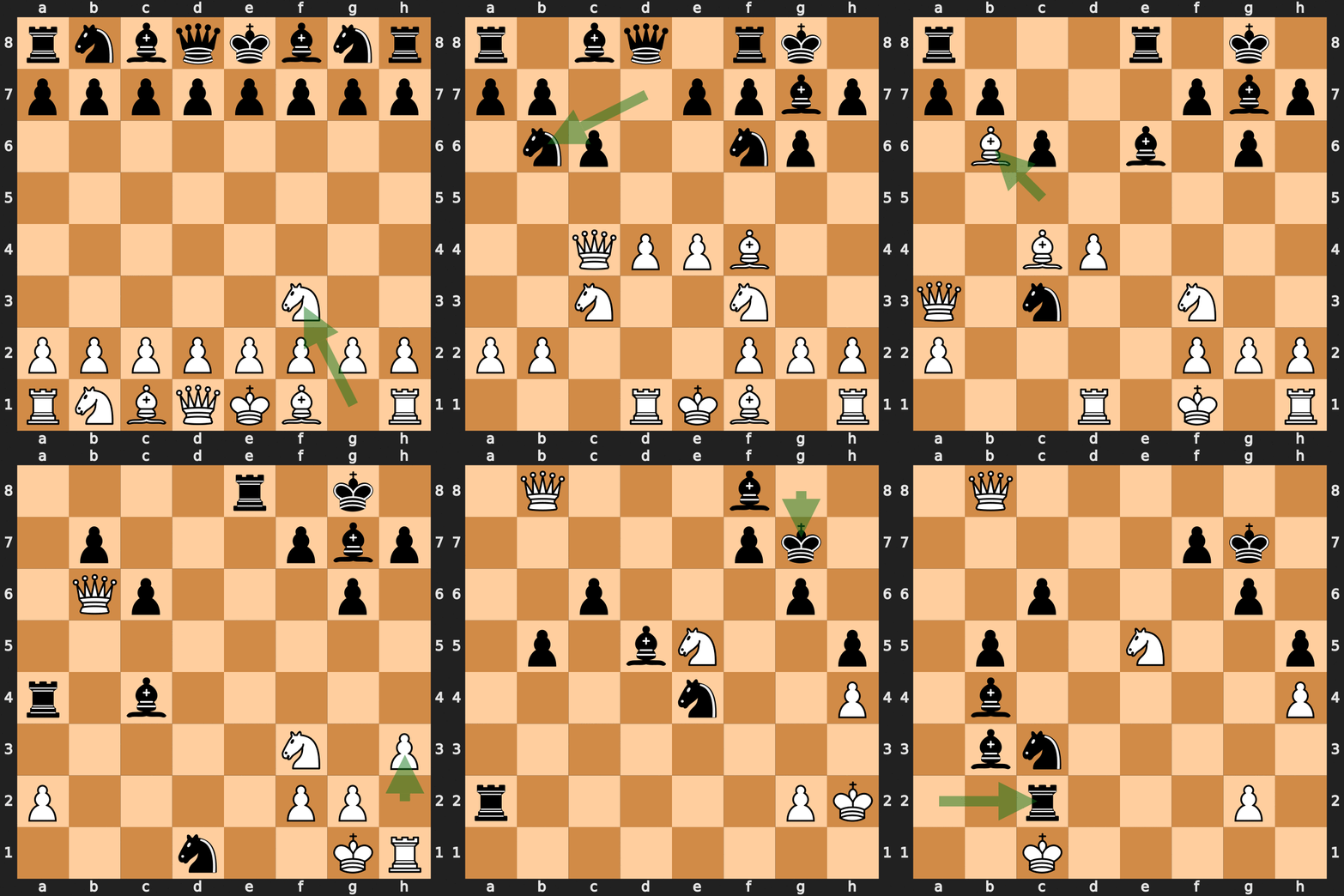
Algebraic notation in chess shows each move that a player makes. Ranks (rows) are notated with numbers, while files (columns) are designated a letter. Thus each of the 64 squares on a chess board has a name, the letter first, followed by the number. For example, the most popular opening in a game of chess is to place a pawn on the square e4. This square is located within the “e” file and on the fourth rank.
Chessgames.com provides the algebraic notation, along with some commentary, for “The Game of the Century.”
In order to show what happened during a chess move players write down not only the square that a piece was moved to, but also what piece was moved and whether something was captured, checked, or checkmated. (There are a couple of other symbols, but these are the major ones.) Abbreviations are used in order to save time. The moves are recorded so that the game can be analyzed and studied afterward. Most chess apps online and on phones will create the notation for you.
The algebraic notation of a chess game looks a lot like code. That’s because it IS! It is a string of commands. If you know how to read it, you could recreate a chess game, move by move. You could plug the code into a computer, as chessgames.com did for “The Game of the Century” between 13 year old Bobby Fischer and International Chess Master Donald Byrne originally played during the Rosenwald Memorial Tournament in New York City, October 17, 1956.
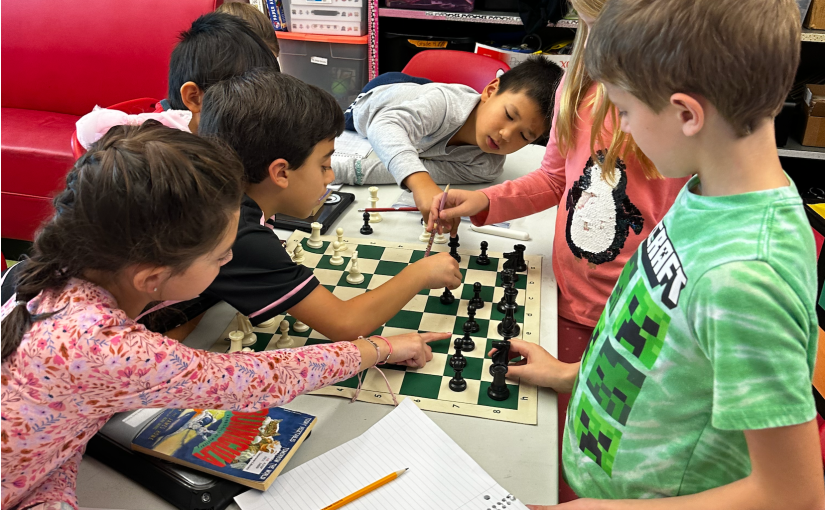
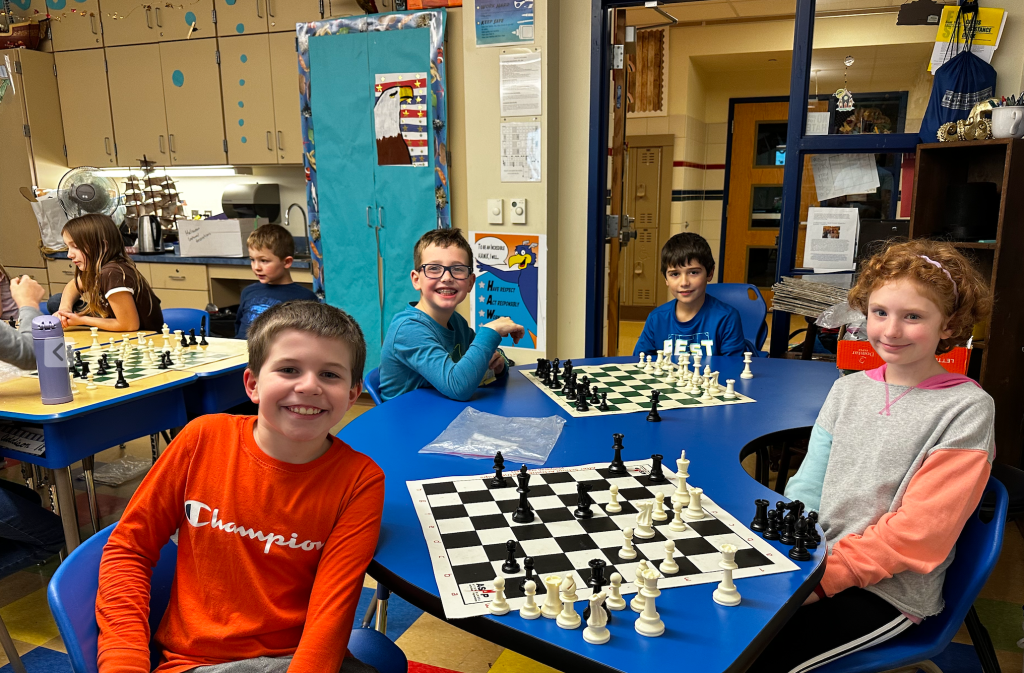
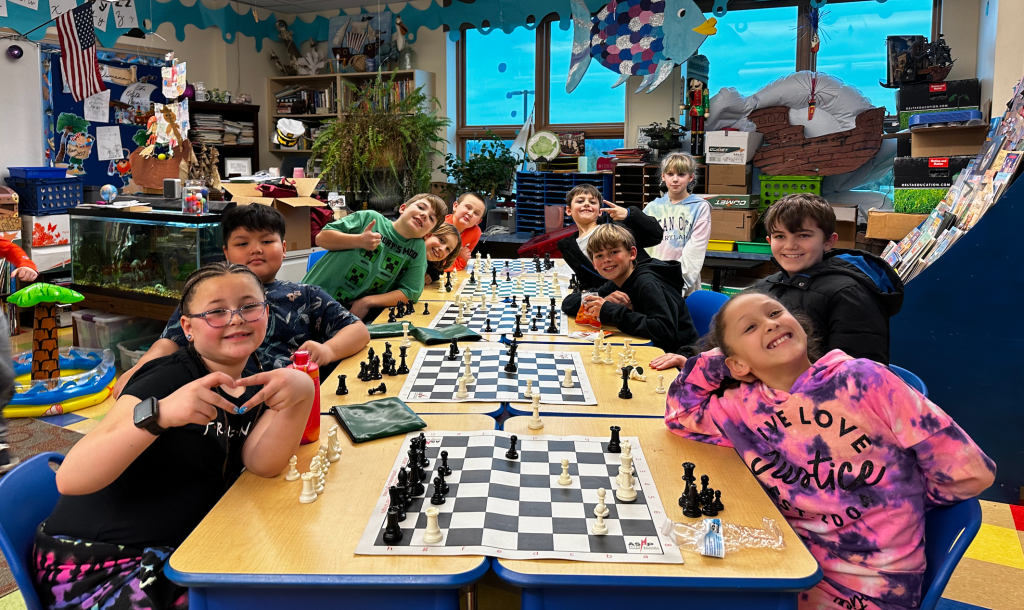
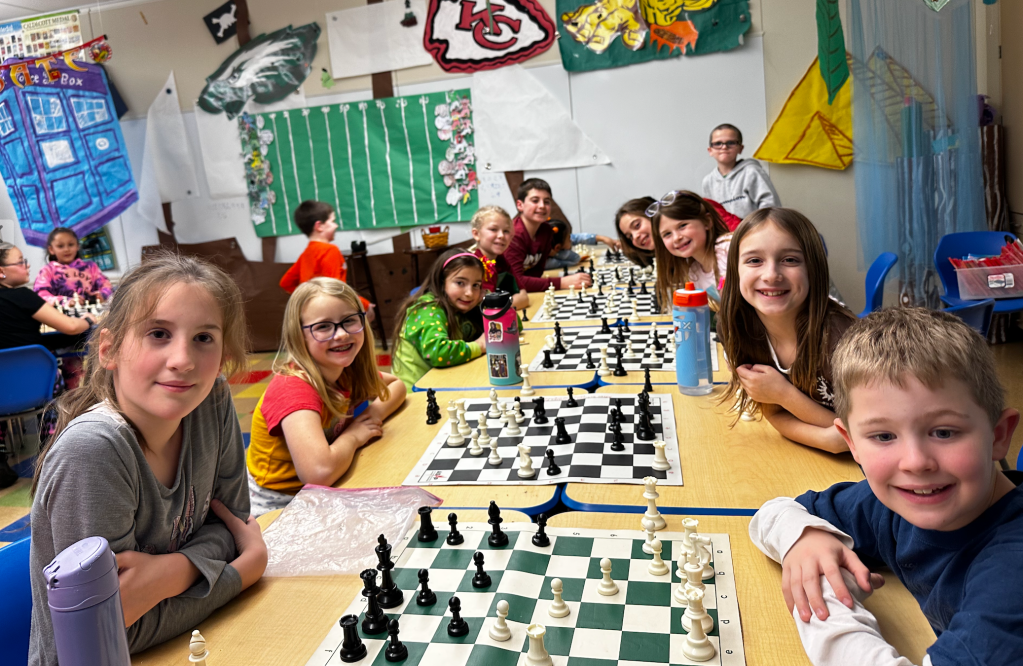
For several years I have been teaching elementary-age kids (7-11) how to play chess. I’ve run a chess club that meets after school. While I always share information about how to read algebraic notation, I don’t require them to use it during play. I want them to learn the game and have fun.
As students get better and begin playing in tournaments, however, they will need to learn to use notation. During competitive play, they will be required to write down the code for each move on a piece of paper. Next to their move, they will also write down their opponent’s moves. In this way, they will be able to “view” the game after its completion. Serious players do this to evaluate each move. Which ones were better than others? Where did I or my opponent falter? What was the critical move? What could I have done differently?
When solving a math problem, it can be valuable to write down some notes. Why? Sometimes you do this to keep short term memory space available. If there are a lot of numbers and a lot of computation is going on, there might be too much to remember in your head. Along the route of figuring out the answer, you write down what you have so far.
Another reason for taking notes can be showing the steps you took to solve the problem. This might help someone else see a path from beginning to end of the math problem, demonstrating how the answer was achieved. They could “replay” the action of solving the problem by reading the steps taken.
In school, this last “reason” is usually proposed by teachers who want to “see” how you did your work. They say, “Show me your work,” so often that it becomes grating. And, writing down each step of computation can become tedious for a student who just knows the answer. Back in January (2024) I wrote a blog (Part 1) about students communicating their math work creatively. Learning to write down the steps involved in solving a math problem has value, however.
Here are a couple of ideas.
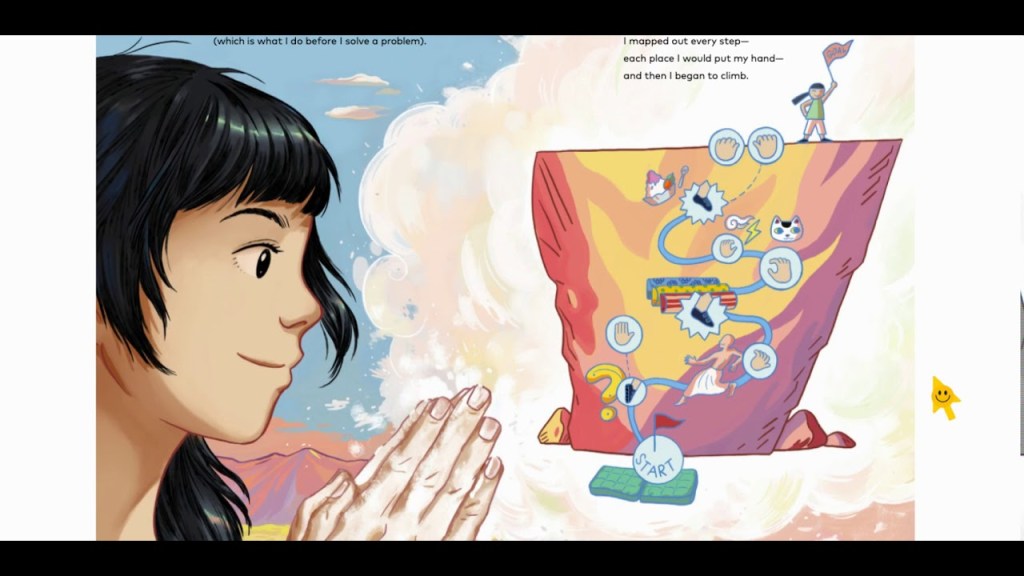
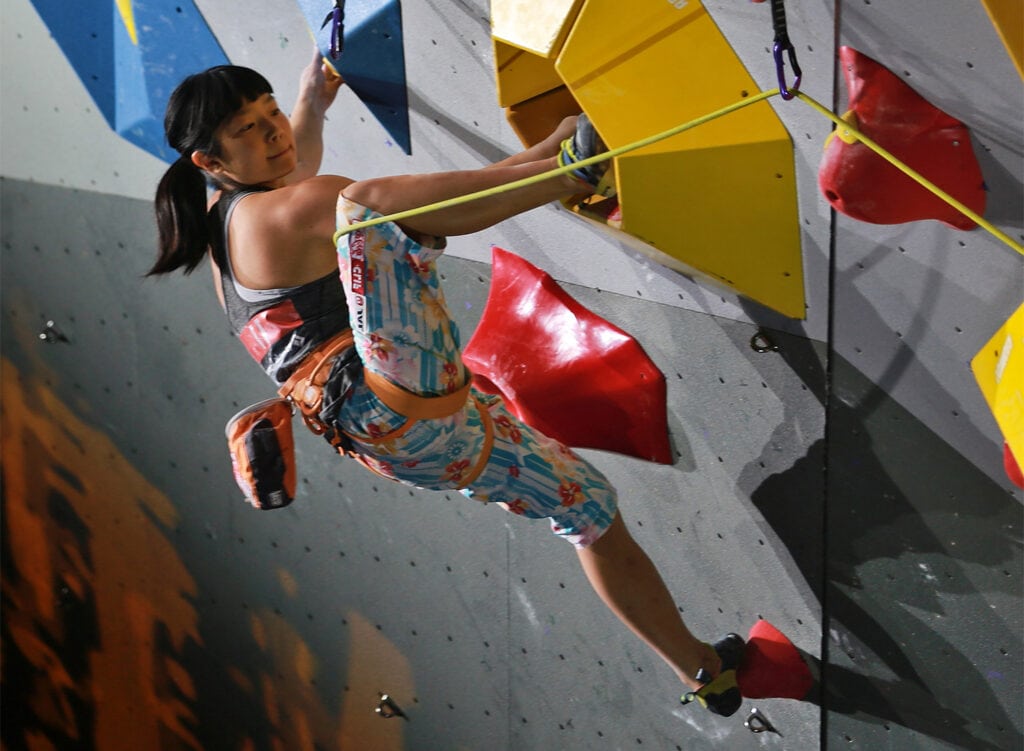
First, instruct students to treat each math problem as though it were a rock-climbing problem. Ashima Shiraishi is a champion of solving problems. She wrote a book about it. “How to Solve a Problem: The Rise (and Falls) of a Rock Climbing Champion” tells the story of 13 year old Ashima figuring out a map that will guide her to the top of Golden Shadow, a V14 boulder in Rocklands, South Africa. The story is an excellent metaphor for not giving up. It also shows how Ashima uses imagery to map out a doable path up the face of a difficult climb. She assigns symbols to the holds and footings that she uses. As she ascends, time after time, for it takes many tries to successfully conquer a difficult problem, she creates a story in her head, using the beneficial symbols (holds), so that she can find her way. The book, illustrated by Yao Xiao, shows (on paper) what Ashima does in her head.
I often see students erase their math when they have tried a set of steps that did not accurately solve a problem. “Don’t do that,” I tell them. “You could very well make the same mistake again. It’s helpful to see what didn’t work, as well as the correct answer. I (and your math teachers) want to see the journey you took, including the fruitless paths.”
Second, teachers ought to present problems that are worthy of their students’ struggle. Ashima Shiraishi has an amazing story of being the youngest person to successfully climb very challenging problems. At the age of 14, she was the first woman (and second person ever) in the world to climb a V15 boulder problem. She has crushed youth competitions, winning several years in a row. When she and illustrator Yao Xaio chose a problem to use for the basis of producing a picture book for kids, they decided on one that was very challenging. Ashima fell many times, having to start over at the beginning. The text shares her process of imaging each place that her fingers or toes would hold as something specific. One was the dot at the end of a question mark. Another was the crook of her dad’s elbow.
What if Ashima used a simple boulder to illustrate her problem-solving skills? One of the most important themes of the short book would be lost; The idea of developing and practicing persistence couldn’t very well be shared if there were no falls.
Create fewer math problems that are more challenging. Cause students to have to struggle to conquer each one. If they are required to make memories, it will mean more. If you want your students to “show their work,” give them a problem so complicated that they need to write down notes to get all the way through it.
The math problem should be a challenging chess opponent in a tournament. Your students should have to show each “move,” as they progress through the solution of the problem.
There will be practice problems. These are like the rock-climbing walls that Ashima climbs to stay in shape and hone her skills. She will climb the same wall over and over. She will challenge herself to complete the climb faster with each ascent. A story may be imagined for the short climb, and it could be repeated in her head a hundred times, giving the climb life and familiarity.
This is like memorizing an opening for chess. Increasingly good chess players will learn a variety of initial moves that great players have developed over the years. They will memorize these opening moves through many steps, so that they can anticipate and prepare for potential rebuttals.
In conclusion, if you want your students to show their work, give them something worthy of writing down the steps it took to complete. Teach them how to make the sharing of their math into a story. In the same way that each move in an important chess game is vital to its end, have students think about what they are doing and share the most important parts of the process. You could even have them try to identify the most crucial part(s) of the problem-solving process. With each boulder of a math problem you give them that challenges their minds and they successfully solve, they should develop a hunger for tackling more and more formidable ones in the future.
“How many more squares is White attacking than Black?”
This problem was awesome on a few fronts. Students had deciphered a Morse code message that shared a short sequence of chess moves written in algebraic notation. They played out those moves and discovered that one player had a huge advantage over the other. “How much of an advantage? Be specific. Can you put a numeric value to the advantage?”
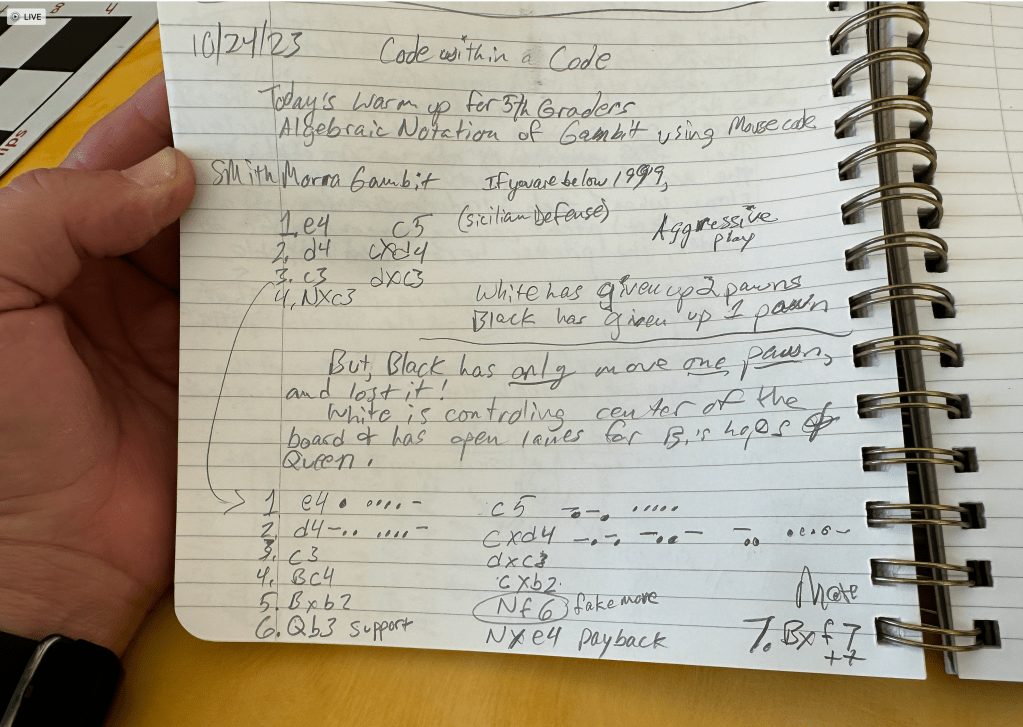
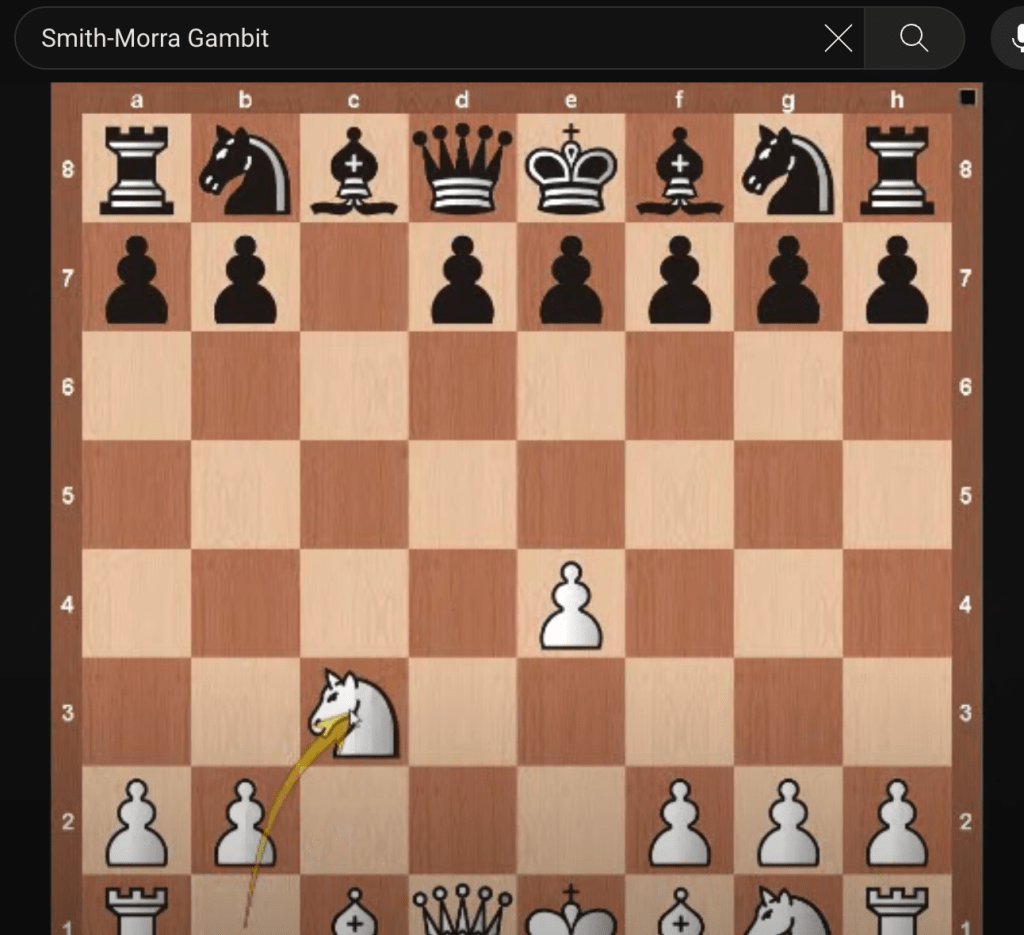
It all began with my preparing a lesson for chess club. I was going to teach club members about gambits. I researched the more common gambits and landed on the Smith Morra Gambit. I found a succinct video on Youtube that explained the gambit. While watching the video, I wrote down the algebraic notation.
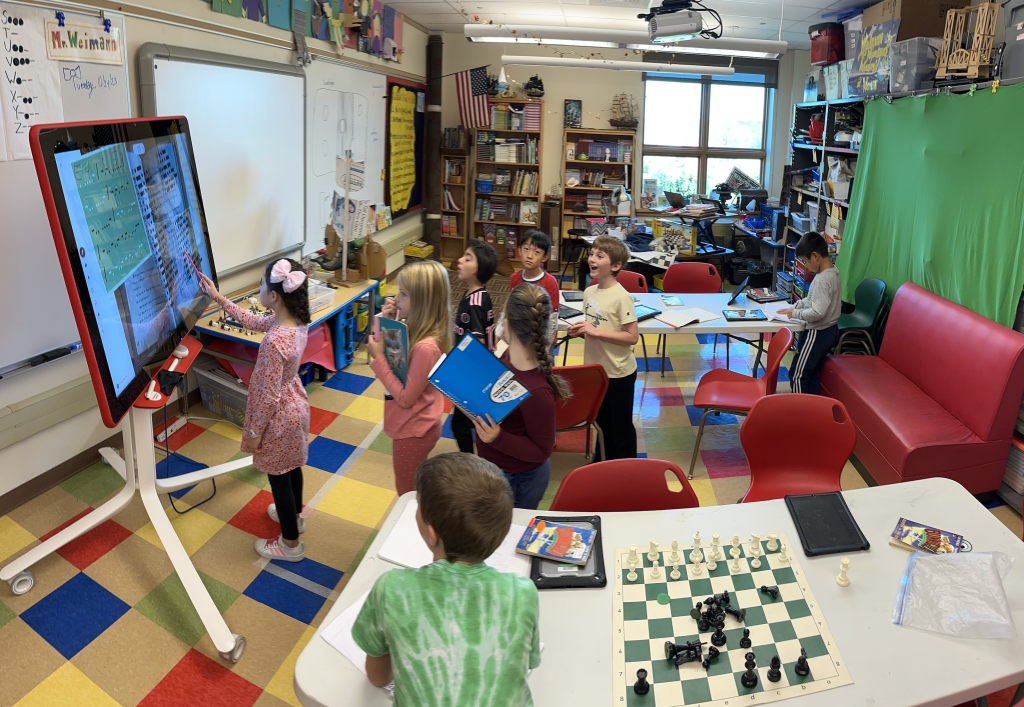
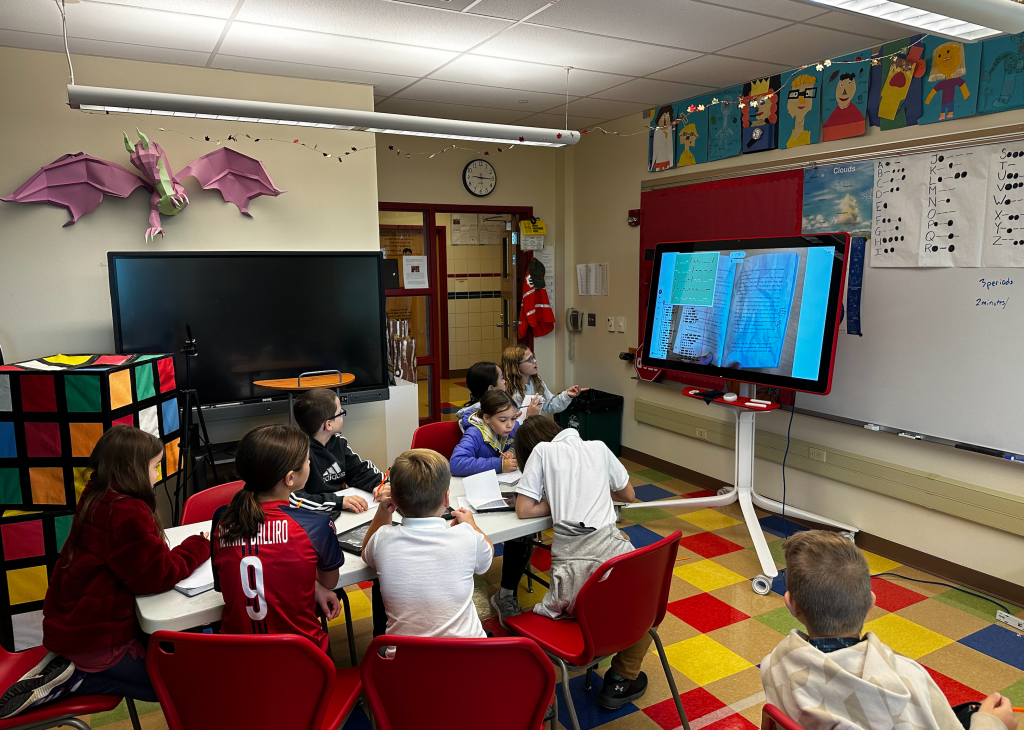
But, I wouldn’t just give them the chess code to learn the gambit; I decided to have my gifted students decode the code! My fifth grade gifted students were the first ones to see the code. They had only dabbled with decoding Morse messages.
I had used Morse Code Translator to change the chess play sequence into dots and dashes. Rather than writing the number of the move; This was going to be confusing enough as it was; I decided to change the colors of the moves. White’s moves were turned to white dashes and dots. I made the background of the text box green, so that you could easily see the white and black codes. I put an image of my code, along with the Morse Code alphabet and accompanying numbers onto a Google Jamboard. The fifth grade gifted students were on it the moment they walked through the door.
The two things that I shared with the fifth graders was that the slanted line (/) separates the words; In this case it broke up the moves, but I did not explain that. I told them nothing about the actual message. The second thing that I pointed out was where each letter or number’s code ended. The translator that I use makes it much easier and faster to produce Morse Code, but sometimes it is difficult to locate the space between each letter/number. After pointing out these two key factors, I stepped back and watched the struggle.
Right away I heard a couple students divvy up the White and Black “words.” I was glad to hear the idea of collaboration. I wondered how long it would take for someone to understand that these were not actually words. The very first coded move was e4, the most popular opening move in all of chess. I heard a few people verbalize bafflement, but several recognized the move, “It’s chess!” someone shouted.
I didn’t help them with any of it. At least one student knew enough to be able to read most of the algebraic notation and make sense of the moves. Of course I had a chess board and pieces handy, and we set up a game. I let the students figure out the sequence of play. When they came to the gambit on the second White move, I stopped them to explain what a gambit was. This was good practice for my chess club lesson that afternoon. A couple kids would get a double lesson, but that was okay. They could be my co-teachers!
“The word gambit is closely related to gamble. It means taking a risk. A chess gambit happens when one player offers up a peace as a sacrifice in order to draw an opponent into a trap or sequence of moves that would benefit the aggressor (the one offering the gambit). Do you capture the sacrifice or risk the piece taking your own?”
I had the fifth graders play through the short sequence until Black’s pawn was captured. Black had accepted the gambit, capturing the initial White pawn placed on d4. White offered up another pawn on c3. When Black captured that, White might feel a little on edge, because now there is a Black piece threatening the second rank of the White team! It is so close to attacking the Queen!!
I pulled one of my old tricks and gave my gifted students a #code within a code… with a riddle sprinkled on top.
Before any more damage can be done, White captures with the Queen-side Knight, Nxc3. White has lost two pawns, while Black is only down one. If you were to only count points, it would appear that Black has the advantage, being up a point. A mere glance at the board should show even a novice player that White is in a much better position!
I explained to the fifth grade gifted students that the best thing to do at the beginning of a game of chess is to control the middle of the board. With that criteria, everyone can easily see the trap that Black has fallen into. There is a White pawn left sitting on the initial e4 square. And, now a Knight is “developed,” backing up the e4 pawn and attacking four more squares (b5 and d5 as well as a4 and e2).
The fifth grade lesson stopped there, but my fourth grade gifted students got a treat. It only took seconds for them to figure out that the Morse Code message was algebraic notation for a chess game. When I heard some groans, I told them, “The first to solve the riddle can play me in a game of chess.” Now, the heat was on. I set the board back up in the middle of a table while my students grappled over letters and numbers seemingly unrelated to one another.
We worked through the Smith Morra Gambit sequence the same way I had with fifth graders. I had the fourth graders figure out the algebraic messaging. They figured out that the Xs meant a piece had been captured. I had to explain that the “d” in dxc3 meant that the capturing pawn had come from the d file. After explaining gambits and discussing the advantages and disadvantages of the board we were left with, I played a blitz round of chess against a pair of students.
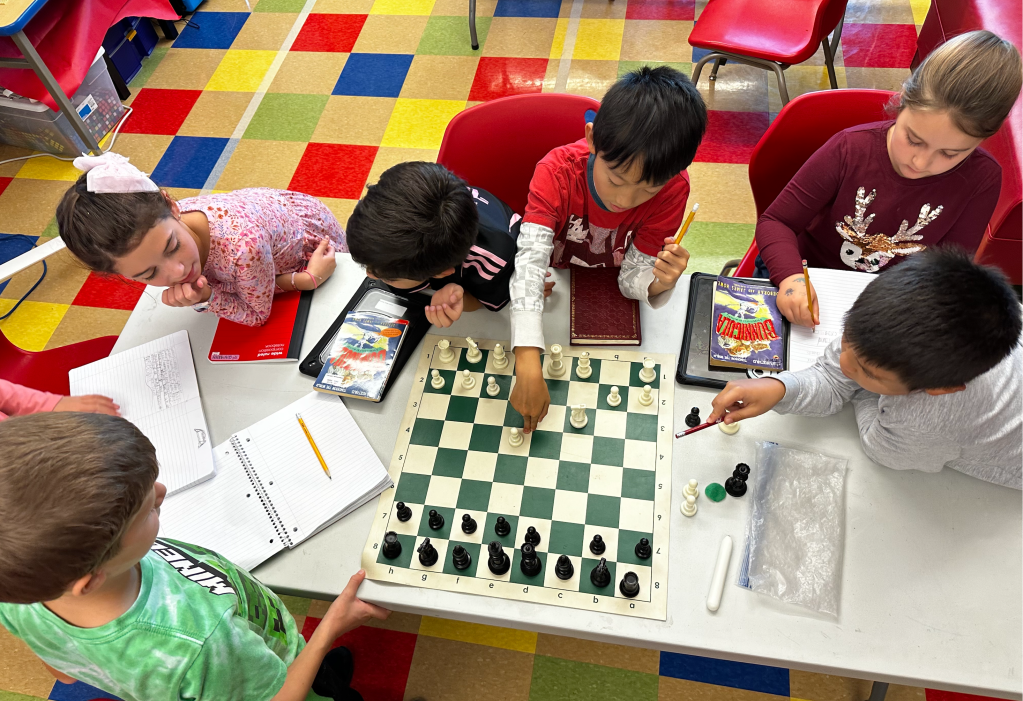
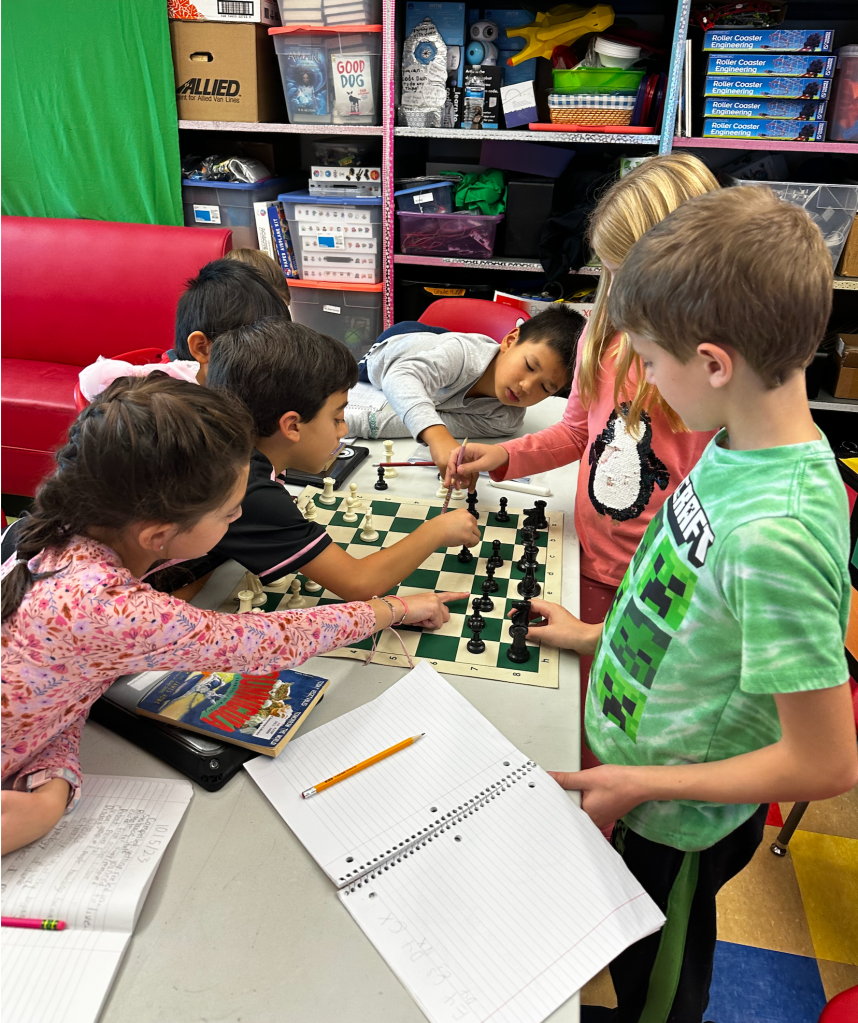
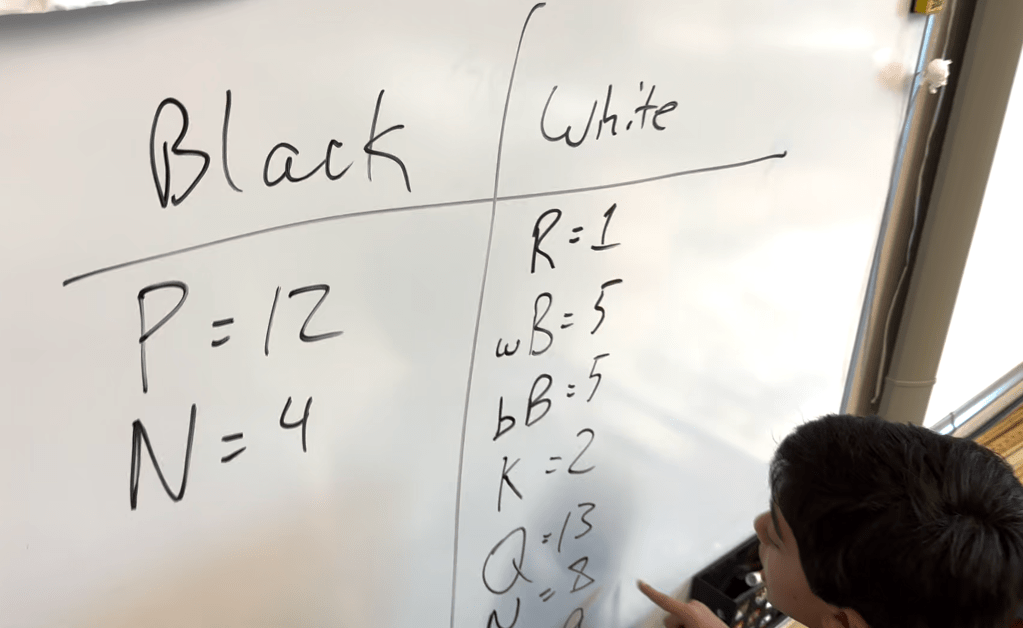
Third grade was next, and these students are not only classy, but they are some of the hardest workers I’ve witnessed. Their grit knows no end. I presented them with the same problem. They labored through decoding my Morse Code message. We played the sequence out. I taught them what a gambit was, and we discovered the significant advantage that White was left with. But… Then I was hit with a question that I liked so much that I recorded it on video so that I would remember it: “We know that White has the advantage, but how much of an advantage? Can we put a number to it? How many more squares is White attacking than Black?”
Not all of my third graders know how to play chess. I taught the team how each piece attacks. “How many squares is the King attacking?” I asked. I showed them how it moves. The answer was two squares. “How many squares are the Bishops attacking?” We looked at their lines of attack. I showed them the squares that the Queen attacked, including the Black pawn on d7. We went over how a pawn attacks diagonally and the way a Knight moves. Then I set them loose.
A few floundered, so I guided them to make a T chart. “Let’s do one color at a time,” I suggested. “Also, how about we focus on only one piece?” We carefully counted all of the squares that the Black pawns were attacking (12). Then we counted up the Knights’ attacks (4).
Next we moved on to White. There was an empty square next to the White Rook, so that counted as an attacked square. We continued counting until we covered every piece. I missed a couple of the the Knight’s attacks, but Gray got my back. She caught my mistake, and we corrected the calculation.
In the end, we discovered that White was attacking 43 squares to Black’s 16, way more than twice as many! So, was the gambit worth it? I’d say so. And, what could Black do differently to limit the massive advantage? Don’t fall for it. Don’t take the gambit. Push forward or ignore, but definitely think ahead.
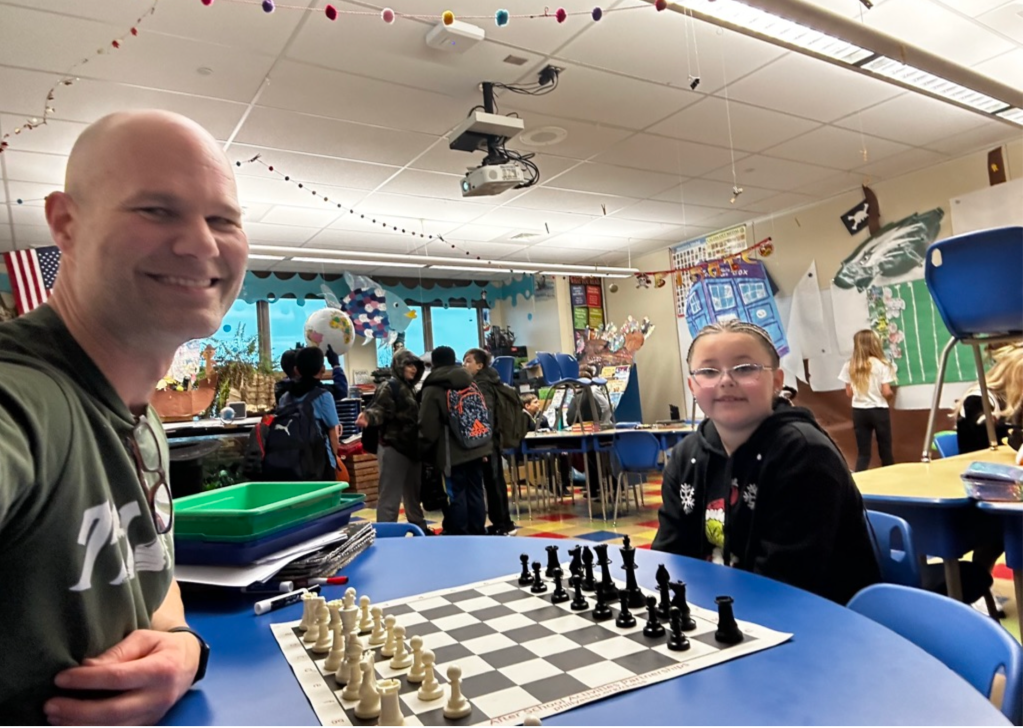
I have a chess board set up at the table, right next to the door to my classroom. This former (but always) Polite Pirate stops by regularly for a quick game before the morning bell.
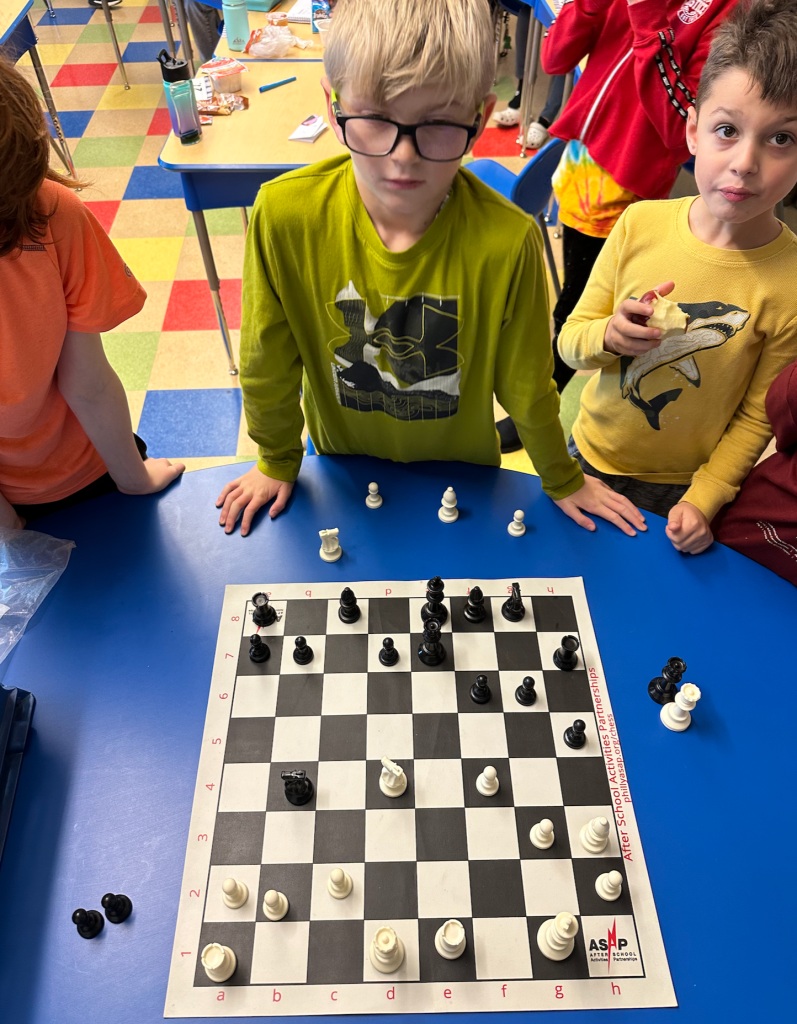
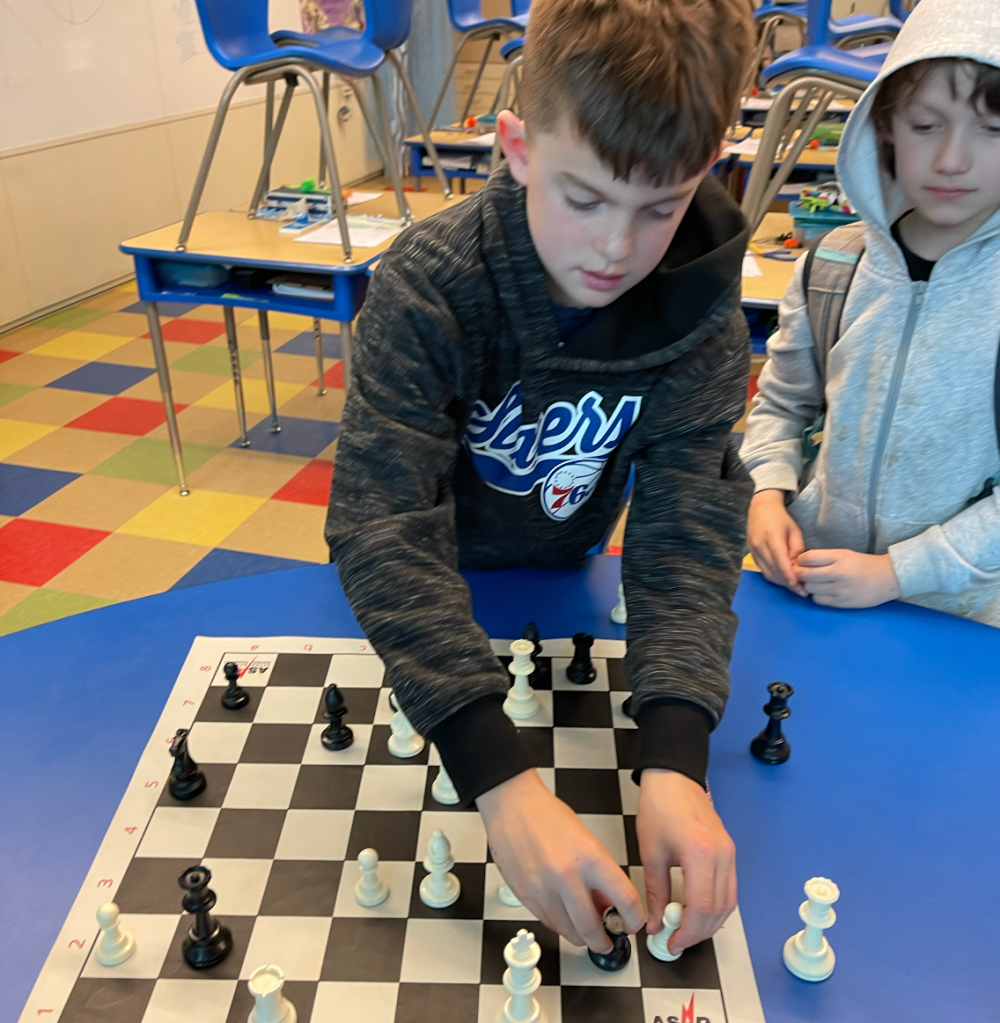
It is common for my students to want to sneak in a game of chess before school. This morning I’m playing a beginner. The student has pushed four pawns forward. I instruct them to, “Develop your pieces. Those are the ones that are not pawns.” Once again, a pawn is advanced. I inquire, “Why are you only moving your pawns?” as I capture one with a Knight.
This student has been getting to class early, just to be able to squeeze a game of chess in before the bell.
“If I get them (pawns) to the other side, I can turn it into a queen.” Now, I understand. This student has learned the exciting idea of promotion. When a pawn, the lowliest of chess pieces, is able to traverse the entire length of the board and achieve the final rank (the row farthest from its starting point), it can be exchanged for Rook, Knight, Bishop, or Queen. The idea of having more than one Queen can make a novice chess player possessed with potential.
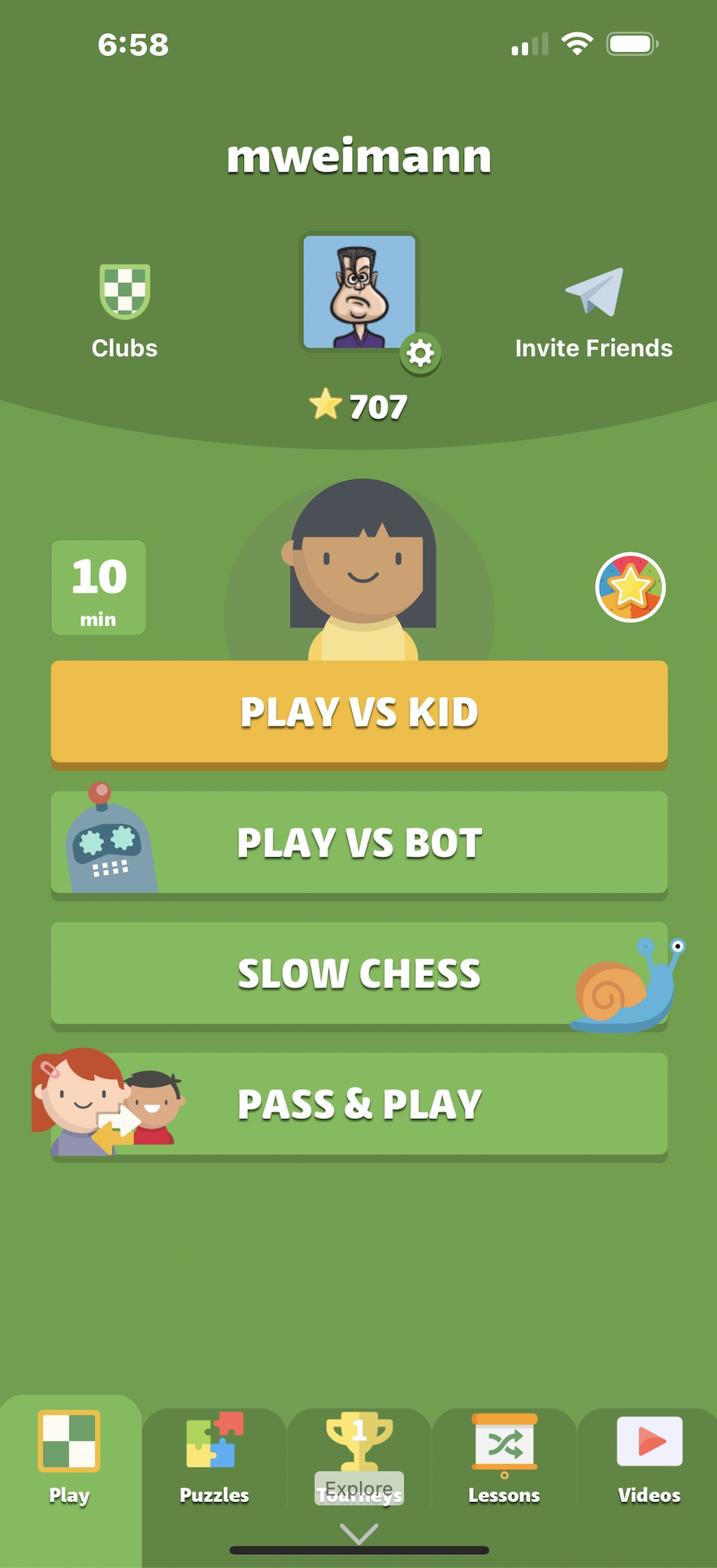
When I am introducing chess to students for the first time, I have them take what I have taught them and try out the concepts in an online app called “ChessKid.” This app is totally awesome! While a paid-for membership will open up a world of resources, students can access some basics for free. The main thing I have students use is the “Play vs Bot.” Students can play the first 3 robots for free. The beauty of using this app is that it won’t let students make illegal moves. Also, there is a feature that allows students to see potential moves when they press on a piece. Circles will appear on the squares that a piece can move to.
Admittedly, the first 3 (free) robots are pretty easy. They will give up their queens early in the game. Students will need to know what they are doing to beat the third, but it is very doable. I end up challenging the students to win their games with as few moves as possible to up the challenge. This teaches them “tempo.”
Something students discover while playing the robots on the Chesskid app, even before I teach it to them, is that their pawns can transform! The first couple of robots hand over piece after piece, so that beginner players can easily push pawns past pieces to acquire multiple Queens. Some of my students have bragged about having 5 queens parading around the board. I point out that they ought to have won the game before accumulating all of those Queens. Really, though, it is fun to explore this feeling of power. (That is an idea to be explored in a future blog.)
Back to the game I’m playing that began this blog. I point out that my Knight just captured one of their pawns, and more captures are sure to follow. “What makes you think I’m going to let your pawns reach the last rank?” I probe.
The student ponders this a second before advancing one more pawn. I’m incredulous. Should I sweep the board, capturing every pawn? They are sitting ducks! Should I allow the student to push a pawn all the way to promotion, so that they feel vindicated? They weren’t theoretically wrong.
“I don’t have to study in school; When I grow up, I’m going to be a professional baseball player.” Have you ever had a student say something like this?
“Even successful, rich baseball players have to know how to read, write, and do math,” the teacher retorts.
“I don’t need to save money. I’m making it hand over fist right now.”
“What do I have to worry about? I’m the healthiest person I know!” Or, “I’m perfectly happy without exercising. What do I have to be fit for?”
Do not count on potential. Plan for a challenging future. Play life like there are threats around every corner, but enjoy the game.
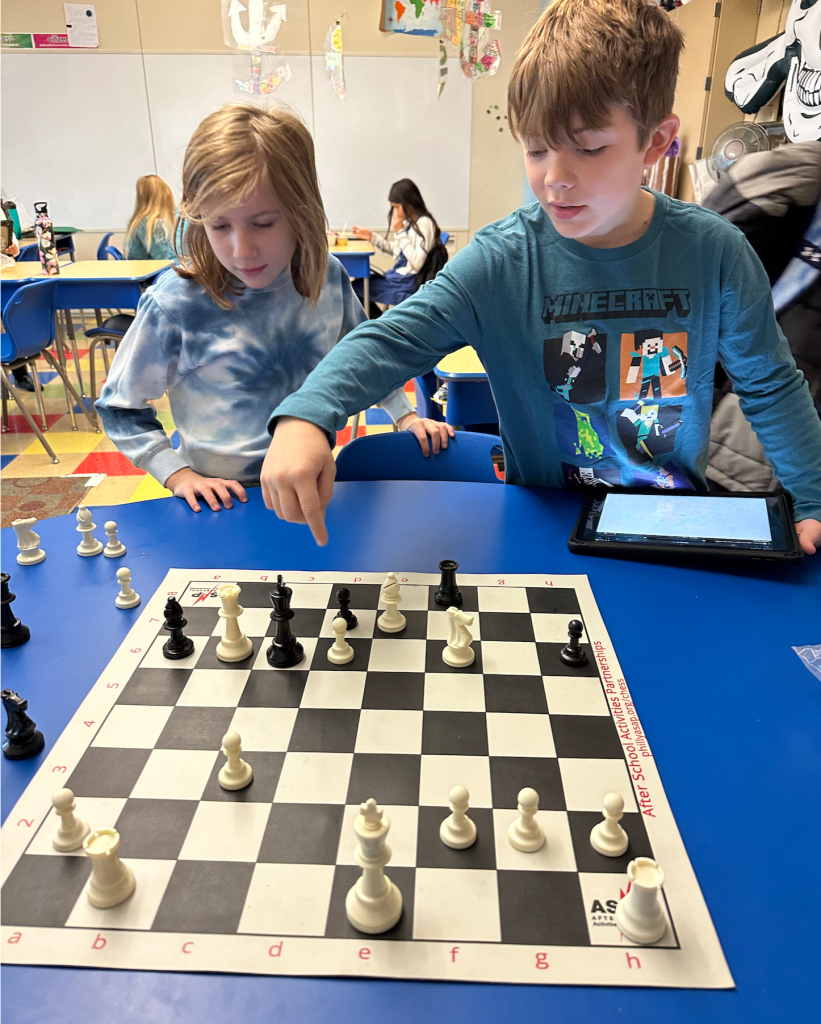
These two analyze a recently played chess game. What moves would have been better? How could Black have avoided the mate?
“You already have a Queen, right there,” I suggest to the opponent sitting across from me. Even as I say it, I know the feelings the student is experiencing. They don’t want to jeopardize their only Queen. If they had a back up, then they could feel comfortable with the possibility of losing one. I know this feeling. Once a piece is in use and moving around the board, it becomes vulnerable.
“The smart thing to do is to protect your potential pawn promotions by holding back a little.” From player to coach, I transition roles throughout my play with this pupil. I instruct my student to “Position your pawns so that they are backing up a more valuable piece. In this way, if your opponent captures your piece, you can retaliate by capturing the offending piece with your pawn.” I show the student how pawns can even back up one another by staggering mine in a large V. “Bishops can slip through on the diagonal, but Knights are waiting to snatch them up!”
There have been times I’ve thrown away my pawns in order to clear a file for my Rook. Recently, I’ve preferred to position a Rook behind an advancing pawn. Go ahead and take it, Queeny! I’m even more keen on this strategy when I’ve saved other potential pawn promotions for the future. Sometimes, I’ll slide my Rook up the side and start cleaning out my opponent’s pawns from behind. Then mine can easily advance, straight toward the last rank.
Have you ever known someone who walks through life like a bull in a china shop? Every tiny bad look or perceived insult is grounds for war. They blow up over the smallest thing. A pawn is not a Queen until it actually makes it to the last rank. Don’t assume more power than you have. Some people go through life proudly proclaiming their importance before actually earning it.
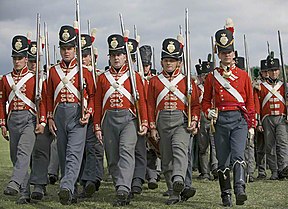
As it turns out, the bell rings before my game ends this morning. No one wins. All of my blabbing about protecting promotional material has slowed down our game. An observer looking at the board might conjure a picture of the Red Coats marching in a straight line, being picked off by Revolutionary Rebels hiding behind trees during the war for Independence. I have pieces attacking the center of the board, and my opponent has a wall of pawns waiting for the picking. Saved by the bell, or unused potential, this game will end with this blog. I hope someone finds the metaphors useful. Pawns can be powerful; They can be a pain for an opponent; But they have loads of potential. [Insert closing sentence, here.] <–I plan to have the Polite Pirates help me come up with a classy closing to wrap this up.
It is common for elementary age students to mistakenly capture their opponent’s King in a game of chess. During today’s chess club, I corrected a couple of kids. “You don’t actually capture the King,” I explained. “You win by arranging the board in such a way that the King is under attack and cannot get away. That is Checkmate.” I asked them to show me how this had happened.
When one of them walked me through the moves, I saw that a pinned piece had been moved, placing the King into check. You can’t do that. I took the opportunity to teach the whole chess club about pinned pieces.
A Pinned Piece in chess is a piece that is blocking an attack on the King. Moving it would place the King into check, and you aren’t allowed to do that.
How does this happen? Sometimes, a piece will be used to block an attack. If White has an exposed King (no White pieces in front of it), and Black moves a Rook onto the same file (vertical column on chess board), the White King is in check. A common defense might be to place the White Bishop in front of the White King. This is exactly what happened in today’s game.
At other times, crafty opponents might trap your piece by passive-aggressively attacking the King. They will arrange their pieces so that they would be attacking your King, if you were to move any of your pieces. You look for a way to shift your pieces into a more advantageous position, but they are locked down. Moving them would jeopardize your King. No can do! You begin to feel stuck, smothered, tied in a straight jacket.
As we were walking down the hallway of my school, heading toward the entrance where parents were waiting to gather their offspring, I closed the lesson on pins by summarizing some of the main points the club had discussed. Without even thinking, I shouted over my shoulder, “Even the most powerful piece can be made powerless with a pin.” That struck me as an important metaphor.
A highly skilled person with a lot of valuable experience is working a job that is way beneath their ability. Why? Why don’t they leave that job and work somewhere with better pay? If they did, they would lose their health insurance. Perhaps a retirement plan is pinned to their current job, and they must wait out the years, until they can cut the tie, or else jeopardize losing all of that savings. Maybe they have worked hard to climb the corporate ladder, and leaving would mean starting at the beginning! It could be pride, money, safety, or more pinning them to their powerless position.
Someone is in a relationship with a person who abuses them. How could they not just leave? Perhaps the abusive person has arranged all monetary and material assets in their name. The hurting individual would have to strike out on their own, penniless, not to mention poor in spirit! Maybe, the abusive person was cutting the person down emotionally. You don’t know how low someone can make another feel. Beliefs like, “I can’t do anything without my partner, because I am so dumb… I need her in order to feel good about myself… I am worthless without my family…” infect the heart and create, not cracks, but fissures in the Love Tank. Power pours out of a person squeezed by emotional abuse. They are pinned to their situation, and you can’t see it at all!
Can you think of any other examples of powerful people pinned to positions? If so, mention them in the comments.
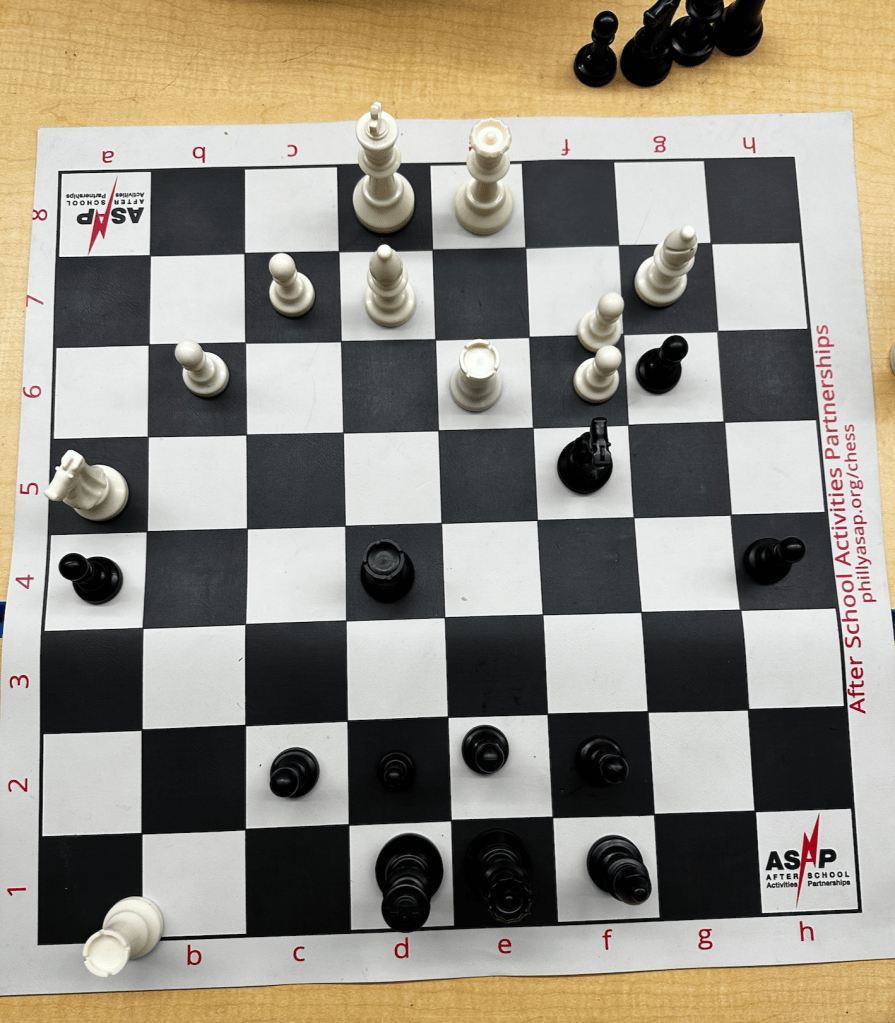
Part of my lesson about Pinned Pieces on the chess board included how to avoid this predicament. “What could White do to get out of the Pin?” I began with.
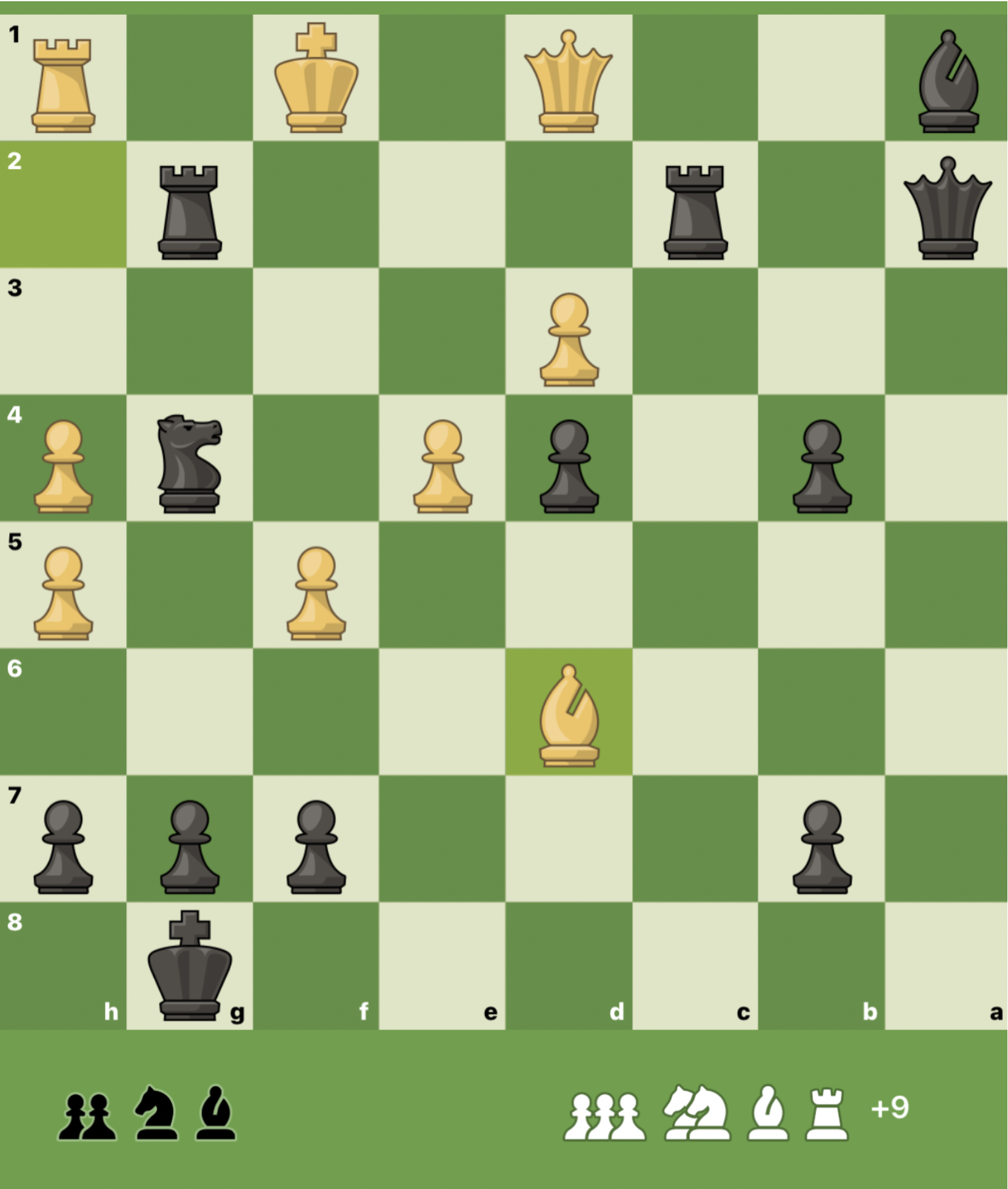
A sharp student mentioned moving the White Rook over a space to block the pin. “Then the Bishop would be free (unpinned) to move around on the board. It could even attack the Knight on f5.”
“But, not before that Knight captured the Rook unpinning the Bishop, after having moved it to d6,” an even sharper student pointed out. “You could move Pawn to c6.”
“How would that solve the Pin Problem?” I inquired.
“The Black Rook would have to move in order to avoid capture.”
I studied the board. “Could Black simply move the Rook to another square, continuing the Pin?”
“Yes, d5 and d3 are both safe. And, if the White pawn advanced, the Black Rook could simply return to d4,” a collection of students offered.
A student in the back of the room raised her hand. I had to refresh my memory of her name before listening to her brilliant idea: “Move the King to c8.” Not only does this free the pinned Bishop, “It gives the King more spaces to move to. E7 is being attacked by the Black Knight,” she explained. Amazing thinking!
Unpin by removing the threat. Our highly skilled worker who would like to look elsewhere for a job might invest in a retirement situation outside of their job. Maybe they could acquire health insurance through a spouse or alternative situation. The abused romantic partner could find support in people or ideas independent of their relationship. They may not be able to “Block” the abuse, but removing the line of attack by getting out of the way could prove both saving and empowering.
In conclusion, if nothing else, analyzing situations from more than one angle can be a powerful way to govern one’s life. Treat your everyday scenarios like a chess match. They are full of cause and effect that, when analyzed carefully, could be played in powerful ways. This can extend to your life goals, as well. Evaluate your vision for the future. Is it “blocked” by a piece you wish would move out of the way? Are you “pinned” by being stuck where you are? Remove the pin or remove yourself, so that the powerless part of your life is no longer being pinned down. Free yourself.
When you’re a kid, you have very little power. Grown ups make all of the decisions for you, from what you wear, to what you eat, to when you wake up and when you go to sleep. What does a kid have control over?
Give your students the gift of power.
Sports and games are tools and times for kids to experience power. After teaching a child how to play a game, you let them make their own decisions. They try out different tactics. Sometimes they fail, and it’s your job to make sure that is okay. We work at providing nurturing spaces to practice wielding power. Both successes and failures will help children adapt behaviors and thinking.
During a foot race, maybe a child will sprint the first few meters, only to find out that they ought to have saved a little energy for the end. Another will conserve energy too successfully, allowing all of her opponents to pass and get so far ahead that she will never catch up. A basketball star will learn that his team isn’t going to be as pleased with him taking all of the praise, even if he did score the winning basket. It’s a good idea to share the wealth when it comes to glory.
There are many life lessons that can be learned and experienced through playing games. One of my favorite games for empowering kids is chess. This is NOT because I am good at it. I’m not. In fact, it is because my students CAN and do beat me at chess, that I have witnessed, first hand the empowerment of the game.
I teach third grade, which means that my students have not quite developed abstract thinking yet. Chess presents concrete cause and effect relationships, combined with complicated but recognizable patterns that help players predict the future.
The game involves capturing your opponent’s pieces and ultimately cornering their king. The various pieces have different ways of moving and capturing. The fact that there are so many rules for moving pieces may seem daunting to a novice, but I find that they provide power. Knowledge of how chess works unlocks the mystery of the game for kids. Have you ever seen the gleam on the face of a child who tells an impressed adult, “I know how to play chess”? You might think that they could perform CPR! And, if you run across a student who has checkmated an adult, you’d swear they could fly or jump over entire skyscrapers in a single bound at the very least.
Immediately after teaching my students how all of the pieces work, I jump right to the very end of the game; checkmate. I show my students how it works and what it looks like. Checkmate happens when you are attacking your opponent’s king, and there isn’t any way for him to get out of being attacked. He is trapped. You possess all of the power of the board.
This video was made when Scarlet was only 6.
Once you understand what checkmate is, you work toward making it happen. This usually involves capturing your opponent’s defensive pieces. A player will try to trick an opponent into giving up “material,” by creating scenarios that cannot be escaped or avoided. It takes planning ahead to forge tactics like forks, pins, and skewers; chess terms depicting powerful strategies. Likewise, it requires noticing patterns to avoid these pitfalls.
When a child wins a game, he or she will feel good about him- or her-self. So much more, if the game is complex and difficult. Combine that with the idea of defeating an adult or someone who traditionally signifies power over them (babysitter or older sibling), and the effects are exponential.
This student is setting up a game for beating me, having done so 5 times, so far.
I have seen this first hand. In order to squeeze more chess into the school day, I sometimes use a chess clock. This is called speed chess. You still try to capture pieces and ultimately checkmate your opponent, but added to the game is “running out of time.” Whoever has their time disappear first loses.
Well, I was playing a wily 3rd grader earlier this year, and he placed me in enough troubling situations that I needed to use more time thinking about getting out of traps than I was allotted. Suffice to say, my clock ran out. As time ticked down to seconds, my opponent’s friends gathered around our game. They couldn’t believe his success. And, when my clock turned red (time’s gone), he jumped up and screamed, “I beat Mr. Weimann!” followed by running around the room, further announcing to classmates, all of whom definitely already heard the news, that he had defeated the giant.
I’ll be completely transparent and honest with you and myself: It felt humiliating. I was super tempted to sit everyone down and explain the handicap of having to make complicated decisions in a short period of time and how I never would have lost, had we NOT been using a chess clock.
Somehow, I was able to swallow that shame. Now, I am proud to say that some of my students have grown in their chess playing skills so much that they can beat me, even without using a chess clock. They practically beg to play me in hopes that they will overpower me. Crowds of kids gather around our games. I’ve had to make up rules like, “No helping one another.” I can’t win against the whole class! They LOVE it.
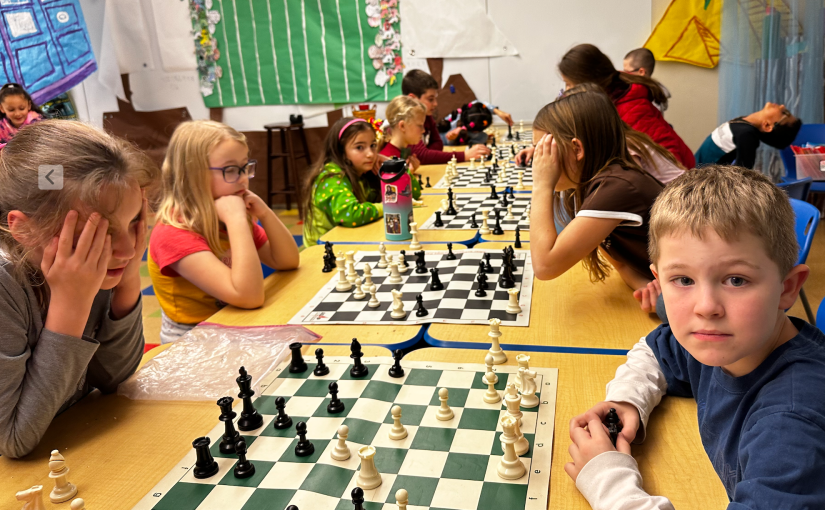
This final match from a classroom-wide tournament (2018) shows the intensity of the sport.
Would I like to be less beatable at chess? Sure, but having a flicker of hope that they could defeat the teacher has inspired my class to become chess enthusiasts beyond all previous groups.
I’ll end with this story and lesson. I wanted to teach my daughter how to play chess. She learned how the pieces worked, and she grew to understand the concept of checkmate. When she found no success in winning a game against me, she lost interest. I came up with an idea borrowed from golf; I gave myself handicaps. The first one was playing without a queen. I play just as seriously as I normally would, but an end game of my two rooks versus my daughter’s queen and rook puts her and I on a more even playing field. It equalizes the power-dynamic.
Another trick I tried was giving my daughter way more time than myself on the chess clock. She now tries to put me into troubling scenarios to run down my time.
Do students beg me to play them at chess at the end of every day, or are they petitioning an opportunity to defeat their teacher? Either way, I’m happy to oblige!
Perhaps you may be concerned about losing power or respect when a child beats you at chess. It is true that they will no longer think you invincible on the board. Clearly, you can be beat. They just did exactly that! But, this does not change any other part of your relationship. If anything, it makes you appear more human.
I have always been keen to point out mistakes I’ve made in the middle of lessons, and I constantly point out that I struggle spelling certain words. Does this make me a less powerful teacher? It’s all about goals. What do you want to be perceived as? Are you hoping to be viewed as lord over them? Do you want to be seen as one who has all of the answers? My goal is to be my students’ guide. I am bringing them from the beginning of third grade to the beginning of fourth grade. Some students will have growth spurts while others will plug along. There are times and situations where it is most important for a student to simply “get healthy” emotionally, mentally, or intellectually, before growing. I will guide them through this experience.
Also, I will do my best to help them realize the power within them. I will work at showing them their power. I use chess to empower my students. What do you use?
There is lots of talk about how great failure is… in books, articles… all over the Twitterverse people are praising the merits of accepting failure. How great is it, really? When was the last time you experienced a real, core-shaking, devastating defeat? It’s pretty painful.
A couple of years ago it was popular to make compilations of videos of people “failing” at tasks that made them look silly. Guys with skateboards fumbling rail-slides down handrails; girls messing up gymnastics; trucks miscalculating the height of overpasses; and more. I fell into the trap of watching several of these. Is there something therapeutic in watching others fail? Laughter is definitely a healing salve, and these short clips will cause you to chuckle, for sure. But, many of these videos are bloopers of people attempting to do amazing feats. Where are the compilation videos of successes? Also, the seemingly therapeutic laughter is achieved at a cost, albeit difficult to measure, to the person whose failed feat will live on in infamy forever captured by video shared so that the public can laugh at his or her embarrassment. Make no mistake about it. We are laughing at others’ misfortune.
To be sure there is therapy in laughing at one’s own misfortune. Additionally, there is a trend spreading where embracing failure is being given value. TED (n.d.) has a collection of talks; over 17; on this topic. I have preached the positivity of negative results to science experiments for years. Failure breeds future discoveries and unforeseen understanding. While this very well may be noble, what about the person relying on results to bolster claims necessary for earning a grant to fund more failures? Companies and governments are probably going to be less likely to give money to projects that prove unsuccessful. Defeat can be incredibly disappointing.
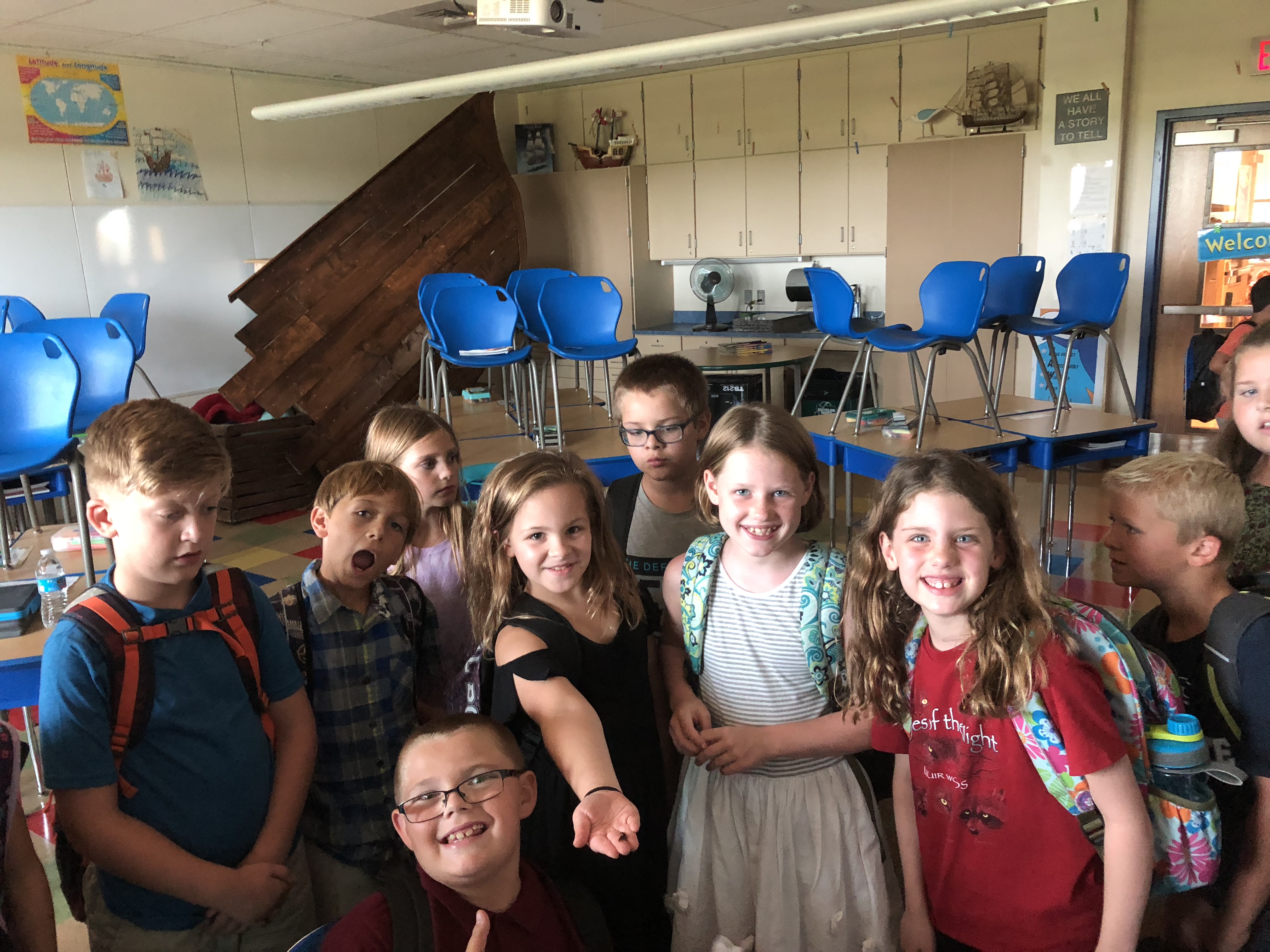
Students found a caterpillar crawling around the room.
I experienced a deeply depressing defeat at the beginning of this school year. The fact that it has taken me several months to share it illustrates the emotional impact. I wasn’t sure how I wanted to frame it. The story is a little embarrassing and revealing. I had to throw away something that had taken me many hours to build. Money had been spent on constructing something that in the end needed to be thrown out. Were these hours and this experience wasted? Yes… and no.
I made these cubbies for my daughter’s nursery, 8 years ago.
Many teachers and parents (Hampton, 2015) experience a sort of nesting phase, similar to a woman about to give birth, prior to the school year. They buy more school supplies than they need, arrange, rearrange, and re-rearrange their rooms over and over, making everything just right, perfect for the new class. Maybe it is a guy thing, or perhaps it’s just “my” thing, but I like to build stuff to get ready for the school year.
The very first item that I ever made was a couple of bookshelves. I love books, and I wanted to have a room full of them. So, I made homes for them. An idea of what I wanted the shelves to look like, how I wanted them to function, and the ease of making them grew in my mind throughout the summer. In between Professional Development sessions and team planning meetings I was drawing, measuring, sawing, hammering, etc. my bookshelves. They came out great, functioned flawlessly, and are still being used… But, the middle shelf was accidentally placed the exact height of the outlet the construction was to hide. It was impossible to plug anything in with the shelves against the wall. This was easy enough to fix. I simply cut a notch out of the unit so plugs had a space to stick out of the wall. From planning to constructing to fixing this problem, the experience prepared as much my pedagogical psyche as it provided a home for my classroom library.
The shelves are still in use, today!
You can see the cut away of the shelf behind this crazy pirate guy.
In the next few years I built a classroom island, a castle, a workbench, fish tank stand/hood, and conference table, among other smaller projects. The classroom island was something I obsessed over the summer prior to making it. The cubbies that I purchased for housing the plunder of books I had been pillaging from second hand bookstores were unattractive and sat flush with the floor. My island has a platform that raises the cubbies off of the ground. I made a countertop that covers the ugly cubby roofs and extends backward to allow students to sit under it. With stools it functions just like the kitchen islands that most students have in their homes.
The castle deserves its own blog.
My workbench was really neat. I didn’t like the way the teacher desk quarantined me behind it, cutting me off from the action of learning. One year I took it all apart and lined it up. The parts included the desk that a teacher’s chair can pull under, a similar table/desk with space under it, and two giant filing cabinets. I placed one of the filing cabinets under the table to hold it up; It had been attached to the teacher desk for support. The other filing cabinet was placed at the end of the twelve foot long line of equipment. Similarly to the classroom island, I built a frame of two by fours to attach one by eights, hanging the creation over one of the long sides and the end so that kids could pull up to it like a gigantic table. Because it was slightly higher than their little student desks, most kids stood to work at it. In my pirate-themed room this came to be known affectionately as “The Plank”.
I learned something new each time I constructed something, and many of the lessons involved solving problems. Every creation proved to be incredibly useful, fun, and loved… Until…
This past summer I got an idea in my head that I could not shake off. It consumed my thoughts. I was picturing building a sunken pirate ship, using planks from the classroom workbench. The workbench had served its purpose, and I wanted to do something different with that space in the room. Plus, I needed lumber for this new obsession–Make no doubt about it–I thought about this project constantly June, July, and August of 2018. Each beginning of the year construction project has been a sort of puzzle. My mind bends ideas and works out how I can form structures quickly and use as little funds as possible. The structure is always something that you can’t simply buy, either. Lastly, it has to be both functional and cool looking. The sunken pirate ship was going to be my masterpiece.
First of all it would be almost completely constructed of wood that I already had, making it virtually free of funds. Second of all, what I pictured in my mind did not exist anywhere but the bottom of the ocean. Thirdly, and most importantly, this new project was going to be the most beautiful, complex, impossible to reproduce, no-one-else-could-possibly-make-this-creation the pedagogical world has ever known! And, it was.
The frame was a puzzle in my mind.
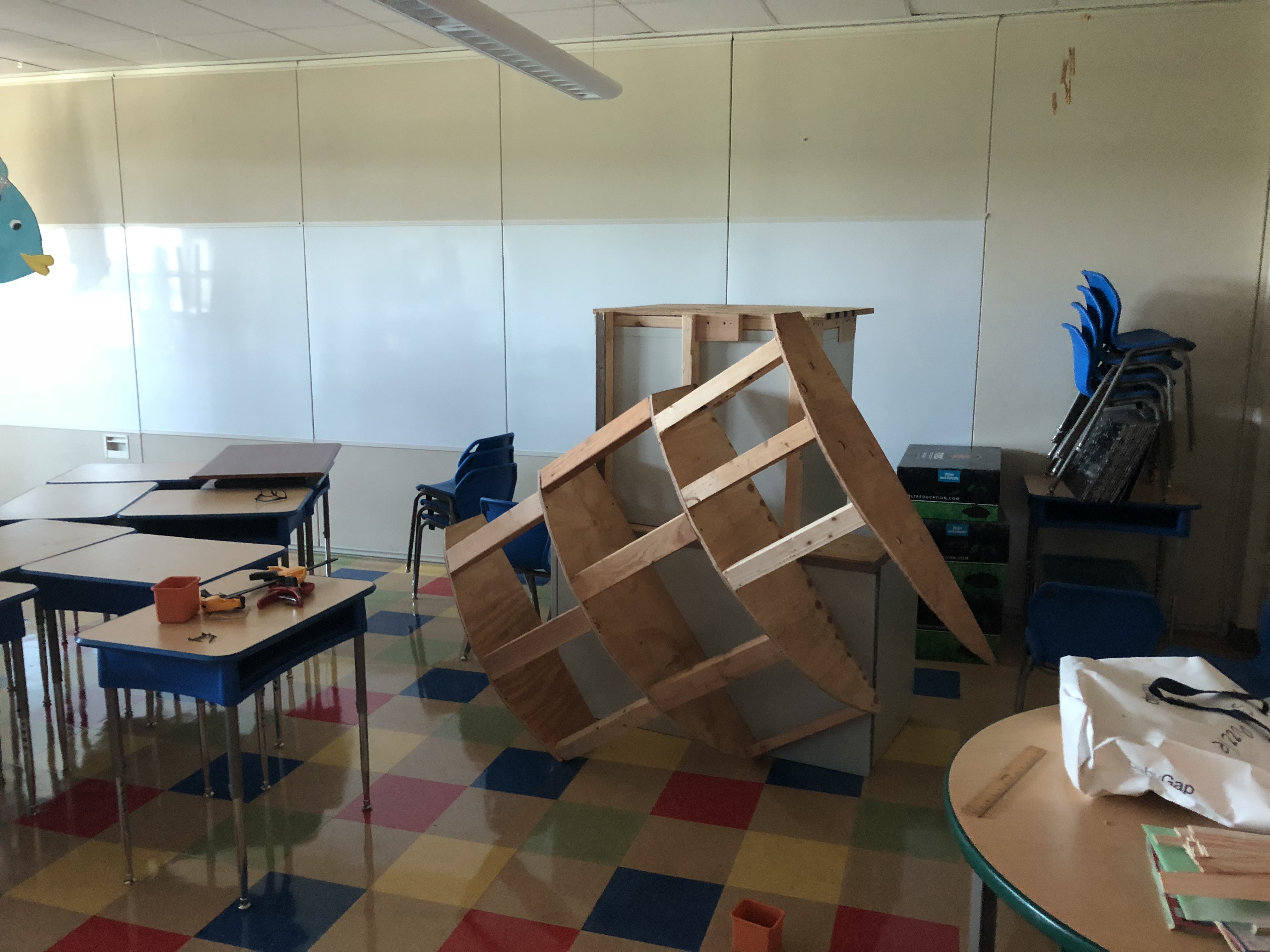
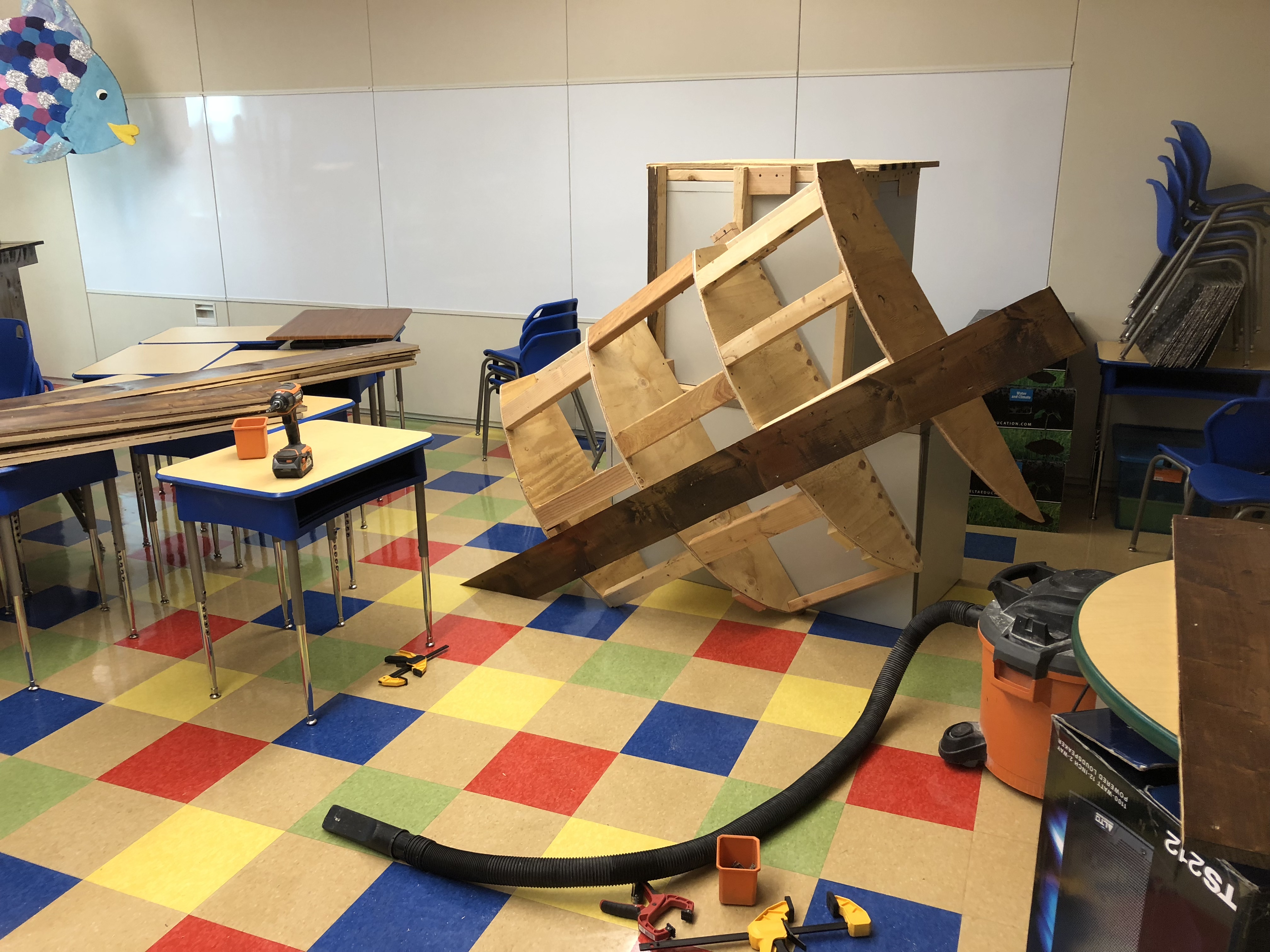
I began by taking a part the beloved workbench and planing each edge of the one by eights so that the angle was 70ish degrees, rather than square. After doing this to all of my planks, I took four foot by four foot pieces of plywood that I brought from home, and I cut out a curve that would serve as the hull of the ship. This was one of the trickiest parts of the project. I brought the plywood up to my room and looked at it for a long time. I wanted the sunken ship to show the curved bottom of the boat, but also come up from the floor at an angle. This meant that I needed a few curved pieces, but different sizes. Additionally, I wanted the model to be the front of a ship, so I had to have the frame graduate from a large curve to a smaller and smaller one. It is almost as hard to write about this as it was to ponder it in my brain. This puzzle took me a long time to solve. Even after I had constructed a frame, it was tricky to figure out how to attach the planks. Should I build the whole thing outside, or piece it together right in my room?
The first plank
I decided to assemble the ship in my room, rather than run up and down the stairs over and over. I figured out what angle to cut the bottom of each plank, ending at the floor, and attached my first one. It was beautiful, already! Just the success of figuring out how it could work was exhilarating.
I kept adding planks, alternating lengths and looks. I wanted it to look like the front of a pirate ship that had broken in half, so I left some of the boards ending at varying lengths. The front would be cut in an arching round curve, or so I hoped. This was still a little fuzzy in my head.
The top part of the ship would be flat or vertical, having no curve, to show that this was more than just a rowboat. It had been a tall mast ship. I continued the framework and attached more planks.
As you can see, from these images, the ship was a work in progress. Much like a sculpture, I was cutting, shaping, adding, removing, and attaching pieces to adjust the art as it evolved. (Through constant formative assessment I made adjustments.)
Some of the shape of the ship would be produced simply through optics. I would position it at such an angle as to make the front of the boat look like it not only curved up, but also came to a seam with the opposite side (which obviously did not exist). One final extremely difficult, mind-bending trick was figuring out what to do with the front of the ship. I wanted it to look like a beam running the spine of the hull. Luan is a very thin wood that comes in sheets and is used for subflooring. You use it to make an otherwise uneven or bumpy floor smooth before laying tile. Because it is so thin, it is very pliable. It was very difficult to bend, hold, mark, and cut, but I got a piece that curved with my boat’s bow pretty well. I tossed around having a spear like staff sticking off the front, also, but the monstrous beast was already nearly touching the ceiling! A broken off point seemed to fit the theme of disaster.
Little did I know the disaster that was about to befall my creation, next.
Fellow teachers from my building visited my room, having heard the commotion or news of my creation. They were increasingly impressed as the structure was developed and took on shape. I remember wanting the boat to have a certain semblance to a ship before inviting my principal, Dr. Moyer, up to see my masterpiece’s progress. When I did finally invite him, I didn’t receive an enthusiastic response. In fact, it took a day before I even heard from him. At the time I was happy to have more minutes to get the ship that much closer to completion. When Dr. Moyer did finally join me in my room, he brought bad news.
Clearly, it pained my principal to inform me that after all of the work that I had put into this beautiful masterpiece, it was going to have to go. It wasn’t his decision. He shared with me an email from maintenance that he had received. The message explained that “The pirate ship being built in room 207 had to be removed, immediately” due to several violations and concerns. Dr. Moyer didn’t see any way around it, but suggested that I talk to the head of maintenance.
The pirate ship was just about done at this point. I called my school district’s head of maintenance several times before we finally connected. Over the phone I told the person who is in charge of not only maintaining all of the district’s facilities, but also responsible for students’ safety that I understood every point that he was making in his email to my principal. I explained that some of the concerns could be remediated and I asked for a chance to make some adjustments to my creation. This saint of a man told me that he would consider my changes and take another look at my project.
This was it. I had to move the ship away from the sprinkler head in the ceiling, make sure the structure was secure, and smooth rough edges as much as possible. I put last minute, finishing touches on the ship to make it look as good as it could… And then, I waited for a verdict.
I am not listing every concern that my masterpiece had raised in the mind of the head of maintenance, but suffice to say, I was unable to completely rectify enough of them to satisfy the justification of leaving the heap of wood in my room, permanently. It was honestly touching how obviously moved this understanding and caring individual was when he told me that, “Unfortunately, the pirate ship still had to be removed from the classroom.”
I had worked feverishly with an obsessed passion to complete this project before school began. I wanted to have this amazing, awe-inspiring, gigantic addition to my pirate-themed room ready for students to appear Monday morning. I couldn’t wait for them to feel the presence of the sunken pirate ship looming in the back of the room. Removing it would be like losing a limb.
Although temporary, the pirate ship made an impression.
Hesitatingly, I inquired if I could just keep it long enough for students to see it. After a pause, my savior said that he needed the ship removed, but that he wasn’t planning to do a walk through of my building on the first day of school. It was understood that if anything negative happened, it was on me. Having constructed the creation myself, I knew that it was perfectly safe. And, I was very confident in my classroom management, so I took the chance of letting my students at least view the craziest creation I had ever attempted.
Dignified Defeat
I took the pirate ship down. I was okay with this decision because it was made with the safety of students in mind. But, make no mistake about it, this was a defeat, a loss, a failure. As I said earlier in this text, I struggled to publish any information about the pirate ship. I never tweeted images of it or talked about it publicly on Facebook. Was I simply embarrassed? Yes, but even more than that, my dream was defeated.
…Or, was it?
I told the head of maintenance that I had envisioned this creation over the summer, and I felt like I just HAD to make it. He suggested that I speak to the people who produce plays at the high school to help with making their sets. There was a respect for my creativity. I’m not sure that he ever completely understood, but I could not NOT construct this pirate ship. I had to see if I could do it. I had to see if my vision would work. I had to see if I could puzzle out the angles and curves. I had to see what it would look like. Could it become anything even close to what I envisioned? As it turned out, yes, I could. Yes, I did. Yes, it was… beautiful. And, now it is gone.
I eased myself into my defeat by thinking I would reconstruct the ship down by my pool. But, I’d have to build a whole new frame, and I didn’t think that the low-quality wood would hold up outside. In the end I let the thing get moldy and threw it all away.
A chess tournament training I attended recently shared what kids must master before attending their first match. They have to know how to checkmate or win a game. They should know how to operate a chess clock. There are a couple other elements, but what stood out the most to me was the idea that kids must learn to lose. At the time I pictured my 7 year old daughter who hates losing. She has melted down to tears when she loses. But, since then, I have mulled this concept over. At both the beginning of a chess match and at the end you shake hands. It is different from other sports. You don’t jump into competition and then slap hands carelessly at the end, chanting, “Good game, good game, good game,” while never looking the victor in the eyes. A dignified defeat is thankful for the opportunity to learn through this match. I was able to try out my skills, make some good decisions, show my stuff, prove myself to myself and perhaps others, and I am now a better stronger person having competed against you. Maybe, like a match I played against someone better than I, the outcome will be a feeling of “At least I held my own.” There is dignity in that attitude. Dignity is an attitude.
In conclusion, I am pleased to profess that although my room does not dawn a disaster of a sunken pirate ship, it does house one classy educator who has learned the lesson of dignified defeat.
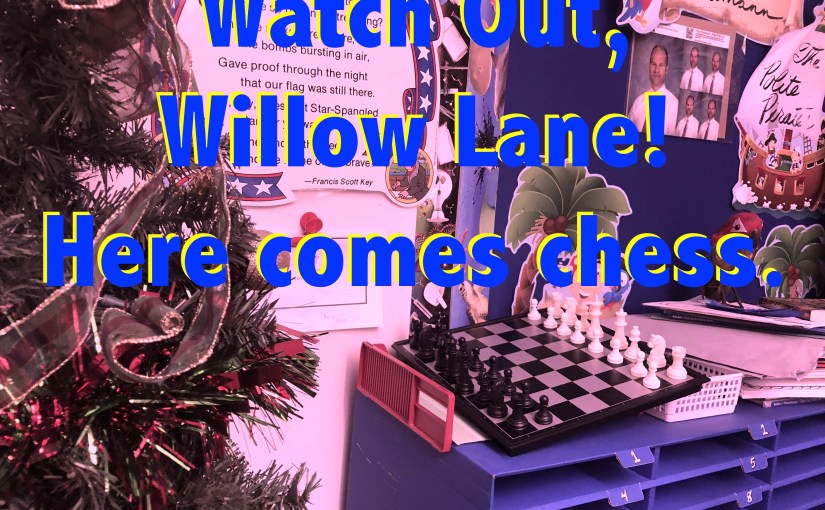
I was glancing around my classroom before I unplugged the Christmas lights and took off, yesterday, and I saw this: A chess board had been “put away” by being placed on the Red Bin. The Red Bin is the place where notes, money, messages, etc. for the office are placed first thing in the morning. They then get sent down to the office with our lunch count in the green envelope seen under the chess set.
We are just beginning our school chess club, this year. I accepted too many members, and don’t have enough of the nice big vinyl boards with 3 inch plastic pieces for everyone. (Christmas idea;) So, we have been using a mishmash of different sets. The one in the picture is magnetized, that’s why the pieces can stay in place.
What struck me about this pic is the concept of actually sending the board to the office! Did a student think that this was a message for the secretaries? Should we move a piece and share the board with another class? There is a buzz around the school of students becoming increasingly interested in this “thinkers game”. I have been working on populating a webpage from my classroom website with chess related information that could be helpful not only to the members of our club, but any beginning player. Mr. Vitale, my third grade teammate and partner in running the chess club, and I have made several videos to post on this website. My dream is for the whole school to become interested in playing chess. I wouldn’t be upset if other elementary schools caught this vision. Wouldn’t it be great for our district, state, country to learn, practice, and master thinking strategically, analytically, as well as creatively?
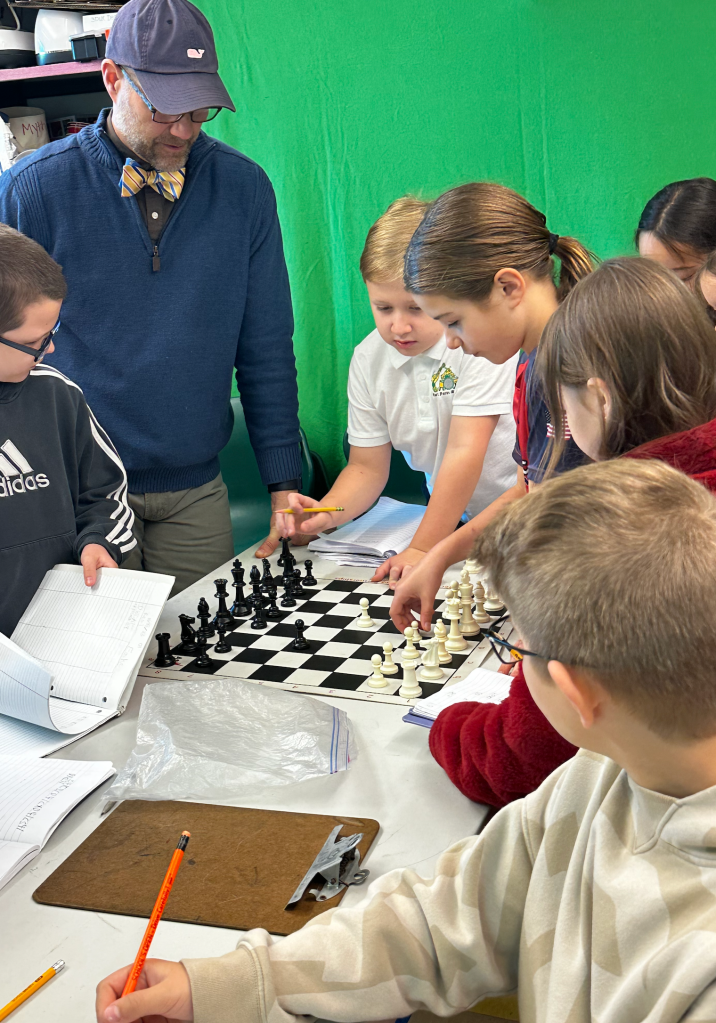
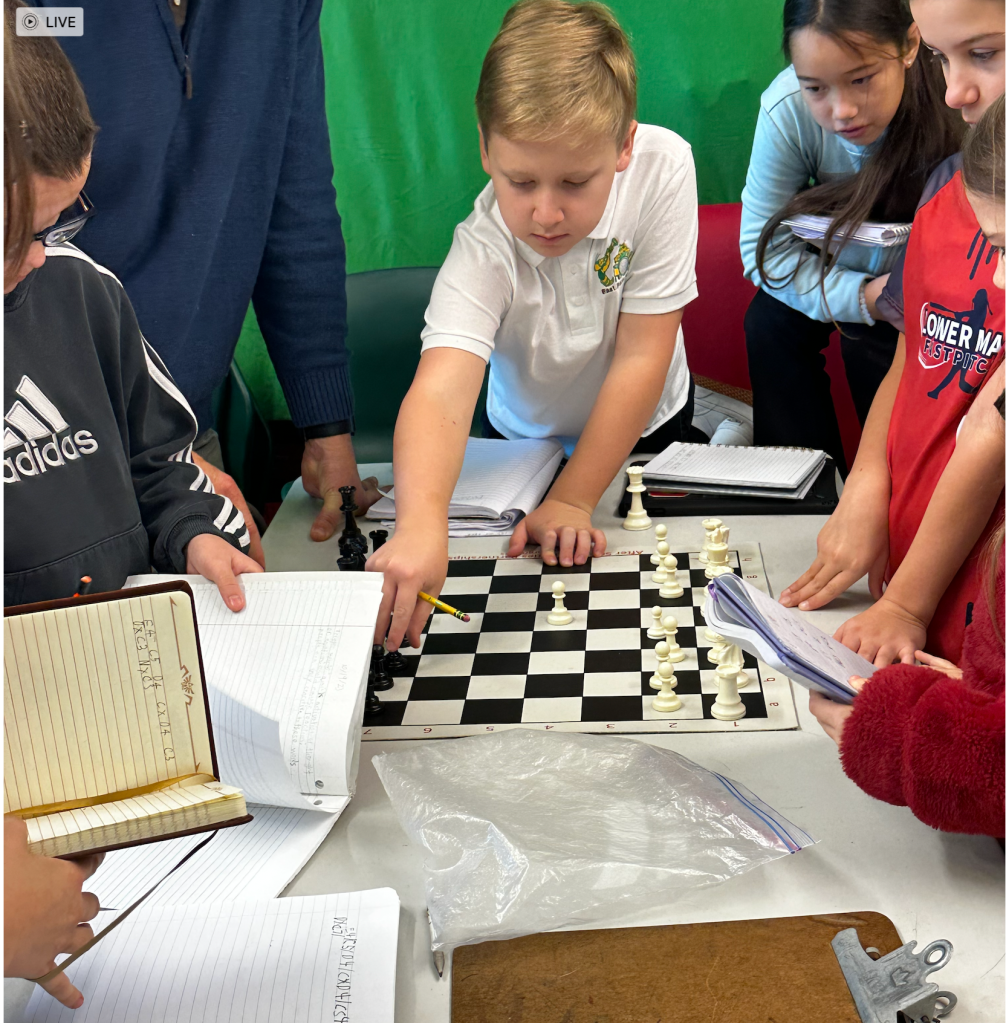
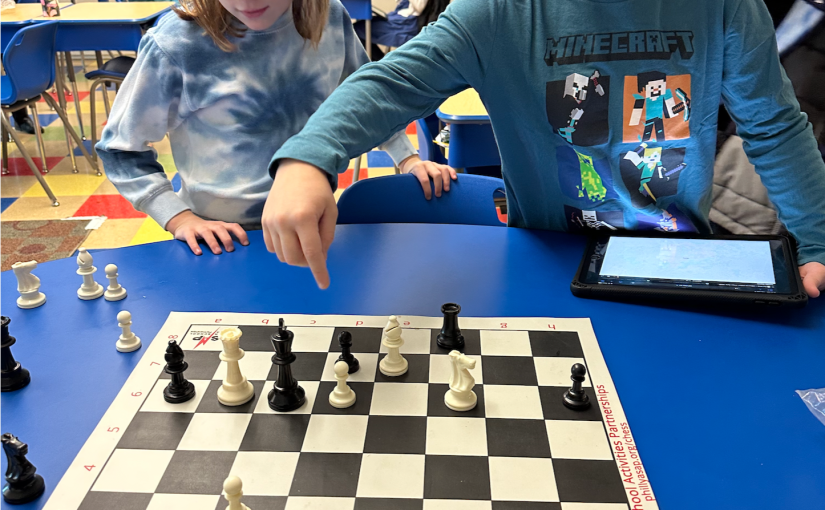
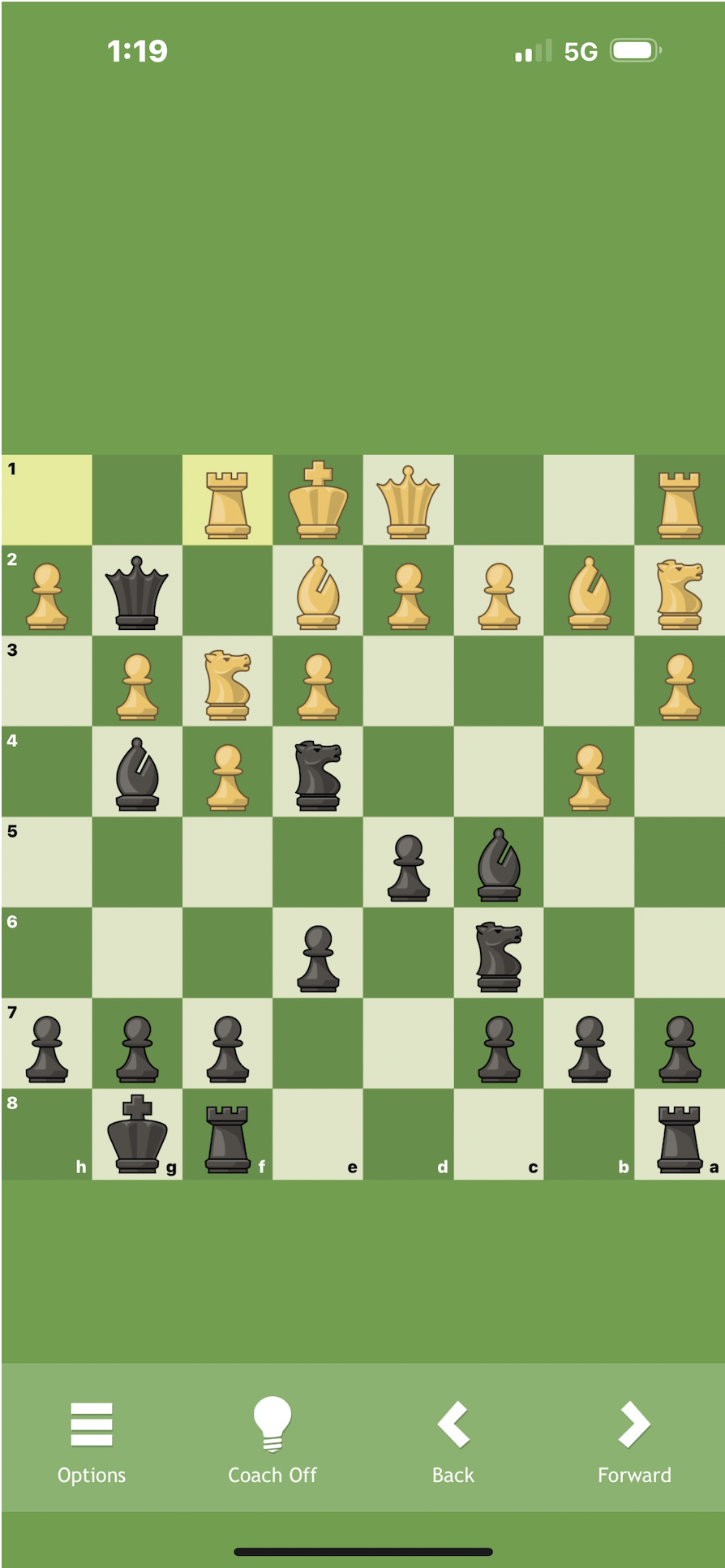
Mr. Vitale and I began a chess game this past week during lunch. We couldn’t finish it, so it remained set up in Mr. Vitale’s room. He couldn’t help but show and talk to his students about it. I took pictures and shared them with my class. By Friday, we were able to complete the game, but only after both of our classes worked on analyzing the following images to help with potential moves. It was fun, exciting, motivating, and infectious. By Friday, my students were sneaking onto Chesskid.com whenever they could. I found iPads with chess games begun, hiding under notebooks.
Here is an idea: Teachers sign up for the Chess Challenge. The magnetic board travels around the school, visiting learning spaces (not just classrooms). A chess enthusiast, either chess club member or one of my students or myself, can visit participants, if desired, to help with some chess instruction. (In other words, teachers shouldn’t feel like they have to be good at the game to participate.) A paper with notation will accompany the board. This will also be posted on the website for classes to keep up with the game, virtually. The color a class is responsible for will depend on which is moving at the time the game arrives at their doorstep. If it is Black’s move when Room 205 gets the board, then they are part of the black team. When a class captures a piece, they get to keep it until the end of the game. They can display it as a chess trophy. Much of the game is strategy, so rooms could even display thinking by posting writing or drawings of the ideas that prepared their move. Perhaps awards could accompany the moves that displayed creative, analytical thought.
My aim is to not only spread the love of chess, but inspire thinking, especially an affection for analytical reasoning. Lets get kids excited about using their cognitive abilities as much as they are pumped to tackle, shoot hoops, hit home runs, etc. The brain may not literally be a muscle, but it should definitely get exercised!
I couldn’t possibly be more excited to be starting a chess club at Willow Lane Elementary! This Tuesday is our first meeting. I had tossed around the idea of starting this club when I began teaching at Willow, 8 years ago. Instead, I began an after school club that published a school newspaper: Willow Lane News Update.
This experience was very rewarding. I learned a lot about iMovie, editing and publishing, plus Google Sites. I found a fantastic tool for online publishing; Smore.com. I don’t regret one minute of it.
The chess club will be a lot different because, while it can be addictive, it doesn’t hang over your head the way a publishing deadline, albeit self-imposed, might. It’s just a game. Or is it? –Check out these two battle for Room 207 2017-18 classroom champion after a week and a half tournament!
The idea for this blog began when I decided to pick up the Newbery Medal Winner that I’ve been slowly chewing, “Tales From Silver Lands” by Charles J. Finger (1924). Low and behold, what do I think of but chess… Of course! But, hear me out: A character from the second story (Yes, I am only on the 2nd tale!) exhibits a wonderful quality that chess shares: Equality.
There is an aging king who is seeking a son-in-law to take over the reign of his land. The beautiful, talented, wise princess has found no suitor to her liking. Men from every corner of land compete in sports and arts to win the woman’s affection. One day a man dressed in rags shows up. Every other suitor brought wonderful gifts for the princess and king. This man has nothing. But, when he competes in the contests, his carefully aimed arrow splits that of the best marksman’s. This ragged man does not just run faster than the deer-like champion. He flies like the wind. And, when it comes to singing, the man dressed in rags attracts the beautiful birds of the jungle, who cover him with wonderful wings. In other words, the man who seemingly had nothing, possessed the greatest talents, abilities, and attraction.
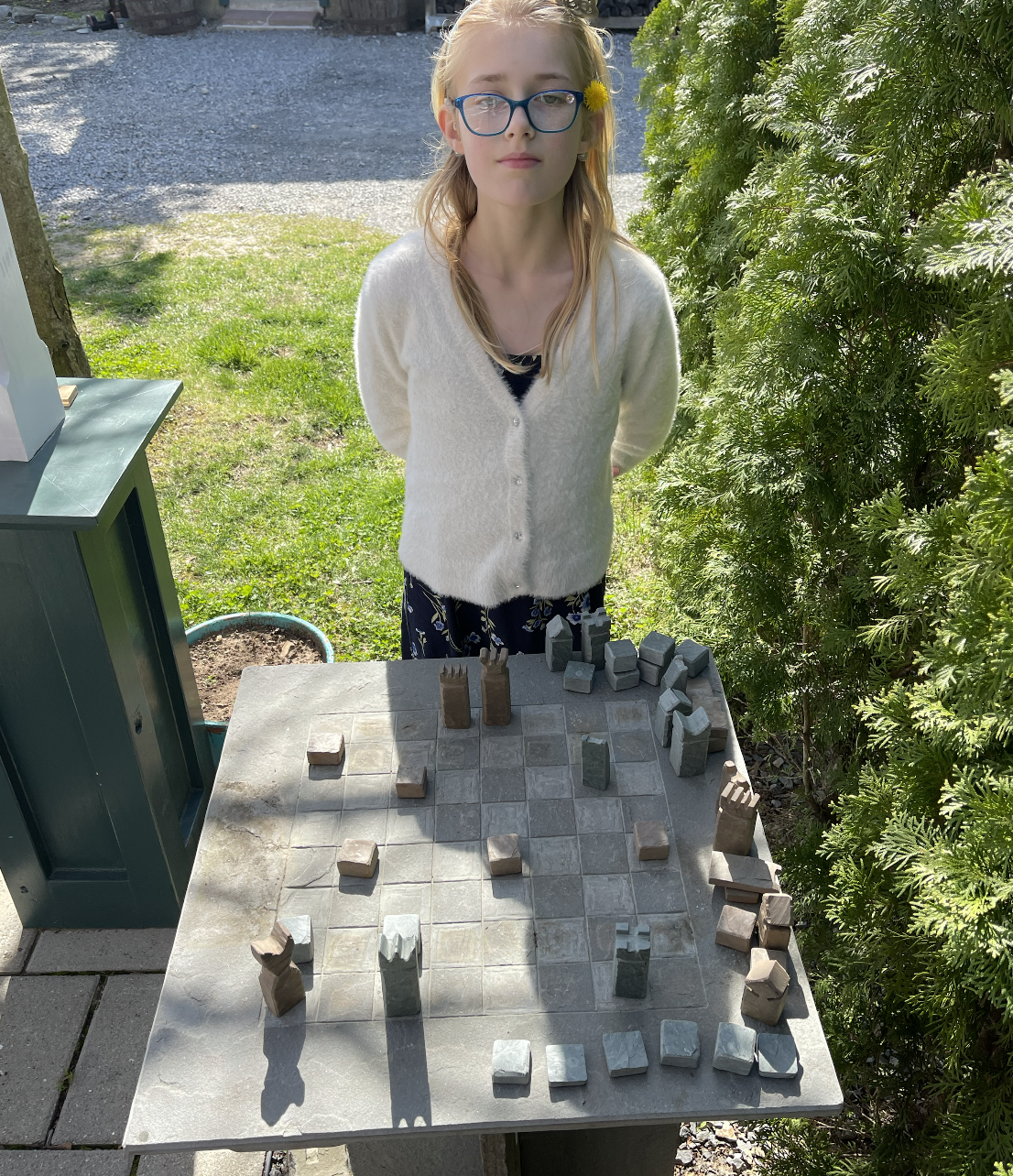
No matter how large the piece, the symbolism remains the same.
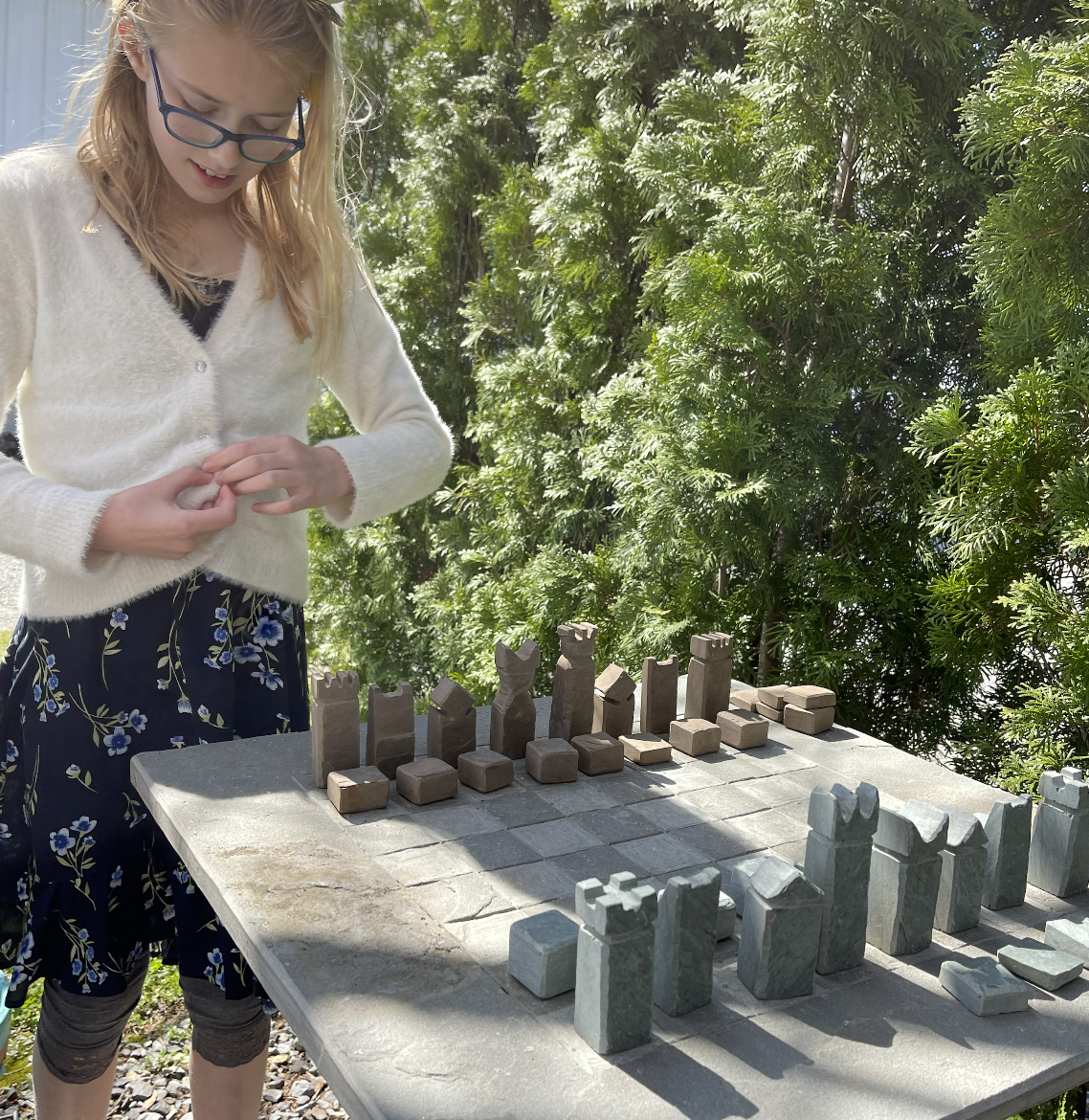
The tiniest chess board can be played with the same depth and complexity as a DGT Timeless set used by championships.
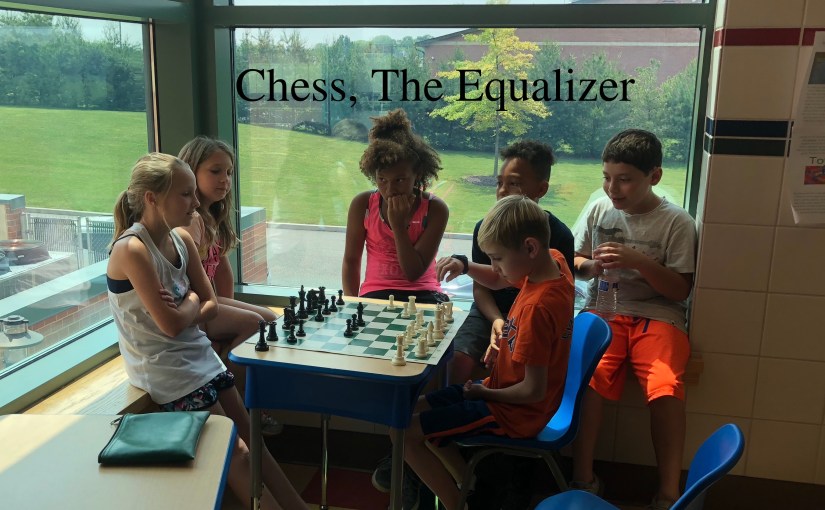
One of the amazing things about chess is that anyone can excel. It is a classy equalizer. No matter the age, gender, physical ability, or socio-economic status, chess is a vehicle anyone can drive.
It was the ability of the man dressed in rags to out match his opponents, rather than his looks, wealth, or status. The events that he competed in could have been practiced for nearly free, so that this character could have grown up running and singing. He might have made his own bow and arrows that he used to gather the food to stay alive. In the same way, chess can be taught to and played by all. It is a game that anyone can learn and grow to play well.
The 2018 World Chess Championship began this week. I was reading an article about Magnus Carlsen, five-time world champion, and was impressed by one of his life goals: “Make chess cool” (Kleinman, 2018). Carlsen has produced an app called “Play Magnus” in which chess enthusiasts can choose different ages of Magnus Carlsen to challenge. The idea is for players to gain bragging rights. This champion of chess is putting himself out there for kids to beat! “I defeated Magnus Carlsen!” is what he hopes to hear from kids who will spread the excitement to future potential pawn pushers. What a great ambition. And, the greatest equalizing part of it all is that the app is FREE!
Another popular and fantastic equalizing story is that of Phiona Mutesi, “Queen of Katwe.” The true story of Phiona, who is from a village in Uganda where kids have to sleep in hammocks, high off the ground, so they don’t get washed away, out of their homes by surprise floods, among other things, was made famous by author Tim Crothers (2013). His book was made into a Disney movie in 2016 (Nair).
Frank Brady, the author of the one of the best-selling chess books in history, “Profile of a Prodigy,” wrote an article about an exhibition, “Into the Human Light: Uganda” (2016), for the US Chess Federation. In addition to all of Phiona’s hardships living in Uganda, Brady suggests that her plight was “sad”… until “She found chess.” Never mind economics, chess can raise the human spirit.
Finally, I would be remiss if I did not mention one of the most influential organizations in helping me prepare to begin the new Willow Lane Chess Club: After School Activity
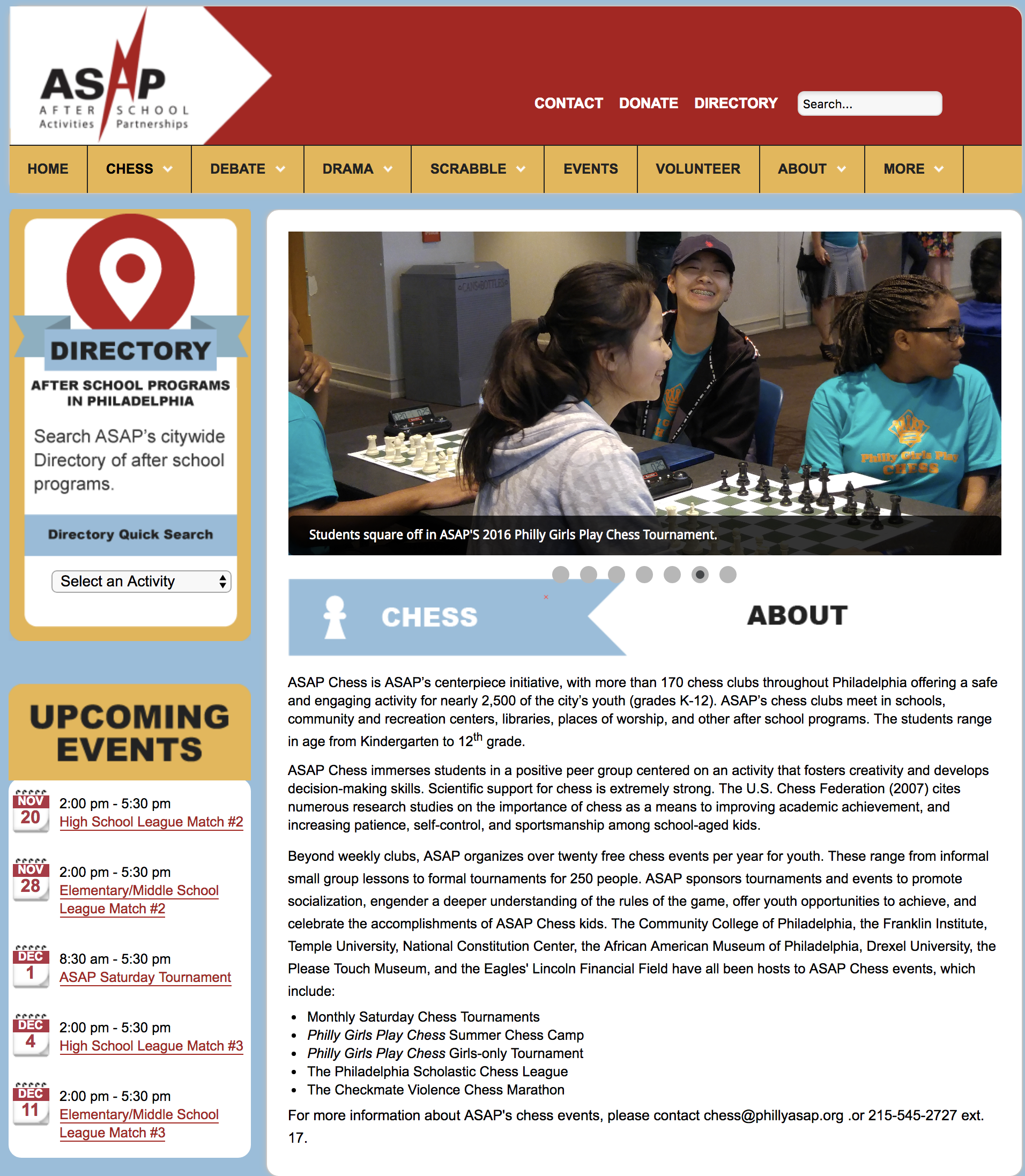
ASAP works to equalize the opportunities for urban kids to be able to participate in the challenging, competitive, thinking, rewarding game of chess.
Partnership (ASAP) of Philadelphia. This past summer a friend, Julia Dweck, invited me to a Scrabble training that took place on the eleventh floor of a building in the heart of Philadelphia. I made the hour-plus drive to meet her there, and it was one of the better decisions I’d ever made! Come to find out the same organization that provides free training and supplies to educators interested in starting Scrabble clubs also promoted chess clubs. I greatly enjoyed my Scrabble training, and before leaving, found out about the chess program.
There is endless amounts of free apps, websites, curriculums, worksheets, etc. about chess online and at libraries. I downloaded a humongous manual on managing a chess club the summer before. It wasn’t until I revisited the ASAP office on Locust St. in Philadelphia, again in July, though, that I felt like I could actually do this. A handful of other future club leaders and myself were shown how to focus on deepening an understanding of each piece, rather than simply explaining the rules and letting kids have at it. Not only is this training completely free, but if I were an educator within the city limits, the organization would have provided me with supplies for free! In addition to the phenomenal training, ASAP also sponsors several free tournaments and other events throughout the year. The kids of Philadelphia are incredibly lucky to have this truly philanthropic organization. It is working to equalize the opportunities for urban kids to be able to participate in the challenging, competitive, thinking, rewarding game of chess.
Being a pawn in someone’s game is not positive, but why? We’ve all heard the analogy used, but what does it mean?
This evening I attended the second of three two-hour training sessions in Philadelphia, preparing me to coach a chess club this coming year. I sat directly across from a man who could teach a plant to play competitive chess. He cleared the chess board of half its pieces. Yesterday, we learned all about how to help kids comprehend the use of every chess piece, save one. This one covered two entire ranks* of the board before me.
“No other piece has more rules governing it than the pawn,” Steve Shutt told the table of teachers. As people produced parameters for the pawn (we came up with eight), I pondered the symbolism of the weakest piece being the most restricted. My first thought was that the rules protected the pawn. My blog title was going to be, “Protecting the Weak is Classy”. I found it curious that the symbol of something being meaningless enough to thoughtlessly use up without recourse would have the most regulations. A practical parallel might be that a ruler must regard certain stipulations in order to “pawn off” a person, and perhaps these were installed to safeguard the weak. That would be classy.
Alas, although the chess player has laws governing the use of the most prolific piece, these rules do NOT protect the weakest member of the team. On the contrary, it is the rules that make it weak. The pawn is not allowed to retreat; It can’t move backward. While other pieces can simply land on a space, capturing the piece occupying the square, a pawn is not allowed to attack straight on; It must attack diagonally. This restricts its movement, so that the pawn cannot move forward when something is blocking it. Pawns get stuck all over the board, forced to wait for the pieces in front of them to be captured or moved. Ironically, the ONE unique power of the pawn, its ability to move two squares forward for its first move, can even be stripped away through en passant!
There is good news for our symbolic pawn, however. As I mused about the plight of the pawn on the way home from my chess training, I was speaking with a fellow chess enthusiast and new friend, Alex Pappas. He pointed out that the pawn is the only piece that has the power to change. If the pawn reaches the opposite side of the chess board, it can change into any piece it wishes. Most players choose a queen, the most powerful piece, but the pawn is not restricted to changing into a queen. Finally, the pawn is liberated from all restrictions.
In the game of life, a person wielding power would do well to realize the potential of his/her pawns. A hidden talent could be a pawn. Perhaps the career path you have chosen does not permit you to be as artistic as you would like. Your creativity is blocked everywhere you try to use it. Keep pushing forward, and maybe your natural talent or personal passion will be honored in the end, providing you with power and opening exciting doors.
This is one of the most attractive things about America. Someone can grow up surrounded by peers who want to cut you off (diagonally), yet persist to rise above the tide, weaving in and out of adversity, to finally be crowned with riches and power. There are parameters that fence you in, but there isn’t anything tying you down. I’ll leave you with this: While climbing up is classy, holding others back or down is not…





















 The top part of the ship would be flat or vertical, having no curve, to show that this was more than just a rowboat. It had been a tall mast ship. I continued the framework and attached more planks.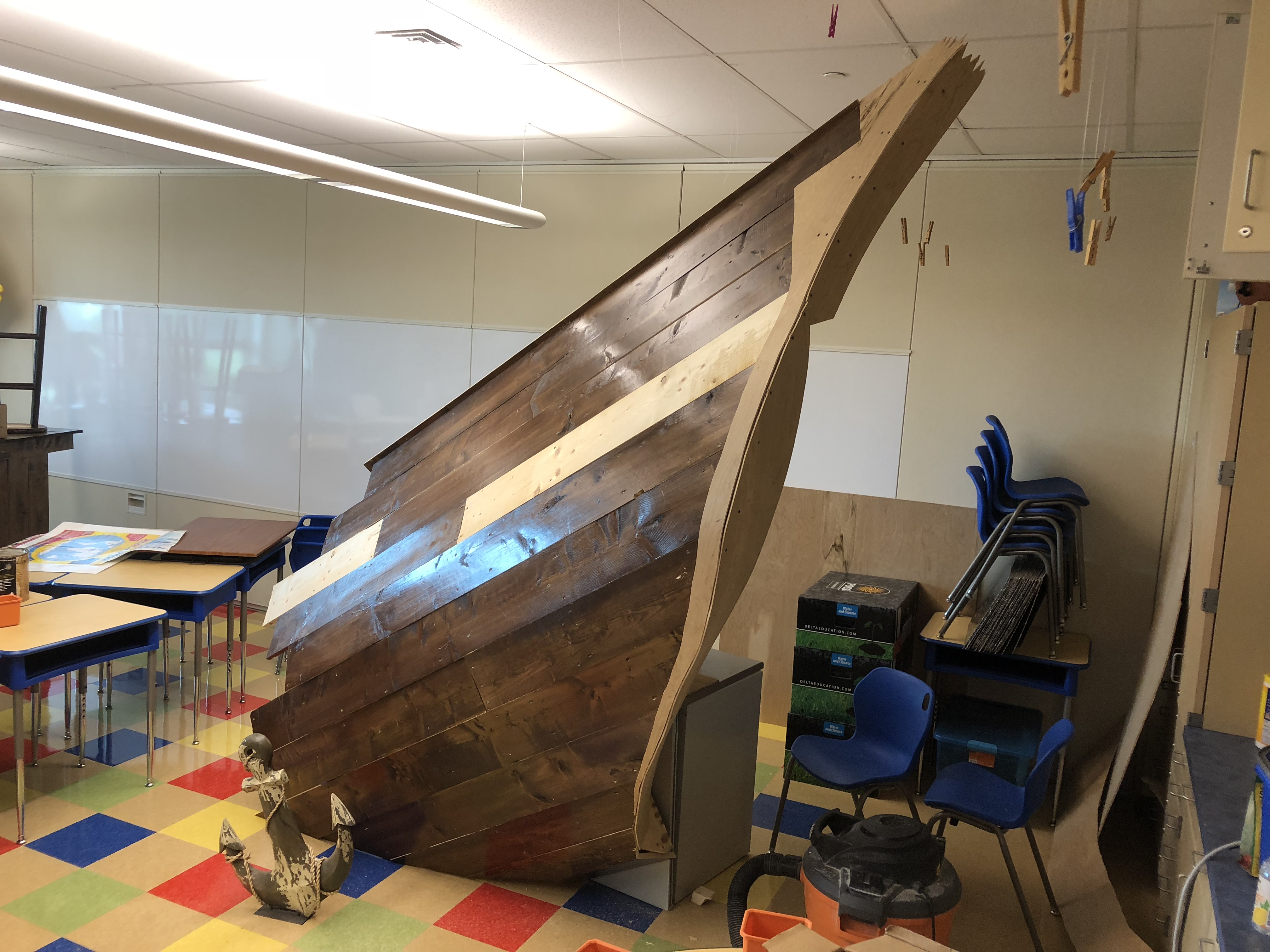


 should know how to operate a chess clock. There are a couple other elements, but what stood out the most to me was the idea that kids must learn to lose. At the time I pictured my 7 year old daughter who hates losing. She has melted down to tears when she loses. But, since then, I have mulled this concept over. At both the beginning of a chess match and at the end you shake hands. It is different from other sports. You don’t jump into competition and then slap hands carelessly at the end, chanting, “Good game, good game, good game,” while never looking the victor in the eyes. A dignified defeat is thankful for the opportunity to learn through this match. I was able to try out my skills, make some good decisions, show my stuff, prove myself to myself and perhaps others, and I am now a better stronger person having competed against you. Maybe, like a match I played against someone better than I, the outcome will be a feeling of “At least I held my own.” There is dignity in that attitude. Dignity is an attitude.

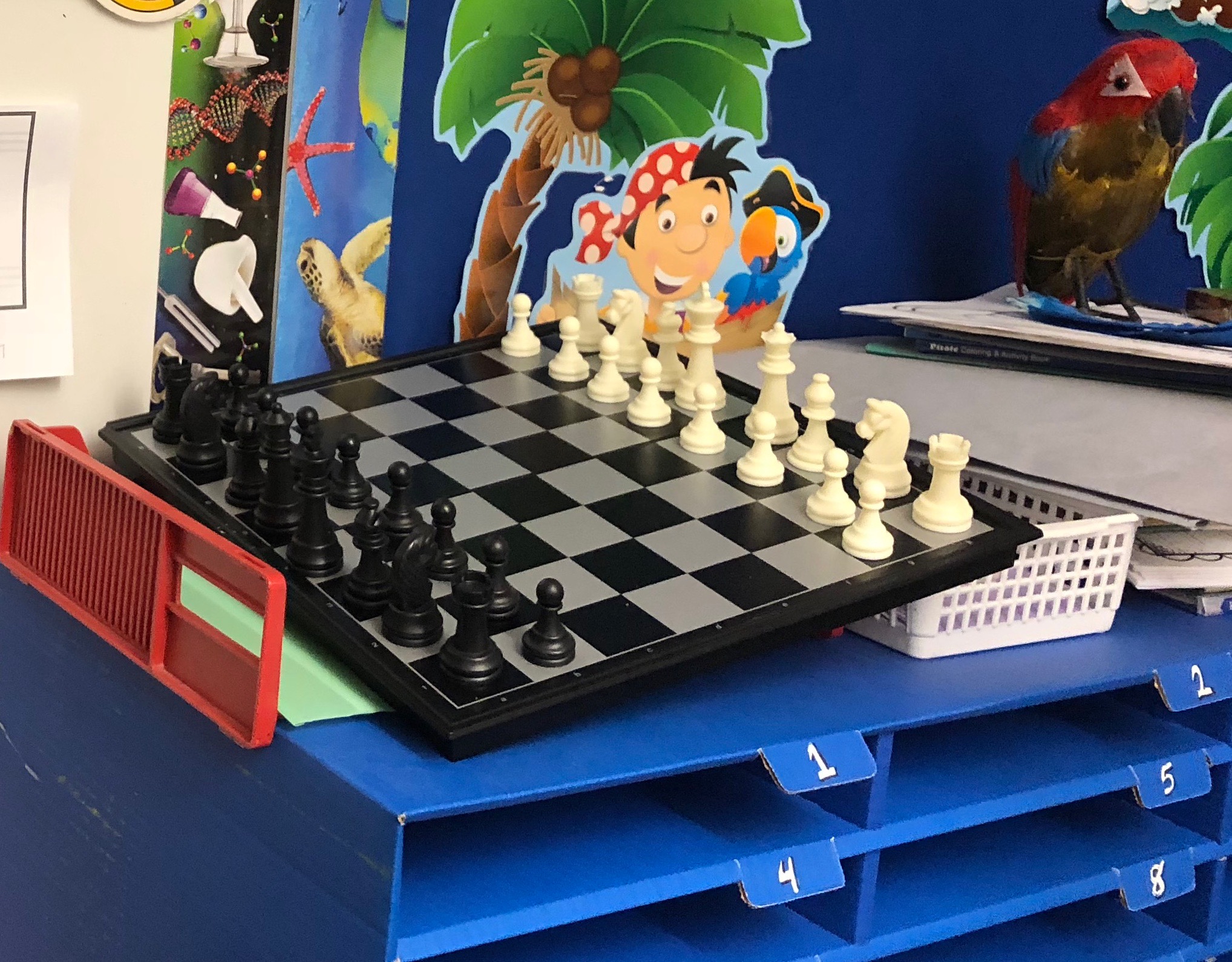 I was glancing around my classroom before I unplugged the Christmas lights and took off, yesterday, and I saw this: A chess board had been “put away” by being placed on the Red Bin. The Red Bin is the place where notes, money, messages, etc. for the office are placed first thing in the morning. They then get sent down to the office with our lunch count in the green envelope seen under the chess set.
 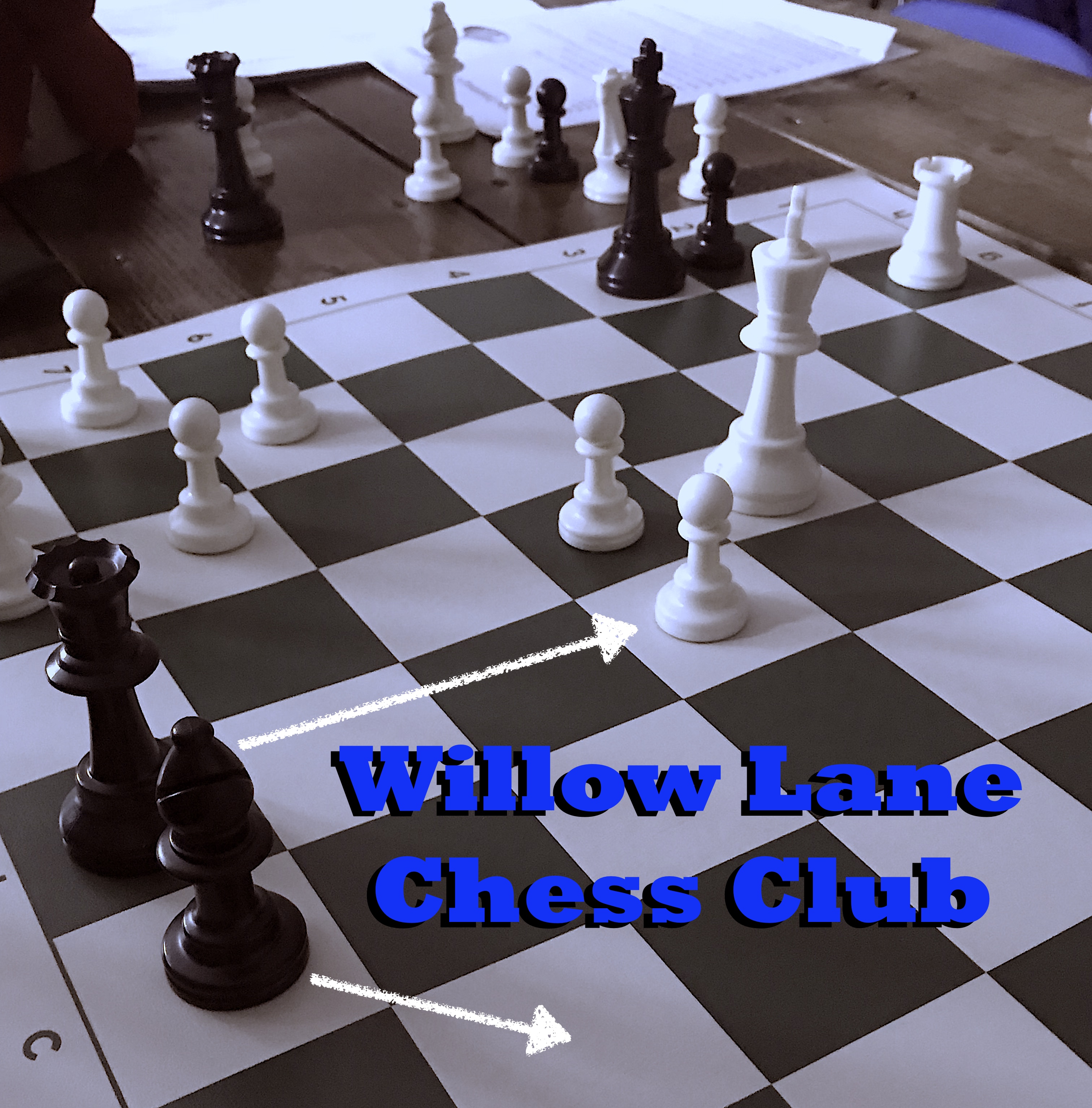 We are just beginning our school chess club, this year. I accepted too many members, and don’t have enough of the nice big vinyl boards with 3 inch plastic pieces for everyone. (Christmas idea;) So, we have been using a mishmash of different sets. The one in the picture is magnetized, that’s why the pieces can stay in place.




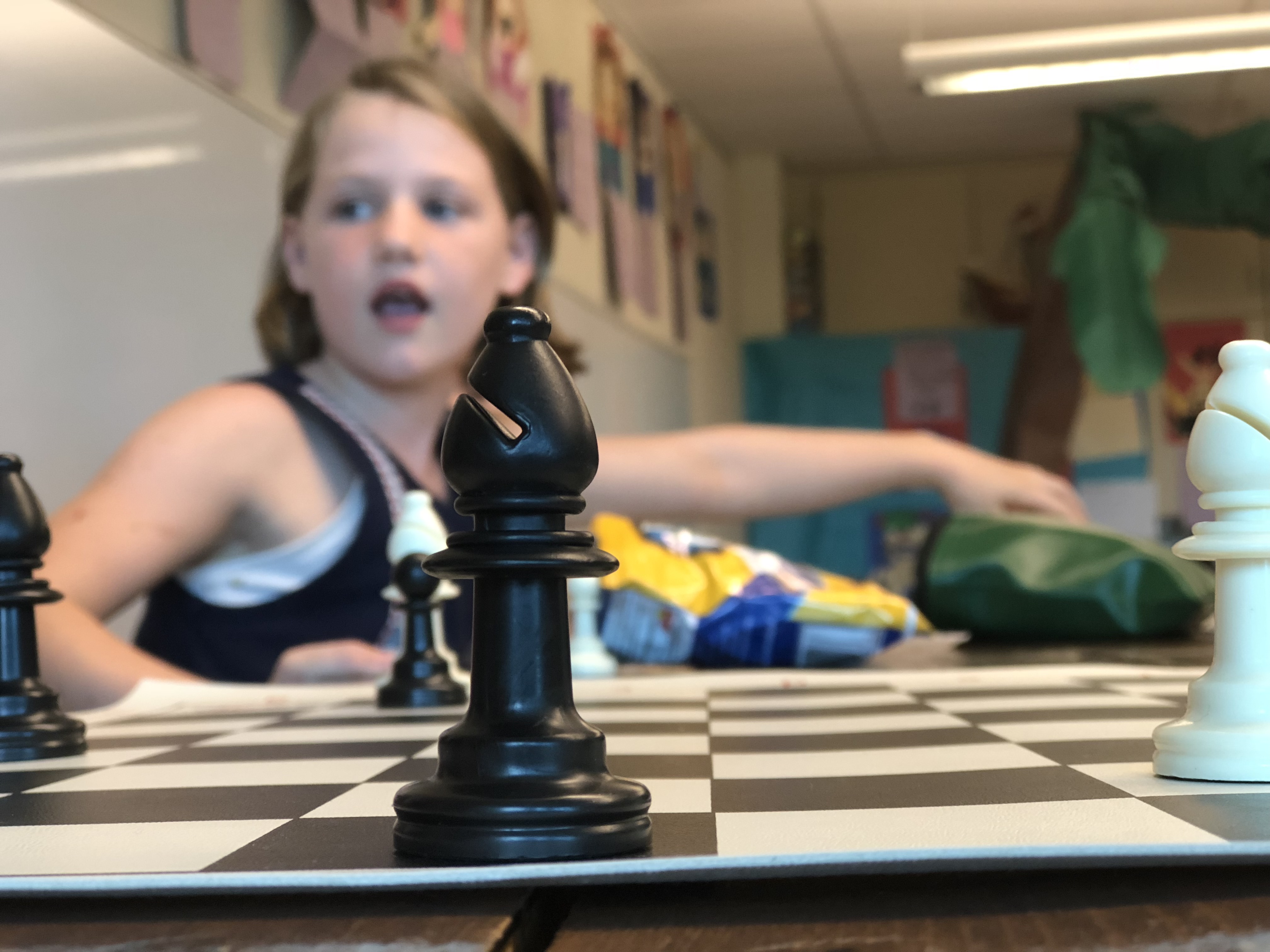
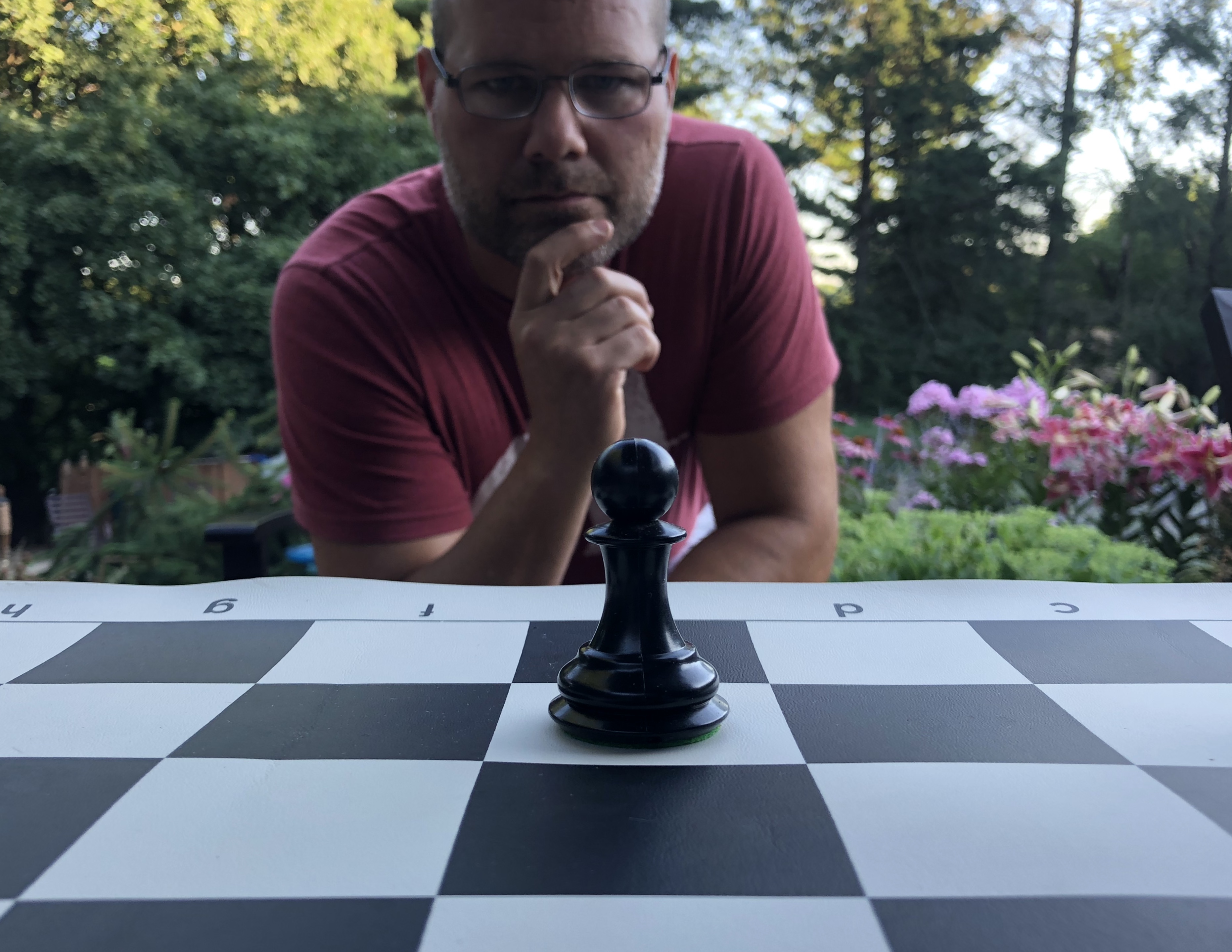
 who could teach a plant to play competitive chess. He cleared the chess board of half its pieces. Yesterday, we learned all about how to help kids comprehend the use of every chess piece, save one. This one covered two entire ranks* of the board before me.
  “No other piece has more rules governing it than the pawn,”
  these rules do NOT protect the weakest member of the team. On the contrary, it is the rules that make it weak. The pawn is not allowed to retreat; It can’t move backward. While other pieces can simply land on a space, capturing the piece occupying the square, a pawn is not allowed to attack straight on; It must attack diagonally. This restricts its movement, so that the pawn cannot move forward when something is blocking it. Pawns get stuck all over the board, forced to wait for the pieces in front of them to be captured or moved. Ironically, the ONE unique power of the pawn, its ability to move two squares forward for its first move, can even be stripped away through
 The Captain of Class