
(Part 1 of obviously more than 1, but not sure how many just yet;)
With the winter holidays approaching, I wanted to prepare The Polite Pirates (my students) for being stuck in the house with “nothing to do.” While I’m not against video games, I think it’s wise to have some alternatives.
Hands-on games that promote thinking and problem solving are my favorite to teach and play. Chess and Dominoes are begun early on in the year. Now, it’s time to break out the Cribbage board.
The fact that there are tiny pieces that could easily get lost makes the unpackaging mysterious and exciting. The board looks interesting, and young students can’t wait to get their little fingers on those tiny pegs! This affords a concrete reward for paying close attention and practicing the game well.
Teaching Cribbage to children requires a scaffolding approach. There are many rules and ways to acquire points. They must learn all of these before earning the privilege of placing pegs on the board. This motivation helps keep them interested and focused.
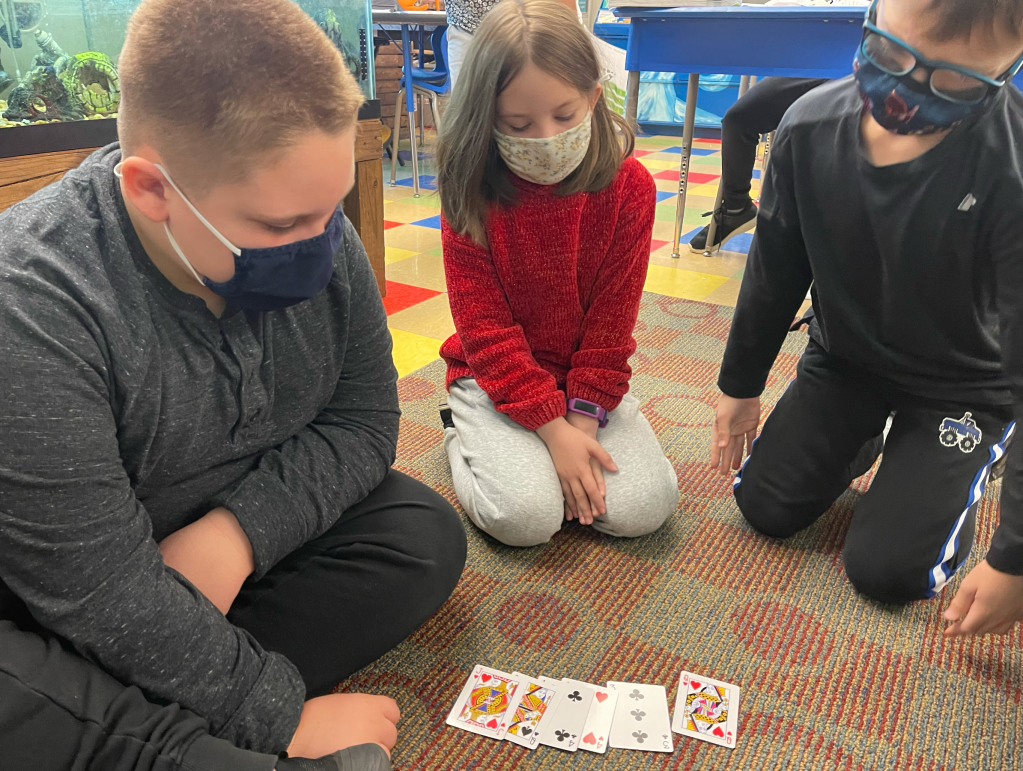
Analyzing combinations to find potential points.
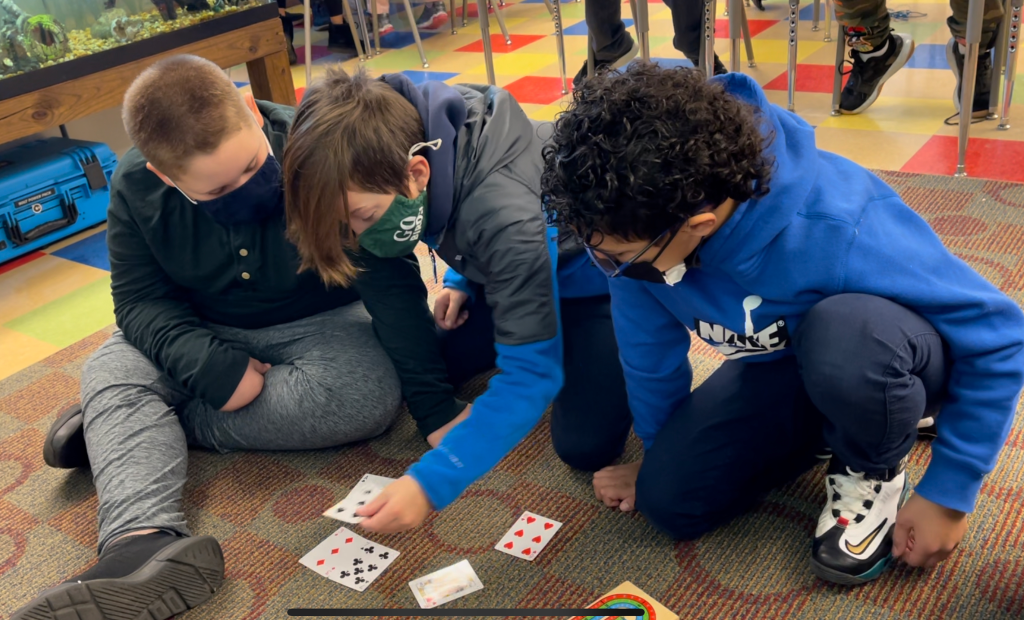

After showing and modeling the board just enough to wet their appetite, I explain that the first part of the game is all about analyzing your cards. You must decide which cards to keep and which ones to discard (They go in what is called a “Crib,” but we don’t worry about that at first). First, I model, looking closely at 6 cards. Leaving out the idea of runs, I explain that we are looking for pairs and combinations that make 15. With only these 2 criteria, we work on adding up card values and counting potential points.
[A couple of things to keep in mind: Aces are always valued at 1 in Cribbage, and face cards are all 10. Also, and this is fun for teaching the point system/using combinations, three-of-a-kind is 3 separate pairs, totaling 6 points (2 points per pair).]
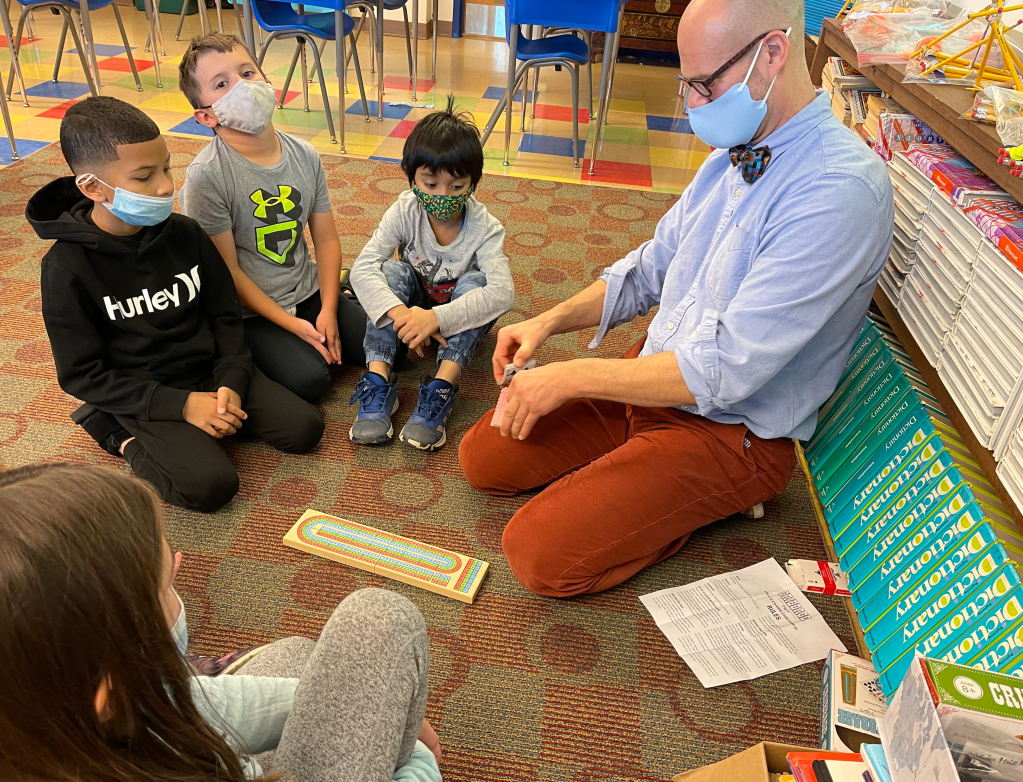
After modeling making wise decisions regarding which card combinations make the most points, I have students try. In groups of 3, I give kids 6 cards to puzzle over. I always shuffle the deck between every “round.” This makes it feel more like a card game and less like math practice.
If interest wanes at all, you could move the pegs on the board. That will get kids into looking for as many points as possible. Also, you could suggest that if one team sees points in another team’s cards that were not discovered and therefore not counted, the team that discovered the missing points gets them!
In other words, you have Team A and Team B. Each team gets 6 cards. If Team A only found ways to earn 4 points, but when they show their combinations, a player from Team B notices an additional way to make a combination of 15 that Team A failed to see or mention, the sly individual from Team B who uncovered the extra points gets them for their team (B, not A). This keeps everyone on the alert.
Notice that the students have to use “math discourse” to share what their cards provide. They do this to prove that they deserve the points they are claiming. It allows every player to perform backup mental math.
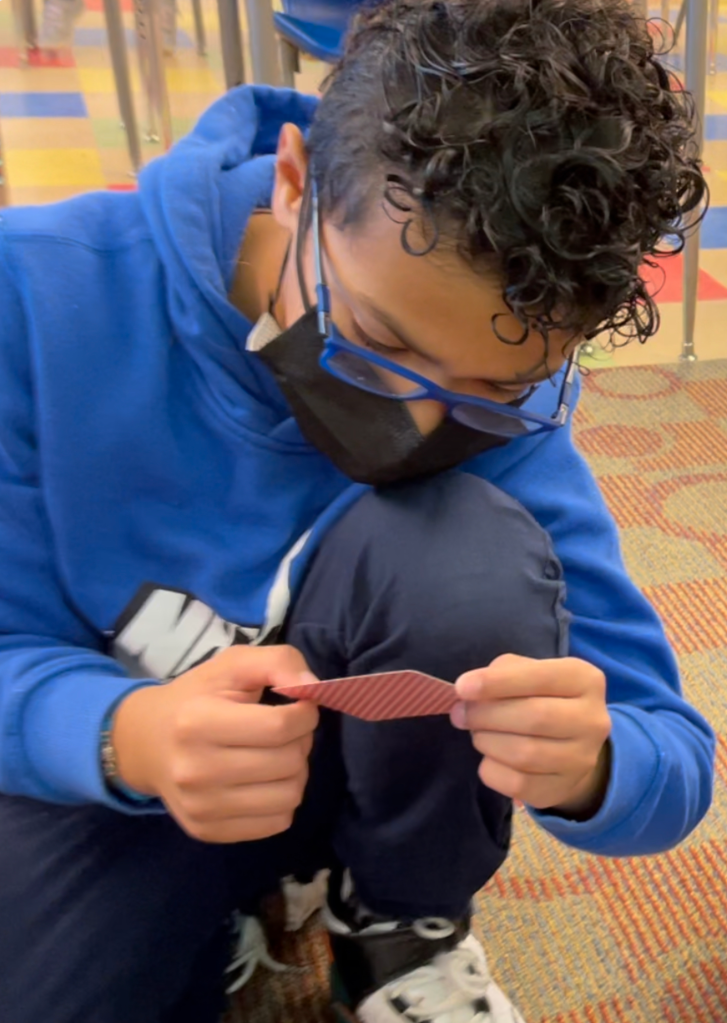
This exercise of looking for combinations of 15 will continue in this way for a week or two. Once students have grasped all of the ins and outs, you can introduce “The Starter.” This card is pulled from the middle of the deck after the cards have been dealt. It is placed face up on top of the pile of leftover cards. Students now have one more card to consider when choosing the 4 cards that they will keep. The Starter is static, staying on top of the deck and being used by all teams.
If you are interested in enriching the decision making process, tell the students that one team will actually get the cards that you discard. The two cards that each team gets rid of go into a “Crib” that the dealer uses to make points at the end of each round. This means that, in addition to trying to figure out what combinations of cards will afford you the most points, you want to keep points out of the hands of others. Don’t gift the dealer with good combinations. Or, if you are the dealer, you can feel comfortable placing a pair or good combination into the Crib.

A way to differentiate for your students who are continuing to make progress but could use some help is providing a chart of addends that form 15. You could also have manipulatives or base-ten boards/charts for students to make 15. Make a lesson of looking for tens and fives in number combinations.
Just as I would have The Polite Pirates practice for a while before introducing further ideas, I will end this blog right here. Playing with numbers, considering the value of combinations, analyzing which cards should stay and which ones should go, students will enjoy the randomness of shuffled hands. “Cribbage affords players both the anticipation of the luck of the deal as well as ample opportunity to exercise their skills in discarding and play” (Bicycle blog).

 The Captain of Class
Is there more to this? Did you write more? I am reaching my kids how to play using this method. I think it will help them learn quicker than I did. I love this! Please tell me there is more!
LikeLiked by 1 person
Hi Alexis. Yes, there is more… coming.
As it turns out, the game is harder to teach to the end than I originally thought. In previous years I focused on the initial crib-formation decision-making, and that proved to be awesome in producing number sense, fact practice, and problem-solving skills. I have a great crew this year, and we DID get farther with the game. It takes an investment of time to teach and practice. I’ll write more about it.
LikeLike
I’m curious about how old your students are. I’m tutoring a 9 year old in math and she needs more work on mental addition. I’m thinking this will be more fun than just drills.
LikeLiked by 1 person
Hi Kelsey,
While I teach K-5 gifted, I think 3rd grade (9 and 10 year olds) are a good place to begin learning Cribbage. There are a lot of rules and steps. But, if you play/learn the game with your student, it could be lot of fun. A game like this is great for providing a structure or necessity for learning the basic math skills. Also, there is a lot of problem-solving involved.
Honestly though, if you want to focus on addition, Dominos may be a better game for your student. In addition to the original classic game that I like to share with my students, you can use the “bones” (playing pieces) for all sorts of other math games!
LikeLike
Thank you so much for this information. My sons are 10 and almost 7. I struggle with teaching them to play cribbage. Unfortunately, I’m not a great teacher and have little patience. I did teach my husband (who is very good at math) to play but he still had to supplement his education with online info. While I was teaching him I would get confused and doubt what I was trying to teach despite the fact that I’m a proficient player and can play fairly quickly with other players without any confusion or doubt. My dad (deceased) taught my brother and I how to play when we were little and it’s so important for me to teach my kids and carry on the game in our family. Who do I turn to? Please write a book! The ones I’ve purchased are not working and I think your style and explanations are so much more effective.
Thanks for all you do as an educator!
LikeLiked by 1 person
Hi Jeanne,
I’m so glad that you found this blog helpful, and your compliments are much appreciated. Like you, I learned to play this old game from family members. It is fun to read about you sharing it with your family. My hope is for my students to bond with their families through this strategic math game. Sorry to hear about your father’s passing.
In my opinion, the main thing with teaching a game like this is scaffolding. I don’t try to teach my 9 year olds the whole game in one sitting. We tackle a piece of the game at a time. I’m very happy that you liked the blog. I would love to make a book about this, especially if it is lacking! Thanks again.
LikeLike
yes, please write the book, and soon! My grandson is 7, and I want to teach him to play cribbage. The most recent game I taught him is rummikub, and he loves it. He learned chess at 6 and enjoys playing at the library as they have chess for kids once a week all summer. I never have screens on when he’s with me because he’s on them constantly when he’s at home.
LikeLike