Stunning Gems: A Geometry Math Enrichment Lesson

Here is a math lesson that went so well that it would be a crime if no one replicated it. I’m sharing the details in hope that more students can benefit from the learning available. 

The lesson was for fourth graders who had been taught points, lines, angles, and triangles. 

Copy of Instructions

My aim was to create a lesson that students could experience independently. I wanted them to follow my directions without me walking them through the steps. For this reason, I tried to be as explicit as possible when describing what to do. At the same time, I had to balance this with simplicity, so that it did not scare students from the project. 

This was a math enrichment project. It was created to deepen the understanding of students who had proven proficient. The last thing I wanted was for this to be extra work. I had hoped it would be challenging and fun. It was. 

Although I’d hoped students would be able to follow the steps independently, most needed some guidance; at least in the beginning. Below, is an example of what I did when helping students successfully complete this math enrichment project. 

One way that you could adapt the lesson would be to provide the first two lines; Pre-drawn for students. I didn’t. I just dropped off the instructions and told students to use a blank sheet of paper. In addition to blank paper, students will need protractors and rulers with centimeters on them. 
Introduction

After a student read the introduction to the assignment, I paused the project to discuss what a “Stunning Gem” might be. I explained to the students that raw gem stones are found underground, and when they are discovered, they look like sea glass; dull. They were all stunned. I told them that it wasn’t until after a specialist; a jeweler; cut the rare stones and polished their sides that they shone beautifully. 

“The angles have to be made just right, with straight sides, so that light can bounce off of the translucent walls of the gem like a prism.” This set the stage for measuring accurately and drawing straight lines on their papers. 

Getting Started

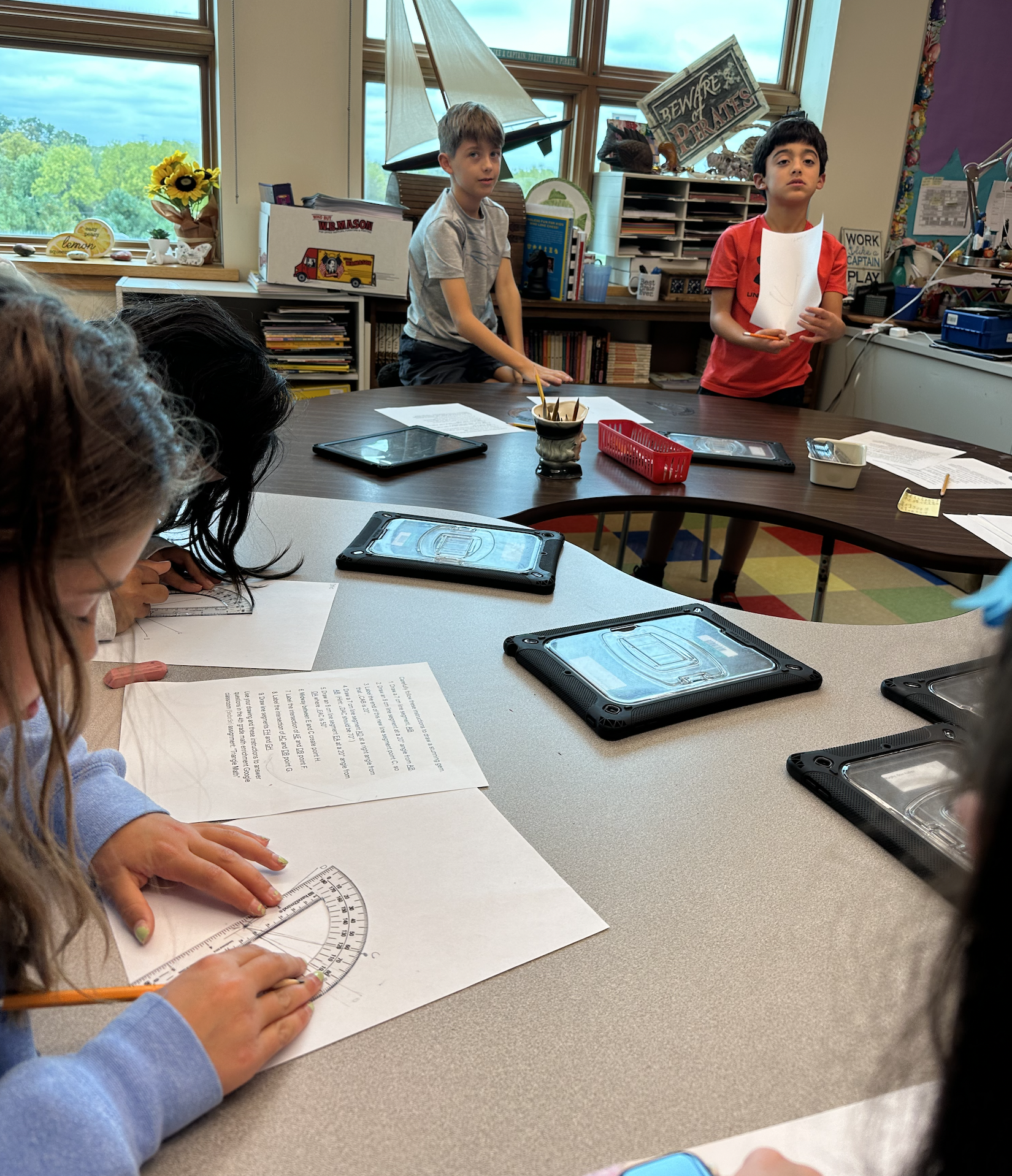
Each student had a blank piece of paper, a pencil, and a medium sized protractor that had a centimeters ruler in the center of it, along with his/her own set of the instructions. I had a different student read each step out loud. We went step by step, with me modeling the work. 

At the very beginning I showed students how to draw the first line. I had them make a dot about one third of the way up from the bottom of their paper, right in the center. “Label that point A,” I told them. “Use your ruler to draw your 7cm line like this.” I drew my first line diagonally, at about a 45 degree angle toward the right side of the paper. 

The paper with the instructions on it does not specify any of this. I didn’t want to type so many steps that students were completely turned off. I figured they could just figure out what worked best. Make mistakes; fix them; “#ProductiveStruggle” is what I’ve been telling everyone this year. “It’s good for you! Builds character.”

After the first line is drawn, we label the end opposite point A, “B.” Next, we are instructed to “Draw an eight centimeter line twenty degrees from line segment AB.” Here, I show them that they ought to draw this new line closer to the center of the paper. I also tell students to draw their lines lightly. “Don’t press down too hard. You will most likely have to do some erasing. If you make dark, heavy lines, your gem will be less stunning with a bunch of erasures all over it.” 

I won’t go through every line of instruction here. You can see what happens when you read the steps. Suffice to say, there is a lot of protractor practice and line-drawing-procission involved. You definitely want students to help one another and be open to mistakes. Luckily, these are not actual diamonds.

Finished Product

It takes several minutes to complete the drawing, but it’s worth it. There are plenty of “Oooohs” and “Aaaaahs” when the final lines are drawn. 
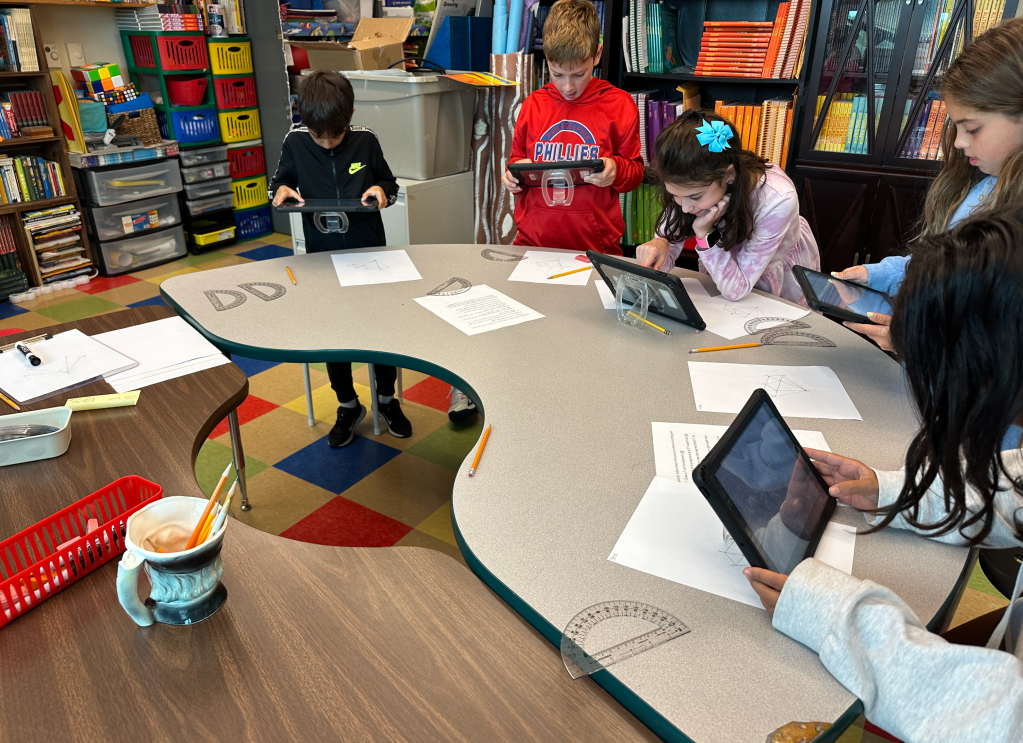
My favorite part of this project is that the drawing is a tool for answering some geometric questions and even playing a game. Ahead of time, I typed the questions into a Google form, along with multiple-choice answers, so that the form will provide a score immediately upon completion. At the bottom of students’ “Stunning Gem” instruction paper is a code for the Google classroom where the assignment can be found. This was the first project of the year, so students had yet to access this new classroom. 

There were two assignments in the new Math Enrichment Google classroom. The first contained a Google doc with the same instructions students had just used to draw their stunning gem. This assignment asked students to take a photo of their drawing so that I could see how well they did. The Google doc was available for them to make another one, or in case they lost their original set of instructions while still making the gem drawing independently. 

The second assignment had the Google form in it. This form asks questions like “Which triangle is an isoceles triangle?” And, “Which triangle is scalene?” In addition to these identification questions, I made the drawing a game in the last few questions by asking students to look for the total number of triangles that can be formed with the lines. 

Finally, I set up the Google form so that students can see their peers’ answers and edit their own, once they have submitted their work. This is math enrichment, and my aim is to enrich; Not assess. They loved getting perfect scores… Albeit, eventually;)

Origin of Lesson

The idea of having fourth graders who were learning about lines, angles, and two dimensional shapes draw pictures of diamonds came from a lesson I did with third graders. They were writing diamonte poems, and I taught them how to draw a diamond to accompany their poetry. 

I took this concept of drawing a diamond, and tried writing instructions for sharing the steps with out an illustration. The product of pupils producing stunning gems from nothing but words was even more rewarding than I had expected. They were genuinely wowed by what they made. It felt like they had created something spectacular from nothing but lines and angles! 

Lessons Learned

First of all, a confession: I forgot to include a couple of steps in my first attempt at this lesson! A whole group of students was completely mystified, if not aggravated by the project when a substitute teacher tried to lead them through the drawing exercise without me. When I saw what they did and spoke with them, I figured out what was missing. There are lines that must connect the points on the top of the gem that I never mentioned. I fixed the instructions and pushed out the additional steps in an announcement via the Google classroom stream. 

Additionally, this is not a “Whole-class-project.” This is designed to enrich the math understanding of students who are already good at using a protractor and ruler. When there are too many students to check between steps, others get bored, misbehave, go ahead, mess up their drawings, and the lesson is less successful. 

Give yourself and your students plenty of time. This will take a good 45 minutes to do. You can have them come back to it, but it’s best to wrap up all of the drawing at once. Also, have them take the photo and put it in the Google classroom assignment while in your presence. They rarely do this on their own. 

Pedagogical Aikido

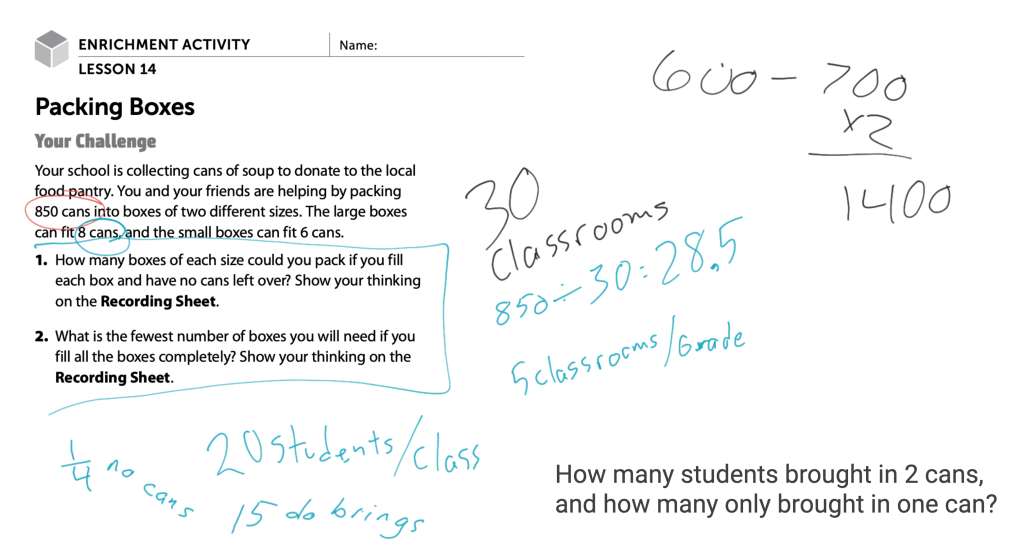
“Where did the 850 cans come from?” I was in the middle of sharing the iReady enrichment lesson (14) with my fourth graders when one of them asked me this question.

Have you ever had a student ask a question in order to postpone learning? If you’re a teacher, then that’s a silly question. Of course! 

This is one of the few things that I remember from my elementary and middle school days. It was a thrilling challenge to try to come up with just the right topic or question that could throw the teacher off track. 

We would hope and pray for a story. Then, we would artfully flatter and ask questions that would lead our pedagogue down the rabbit hole of memories, further and further… away from the lesson at hand. 

Fast forward forty years. Today’s students still play the same tricks on their teachers! This past week I was engaging some fourth graders in math enrichment, when one of them tried steering me off task. Little did they know, that I practice Pedagogical Aikido

Redirecting Energy

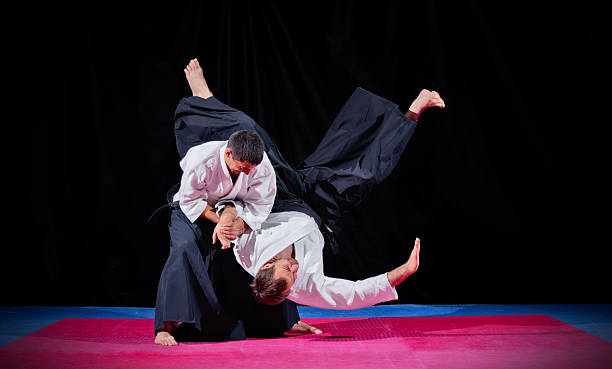
Aikido is a form of martial arts that is known for using an opponent’s energy (ki) against them. Masters of this study practice redirection. 

Although I have not formally studied Aikido, I love its principles and attempt to use the philosophy of redirecting thought and energy within the walls of my classroom as much as possible. 

For example, the other day when my student asked about the origin of the 850 cans in our math problem, I allowed the student to think that he had derailed the lesson. I told him that this was an excellent question. “850 cans is a lot of cans. Where would a school get that many cans for a fundraiser?”

The martial art Aikido uses a triangle to teach the redirection of energy. There are three components that work together to use an opponent’s attack against them, saving your energy and neutralizing the situation. It all starts with Balance, known as tachi waza (Aloia, 2020).

“How many students does our school have?” I asked the class. 

I could have squashed the student’s inquiry, telling him something like, “I don’t know where the number of cans came from. It’s hypothetical. Let’s just move on!” Or, “It came from Curriculum Associates, the authors of our math program. Don’t ask silly questions.”

If I had done that, I would have disrespected the student. A dismissive teacher or one who blocks the question head on is too hard, too strong; the lesson too one-sided. By allowing for the question in the first place, and then entertaining it, I had my center of gravity low to the ground. My metaphorical feet were spread wide apart and knees bent. The question didn’t topple my lesson. I was balanced.

In answering my question, the students were surprisingly accurate. Our school has around 700 students. “How many cans would we have if each student brought in one can?” I prompted. That was easy. “But, not every student will bring in a can… And, some will bring in more than one.” The easy back and forth of these simple concepts established a flexible, down to earth ease of thinking. It also revealed the problem. We don’t know where the 850 cans came from.

Next, it was time to Break Balance. This is the second part of the redirecting-energy triangle. “The opposite of balance is imbalance, or kuzushi. To break an opponent’s balance, one must first redirect their energy to one’s own advantage” (Aloia, 2020)

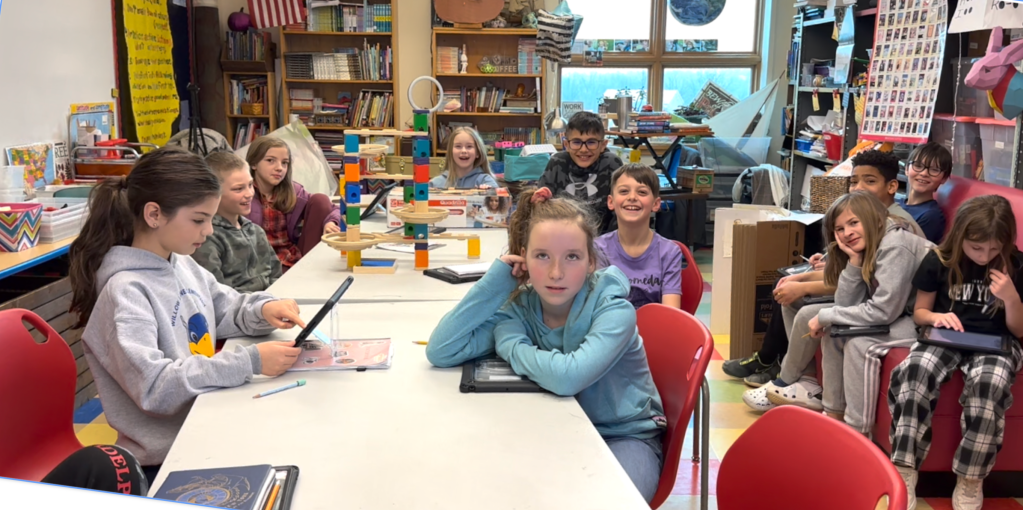
I shouldn’t be surprised, but I was very impressed, nonetheless, at how quickly my students figured out how many classrooms our school had. It was the advanced fourth grade math students receiving enrichment, after all!

I had begun the imbalance kuzushi by getting the class to come up with the total number of classes in the building. After figuring out that our school has five classrooms per grade and our school teaches six grades, if you include kindergarten, we discovered that there are 30 classes represented.

“Let’s say that our school collected 850 cans. How many cans would each class bring in?” The students had no clue where to start.

Antonio Aloia (2020) explains that kuzushi has two arms. The physical off-balancing of an attacker, parrying the opponent’s strike and redirecting the momentum of the assault, coupled with a strike of their own is what one normally thinks of when imagining Aikido. Um, of course there isn’t any literal physical contact with students, let alone “attacks,” but presenting this new problem of dividing up the number of cans by the number of classrooms was a cogitational assault of sorts.

The other arm of kuzushi is a psychological off-balancing. This is where a martial artist would “Distract a would-be opponent by bringing their attention to something else, be it an object on a building or something farther away and behind the opponent” (Aloia, 2020). Pedagogically, this happened when I changed the student’s original question from “where” to “how”: “Where did the cans come from?” turned into “How could a school come up with so many cans?”

While the martial art of Judo involves throws, Aikido keeps your opponent tight and controlled. Perhaps counter-intuitively, it is concerned with the well-being of the attacker. So, rather than toss my students aside to flounder with the problem of dividing 850 by 30 on their own, I guided them through the process of figuring out the answer.

I asked them how many cans there would be if every class brought in 10 each; 300. “Okay, maybe that was the first week of the fundraiser. If each class brought in another ten cans during the second week, how many cans would the school have collected?” We were up to 600 cans. They were starting to catch on. 

One of the students used Google to divide 850 by 30. Rather than scold him, I asked him if it were possible for any of the classrooms to bring in .333333 of cans. This was a silly question. “What happens with the remainder from the division answer?” I asked. They didn’t know. “For our purposes, we will assume that the students from every classroom brought in 28 cans. The teachers brought in the rest.” My students were okay with this explanation. 

The third side of Aikido’s redirecting energy triangle permeates everything. It is ki or energy. Don’t think of it as power or force, though. Ki is more like momentum.

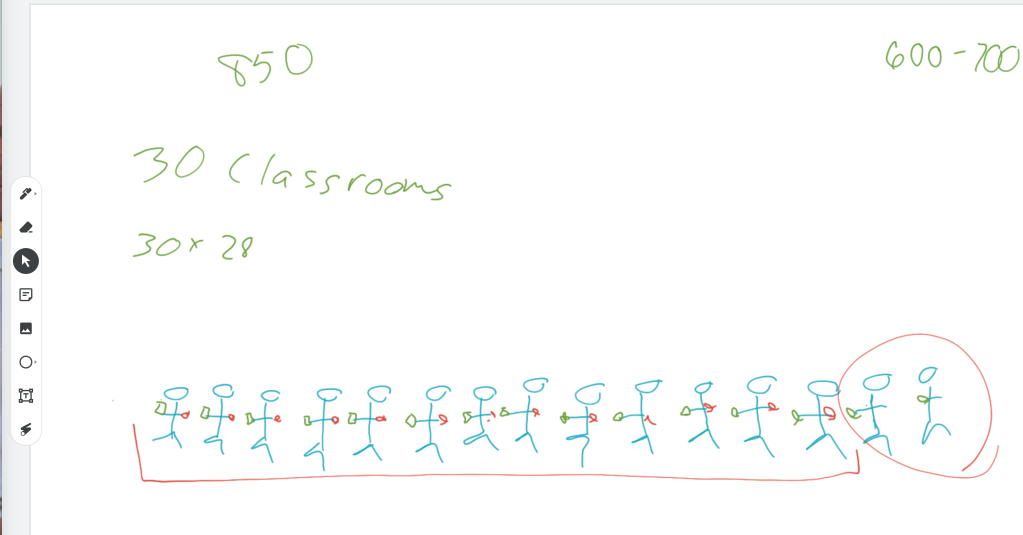
“How big are our classrooms? How many students are there in a classroom?” I got several answers on this. We decided to use the number 20. “Let’s say that a quarter of the students don’t bring in any cans. If the rest are responsible for bringing in 28 cans, how many brought in two and how many brought in one?” My students just looked at me. I told them to try and figure it out on their own, and then I’d show them. 

One student crushed it, and I had her show the class what she did. Then I modeled drawing a picture to solve the problem. 

After all of this, I told my students, “Now that we have collected all of these cans, we need to put them in something to bring them to the food pantry that we are donating them to.”

“If Dylan went out and bought a bunch of boxes… Thank you Dylan! (Dylan is all smiles at this point; He may or may not have been the person to ask the question that started all of this;) And, if Dylan’s boxes are all the same size, holding six cans each, how many boxes would Dylan have to get?” I let them wrestle with that a little while. 

When I was prepared to let them demonstrate their math on the board, I turned to the slide that had the original question on it. They reread the word problem as I decided on who would come forward to share their work first. A few students groaned and some others called out. “That’s the problem we just did!” 

“Yeah?” I feigned ignorance. 

I used someone else’s name when I told the story about getting bigger boxes; Ones that held 8, instead of 6 cans. “How many of those boxes were purchased?” 

As it turns out, we never got to fully explore the last question, but a couple of students tried solving it in their heads. I had completely Aikido-ed them! Lol.

Redirecting energy can be an even more effective motivator than a cool lesson. Take their energy, spin it around, and use it against them. Students will feel like they’re in charge of their own learning, and in a way, they are!

Source

Aloia, A. (2020, June 19). Reflecting on Jujitsu Pioneer George Kirby’s Advanced Techniques for Redirecting an Opponent’s Energy. Martial Arts of Yesterday, Today and Tomorrow. https://maytt.home.blog/2020/06/19/reflection-on-jujitsu-pioneer-george-kirbys-advanced-techniques-for-redirecting-an-opponents-energy/comment-page-1/?unapproved=2695&moderation-hash=f6966939a4ca212a2123a94cabda8d13#respond

The One-Room Schoolhouse Game

The other day my elementary school had an assembly. When it was over, a fourth grade class was left with no teacher. She had attended a meeting that was running over. Since I didn’t have a class at the moment, I decided to bring her students upstairs for her. As we waited in the fourth grade classroom for the teacher to return, I wondered what I would do to maintain a semblance of sanity. I decided on a game centered on behavior: The One-Room Schoolhouse Game.

When the teacher, accompanied by an instructional assistant (IA), entered the room, they couldn’t believe their eyes. Every student was sitting up ramrod-straight. Every single eye was trained on me. The IA verbally queried, “What is happening in here?” She was incredulous. I was in my element.

Educators are show(people). We are either putting on a performance to attract the attention of our students. Or, we are ringmasters, making sure the mayhem stays within the bounds of 42 foot diameters (the official size of a circus circle).

This is an image of the Claussville One-Room Schoolhouse, the same that my class visited on many field trips.

There are many ways to perform, but methods for maintaining order is more limited. Many years ago I came up with a unique way to do both at the same time. 

When the IA, who had seen the game in action, entered the faculty room at lunchtime, she practically burst with enthusiasm, announcing to the other teachers what she’d seen. Some of the staff members wanted in on this game of good behavior that students seem to enjoy. I explained the rules to them. Since then, I’ve had a couple of teachers ask me to share with their classes how the game works. I’m more than happy to oblige.

Then, I searched my blogs to see if I’d written about The One-Room Schoolhouse Game. Unbelievably, I hadn’t! So, here goes.

It began many years ago. I brought my 3rd grade class of “Polite Pirates” (what I called my group of students) on a field trip that visited several historical sites around our area, all in the same day. It was a fast-paced adventure of a field trip, running from one stop to another, practically assaulted with information. 

I made this video from photos and video of my 2016-17 class visiting Claussville.

We began the day at Trout Hall, the original house of the Allens, the family that founded Allentown, Pennsylvania. The building is staged to look like it had during the Revolutionary War era. A tour guide led us around the house and explained many interesting facts. 

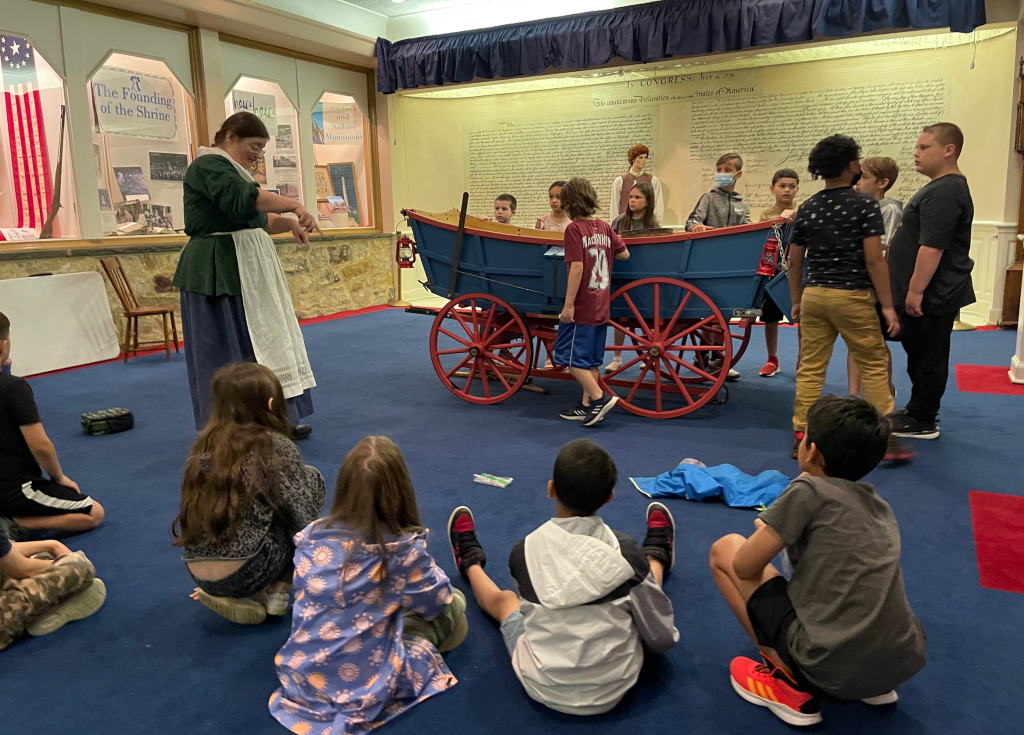
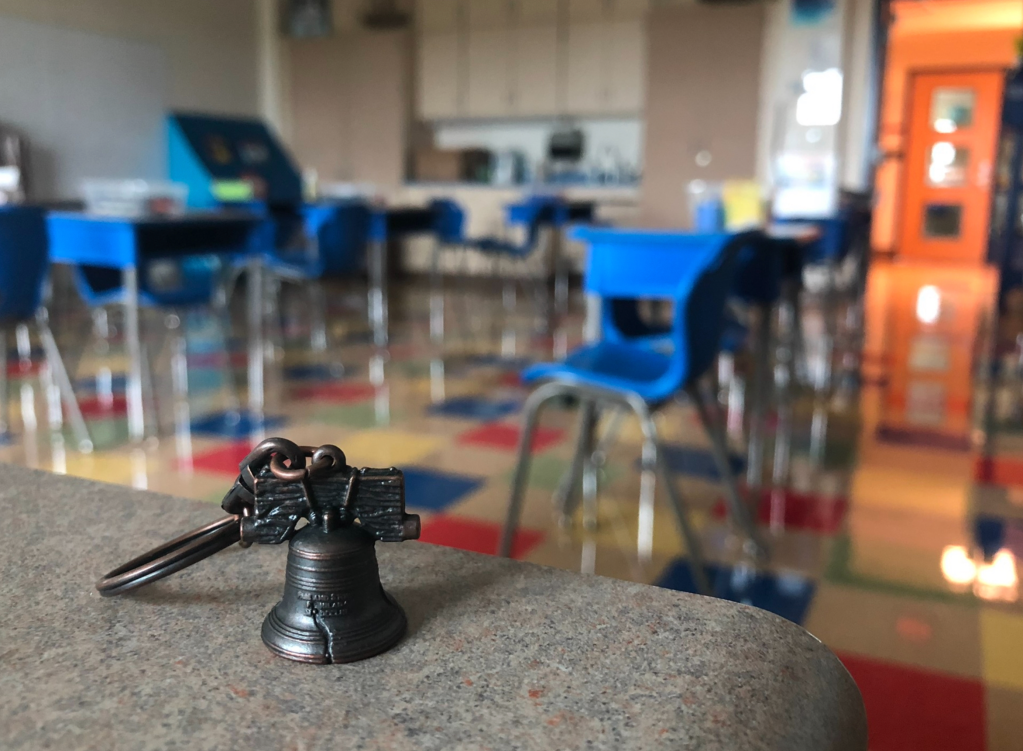
From there, we traveled only a few blocks away, where the Liberty Bell had been housed during a portion of the Revolutionary War, hiding it from the British. The Liberty Bell Museum has a life-size replica of the original bell, a slightly smaller than lifesize model of the wagon that would have carted the famous bell, along with several others from Philadelphia to our town. They have a nice mural and story display that they show. They also provide a favorite feature of every field trip; a gift shop! This is where I acquired my famous “One-Room Schoolhouse” bell. It is a mini replica of the Liberty Bell.  

This is my 2021-22 class in front of the Claussville One-Room Schoolhouse.

The final stop of the day was  an old school building that was preserved to look the way it had when it was used as a one-room schoolhouse as late as 1956. The Claussville Schoolhouse is where I learned the practices that what would turn into the rules of my One-Room Schoolhouse Game. 

A tour guide walked us through what it would be like to go to school one hundred years ago. Every grade, from first through eighth was taught in that one room! Because of this, the school master had to be very strict. 

I explain all of this nowadays when I introduce The One-Room Schoolhouse Game. Believe it or not, me acting like a big meanie is one of the more fun aspects of the game! Students love tempting me to pretend to yell at them. Suffice to say, this is far from my typical conduct. 

The Game

Now you know where the idea for the game originated, let me explain how it’s played. I introduce the game on the very first day of school. It contrasts the comfortable social/emotional learning (SEL) environment that I foster and points out how nice I actually am. 

Right off the bat, I talk about what school was like a hundred years ago. Because there weren’t any buses, schools only serviced local communities. Every kid walked to school. The building housed every grade, from first through 8th! A teacher was responsible for managing lessons for eight grades, all at the same time. And, there was only one teacher. They could not afford to have any disorder or misbehavior, so the teacher was very strict. 

“There were many rules for doing things. First of all, the students had to sit up straight.” As I say this, I morph into a very serious, demanding persona. Every student whom I have ever shared this game with has always straightened his/her posture at this point. “There is absolutely NO talking.” I look around the room, daring students to even think about speaking out loud without being called on. The students are loving this. They are on pins and needles, waiting to see who might get into trouble. I have transformed into a scowl-wearing, grumbly ogre of a teacher. 

Power of Role-Play

The tension mounts as I walk around the room. I might at this point explain some of the primitive punishments that would have been used during the days of the one-room schoolhouse. It’s not impossible for me to slap a ruler onto a desk to really amp up the mystery of the experience. (Of course, I make certain all of my students understand that corporal punishment is unacceptable in connection with education… but, that is how it was.)

Once I have my students good and primed, it’s time to share the rules of the game. When they are called upon, they are to stand, push in their chair, name the person or persons they are addressing, and make their statement in a complete sentence. I always make it clear that they are to “Refer to me as Mr. Weimann, or Captain Weimann if you’re classy, and you wants to be classy! If you are answering a question, and the information is pertinent for your classmates to pay attention to, you say, ‘Captain Weimann and fellow classmates…’ If there is another adult present, and your answer would benefit that grown up, you say, ‘Captain Weiman, Ms. so and so, peers and/or fellow classmates…’ You get the idea.” We practice this a bit. 

That’s pretty much it. I throw in some variations or additional rules throughout the year to keep the game interesting and fresh. One day I might go crazy about neatness, causing everyone to clean up their desks and the floor around their work spaces. Another day I could go nuts about hearing them breathing. They love it, the more extreme and just beyond grasp the parameters are. A really fun one is pretending to be the mean one-room schoolhouse master and prohibiting all smiling. They practically burst, but work so hard to meet the requirement! 

The trick is to do the game just enough, both in the number of times you play it and how long it lasts. It slows everything down; the making kids stand up, push in chairs, reanswering because they forgot to say who they were talking to or didn’t use a complete sentence. 

This is the tiny bell that turns the room into a “One-Room Schoolhouse.” So little: So powerful!

The students love the game, though. They usually beg me to ring the bell, for I explain that the tiny bell that I got on that very first field trip to the Claussville one-room schoolhouse has magical properties. Whenever I ring it; and only when Mr. Weimann rings it; we are magically transformed into a one-room schoolhouse. This, of course, is a huge part of the game. 

Sometimes, I will pretend to be unhappy with what is happening in the room, and “threaten” to ring the bell. The class will gasp in mock shock. If I do ring it, they all groan and moan, as if they were just strapped into straight jackets against their wills. …But, they quickly sit up straight, quiet down, and see who the big, mean school master from the past will pretend to pick on first. They are always disappointed when we return to the humdrum of contemporary time, and I turn back into fun, loving Mr. Weimann. 

Back to the Future

This game is like “The Floor is Lava,” in that no one gets hurt, it’s all just pretend, and it amps up the excitement of an otherwise typical walk-through-the-park day. It is perfect for jazzing things up right in the middle of mundane stuff. A little ring of the bell commands everyone’s attention to both behavior and their tasks at hand. 

I had no idea how different the 4th grade class that I was sharing the game with was acting, but their teacher and the accompanying instructional assistant recognized that something unique was going on. Rather than explain the game, myself, I allowed the teacher to call on students, who nearly burst with pride to show off their new skills. 

It took a couple of kids to get all of the rules out, but once I felt comfortable that the teacher understood what was going on, I was free to leave the past. On my way out I whispered, “I’d wait a couple of minutes before ringing that bell. Ride it out;)” 

You don’t want the game to go too long. Fatigue can set in. For the game to be fun, it has to be special, so don’t play it too often or too long. Let the students petition for it a few times, and then surprise them after returning from lunch or in the middle of a multiplication game. Use it for a transition to another lesson. Above all, have fun.

This video shows all three stops of the Polite Pirates’ Lehigh Valley, PA historical sites field trip (2018).

Math Games: Dessert for Dinner?

What if you could produce a dessert packed with protein and healthy nutrients; I’m talking even more beneficial than a typical meal. Would you serve this delectable dish for dinner every day? My conclusion may surprise you.

Last week was Parent-Teacher-conference-week at my school. Students had half-days, and families either visited the building or used virtual conferencing tools to converse face to face with educators. This was the very first time that I bounced around from teacher to teacher, visiting the conferences of my gifted students’ parents. While there are many ideas that I could comment on, the one that stands out most was from the parent of one of my math enrichment students. 

The family has a third grader who is gifted, and that is why I was attending the conference. But, his little sister, who is in first grade, attends my math enrichment lessons, and it was something that she said that got me thinking. Her parents told me that they asked their daughter what she did in math enrichment class, and she told them, “We play games.” 

“Is that all?” I imagine them pressing, being the good communicative parents they are. Yup, is the first-grade answer:) 

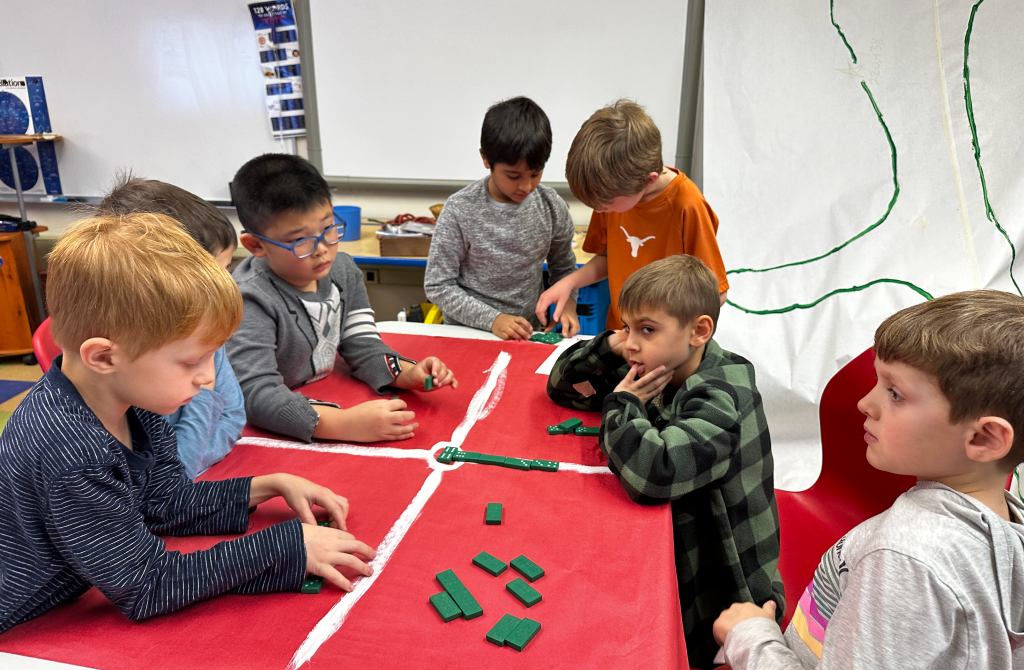
This is a recent pic of 2nd grade learning to play Dominos.

I laughed when I heard their tale. I explained to the parents that I was teaching the first graders Dominos. After defending the fact that there is a lot of mental math and problem-solving, there was some light banter between parents and the regular ed teacher about only knowing the stacking and tumbling side of Dominos. 

Because their gifted third grader had already experienced lessons showing the critical thinking development of Dominos, it wasn’t necessary to get too defensive. They were “on board” with my use of games for strengthening math skills. But, the idea of my lessons being categorized definitively as nothing more than games gave me pause. Initially, I was perfectly okay with tricking students into learning through having fun. What teacher would turn down that strategy? “Can we have some more math enrichment, please!” the students whine. “Um… Yes!” every math teacher in the world would utter. 

Then I thought about the idea of turning everything into a game. Wouldn’t that be wonderful for the students? But, would it be healthy? Hmm… 

This is where the thought experiment at the top of this blog originated. I was musing over my math lessons being perceived as games, and I dreamed up the analogy of only eating dessert. Prepare to enter a rabbit hole of research. I’ll try to keep it palatable😉

History of Dessert

Asking “Why does dessert even exist?” feels a little like questioning the purpose of gold or jewels. Isn’t it obvious? It’s awesome! 

Believe it or not, dessert did not always exist, however. Similarly to gold and jewelry, it was discovered, and has evolved over time. The French are responsible for turning entremets into dessert (Gerson, 2019). Before there were sweets to end a meal, entremets were served as “interval” dishes, literally “between-foods” courses (Teppen, 2015). They were meant to cleanse the palate. They may be sweet, but not necessarily. 

Eventually, a final course of fruit, called le fruit, was formalized (Gerson, 2019). Only, before serving it, the table must be completely cleared. This cleaning of the table was called desservir, the French verb for “to clear.” More than tasting wonderful, the original final course of fruit developed into something lovely to gaze upon. Some desserts even consisted of “Elegant metal and glass structures holding whole apples or plums. Other times, meticulously crafted sugar figures became the center of dessert displays, and might not be eaten at all. Dessert specialists in the eighteenth century were supposed to understand architectural design and be capable of replicating it in sugar paste” (Gerson, 2019). 

These creators of dessert, as it came to be known around the time of the French Revolution, when the Bourgeois assimilated the term, were originally more like artists than chefs. Maryann Teppen (2015) writes of an entire battle scene, complete with tiny sugary soldiers with guns and canons, that told the story of Louis XV’s demise crafted out of sugar. It is hard to imagine your dinner table being cleared; plates, napkins, silverware, and foods being “dessert-ed” away; only to be replaced by an elaborate, sugary scene of violence that you feast your eyes upon but don’t touch!

Modern dessert serves a different purpose. BreezeMaxWeb (2022) suggests it psychologically signals the end of eating. Consuming a small, sweet treat at the conclusion of a meal might communicate to the body and brain that we are all done, and there is no need to nibble superfluous snacks. The End. 

A practice that I began a couple of years ago has helped me lose some weight and become more healthy; I will eat an apple at the end of every lunch. Many years ago I heard that apples help clean your teeth, and apparently there is some truth to that (Apples: Dental Hygiene Facts, 2017). Once I’ve eaten my apple, I cannot/will not eat anything else. I don’t want to undo my teeth cleansing. This has helped me de-snack my afternoons.

Let me reintroduce the concept of math games, here. Could a game be used to transition from one course of subject matter to another? Would playing a game cleanse the cognitive palate, and prepare students for something completely different? Of course! Would this be an appropriate way to signify we are done with the subject? I think so.

Delayed Gratification (Deferred Satisfaction)

How many parents use dessert as a reward for finishing a well-balanced meal? That treat is the ribbon at the end of a race. Some contests require more work and take longer, but when getting to the game of a lesson is the goal, students may trudge longer, work harder, and persist through all kinds of problems. Those students who finish first might learn patience through having to wait for their peers to catch up with them before the whole group can consume the dessert of a lesson together. 

Self control. Training. Conditioning. “If I let you eat this piece of cake, do you promise to gobble up all of your peas and carrots without complaining?” doesn’t just sound silly. I probably don’t have to tell you that this is an ineffective reward model;) 

But, what if the dessert is carrot cake? What if the dessert is healthier than the dinner? Then what? “Eat all of your cake, or you won’t be given any peas…” Wait, what?!

Is there something to be said for learning to crunch through cardboard in order to earn cake? According to a longitudinal study spanning 40 years (Casey et al., 2011), learning and practicing self control early on in life can lead to better academic performance, less behavior problems, and even higher SAT scores. Casey and company (2011) describe in their paper, “Behavioral and neural correlates of delay of gratification 40 years later,” some ways kids can curb the pull of stimuli by learning cognitive control. There are mental strategies and tricks that people can use to provide buffers, dampeners, and walls to contain and maintain self sovereignty. Students may never learn or develop these important skills if they are never asked to wait for anything.

Through reading this research I wondered if teachers, themselves, are bypassing the delay of gratification when they jump right into games to teach. What educator looks forward to grumblings from their students? I propose that most  would prefer praise of pupils happy with pedagogical practices over the squabbling of scholars required to earn a fun activity. Are we educators partaking in dessert before dinner when we teach with games?     

Dessert Before Dinner

Before we beat ourselves up too much, let’s bring our metaphor along with us as we explore a couple of Jamarillo’s fun list of 11 Reasons to Eat Dessert First (2023). This may initially seem like a self-serving exercise, justification, or defensive maneuver, but hold on. Jamarillo raises the point that food can sometimes be a serious psychological hangup. “When we have disordered eating, we can often develop food or meal fixation.  Dessert is one of the most common food items restricted. This can lead to binge restrict cycles and disruption of hunger cues” (2023). 

Is it possible for students to develop “learning disorders” by experiencing “binge-playing” with learning games after enduring unnecessarily long restrictions? Just as Jamarillo (2023) suggests that dessert-first-eating can help overcome eating disorders through stimulating hunger, tapping into nostalgic memories, practicing navigation of bodily needs versus wants, and learning to respect cravings, beginning a lesson with a learning game can help students who struggle academically to open up to pedagogy.  

One thing more, and this might be a great way to end this blog, Jamarillo (2023) ends her short article with the fact that dessert is an ambiguous course. It can be a sweet, but doesn’t have to be. Fresh, raw fruit could serve as dessert. Pies, pastries, a tiny chocolate or candy, sweetened veggies, and yes, of course cake can all constitute desserts, whether eaten at the beginning of a meal, middle, or end. 

In conclusion, my first grade student may imagine all she does is play games during math enrichment time, but this learning dessert is rich with problem-solving proteins, mental math nutrition, and healthy higher-order thinking! With the short amount of time I have with my students, I have to make my challenges tasty. And, I’m okay with that;)

Sources

BreezeMaxWeb. (2022). Why Is Dessert Important After Eating Food?. Casa Romana Sweets. https://casaromanasweets.com/why-is-dessert-important-after-eating-food/#:~:text=When%20you%20eat%20dessert%20after%20your%20meal%2C%20it%20signals%20to,moving%20after%20you%20eat%20it.  

Casey, B. J., Somerville, L. H., Gotlib, I. H., Ayduk, O., Franklin, N. T., Askren, M. K., Jonides, J., Berman, M. G., Wilson, N. L., Teslovich, T., Glover, G., Zayas, V., Mischel, W., & Shoda, Y. (2011). Behavioral and neural correlates of delay of gratification 40 years later. Proceedings of the National Academy of Sciences, 108(36), 14998–15003. https://www.pnas.org/doi/full/10.1073/pnas.1108561108 

Cherry, K. (2023, November 5). The Meaning of Delayed Gratification: Deferred Satisfaction and Its Rewards. Very Well MInd. https://www.verywellmind.com/delayed-gratification-why-wait-for-what-you-want-2795429 

Apples: Dental Hygiene Facts. Summit Dental Health. (2017). https://summitdentalhealth.net/apples-dental-hygiene-facts/  

Gershon, Li. (2019, August 21). The Invention of Dessert. JSTOR Daily. https://daily.jstor.org/the-invention-of-dessert/  

Jaramillo, S. (2023). 11 Reasons to Eat Dessert First. Peace and Nutrition. https://peaceandnutrition.com/11-reasons-to-eat-dessert-first/  

Miller, K. (2019, December 30). What Is Delayed Gratification? 5 Examples & Definition. Positive Psychology. https://positivepsychology.com/delayed-gratification/  Tebben, M. (2015). Seeing and Tasting: The Evolution of Dessert in French Gastronomy. Gastronomica, 15(2), 10–25. https://doi.org/10.1525/gfc.2015.15.2.10