Paper Football Field Goal Line Plot Lesson

Driving question: What is the perfect length of a paper football field? We are talking, one that allows some paper footballs to score goals, but not every “kick.”
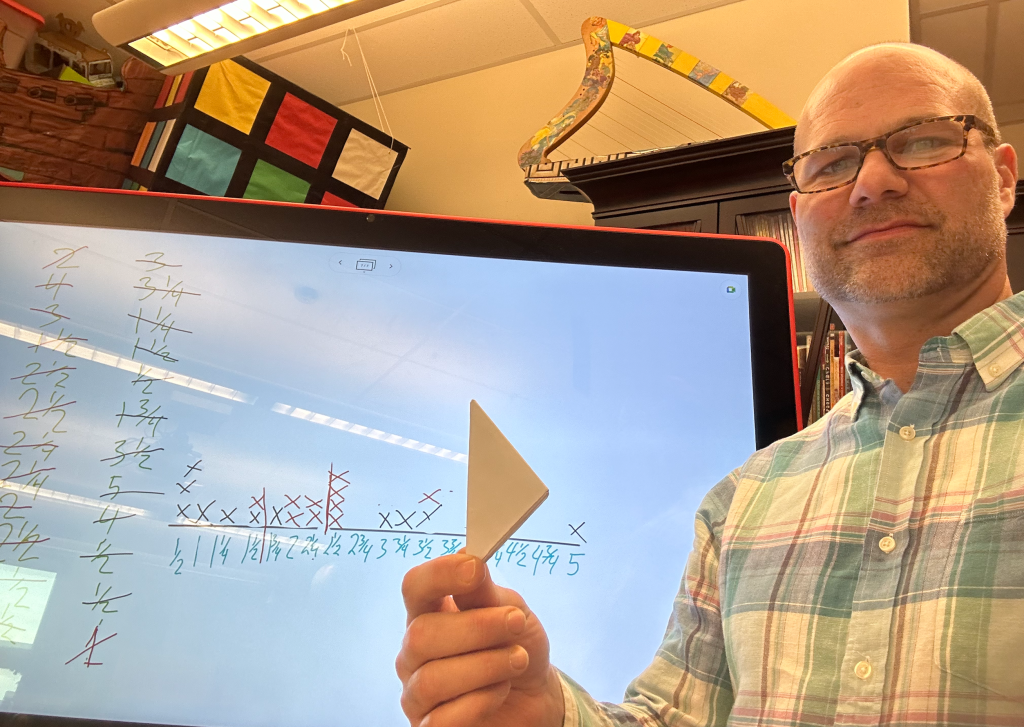
Goal: Students will create and use a line plot to categorize data in a way that makes it easy to interpret. They will analyze the data to determine the best measurement for flicking a paper football accurately.

Prep: I folded a paper football out of an ordinary,letter-sized piece of paper (8 ½ by 11 inches). You fold it the same way you fold an American Flag. Have one pre-folded, but this could be part of the lesson, if you have time. (I didn’t have X.) 

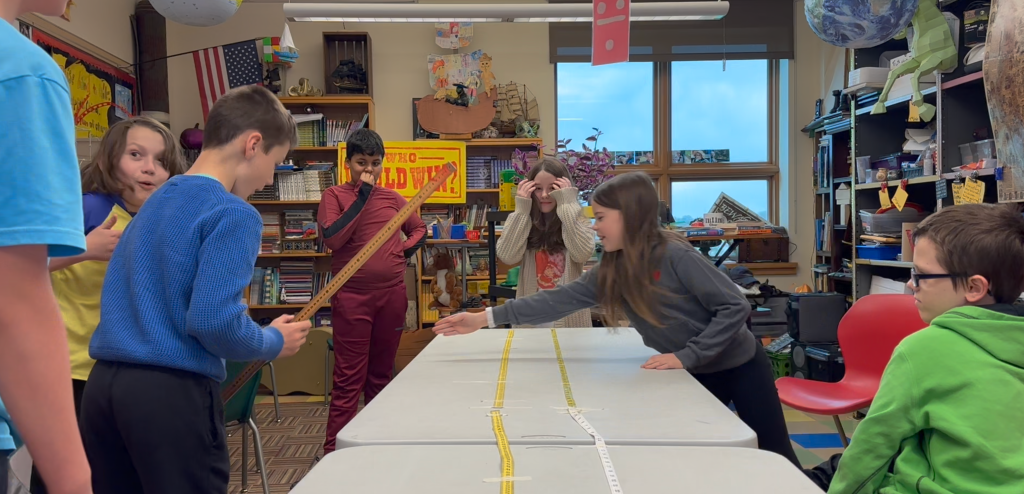
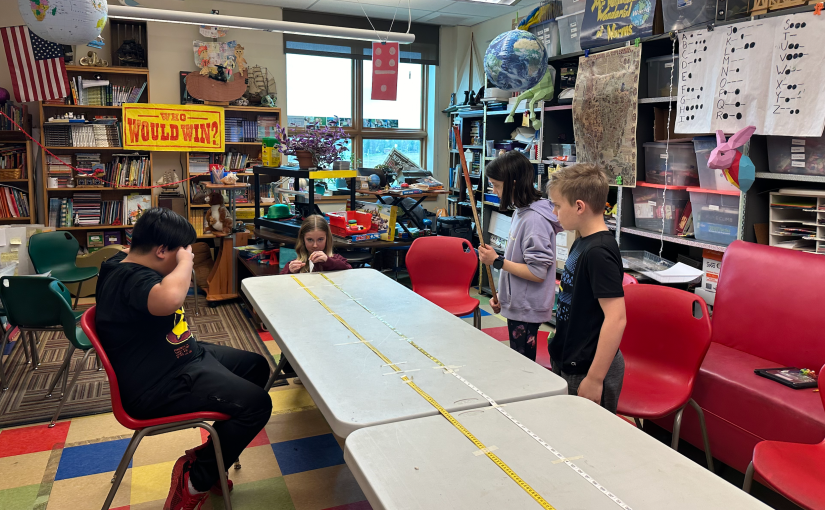
I placed two tables end to end, creating a lengthy runway for measuring. Before students arrived, I taped rulers to the table top the entire length of the two tables, about 3 inches away from the center. I put pieces of tape at each foot so that it would be faster and easier to locate the increment. 

Lesson: I told the students the object of the lesson was to determine the “goldilocks length” of a paper football field for this group of students. Another group may be better or worse at flicking the paper football. We are going to collect data that will help us tailor our “field” to our group. 

“We don’t want the field goal too close, or every single flick will score a point. We also don’t want the field goal too far away. Then no one will score! There will be a window where some will score, but some won’t. We will use data to find that sweet spot. And, we will use a line plot to help us read the data.” 
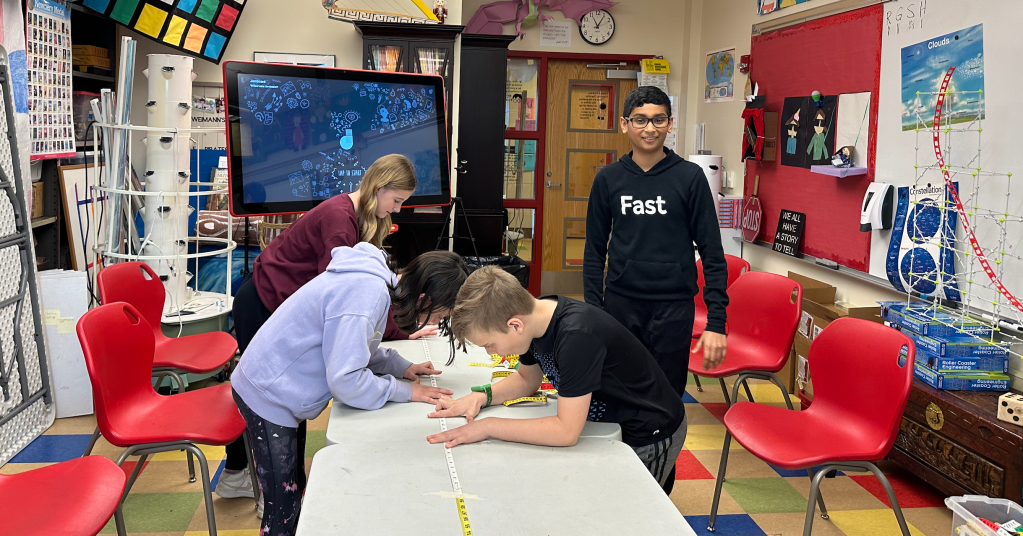
The first thing we did was figure out the width of the field goal, so that we could finish constructing our mock field. I had each student form right angles with their thumbs and index fingers. Then, touching thumb-tips, they placed their finger field goals on the measuring tape (ruler) I had already taped to the tables. As students shared the measurements of their finger field goals, I wrote them on the dry erase board. We had 6, 6, 5, 5 inches. 

I had taught my students how to average numbers earlier in the year. They were bouncing with the information, now. “It’s 5.5,” a girl offered. 

“How do you know?” I queried.

A boy suggested that it was right in the middle of the numbers. I affirmed this by circling the middle four and five. The girl who had provided the original answer shared what she did to get it, and what one should do to find the average of several numbers. “You add all of the numbers, and then divide by the number of numbers.” We discussed dividing 22 by four in order to review fractions and decimals, and to double-check our answer.

Next, we used mini (six inch) rulers to measure five and a half inches distance between the already taped down ruler and a new one. I had the students tape it down. Now, we had a runway that was the average field goal width, running about ten feet long. 

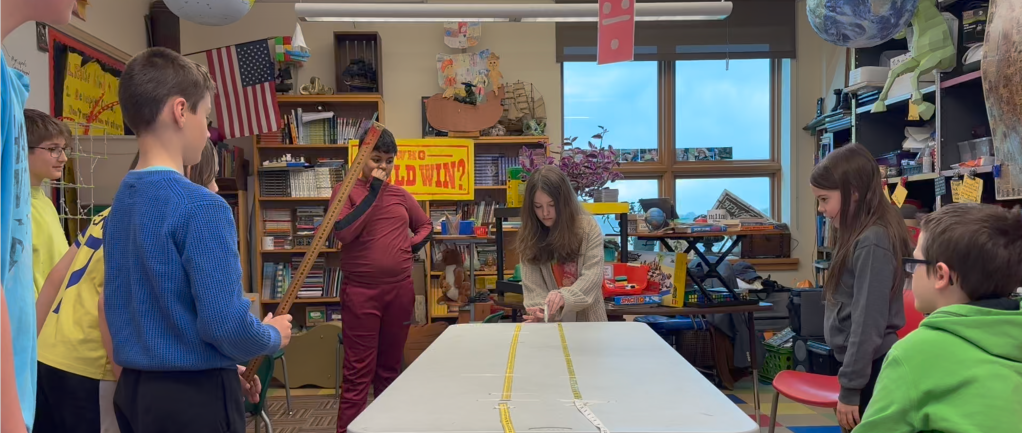
I demonstrated how to flick the paper football. Each student got three tries. If any of them were duds (didn’t fly), we conducted a retry. There were a few very short flicks, but all in all we collected some valuable data. 

This line plot is not great because the line is not accurate. There ought to be measurements that do not have Xs. Every 1/3 foot should be labeled.

About half of the flicks landed between the two rulers; within the field goal range. These measurements were written on the board in one color. The flicks that did not land between the rulers were recorded in a different color. All of the measurements were recorded to the nearest ⅓ of a foot, in order to use mixed numbers on our line plot. 
Once the line plot was finished, it was easy to see the window where the field goal ought to be erected. There was a collection of accurately-flicked colored Xs up to a point. Then the other color, the color of missed flicks began to move in. At a certain point there were no longer any accurate flicks. The brackish space containing both colors contained the available distances. 

Some students wanted to place the field goal at the first measurement that recorded a miss. I explained that, were we to place it there, nearly every flick would score a point. Even the misses that went far could pass between the goal posts before veering off to the side. I drew a picture illustrating what I meant. 
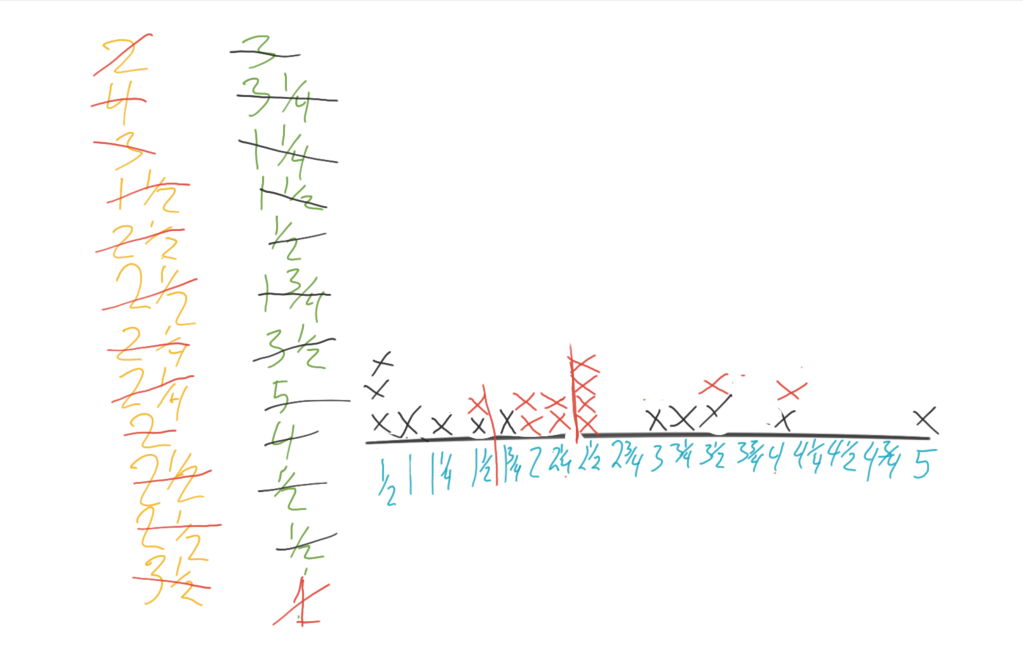
We drew lines at measurements that we thought the field goal would work best. Then we discussed pros and cons referencing the data.

One student wanted the goal posts erected right before the very last successful data point; The last one to land between the two rulers. I told him that “This would guarantee that only one person would get one point for one flick out of… How many did we do? That might be too frustrating, and not very fun.” 

We ended the lesson without deciding on the perfect distance. Basically, the thing to do was to use the data that we collected to try out some reasonable distances, and see which ones were more fun. The beauty of the paper football field goal game is that the field is so malleable. It is all about fun, and that’s what I hoped the line plot lesson would generate. If nothing else, it was memorable. 
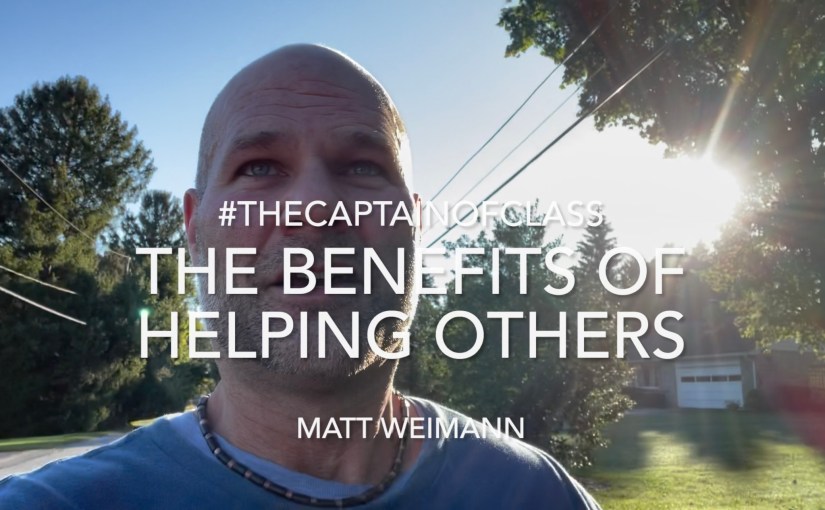
Get Endorphins From Helping Others

Have you ever felt super good after experiencing an extra grueling workout or after finishing something really difficult? This is natural and normal. The human body has a way of protecting itself from feeling pain; It releases what some call a “Happy Hormone” that tricks the mind, so that the body can heal in peace. This hormone release is known as endorphins (Myers, 2021).

I like to run in the morning for a couple of reasons. One is that it is when I have time. Running while my daughter and wife are sleeping means I’m not using up time that would be spent with them. Also, my wife and daughter aren’t the only ones sleeping at the hours I run. There are far fewer people pounding the pavement when the sun is just barely hinting over the horizon than later in the day. In other words, I can run in peace, with much less crowded park paths. 

The other day I was running at a nice clip, and I was feeling pretty good about it, when a guy called to me from a jeep. He asked me where the “Water Park” was. I stopped to tell him to turn right at the light. I was about to explain more, but he told me that this was enough information. It actually was, since there are signs, and his destination was right around the corner. 

As he drove off, I was left with curious thoughts and feelings. It is rare for someone to release you from helping them. Most people would sit there and take in all of the directions I would be willing to give. Another interesting realization was that I didn’t feel annoyed about this interruption hurting my pace or disrupting my run. I use an app to measure my pace, and I enjoy keeping pretty close tabs on how I am doing. A recent goal has been to run at a slightly faster pace. Stopping to talk to someone would hurt my overall average! 

The overwhelming feeling that I experienced was one of giddy elation at simply helping someone. It was so strong that I videotaped myself sharing a hypothesis about these emotions. I wondered if, in addition to exercising, there were other times and ways to get endorphins. 

Lots of runners are familiar with a “runners high” after a run. This high feeling helps the exerciser (It doesn’t have to be running; Any form of physical activity or exertion will work) NOT feel the pain that their muscles will experience. It is the body’s way of self-repair. 

When I helped the traveler find his way, I had stopped what I was doing. My pace was suffering. I was not using my time for me. My focus was being distracted. My goals were getting harder to meet. In short, I was experiencing, albeit minor, psychological pain. But then, afterward, I felt awesome, having helped someone. 

My scientific question: Could helping people cause endorphins to be released? 

From just a tiny bit of research the answer seems to be, yes, helping others can cause real, physical, good feelings (Myers, 2021).

I highly recommend that everyone conduct many science experiments of helping others. How does it feel? Journal about it to collect data and observe trends.

Also, share with me not only what you discover from your own personal research, but any articles that support (or deny) this claim. I’d like to dig deeper into the physical benefits a person acquires from helping others. 

“Being kind” isn’t just a nice thing to do. It actually benefits your self. So, be kind for #selfcare. 

Sources:

Myers, Amy. July 26, 2021. What Are Endorphins & Why We Want Them.  https://www.amymyersmd.com/article/what-are-endorphins/ 

3 Classy Things Dolittle Does

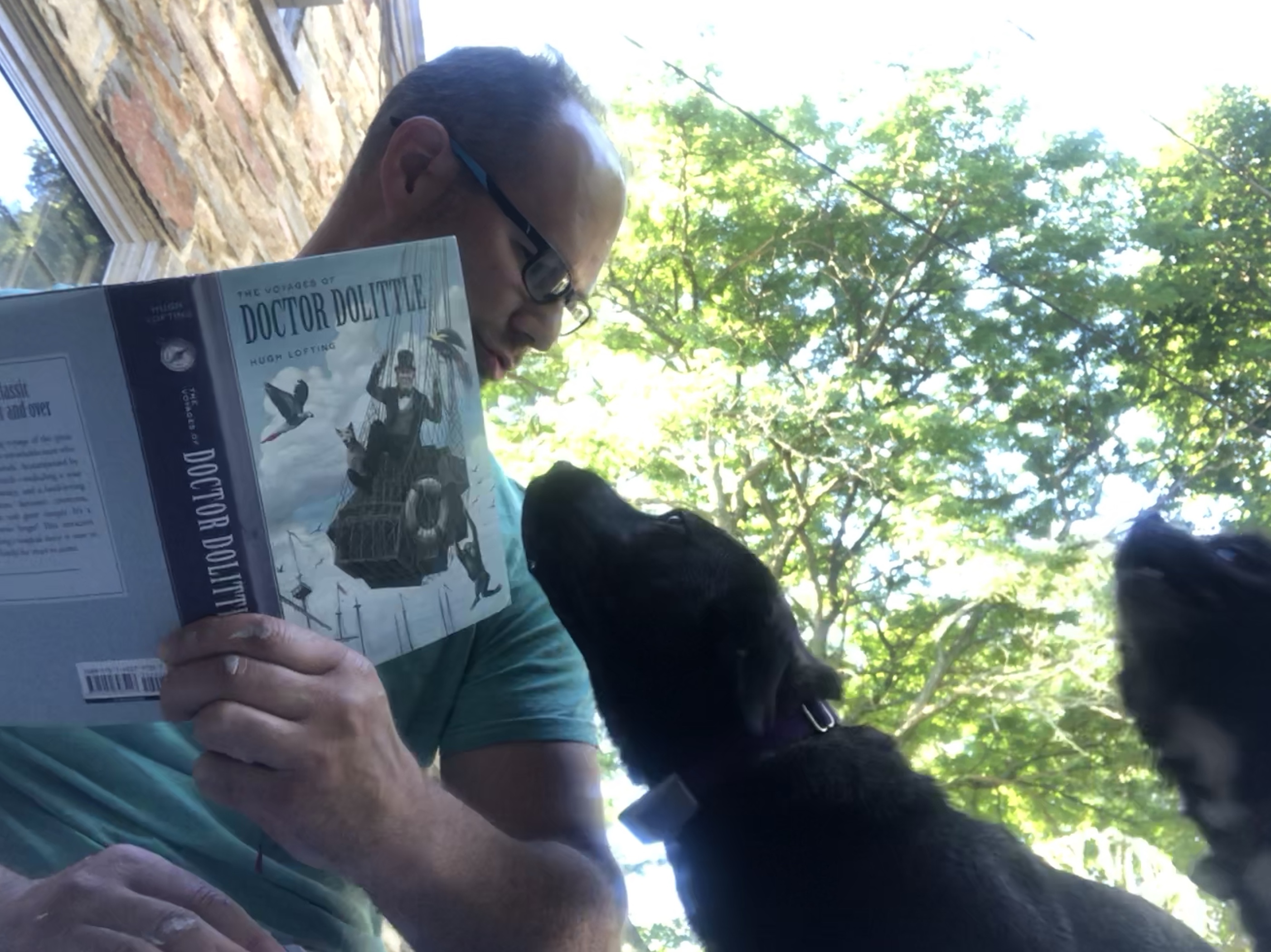
IMG_9875 copyAlthough I read “The Story of Mankind” first, I haven’t finished composing my blog for it. The book covers all of history, from the beginning of time to the “Great War.” (World War II hadn’t happened at the time of its publication–1921, so “World War I” was not numerated yet.) It is going to take me a couple of days to whittle my thoughts down to a handful of classy things. For this reason, I am providing my thoughts about the second ever Newbery Award winner, “The Voyages of Dr. Dolittle” (1923) first.
Hugh Lofting’s creation of a medical doctor turned veterinarian after discovering he can communicate with animals was so successful that it spawned 13 books in all. “The Voyages of Dr. Dolittle” is the second of the series. I was hesitant to jump into a sequel, having never read “The Story of Dr. Dolittle”, but was pleasantly surprised to find it very independent… and immensely entertaining, not to mention very valuable. Here are three classy takeaways.

  1.  A Unique Attitude Concerning Wealth: Dr. Dolittle cares little for monetary wealth. He needs money to go on his voyage and buy provisions, but his true wealth is the knowledge that he gains with new discoveries. The doctor never frets over where his funding will come from. He even seems to avoid the matter. When he is making a wager with Don Enrique during “The Doctor’s Wager” (Chapter 34), I was sure that Dolittle was going to ask for money. I was completely surprised by what the author put together! It was some of the most interesting reading I have experienced. Discussion Point: What is the most valuable thing you can think of? (Discuss the word “value” first.)
  2. Respect: In addition to speaking with the animals, the doctor treats them with respect. Throughout the entire book every animal is given the same level of dignity as humans. Discussion Point: The “Irony” of Dr. Dolittle cooking bacon for breakfast within sentences of a heavenly pig entering the animal-loving home. 2nd Discussion Point: I would talk to my students about the assumption of intelligence. The author, through the character of Dr. Dolittle, assumes every animal not only communicates within its species, but is smart enough to speak with any other, as long as the language specific to the species is understood. This is a fallacy that, in my opinion, ought to be mentioned, so that young listeners’ minds do not develop misconceptions.2369136756_0e0290fb16_b

Respect is given to enemies. In the beginning of chapter 48, “War!” news of a “thievish” and “envious” group of people preparing to ransack the provisions of a more studious tribe is communicated to the Dr. and his party. His response sums up the classiness of the doctor’s character: “Yet let us not judge harshly. Perhaps it is that they are desperate for food, having their own crops frost-killed before harvest” (p. 183). And, I won’t spoil it for you, but you will be as surprised as the Bag-jagderags when you read the end of “The Peace of the Parrots” to find out how the doctor treats these warmongering thieves. Discussion Point: What might someone else have come up with for “terms” of peace? Look up the terms of peace from other great wars.

Warning: With heavy heart I mention that this, like many old texts, contains traces of racism. I read the original 1921 version of the story that is now in the public domain. I thought that I would merely be mentioning the fact that the n word is used two or three times early on in the book as vernacular of England countrymen. But, upon further reflection, I want to mention a bigger idea. There is a character in the text, Bumpo, who is an African prince. This person studies at Oxford, which is prestigious, and one might, at first glance, think that this is doing Africans a service. When reflecting on the tale as a whole, however, I realized something disturbing that cannot be fixed by simple bowderization (Dominus, 2006). Bumpo, the Oxford student, is relegated to carrying things and cooking for the crew of the curlew (ship), while Tommy, an English boy of ten or eleven, is the doctor’s right-hand man. I’m not sure what kind of “discussion point” to make here, other than the fact that people have traditionally favored humans that look, act, and speak like themselves. This royal, presumably rich (Bumpo traveled to and paid for an education in Oxford.), intelligent (Bumpo was halfway through his studies.) man from Africa is portrayed as less of a person than Tommy. Think about it logically. Bumpo and the doctor have way more in common than do Dolittle and a boy. Tommy doesn’t even come from an educated, wealthy family! I must stop.

3. Science: Although purely and fantastically fictional, this fun novel paints scientific study in a perfectly delightful, exciting, and adventurous light. When other books have kids seeking treasure with buccaneers, Stubbins (the boy’s last name) joins an unlikely captain on the most exhilarating voyage any boy could hope to experience. This tale brings science to the plane of pirates, making knowledge and study as exciting and valuable as gold dublins!

Here is a bonus classy point. I loved the emphasis on thinking in this book. It seemed to me ironic that someone who does so much would be named “Do-little”. I was pleased to see his name changed, albeit temporarily, late in the book, to “Thinkalot”. It was rewarding to see this quality pointed out, rewarded, and admired in a children’s book. And with that I leave you. This was a very classy classic that I plan to read to my class this year. I look forward to the thought-provoking discussions my class and I will enjoy.

IMG_3635

Lofting, H. (2012). The Voyages of Doctor Dolittle. New York: Sterling Children’s Books. [Bowdlerized version, omitting or changing several racially inappropriate phrases]

Dominus, M. (2006, January 23). The Bowdlerization of Dr. Dolittle. Retrieved July 8, 2018, from https://blog.plover.com/book/Dolittle.html