Building Strategic Thinking with Dominoes

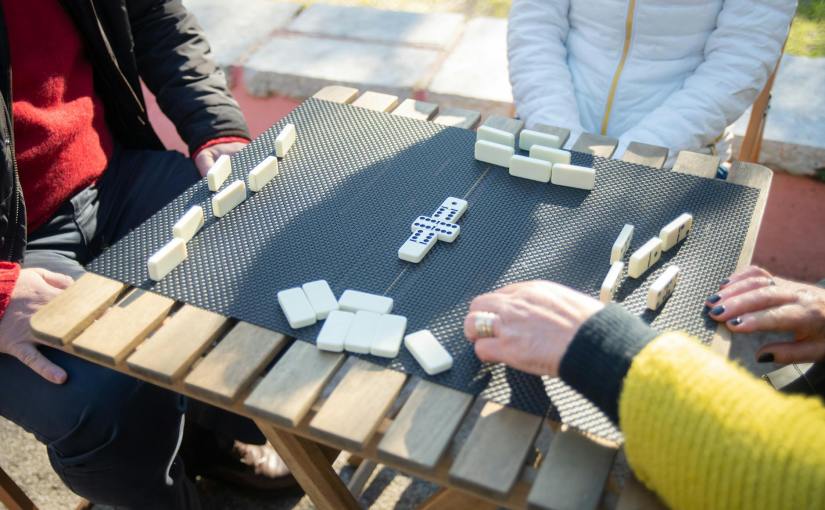
My 5th grade gifted class revisited the game of Dominoes last week. It took some review, but they enjoyed playing the game. I told them that one of the reasons I had taught them the game was because it is a classic that they could play with grandparents and other elderly people, bridging the gap between generations. The game has been in existence for over 900 years! 

In addition to the game being old, it also presents an opportunity to practice strategic thinking. In an effort to prove this to my 5th graders, I have begun dreaming up scenarios where a player might use analytic skills to make a counter-intuitive move that would benefit them in the long run. 

There are times during a game when you have more than one Bone (Domino) that you can play, but none of the plays will give you points. Sometimes, it does not matter which one you put down, but other times you can plan ahead. Much like you would in chess, you can set up future moves by arranging the Bones to meet your needs. Playing them in a particular order would benefit you more. 

I planned on showing my 5th graders what I meant by setting up scenarios of games and taking pictures. I have done that many times to teach the problem-solving aspect of Dominoes. 

Using photos as teaching tools works great on interactive devices.

Then I thought, Why not have my gifted students make up the puzzles themselves? I will give them the parameters, and they have to try to figure out how to show the need for strategic thinking through constructing an image of a hypothetical game. 

The puzzle would be an image showing Bones (Dominoes) already played, Bones available to a player (standing up so Pips or dots were showing), blank sides of the opponent’s Bones, and maybe a Boneyard (unused Dominoes). 

If you are a novice Dominoes player, some of this vocabulary might be new to you. Bones are the game pieces, named after what they were originally made out of; Ivory or elephant tusks (bones). The Boneyard is made up of the unused Bones lying face down. Face down means that the Pips or dots on the bones are not showing. All you can see is a blank Bone or the uniform design that is printed/carved on every one of the 28 Bones of the set. Bones often have something decorative on the side without Pips, so that players can identify the 0-0 Bone more easily. Every Bone has two numbers on it. There are two ends of the number side of a Bone. No two Bones have the same combination of numbers. Beginning at 0-0, the Bones go up to 6-6. 

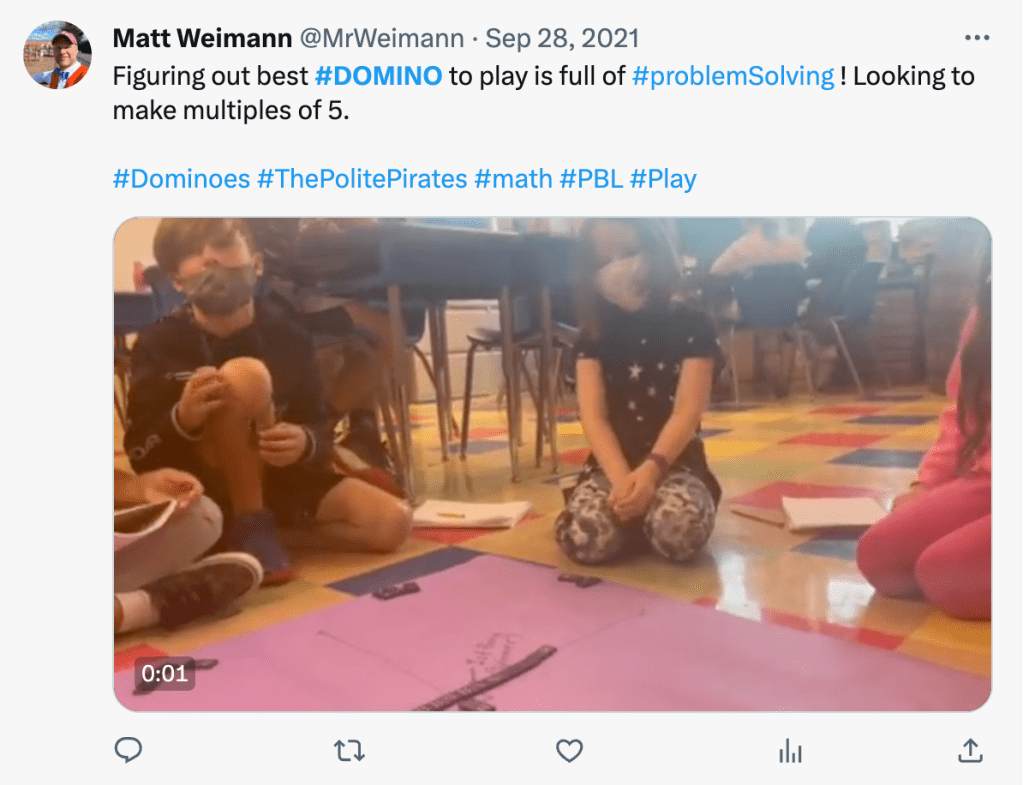
The Plan: In order to demonstrate strategies for play, I am going to have my 5th graders come up with puzzles that point to weighted plays. In other words there will be better moves than others. People trying to solve the puzzles will have to analyze the potential moves. Which one is better and why? Puzzle-solvers will be required to explain the move they chose. 

This is from the beginning of the year.

The Work: Arrange Bones as though they had been played in a game. This means matching the ends of Bones; Six is connected to six, three to three, etc. There ought to be four lines of play that a player can connect a Bone to.

Each player has Bones left to play. One set of Bones is standing up, with the number of Pips showing. These are the Bones that the puzzle-solver has to work with. (Normally, when I am teaching Dominoes to students, I have them lay all of the Bones down, so that every student can see all of the Pips. This is so that every single play is a lesson on problem-solving. When one plays a real game, you do not show your Bones to your opponent.)

The Bones that the puzzle-solver has to work with (the ones showing Pips in the image) should have numbers that can be played. They contain the number that is present at the ends of the lines of play. One of the Bones that can be played would cause the sum of all four ends of the lines of play to add up to a multiple of five, which is how one acquires points in Dominoes. This would seem like the best choice to complete the puzzle. 

Because we want this to be a puzzle that causes Domino players to grow in their understanding of the game and not just an illustration modeling how to play, we aren’t going to make the correct answer to our puzzle be an obvious choice. A good head-scratcher will require a player to look beyond the obvious play. 

If four Bones with the same number have already been played, and the puzzle-solver has two of the remaining Bones with that same number, how likely is it that the opponent of the puzzle-solver has any Bones with that number

Here is your task: Make it so that playing the Bone that does NOT create a multiple of five is the better play. 

I’ll have to share this lesson with my 4th graders, as well!

How could this happen? If the opponent of the puzzle-solver is forced to draw a Bone from the Boneyard, rather than playing a Bone, not only will they not earn any points, but they will be growing the number of points that the puzzle-solver will get at the end of the round; The round that the puzzle-solver is now more likely to win because they have fewer Bones left than their opponent. 

At the end of each round the player who uses up all of their Bones first gets points from the Pips that are on their opponent’s remaining Bones. In order for the play that did not make a multiple of five in the first place (at the beginning of the puzzle-solving exercise) to be the better play, the final play must provide more points than the potential multiple of five. 

If the multiple of five would have been fifteen, and there is no way, given the Bones that are left, for the puzzle-solver’s opponent to have a total of Pips greater than fifteen (you always round up, so sixteen would go up to twenty), then not playing the multiple of five during play would not necessarily be a winning strategy. Typically, you would play the multiple of five, get the points, and hope for the best. This exercise is designed to show my 5th graders that if you plan ahead, the delay of point acquisition could very well bring a windfall of greater point tallies. Not only is this a good life lesson, but it can help them play the game better in the future. 

Now, if you want to try to figure out how to create a puzzle that fulfills these requirements on your own, without any help, go for it. You can return to this writing when/if you get stuck and need some guidance. The next section provides some helpful hints. 

If you aren’t sure where to start, or you have hit a mental block, check out these ideas.


Some Helpful Hints: 

Limit the available Bones. You can do this several different ways. One is to only give the puzzle-solver two bones to choose from. 

Another way to limit the potential outcomes is to make the lines of play long. Have most of the Bones from the set showing in the lines of play, so that the potential Bones of the opponent is narrowed to only a few possible numbers. The puzzle-solver can reverse-engineer the game to figure out what Bones are left to be played. It’s like “card-counting,” but legal;)

A very effective strategy for creating a doable puzzle is to limit the numbers in play. Idea: Make the ends of the line of play all the same number, and the puzzle-solver has the remaining Bones that contain that number. For example, there is a one at the end of all four lines of play. There are only seven Bones that have a one in them. If four of these are played, and the puzzle-solver has the remaining three, then the opponent cannot possibly play any of their Bones. 

But, the puzzle has the puzzle-solver making the next play. How can the puzzle-solver cause their opponent to have to draw from the Boneyard? See if you can figure it out.

There are a couple of ways to solve this problem. One answer is to provide the puzzle-solver with a double. A double has the same number on both sides. When this is played at the end of a line of play, it keeps that number going! 

Another solution requires more work, and could therefore be trickier for the puzzle-solver to find. Make it so that all of the Bones that the puzzle-solver possesses have numbers on them that can’t be played. You have to position every bone that has any of the other numbers on them within the lines of play. No need to worry about your puzzle-solver using up their Bones because every one of theirs contains the same number as the ends of the lines of play. 

Stack the Pips. Create lines of play that have low numbers, thus ensuring that the Bones that the opponent possesses are more likely to have higher Pip counts. In this way, even if the puzzle-solver would make a fifteen or twenty with the false-solution-Bone (the one that would make a multiple of five and seems to be the better choice for the puzzle-solver to choose), the total Pips that the opponent would have must be greater than the multiple of five. This number work is truly statistical thinking. Out of all of the Bones still available, how likely is it for the opponent to have a high enough number of Pips for the counterintuitive play to benefit the puzzle-solver more? 

This puzzle would allow for the opponent to make a play or two before the puzzle-solver is out of Bones. My student would have to work through all of the possible outcomes to ensure that the puzzle-solver would come out on top. 

3rd graders learn to play Dominoes

Try it out, and make the puzzle fool-proof. When making the puzzle, turn all of the Bones over so that the Pips are showing. Create a model of lines of play. Give the puzzle-solver the Bones they will work with. Now, look at the Bones that the opponent could have. Adjust the lines of play, so that there is no possible way for the opponent to have a way of winning. You also have to double-check that there are only Bones that would cause the opponent to have more Pips than the false-solution. Then turn over the Bones that form the Boneyard, and stand up a couple that represent the unknown opponent’s Bones. 


Conclusion:

Normally, I will do a lesson like this, and then write a blog about it. This is different. I have used my writing to think through what I want to have my 5th graders do. 

My aim is to have them build their understanding of the game of Dominoes and learn statistical analysis through the process of constructing their own puzzles, rather than just solving mine. Hopefully it will be successful, and I can write a follow up blog about how wonderful it went… or the lessons I learned through its execution, pun intended;) 

If you try this idea or one like it, please share your results. I’d love to learn feedback and improve future teaching. 

Sources:

Marcus, M. (2020). How to Play Dominoes . Cool Math Games. https://www.coolmathgames.com/blog/how-to-play-dominoes
Out-of-the-Box Thinking w/ Dominoes

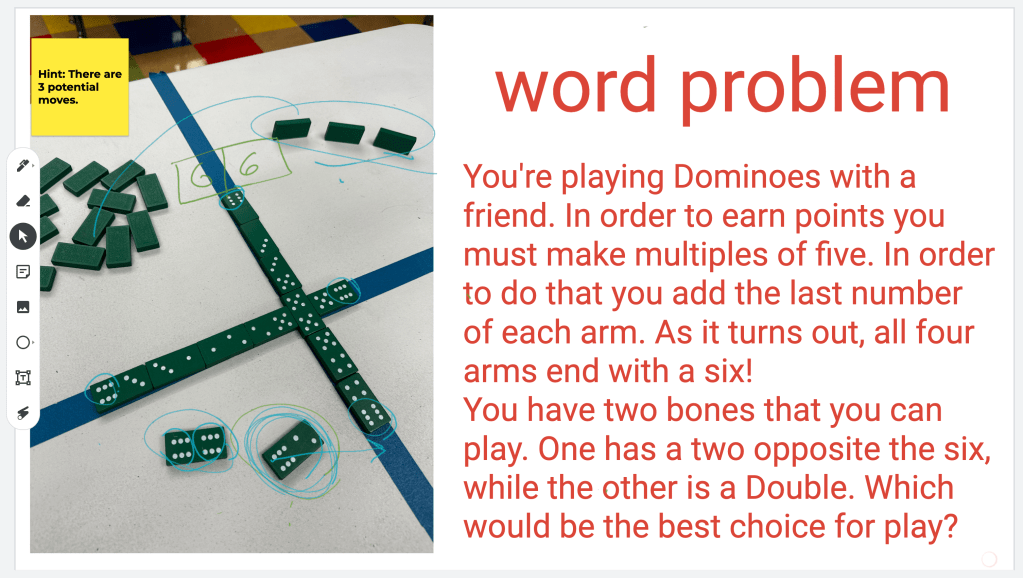
This is a screenshot of the last paragraph + picture from my last blog, with the question of the day above it. I presented this on our Google Jamboard at the beginning of gifted teaching time for students to wrestle with.

I’m back with some more Dominoes word problem work. At the end of my last blog about Dominoes I dreamed up what I thought would be a good problem to get students thinking. It seemed not only doable to me, but I worried that it might be too easy. Not so.

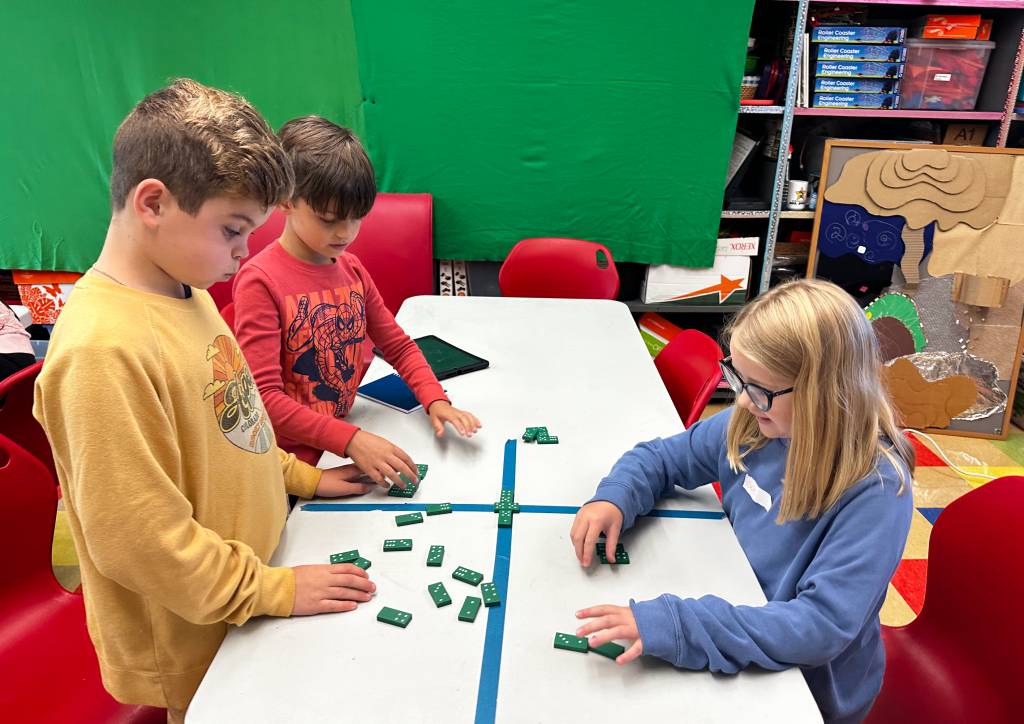
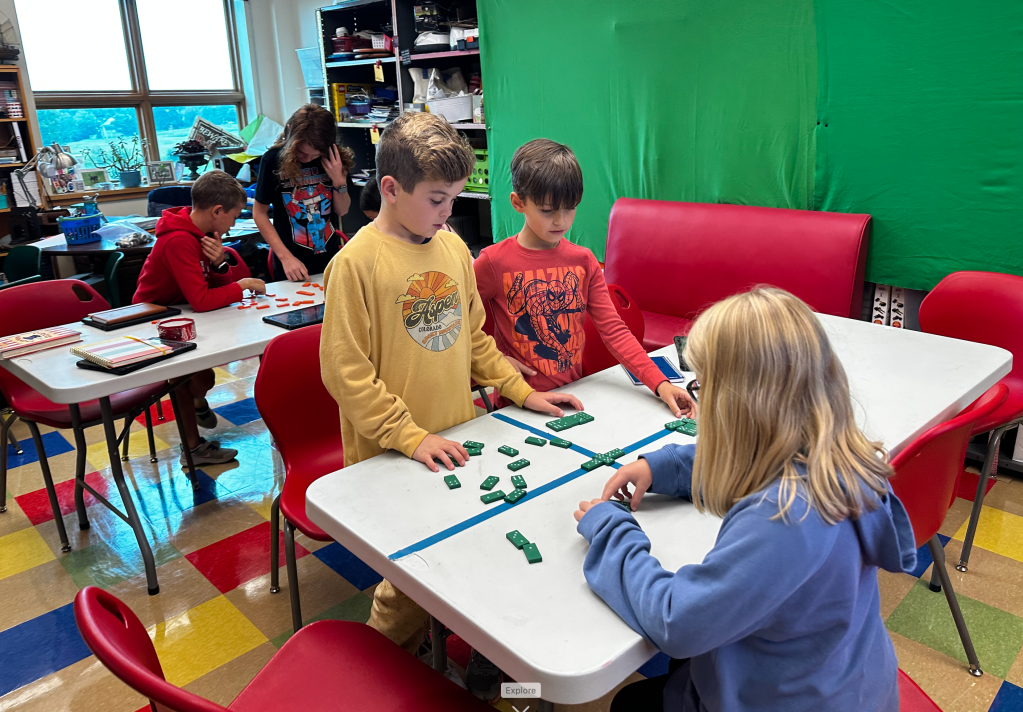
I asked my students, “What is the highest score possible in one play of Dominoes?” I put 28 bones (one whole set) on each table, and encouraged students to move them around looking for the best combination.

This is a screenshot of photos that I used to show students how to connect Bones, adding up all of the ends, and analyzing which Bone would make the best play.

A game of Dominoes proceeds until one player or team acquires 150 points. It takes several rounds to accumulate that many points. During each round the players add Bones (Domino pieces or tiles) to an existing cross of Bones. You have to connect the same numbers, so a 6-4 Bone could not be added to a 5-1 Bone. It could be added to a 4-4 or a 6-6 Bone. When you connect a new Bone to the Line of Play, you add the last number from each end. Your goal is to have a sum that is a multiple of five. Only multiples of five get recorded as points, pushing you closer to the goal of 150; victory.

The first group that I met with are 5th graders. They are still learning the game. I thought that providing the question of figuring out the very best play would create a goal; “This is what I can aim for.” Instead, my students began building towers with the bones and grumbled, “Why don’t we just play Math 24?” Upon self-reflection, I now realize that my word problem was like asking someone who is just beginning to learn how to construct an airplane to calculate how fast it will go. “Dude, let me get the wings on this thing, already!” Ha, ha. Sorry, students.

Before wasting too much time, fostering further frustration, I decided to scrap the 5th graders’ warm up and move on. I made a mental note on the idea of a Math 24 preference, though. This gave me much to think about; More to come on that, soon.

My 4th graders were at their wits’ end.

I didn’t even try the problem with my 2nd graders, who are also novice Domino players. I thought I’d wait and see how my experienced 4th graders, the students whom I taught to play the game last year, would do. These guys would love the challenge, and should have all of the conceptual tools necessary to tackle this problem. They’re the ones in the picture on the Google Jamboard, for crying out loud!

My 4th graders jumped into “Problem-Solving” mode right away. Their biggest hangup was trying to play the game from the beginning. They kept trying to build the arms from the center of the game, forming a cross they way they always do. That won’t work when attempting to find the highest possible score, though. They would have already used the Bones with the greatest number of Pips (that is the technical term for the dots on the Dominoes) on them. Those need to be saved for the ends.

I must have told them to, “Focus on the ends of all four arms. Don’t play a whole game. You don’t need the center of the cross in order to calculate the largest point accumulation possible,” a dozen times. I began to feel like a broken record.

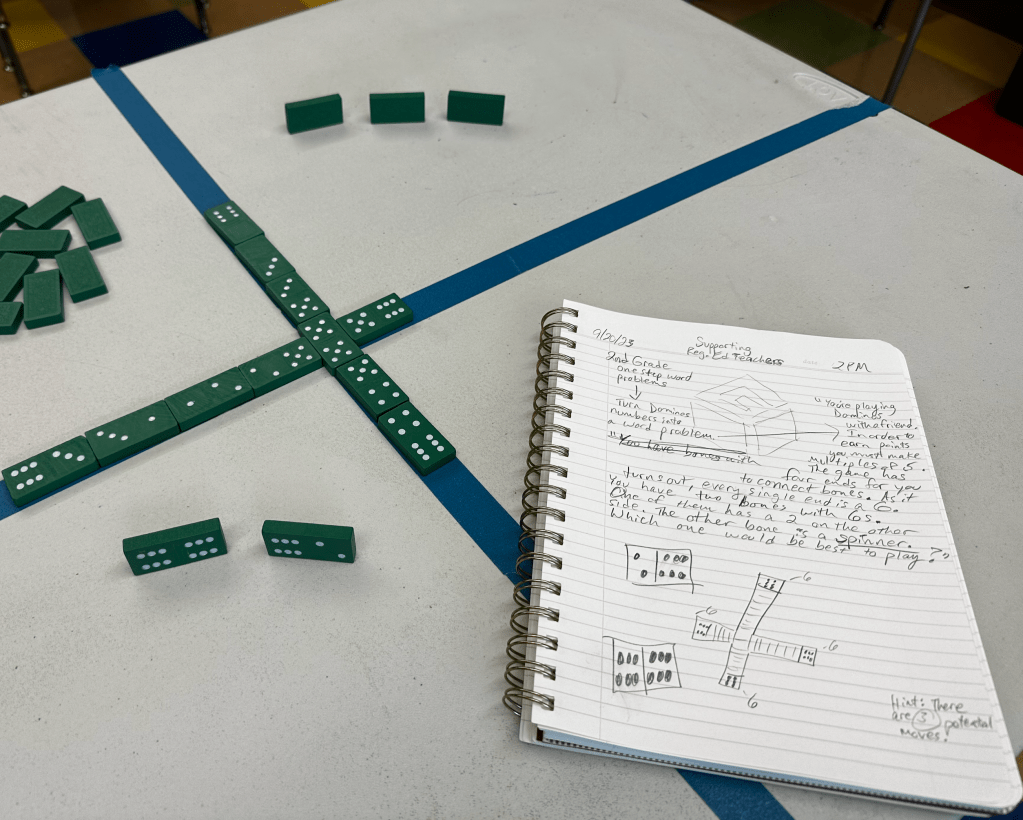
This is a picture of the notes from my journal that led to this “Wonderful Word Problem.” I only focused on the ends of the Line of Play. I’d hoped that this is what my gifted students would do.

Finally, I stopped them and taught them a new vocabulary word: Hypothetical. “This is a hypothetical situation. If you could have the ideal play; The absolute best play ever, what would it be? Don’t worry about what was already played. What Bones would give you the very highest points?”

This is truly Out-of-the-Box Thinking. I wanted my gifted students to leave the box of the game and imagine only the very last play. All previous plays are fog. They don’t matter. You can only see the tips of the Lines of Play, and they have huge Bones… Doubles, every one of them; The highest Doubles, even! Eventually, I had to just tell them the answer.

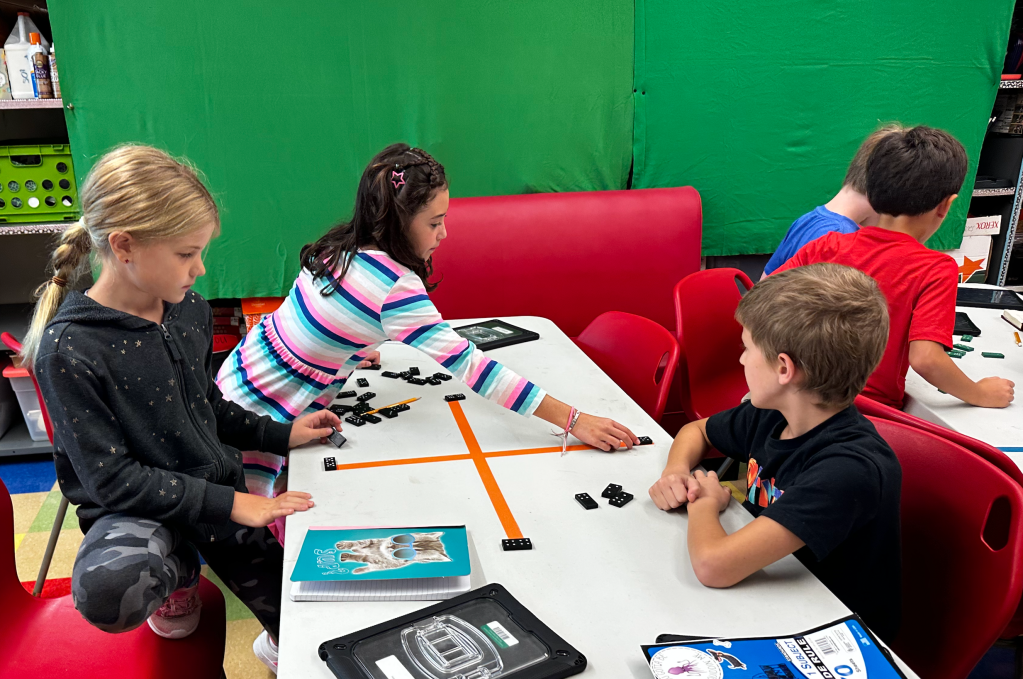
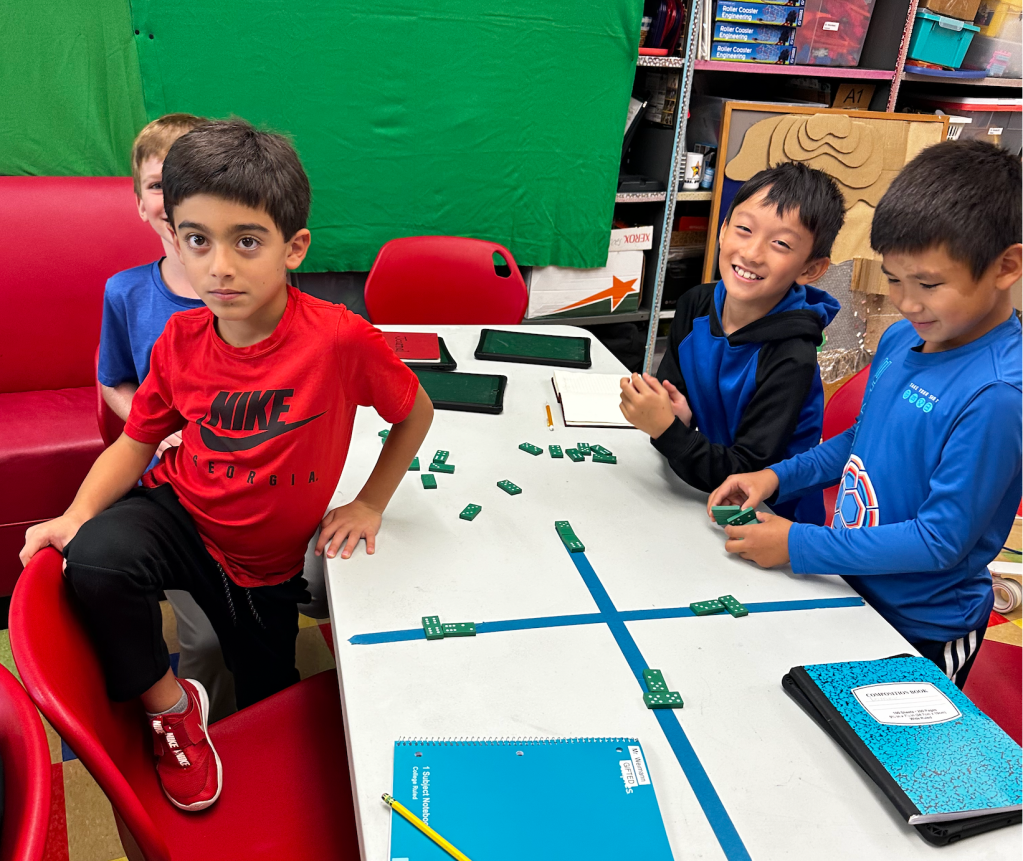
I had one last group to try out my wonderful word problem. I started the Domino difficulty by sharing with my 3rd graders that the 4th graders could not do this. That got their competitive juices flowing! Next, I did not allow them to put any Bones in the center of the cross. “We are NOT playing Dominoes,” I explained. We are figuring out a hypothetical question: “What if you had an opportunity to make a play that gave you an enormous amount of points? How many points would be the greatest possible in one play of Dominoes?”

Believe it or not, the 5-5 Bone is worth more than the 6-5 Bone, because it can be played differently.

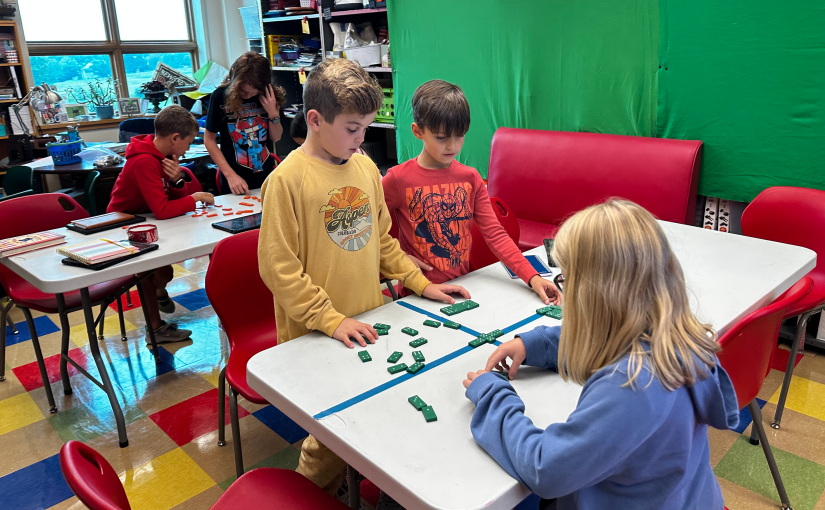
I guided their thinking toward the Bones that represent the greatest numbers. Even though a 6-5 Bone has more Pips than a 5-5 Bone, it does not present the greatest value when played at the end of a line. Why? Because, you don’t add the 5 and the 6 from the 5-6 Bone. Only one of the numbers would be available for adding. However, if you played the 5-5 Bone sideways, you’d have ten. Gasps, sighs, intake of breaths… Doubles were explored. I forced them to put the Doubles at the ends of the lines of tape I’d stuck on the tables to guide Lines of Play.

Letting the 3rd graders figure out answers to my guiding questions, I led them through Out-of-the-Box Thinking. In the end, they felt like they had solved the problem, and they had (with a little guidance from their teacher). Lesson: People can be taught to Think Outside of the Box. It is not necessarily natural.

Dominoes Word Problem: Math Enrichment

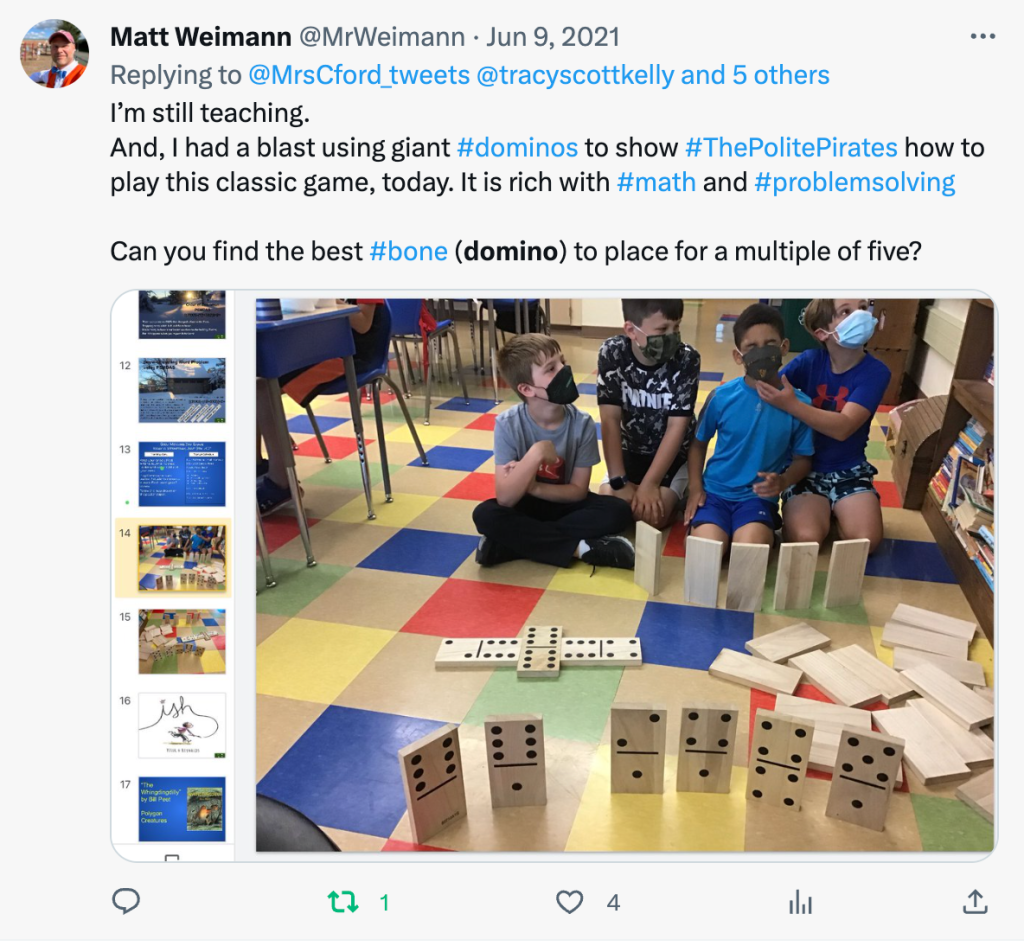
I used to use a giant set of Dominoes to introduce the game to The Polite Pirates (my 3rd graders).

Playing the game of Dominoes is an excellent way to introduce and practice problem solving. I’ve used this game for several years in my 3rd grade classroom, and now I am introducing it to my gifted students. 

This past week was the first week that I met with my elementary (K-5) gifted students. Obviously, the various grade levels were in different places when it came to math concepts. Second grade is working with word problems. Third grade will be tackling multiplication soon. Fourth grade is focused on geometry right now. And, 5th grade is preparing to use formulas to solve for volume. 

Dominoes can be used to introduce multiplication, using cumulative property, strengthening mental math, not to mention strategic thinking.

Tuesday morning’s second grade gifted lesson began with my typical introduction to Dominoes. I told the students that each tile is called a “Bone” and the pile of unused tiles is the “Boneyard.” They learned that there are always 28 Bones in a game, and that every single Bone is different. Each one has two numbers on it, even the ones that look empty! “What number is on this side?” I asked holding up a Bone with a six on one side while the opposite was blank. They didn’t skip a beat in guessing “Zero.” 

It took a little longer to explain adding the ends of each Line of Play. “You add up any number that is at the tip of an arm, no matter how long or short the line is,” I told them. We practiced some play. The adding wasn’t a problem. We discussed using the cumulative property to switch up the order of numbers, so that the mental math was easier. “Look for combinations that create ten,” I told them. “Rather than adding 4 + 5 + 4 +2 equals fifteen, combine the 4, 4, 2, first. Then you instantly know that the five makes fifteen.” 

I let students draw and write on the Google Jamboard to show and explain their thinking.

“Points are only awarded when the sum is a multiple of five. The ends of all of the lines of play add up to ten. Is that a multiple of five?” They knew that ten was made up of two fives. “How many fives are in 15? 20? 50? 500?” Flawless computation… Multiplication, here we come!

“Whenever you earn points, you say, ‘Give me ten…’ or however many points you earned.” I learned this from a fun video that taught me how to play ages ago, and elementary students LOVE this aphorism. 

“Give me ten!” one of my second graders beckoned. I put 10 on the board, and we played a couple more sets before moving on to our Self Portrait project. Even though I only have my gifted students for 40 minutes at a time, I found doing more than one mini lesson to be helpful in keeping their interest. 

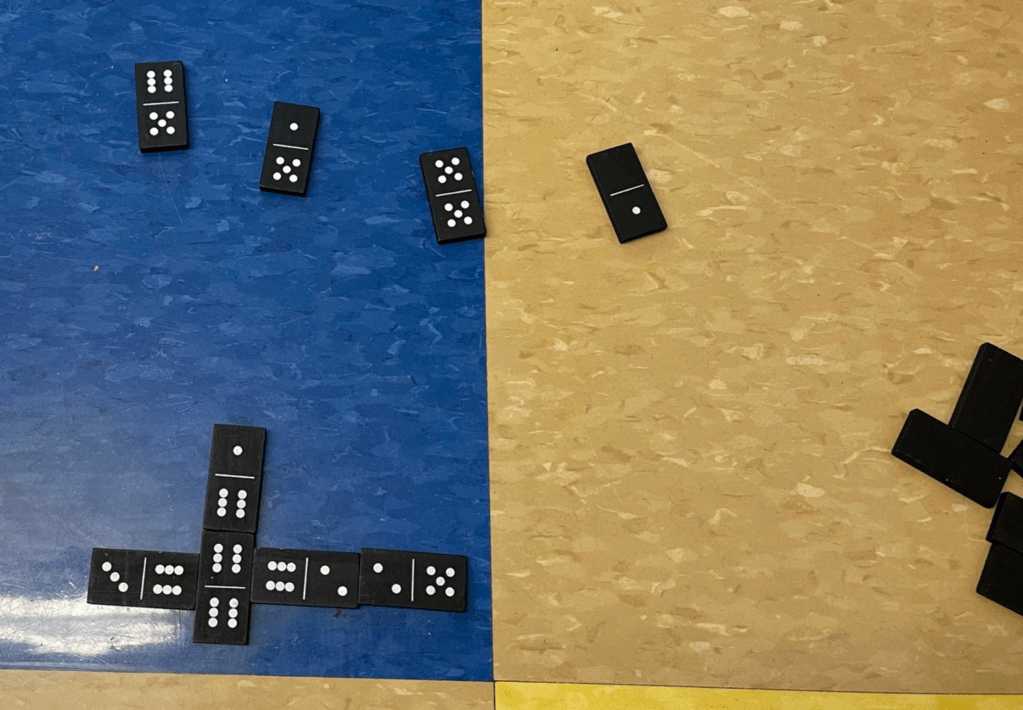
After school, I came up with a word problem for Wednesday using Dominoes. I typed it into a Jamboard. Even though I tried to word it in such a way that you could visualize the game in your mind, I went ahead and used Domino tiles (Bones;) to make a model of the hypothetical game on a table and took a photo. I imported the picture on the Jamboard slide with the word problem text. 

I snapped this pic, so that I could show my students the thinking behind their word problem. I am hoping to inspire them to use their “Gifted Journals” to jot down ideas through drawing diagrams and writing notes just like this.

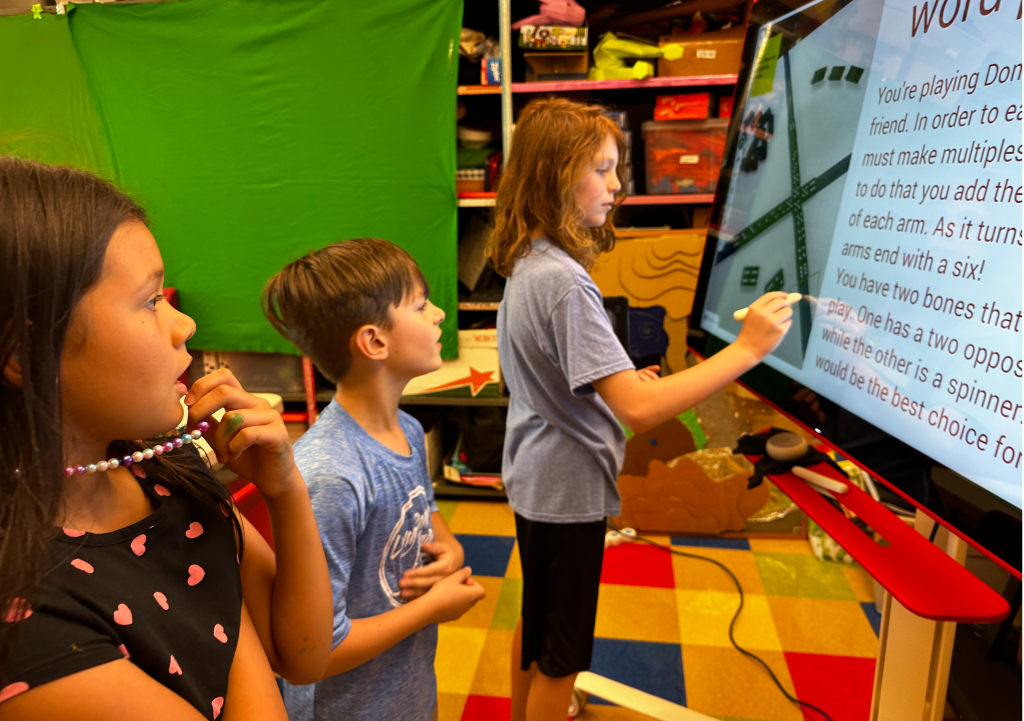
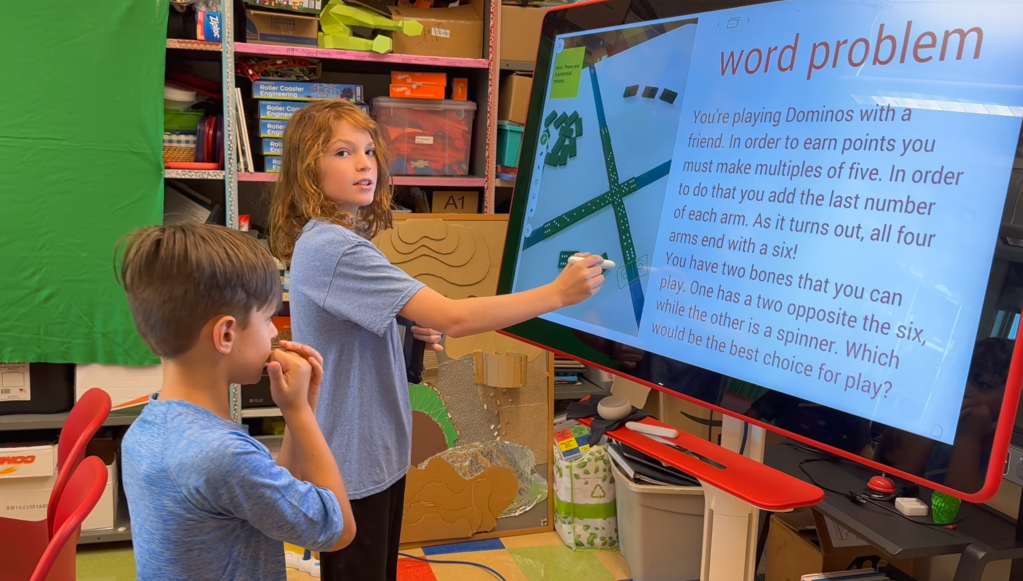
When Wednesday arrived I was excited to try out my word problem. The first group of students that I met with was 5th graders. Because I do car duty, I get to my room at the same time as my students. This morning I had placed a note on the open door, instructing them to try to work out the answer to this problem while they waited for me to show up. The word problem was presented on a giant Google Jamboard that I’d rolled in front of the entrance to the room. 

The group was crowded around the screen when I got to my room. I enjoyed listening to their discussion of possible moves. From what I heard, a couple students were aware of the general concept of matching numbers. They didn’t quite understand adding all of the numbers from the end of each line of play, but that was okay.

When one of the students decided the trick to solving the problem was to simply take a new Bone from the Boneyard, I invited the 5th graders into the room. Before talking Dominoes, I praised their persistence and told them that I was proud of how hard they worked. I purposefully pointed out the failure to solve the problem as an example that not everything will come easily to them. It is my job to come up with challenges that stretch their thinking, and I intend to make not only their intellects but also grit grow. 

As I explained the solution to the puzzle, I used it as a teaching tool. When I informed them on how the points work, they noticed that placing the Bone with the two on one side at the end of one of the lines of play would bring the total sum of all of the arms to 20, a multiple of five, and thereby an opportunity to earn points. “Good. But, there is a third and less obvious option,” I told them. “This one,” I said, pointing to the Double that had a six on both sides, “Is a Double. It is special. Not only can you play it with one six touching the line of play (also a six), but you can set it perpendicular to the line, thereby creating an extra arm.” I waited for someone in the group to notice the new sum. 

It didn’t take long for a fifth grader to notice that all of the sixes add up to 30 points. “Turning the Double on its side, created a fifth number to add. Since all of the numbers were the same, you can’t help but have a multiple of five! It is literally five of the same number.” 

I tried the word problem on my daughter Scarlet who had a brilliant reason for using the Double instead of the 2-6. In addition to the points, you would cause your opponent to have to take from the Boneyard, because chances are they won’t have a six. Limiting their options was very strategic thinking. I shared this strategy with my 4th graders who already knew the game well.

Next, it was 2nd grade’s turn. These kiddos had just learned how to play the game for the first time the day before. I used the word problem to reteach some of the ideas. More than focusing on problem-solving, I walked my second graders through the mechanics of writing a word problem. We discussed the details of Dominoes that I included in my little story. “Why did I mention multiples of five?” I prompted. “The goal is to earn points.” 

I had toyed around with the idea of only having words. When I originally crafted the word problem, I didn’t have the Dominoes laid out on a table. I tried to provide just the right amount of text for students to be able to visualize all of the details necessary for solving the problem in their heads. At the last minute I decided to include a photo with the problem. This was only the third day I was teaching these students! Watch out, though. Word problems, here we come! 

Pride flooded my person when fourth grade arrived in my room and crushed this problem within seconds. I’d taught all but two of these students how to play Dominoes last year. When I saw how quickly they solved the puzzle, I wished I’d hidden the photo. 

I pointed out the verbiage at the end of the word problem. “Why is it okay that I didn’t say what numbers were on the Double in the word problem?” I asked them. I had left out this vital information on purpose, and I wanted to see if they could find the puzzle within the puzzle. I did this kind of trick with them all last year. They understood that it had to be two sixes because the word problem stated that “You have two bones that you can play.” If the double were any number other than six, you couldn’t play it.

Here’s a question I failed to float: “Is it possible that the player has more than two Bones?” And, this is where a photo is limiting. Because you can see only two Bones on the table, it is difficult to imagine there being more than two. But, yes, the parameters of the problem leave that detail open. You have two that are “able to play,” but you may have more. I’ll have to work that riddle into a future problem!

My last group of the day was third grade. Here, I used the word problem differently. After exploring the numbers and solving the puzzle, plus revisiting how to play the game, I drew their attention to the structure of the word problem. It was a story, providing characters (you and a friend), a setting (a game of Dominoes), and a conflict. “This word problem has a plot,” I pointed out. (Plot is the language arts concept that third graders are learning right now.) 

The problem of which Bone to play is the climax of our story. The resolution is a mystery. You could use either Bone. Which one is better? What is the third, less obvious option? How will the story end? 

And, this is the end of my blog about this amazing word problem. But, is it? Through the process of fleshing out the many lessons that coated these Bones, I have come up with some additional puzzles. Here is a taste: “What is the highest score that can be collected in one play of Dominoes? What would the Bones look like at the ends of each line of play?” I think I’ll provide manipulatives; Bones; for pupils to push around when solving this. Good luck!