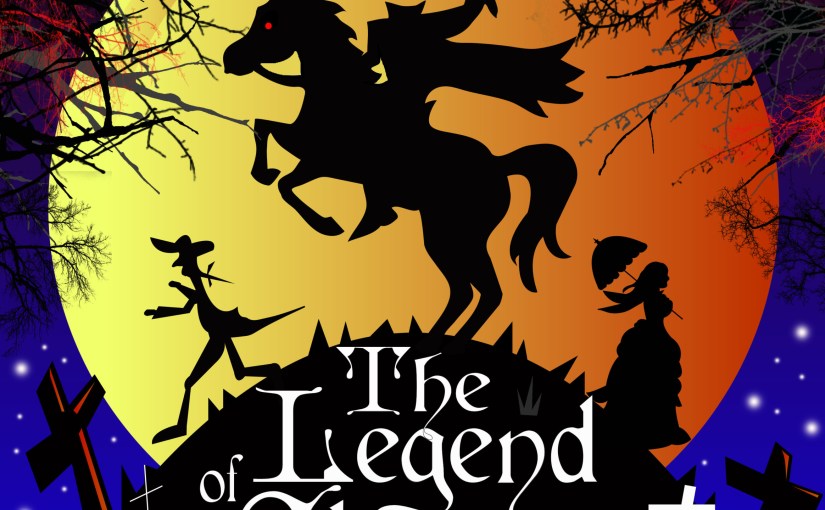
The Ghost of Chauvinism Haunting “The Legend of Sleepy Hollow”

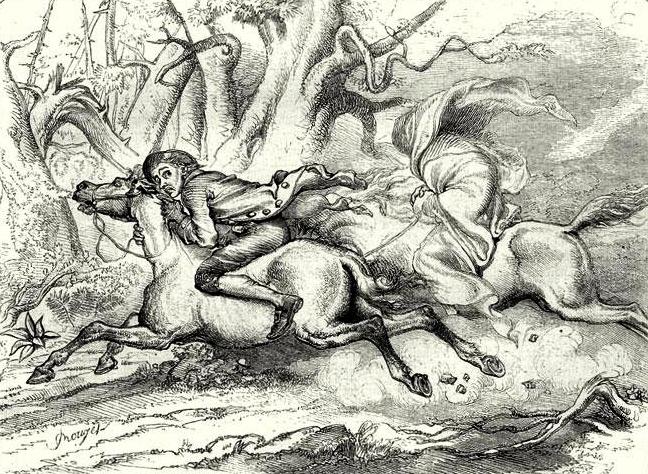
When you think of early Americana, what comes to mind? Apple pies, jazz, rock and roll, the Model T, Thanksgiving, 4th of July and the list goes on. How about ghost stories? Both iconic and popular, The Legend of Sleepy Hollow is easily the most recognizable historical haunt of Americana

I’ve used the two-century old novella in gifted and language arts-enrichment lessons for years. I liked the frighteningly robust vocabulary, easily digestible plot, well-developed characters, and more than surface-deep psychology woven throughout. It paints an interesting picture of historical, colonial America. I especially like all of the inferencing necessary to interpret the text. It has proven to be a very valuable teaching tool. 

Over the years there has been something that has haunted me even more than Sleepy Hollow’s headless horseman, however. As much as I love the way the author brings the goofy, lovable protagonist Ichabod Crane to life, the way Washington Irving objectifies the leading lady leaves something to be desired to say the least.
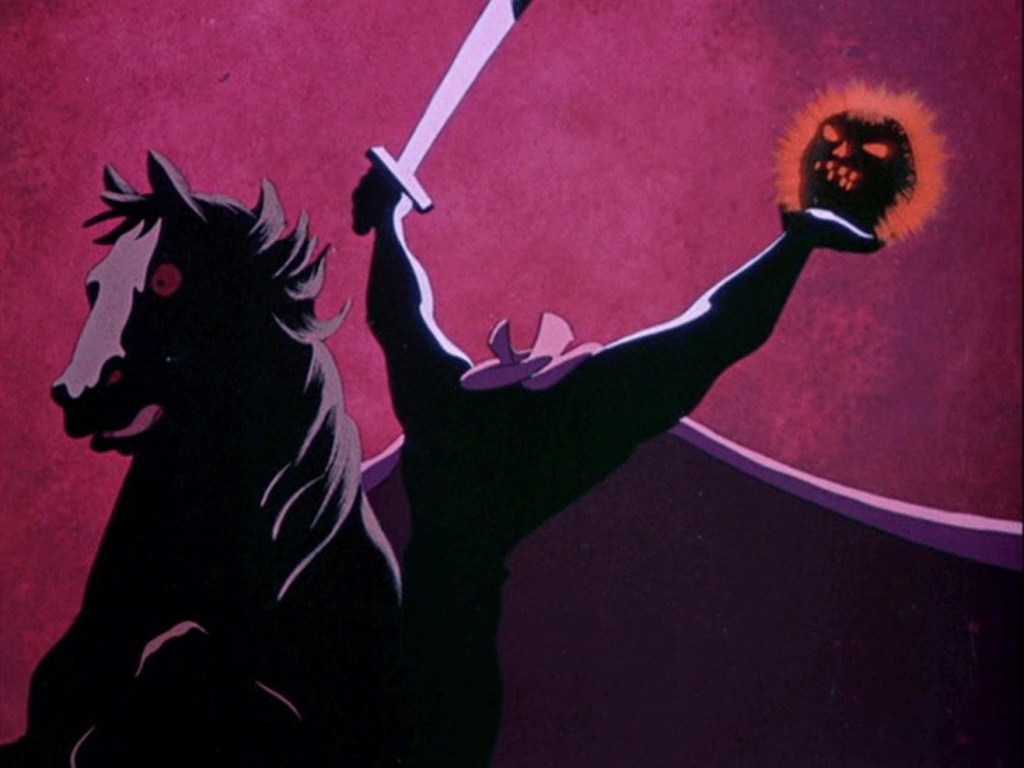
I never explored the idea with my classes because they are young. It’s bad enough that the plot toes the line of romance! Normally, I just gloss over the gross inequality, both of character development and the overt chauvinism on display. This year, however, I presented the novel in a different way. Rather than hide its faults, I told my 5th graders that I would share with them a few reasons that I thought the book was dangerous. That got their attention! 

We had just read and discussed Alan Gratz’s Ban this Book. Should The Legend of Sleepy Hollow be banned? With this in mind, we began to dig into the original text to find support for both sides of the argument.

What I referred to as the “Leading Lady” of the story is Katrina Van Tassel. This is an eighteen year old girl who takes singing lessons from the protagonist, Ichabod Crane. As it turns out, the music teacher is keen on marrying Katrina. The crisis of the story is that another guy also has his aim on this same goal. 

So far, this might not sound too bad: Classic love triangle stuff. The problem is that Katrina is reduced to an object, quite literally. She is treated no more special than the key or combination that unlocks the treasure of the Van Tassel farm.

Katrina is initially introduced as “the only child of a substantial Dutch farmer,” hinting that her inheritance would be impressive. Then, Irving describes Katrina’s looks analogous to foods; “Plump as a partridge… ripe and rosy-cheeked as one of her father’s peaches…”. After this, the author devotes five whole pages to exploring the farm that Katrina lives on, without a mention of the eighteen-year-old who would inherit it upon her father’s death. 

There is no question that Ichabod is driven by greed more than love. It is his desire for Van Tassel’s wealth that spurs on his interest in the daughter. 

“As the enraptured Ichabod fancied all this, and as he rolled his great green eyes over the fat meadow lands, the rich fields of wheat, of rye, of buckwheat, and Indian corn, and the orchards burthened with ruddy fruit, which surrounded the warm tenement of Van Tassel, his heart yearned after the damsel who was to inherit these domains, and his imagination expanded with the idea, how they might readily turned into cash …”
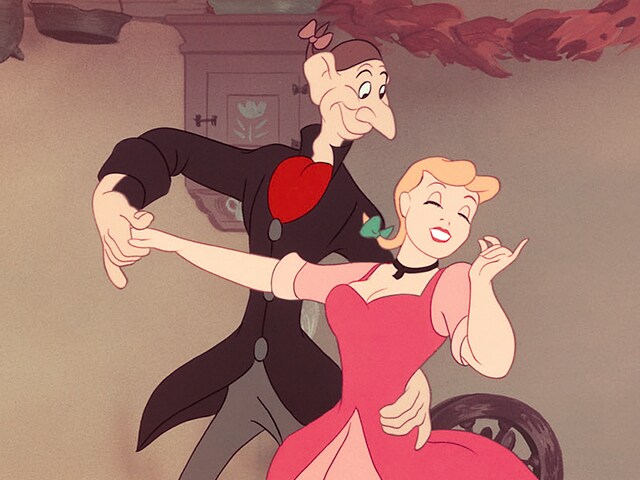
In addition to the unbridled objectification of Katrina, her actions are presented in a passive voice, suggesting that she is less important than the men of the tail. She doesn’t study music as much as she is a student of Ichabod’s. Instead of Irving suggesting that Katrina actually attracted the attention of Ichabod’s rival, the author pens, “The rantipole hero (Brom Bones) had for some time singled out the blooming Katrina for the object of his uncouth gallantries…” not feigning a hint of action on the lass’s part. 

The extent to which Katrina does anything beyond simply being a female human comes from her status as “a little of a coquette.” There is no evidence to support this outside of the… 

“(perception) even in her dress, which was a mixture of ancient and modern fashions, as most suited to set off her charms. She wore the ornaments of pure yellow gold, which her great-great-grandmother had brought over from Saardam; the tempting stomacher of the olden time; and withal a provokingly short petticoat, to display the prettiest foot and ankle in the country round.”
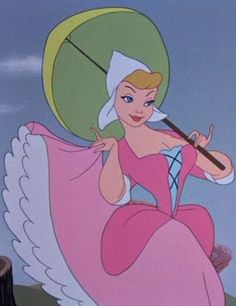
The reader catches a hint of coquetry during the Van Tassel party, near the climax of the tale. “The lady of his heart…” (Notice the continued objectification of Katrina.) “…was his partner in the dance, and smiling graciously in reply to all his amorous oglings; while Brom Bones, sorely smitten with love and jealousy, sat brooding by himself in one corner.” It is thought by some that Crane was used by Katrina to move Brom to jealousy, deepening her talons into his heart, and spurring him into action. He marries her the moment Ichabod is gone for good. After Ichabod receives his rejection at the tail end of the party, the narrator asks, “Was her encouragement of the poor pedagogue all a mere sham to secure her conquest of his rival?”

Lastly, Katrina is the target of Irving’s evident ire toward women in general. Before her introduction, the narrator of the story frames her entrance with ghosts, goblins, terrors, and frights as pithy ponderings compared to the greatest cause of male problems: Women. This is a two hundred year old story, so there is bound to be unpopularly dated stereotyping, but Irving introduces extra bias toward women by comparing them to guinea fowl “fretting about, like ill-tempered housewives, with their peevish discontented cry.” And, a couple of paragraphs later, we find Mr. Van Tassel’s “notable little wife, too, had enough to do to attend to her house-keeping and manage the poultry; for, as she sagely observed, ducks and geese are foolish things…” This comes immediately after the father, characterized as “an easy indulgent soul” is said to “love(d) his daughter better even than his pipe.” Wow! What a dad! Finally, it is perfectly acceptable that this admirable dad sat around smoking, “Thus while the busy dame (his wife) bustled about the house, or plied her spinning wheel at one end of the piazza,” among other things. 

If all of that wasn’t enough, when our funny hero Ichabod Crane is rejected by Katrina, Washington Irving seems to blame the entire female gender. The narrator cries out to the reader,

“What passed at this interview I will not pretend to say, for in fact I do not know. Something, however, I fear me, must have gone wrong, for he certainly sallied forth, after no very great interval, with an air quite desolate and chopfallen –Oh these women! these women!”
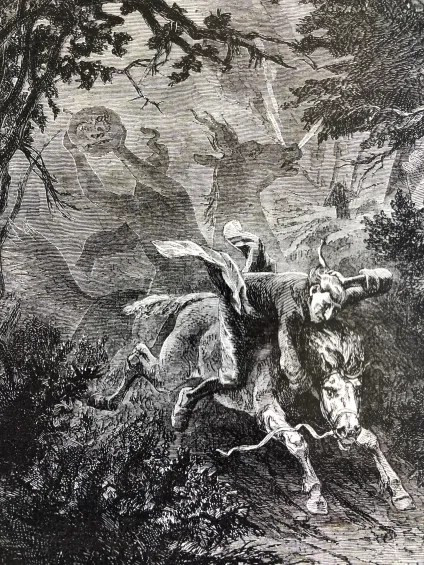
In conclusion, while Washington Irving professes “not to know how women’s hearts are wooed and won” through the words of the narrator of his tail, he treats those hearts like prizes that are obtained, rather than organs of living beings. His text, The Legend of Sleepy Hollow, has many wonderful qualities that have enriched its readers for centuries. I hope that it is read, treasured, and studied for many more. On the other hand, beware of the spectre of chauvinism haunting its pages, lest you be tempted to follow Irving’s ghost down the road of inequality and maltreatment.

Cognomens Are Classy

“Excuse me.”

I like to listen to books while I work. I was wearing earbuds when this person was speaking to me, and couldn’t hear what she was saying.

“Excuse me.”

I thought I heard something, so I turned to look. The woman who was housesitting was talking to me. She had been saying, “Excuse me.”

“How long are you staying?” she asked me. “I’m not rushing you… I just wanted an idea.”

We were the only two people in the house, and she was looking right at me. There was no question who she was talking to. It was me. But, there was something missing. What was it? I couldn’t place my finger on it, but there was a feeling.

She hadn’t used my name.

A Confession

I have a confession to make. I am not good at remembering names. I wish I was. I have worked on it. When I was in highschool, I actually read a book about how to remember names. I still remember most of its points, but I can’t remember who wrote it. Too often, I will come across someone whom I had already met, and their name completely escapes me. So, there it is: My concession of unclassy behavior prior to proposing you do what eludes me.

Back to the Tale

The encounter with the housesitter happened yesterday. This was probably the thirtieth time I had met her. Earlier in the day, I was surprised to find I already had her phone number saved. At that time I learned the name that she normally goes by. I programmed that into my phone, as well.

The feeling materialized into a thought: This woman either didn’t know my name or chose not to use it. Why would someone decide another person’s name was not worth saying? In the past, I have witnessed people speak to hired help differently. More than the words they used, it was the way they said them. They spoke down to the person whom they believed was beneath them. Sometimes the way they do this is through the words they do NOT use. I have experienced people who think that their status elevates them so high above me that they try not to talk to me, as if speaking with a worker will somehow drag them down. Now, I bet that this lady did not feel this way. But, by not using my name, it felt like I was less human; a less person than she.

Earlier that Week

Contrast this feeling with a story from earlier in the week. I was picking up my daughter from daycare, when another parent told her child to, “Stand to the side, and let Mr. Weimann through.” At first, I was surprised that she knew who I was. And then, I thought it classy that she used my cognomen. It made me feel special; important.

A person’s name is precious to him (Schultz, 2017). Dale Carnegie famously suggested a person’s name is the sweetest sound to him. The very first word that anyone types on a keyboard is his name. The first thing we learn to write is our name. It is our label. It’s who we are. There is an art to using other people’s names in conversation. It attracts the listener’s attention (Russell, 2014).

Luke Davis (2017) points out plot lines containing a search for characters’ names in “The Power of Using Someone’s Name”. A name in fantasy stories is sometimes magical. When the miller’s daughter learns Rumplestiltskin’s name, she saves her first born’s fate. Davis suggests that people give permission when they offer their name. They are communicating how you may address them. I remember a few years ago, an adult visited the classroom. He wore a nametag that showed both his first and last name. A kid read it and pronounced the adult’s first name. This adult could have handled this better. He said, “It is Mr. __ to you” to the student. He hadn’t given that student permission to use his first name.

Classics

I love classics. Some have been rewritten, made into movies, talked about so often that reading the original work is like looking at a primary source. There are times I feel like an archaeologist dusting off the first few words a master wordsmith penned. This is the feeling every fall when I get out “The Legend of Sleepy Hollow” by Washington Irving.  

29bd75fffbd860f9116b782fee7b4f5fWith sentences longer than the paragraphs my third graders write, this text presents descriptive writing that transforms the 21st century classroom into a one-room schoolhouse in a comfortably lazy, quiet, rural town. Incidentally, Sleepy Hollow is an actual town. If you cross the Tappan Zee Bridge, a word Irving includes in his text, you will see signs for it.

Remember my mentioning that I listen to texts? I have heard “The Legend of Sleepy Hollow” on audio several times. When you listen to the story, you don’t have the ability to look up the words that you don’t know. You just use context clues or allow the meaning to escape, and move on with the plot. The robust vocabulary is part of the allure of the classic. The enchantment of Irving’s learned lexicon is lost, however, when I read the text to/with my third graders. Rather than bump down a bubbling brook, we get caught with confusion at every turn.

As it turns out, I have never gotten all the way through the classic with my students. I begin reading it close to the start of the year, looking toward Halloween. Everyone has heard the story. Many students tell me they have seen “the” movie. (There are several.) None have ever heard a sentence of the original classic. Even though it takes weeks to get through the first chapter, I find it fun and beneficial for students to experience. We eventually peruse the rewrites and end up comparing/contrasting them with what we have witnessed of the original.

How Does Sleepy Hollow Fit?

What on earth does “The Legend of Sleepy Hollow” have to do with the story that began this blog? When we are first introduced to the main character of Irving’s tale, there is a sentence that I like to present to my students as a riddle: “The cognomen of Crane was not inapplicable to his person.” In addition to the vocabulary word, cognomen, the double-negative throws 8 & 9 year olds for a loop. We had already learned Ichabod Crane’s name, so we could use context clues to figure out that cognomen meant last or surname. The double-negative is harder to explain.

Cognomen

Cognomen is one of the vocabulary words that my brain glossed over when listening to the book on audio. Because it didn’t affect the plot of the story, I didn’t worry myself about it. When reading the text with students, however, it became a curiosity. We looked it up in a collegiate dictionary. (Our elementary dictionaries couldn’t handle it. This makes third graders feel awesome!) In addition to surname, cognomen also means alias or nickname. So, Irving could be saying that he is adorning this character with this name because he wants you to picture him with a beak of a nose. Ichabod’s creator/father, the man bestowing him a surname, Washington Irving, is making this surname a nickname, a cognomen. Of course, I don’t get into all of this with my third graders. We are simply happy to learn the term, surname.

Cognomens Are Classy

Nowadays, we are not reading about Sleepy Hollow. We are looking at manners from a book about being polite. This happens everyday after recess and before math. Last week, 2bookone of our lessons was to use Mr., Mrs., Miss, or Ms. along with the last name (cognomen) when speaking with adults, or find out how the adult would like to be addressed.

As always, we had plenty of discussion, full of stories. I told the students about a neighbor, when I was a kid. He was elderly, and his family did not live close. He loved company, and we would visit him regularly. Rather than calling him Mr. Vinton, he insisted we say “Grampa Vinton”. He turned out to be one of my best friends, growing up. Even though I visited him nearly everyday and we shot rubber bands at each other in his breezeway, I always called him Grampa Vinton. Placing the respectful title before the cognomen helped me remember this was not another kid.

When I was growing up, I had friends who referred to adults as ma’am and sir. This seemed respectful, but never felt quite right to me. Looking back, I now know why. Sir and ma’am denotes mastery. The kid was suggesting servitude. This is not the same as respect.

Mr. Smith

In my classroom I use kids’ last names all of the time. I do this because it is weird and to help me learn/remember their last names, but I have noticed an interesting byproduct: Kids love it. You should see them light up when I call them Mr. Smith. Their faces look like they just won the lottery. Being called the same thing as your mom or dad is winning a lottery of respect. I place the kid on the same title plane as myself. Why don’t they refer to me as Matt? That would be unheard of, but why? By using their last name, I elevate them to the same status.

When the lady refused to use my cognomen or even my first name, yesterday, I was left with a feeling opposite my students’ when I use their last name.

Black History Month: Race

I have one more disclaimer: The text that I was listening to when the housesitter began talking to me was “The Lies My Teacher Told Me: Everything Your American History Textbook Got Wrong” by James W. Loewen. I’m sure you guessed it from the title, but this is one of those truly eye-opening books. I was just listening to Chapter 5, “Gone With the Wind: The Invisibility of Racism in American History Textbooks,” when I heard, “Excuse me.”IMG_8396

Loewen’s text taught me that there are subtle ways that opinions about race are woven throughout most history textbooks. The concepts are thin, and the weave is tight. You don’t even notice it, but there is a thread of attitude here, and a fragment of thought there. Many times, it is what the textbooks do NOT include. They never tell about the laws that demanded black people not look white people in the eye. There were many laws like this that trained race relation deterioration during “equalization” after emancipation that I had never heard. 

I am not about to march into my third grade classroom and dump all of this information onto my students. It has, however, caused me to think about omission as a bad thing. Although it might feel awkward to bring up race, NOT doing so could be damaging. Perhaps, it is like addressing someone without using his name.  

Sources

Davis, L. (2017, August 10). The Power of Using Someone’s Name. Retrieved February 17, 2019, from https://goodmenproject.com/featured-content/the-power-of-using-someones-name-ldvs/
Irving, Washington, 1783-1859. (1963). Rip Van Winkle, and The legend of Sleepy Hollow. New York :Macmillan,
Loewen, James W. (1996). Lies my teacher told me : everything your American history textbook got wrong. New York :Simon & Schuster,
Schulz, J. (2017, January 12). Using a person’s name in conversation. Retrieved February 17, 2019, from https://www.canr.msu.edu/news/using_a_persons_name_in_conversation

A Classy Adventure Aboard “The Dark Frigate”: 3 Effects

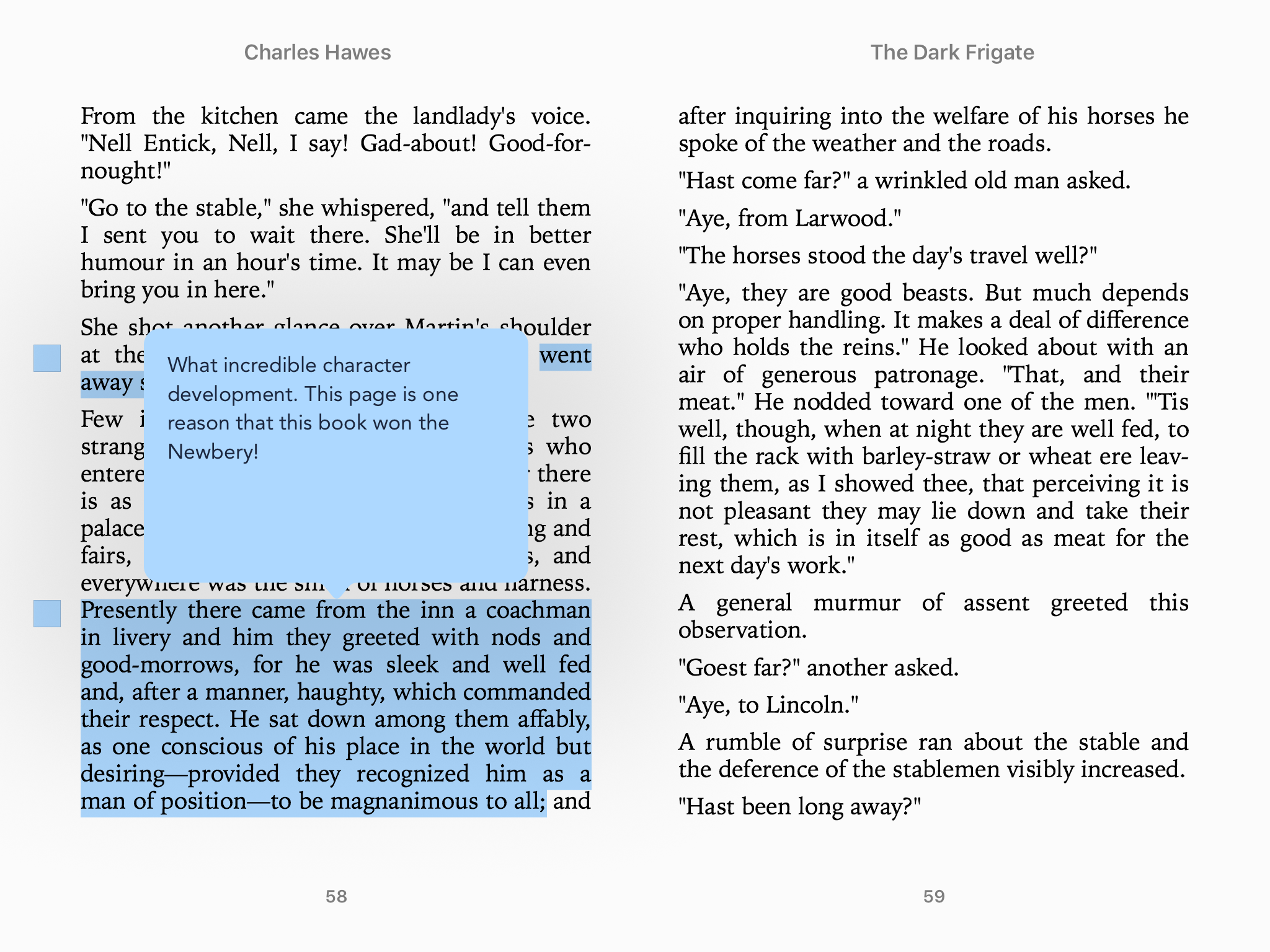
One of my aims in reading the Newbery Award winners is to compare them with one another and contrast them from non-winners I’ve read in order to try and identify the characteristics that made them worthy of award.Character Dev What caused “The Dark Frigate” (1924) by Charles Hawes to rise to the top of the pile of books; best of class; from that year? I’ll be honest with you; When I first began reading the text, I was not very impressed. I shared in a previous blog, “iBooks are Classy,” that more than reading, I was laboring, trudging through vocabulary, vernacular, archaic verbiage, and technical jargon from 16th century sailing. In addition to this, the actual storyline lacked intrigue. The tale begins with the main character, Philip Marsham, wandering the countryside for a while, meeting people, experiencing peculiarities, and making plans before eventually boarding the boat. As I read, I figured these contacts and situations would probably resurface later in the book, the way they usually do in novels, with the author tying everything up tight and tidy. I was in for quite a shock.
Here “Arrr” 3 effects resulting from the classiness found in this not-quite piraty tale.

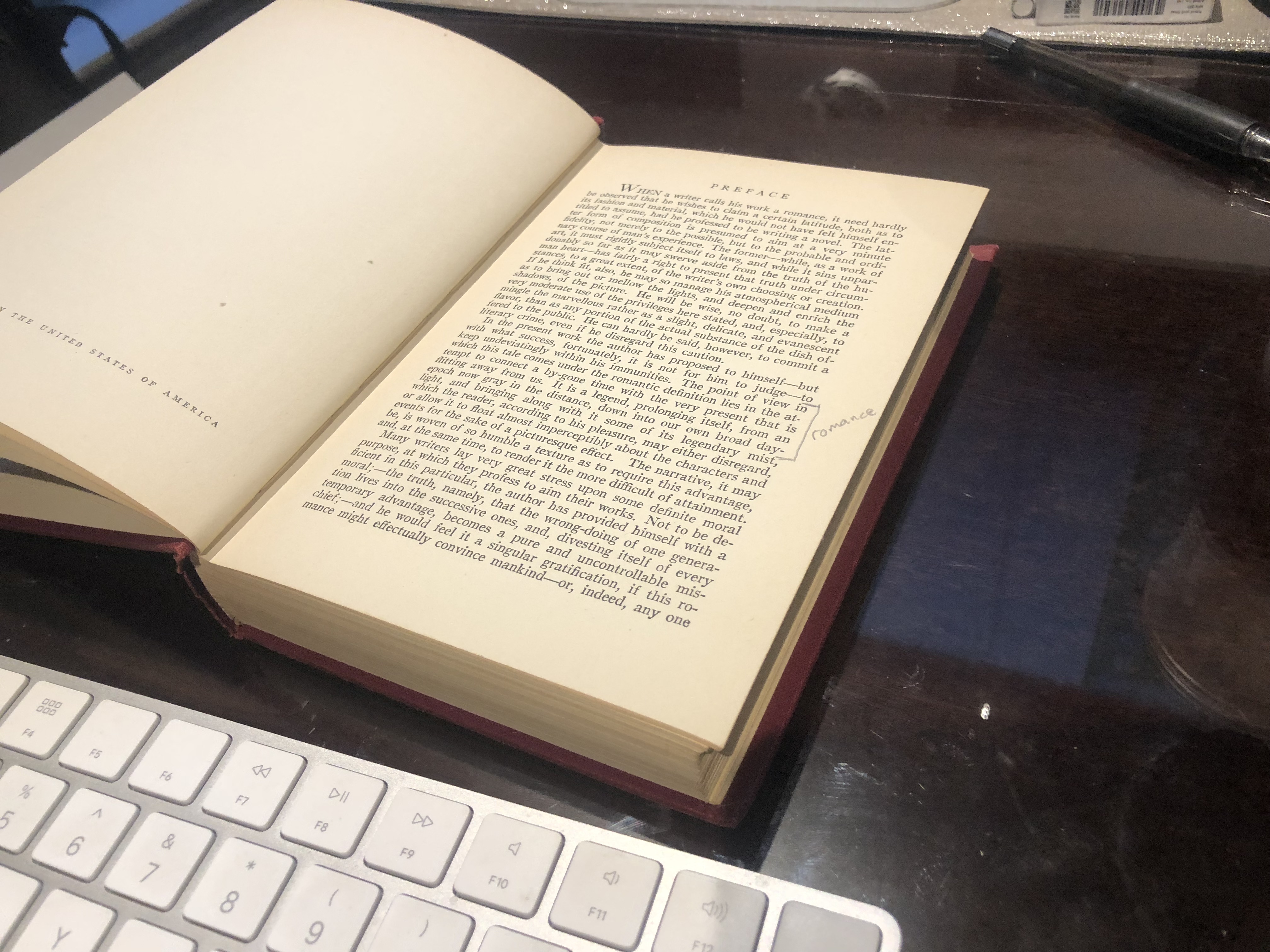
1. Romance. “The Dark Frigate” would not be considered a romance in the traditional sense of the word, but while reading it, I thought of another book that presented a unique definition of romance.

The point of view in which this tale comes under the romantic definition lies in the attempt to connect a by-gone time with the very present that is flitting away from us. It is a legend, prolonging itself, from an epoch now gray in the distance, down into our own broad day-light, and bringing along with it some of its legendary mist which the reader, according to his pleasure, may either disregard, or allow it to float almost imperceptibly about the characters and events for the sake of a picturesque effect. (from the Preface of “The House of Seven Gables” (1851) by Nathaniel Hawthorne)  House of 7.JPG

I read this ages ago, right after graduating college, and it made a profound impact on my thinking. To me, it seemed Hawthorne was suggesting that two things coming together in a beautiful and poetic fashion can be romantic, regardless of gushing feelings, kissing, or roses. “The House of the Seven Gables” (1851) marries Hawthorne’s contemporary post witch-hunting era with the murderous, land-grabbing colonists’ time. Ironically, that was a terrifically difficult read as well. Perhaps that is one of the reasons the book surfaced in my thinking.

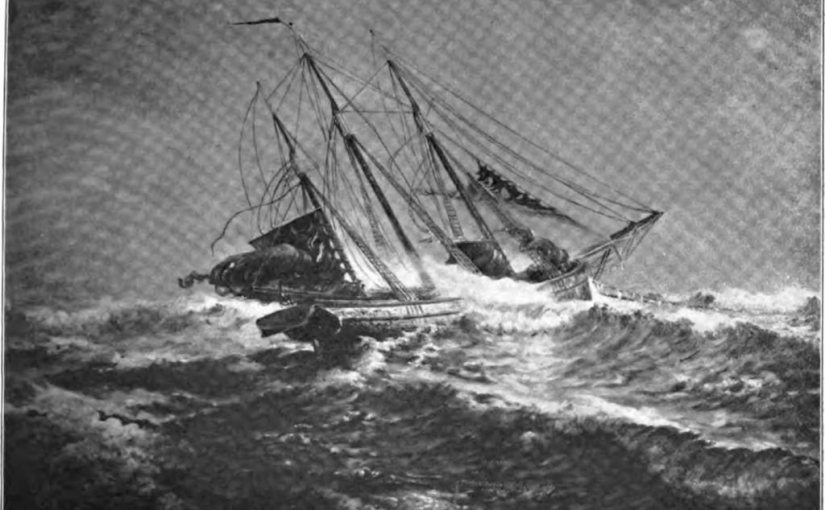
Disappearing.jpgThrough “The Dark Frigate” (1924) Charles Hawes romanticizes eighteenth century English literature. More than it being an adventure on the high seas, it is a vernacular venture in archaic prose. It seems to promote a nautical nostalgia on the verge of disappearing. This was written during the industrial boom, when trains were rumbling through country, trucks bouncing through city, steamships cruising the seas, and planes on the verge of filling the skies. Sailing vessels were as efficient as using horoscopes to forecast the weather in an age when scientists had instruments to accurately predict tomorrow’s temperature.
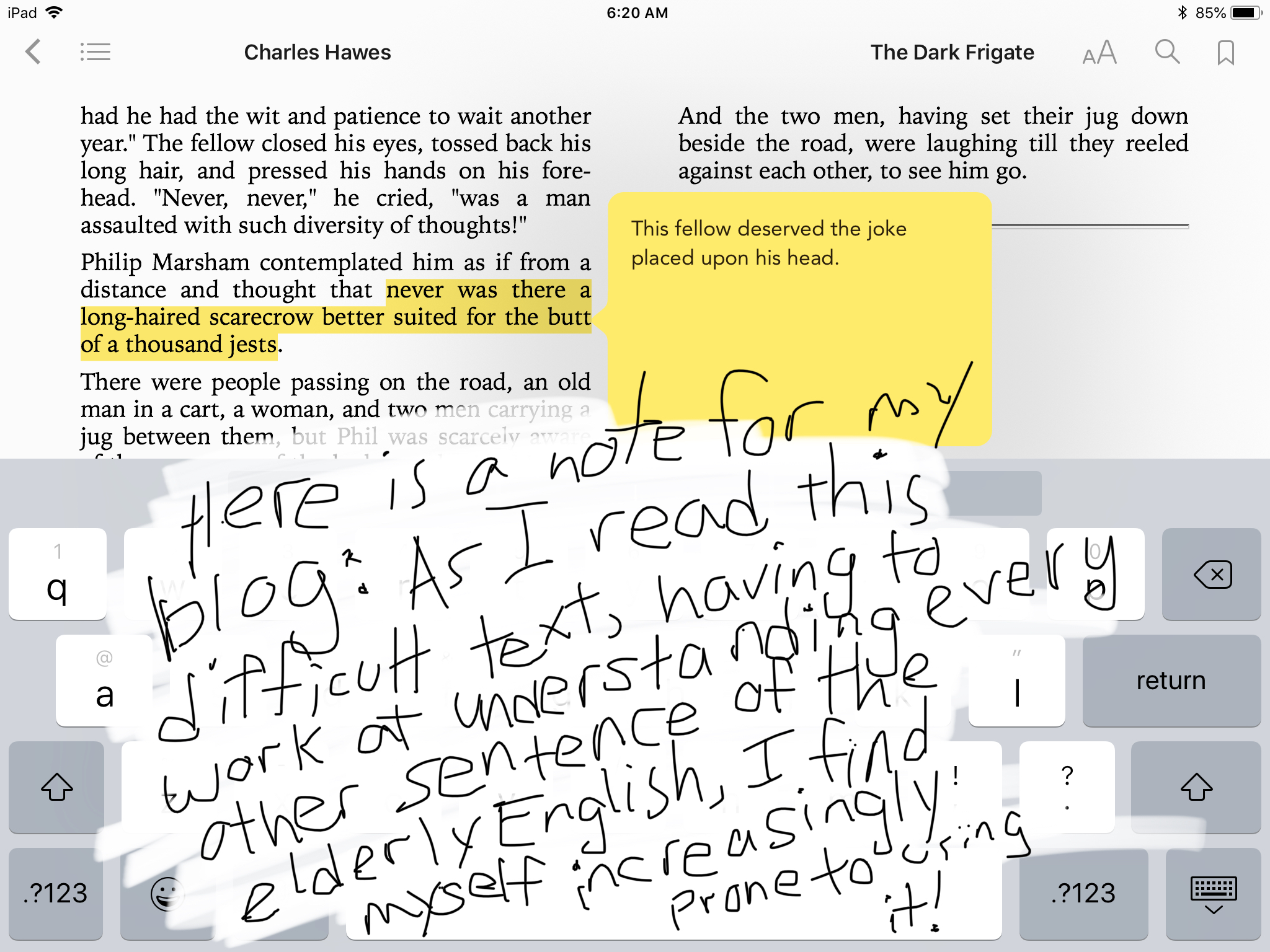
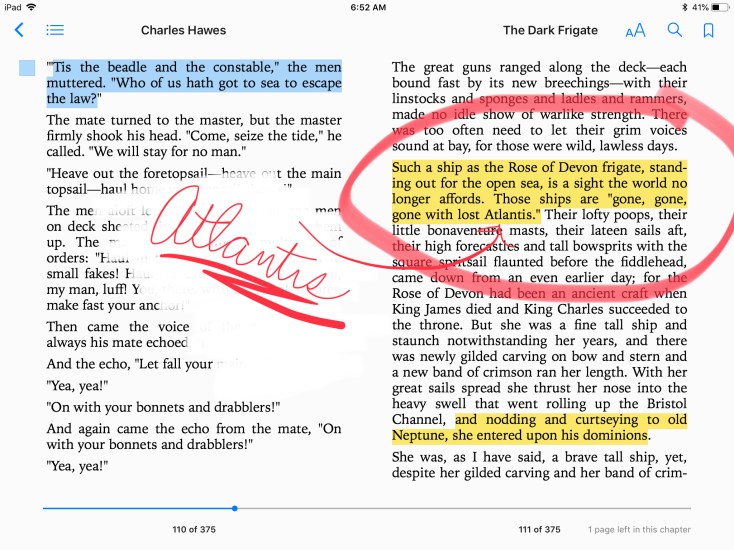
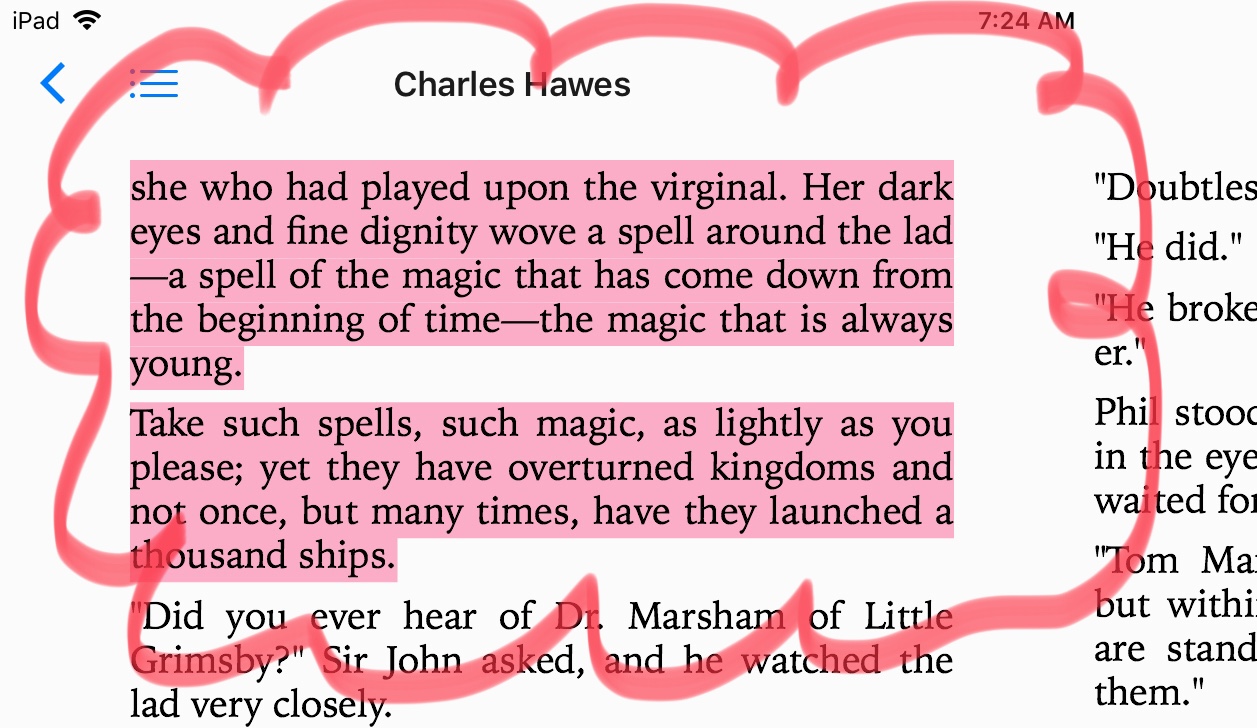
2. Rub. I was enjoying the use of iBooks, leaving loads of notes in the margins while Rub.jpgreading, when I noticed the style of my writing was being affected by the text I was consuming. I laughed at myself and took a screenshot. My use of language was assimilating some of the prose from the book!
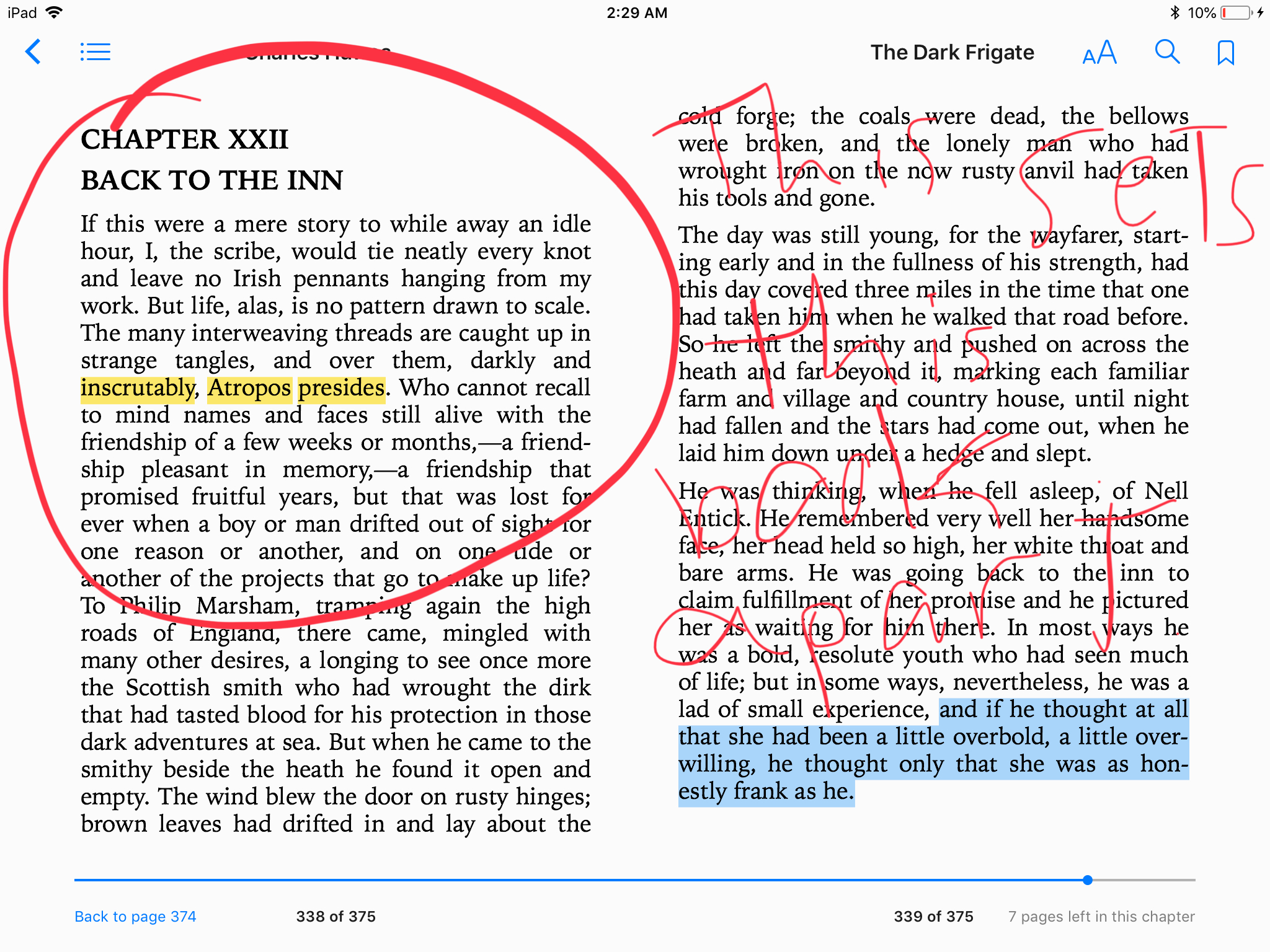
There are a variety of ways to season food. Some food needs no seasoning at all, but other dishes are enhanced by a little spice. The right combination of herbs can help bring out the natural flavors that are right there, but untapped until opened up through the chemical process an herb, combined with heat produces (Goldwyn, n.d.). The difficulty of deciphering “The Dark Frigate” (1924)’s language was working its way into my thinking. In the same way that salt penetrates a meat, opening pores, allowing subtle herbs their entrance, my struggle with comprehension forced me to dig deep into the subject of 18th century sailing speak, building brain pathways to new ways of connecting words and phrases. In short, I found my personal use of English seasoned by this saltwater excursion in literature.   

3. Realism. This book is more than realistic. Other novels fall into the genre of “realistic fiction” because they could potentially happen. Two people could meet ten years after a brief initial interchange, recognize one another, sparks fly, and everything is happy… It could happen. But seriously, how realistic is that? I don’t want to give away the end of the book, but suffice to say “The Dark Frigate” (1924) isn’t just an adventure of pirates; it is a pirate itself. This book will purloin its reader of hope and possibly happiness. However, there is value in understanding that “happily ever after” is for fairytales. Life; true, lived, experienced, trial-and-error; life almost never neatly ties its loose ends into place.

Tying it up.jpg
This dark tale kept me up at night.

The more you struggle to achieve a goal, the more you get from the journey along the way. And, I got a lot out of this read! Also, have you ever worked really hard at something, and when it was over, you thought, “This is it?” Take care to appreciate the process, because sometimes the end result is unimpressive. You train, practice, and work at preparing to hike a mountain, only to find that the cloud cover doesn’t allow you to view anything. That was “The Dark Frigate” (1924) for me. If I hadn’t been taking notes, learning iBooks, and trying to gleam as much as I could from the read, I would have been in a “dark place” after having finished it. As it is, the novel was a wild rose in the forest. I leave you with a breath of fresh air from a dark text:

Final image.jpg


Sources:

Goldwyn, M. (n.d.). The Science of Rubs. Retrieved August 14, 2018, from https://amazingribs.com/tested-recipes/spice-rubs-and-pastes/science-rubs

Hawes, C. (2018). The Dark Frigate. New York: Aeterna Classics. [originally published in 1924]

Hawthorne, N. (1851). The House of Seven Gables. New York: Books.

University of California – San Diego. (2016, May 26). How the brain makes, and breaks, a habit: Neuroscience study identifies brain chemicals, neural pathway involved in switching between habitual behavior, deliberate decision-making. ScienceDaily. Retrieved August 14, 2018 from www.sciencedaily.com/releases/2016/05/160526185419.htm


iBooks Are Classy

A firm believer in active reading, I’ve always enjoyed writing in my books. I journal in the margins. I’ve poopooed the use of digital books for this reason.

During the summer of 2018 I began a project I’d been thinking of for a while–I set out to read every Newbery Award-winning book. I coupled this goal with an aim of blogging about each. My third book in presented a problem.
Being a proficient reader with a large-enough vocabulary, I was flabbergasted to find a plethora of words I did not recognize in “The Dark Frigate.” To begin with, what on Earth is a “frigate”? Granted, much of my missing knowledge was due to the genre of 16th century sailing vernacular, but there was plenty of simply robust verbiage I needed help with as well. So much so that a paper book was as helpful as a pile of shredded scraps, I had to stop every 5 seconds to look something up!
Thus, I decided to finally tryout iBooks.
I had dabbled before and was familiar enough with the tools. At first, it was the ease of looking up the meaning of words I didn’t know from right inside the book that sold me, but as I continued my reading, I fell in love with taking notes, highlighting with different colors, and bookmarking significant pages.Screen Shot 2018-08-06 at 6.48.46 AM
It slowly dawned on me that not only would this be a helpful tool for students, but I can acquire digital books to share with groups of students to use during guided reading! I could have students stop and type notes right in the text. They could take screen shots that are instantly shared with me via airdrop. These can be added to a digital portfolio, monitoring student progress.
Another way of using this digital tool is having a class set of books for a read aloud. No longer do I have to borrow or buy 25 copies of “The Indian in the Cupboard”. All of my classroom iPads can access my copy within iBooks, through using my professional Apple ID. And, not only will kids be able to read along, but they can be asked to connect to the text by highlighting and commenting right in their own copy of the iBook!
I’m not completely done reading “The Dark Frigate” (1924) by Charles Hawes, but wanted to pause to share my thrilling revelation of the usefulness of iBooks. I look forward to blogging about this, the third ever Newbery Award winner. It took me a while to wade through the vocabulary and dialect, plus the plot was droning to begin with, but the action is picking up. Look for my classy blog about Philip Marshal and his adventures aboard the Rose of Devon, coming soon.