How Much STEAM Do Your Lessons Contain?

How do you challenge yourself as a teacher? I’ve been working on making my pedagogy more powerful by pushing lessons forward with STEAM. Originally known as STEM (Science, Technology, Engineering, and Math), STEAM introduces the Artistic element to the closely related fields. When you are teaching a STEM subject, it is common to integrate more than one letter of the acronym (Hertz, 2016), but one of my modus operandi is to try to incorporate as many of the letters as possible into any given lesson. Powering my teaching with as much STEAM as possible is an art form to me.   
Some lessons are more successful at incorporating all five letters of STEAM than others. A recent math lesson got my creative juices flowing, and turned into a beast of learning for my 4th grade gifted students. It all began with an enrichment lesson from Ready Math

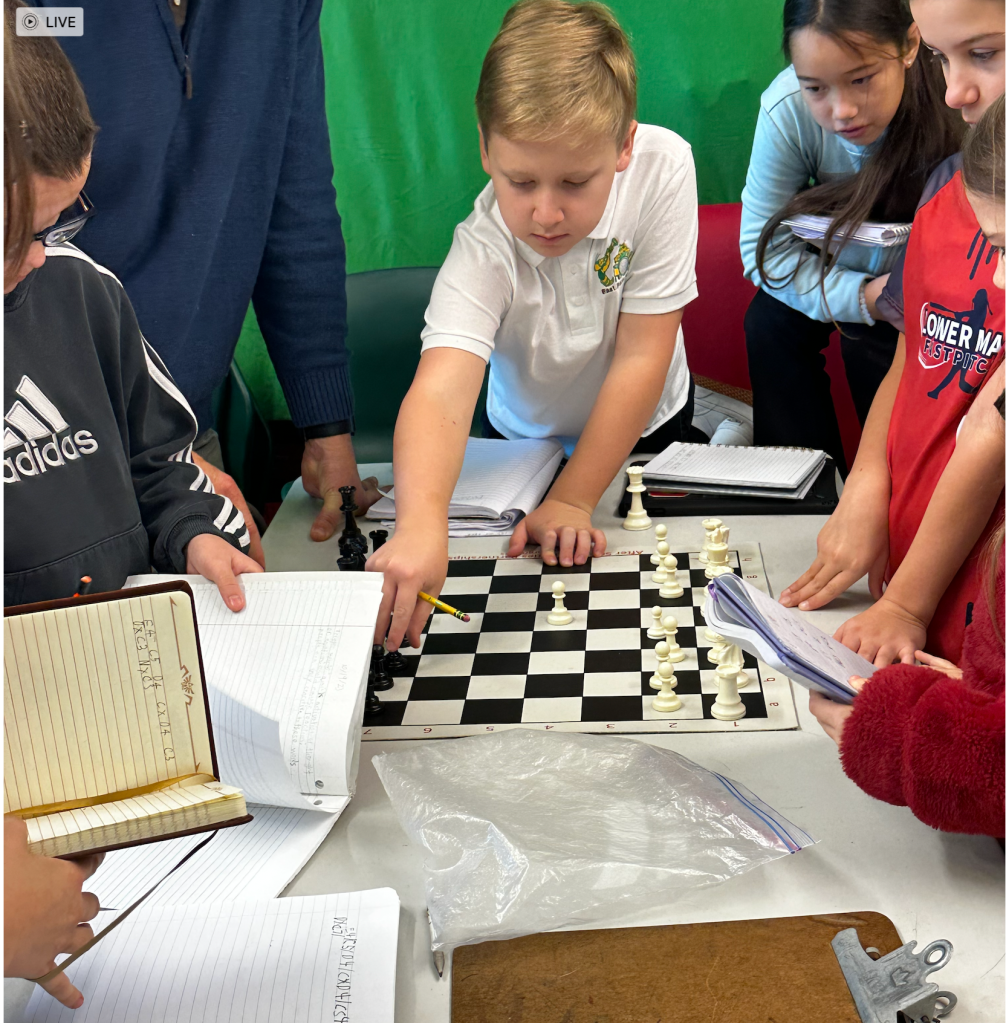
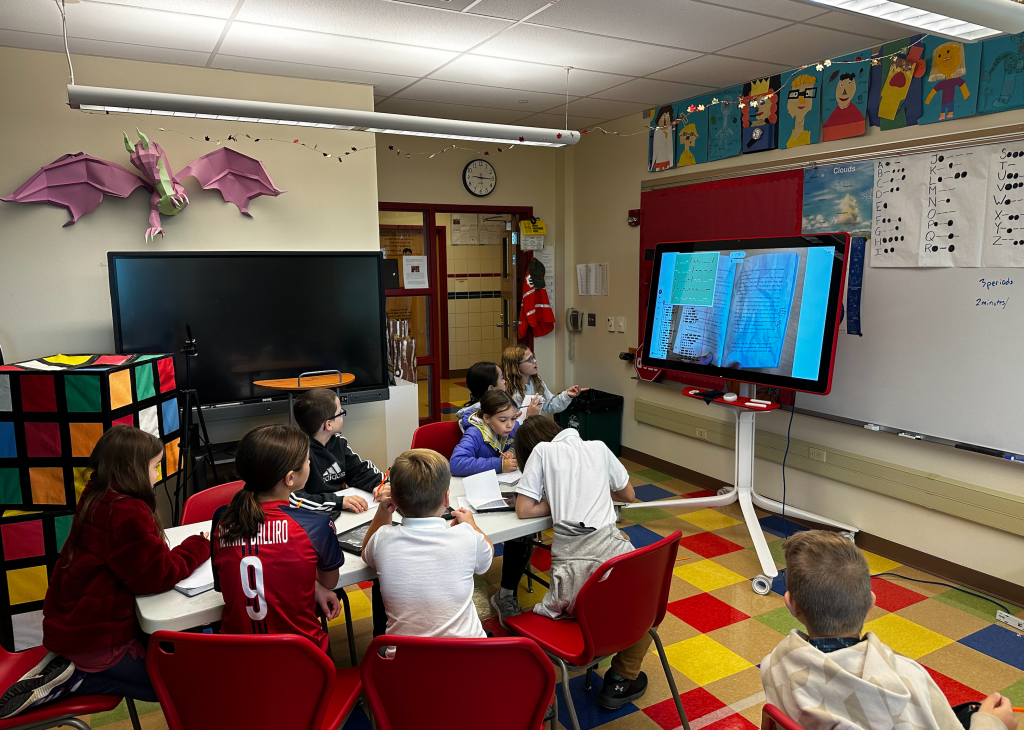
4th grade gifted students use art to get even more out of STEM.

Fourth graders had been reviewing place value as well as adding and subtracting large numbers. This is the perfect example of a math concept becoming boring for advanced students, those who have shown mastery of the subject matter. Once these kids conquer the use of algorithms, plugging in numbers to get sums and differences becomes mindless. Adding and subtracting is like riding a bike. Why make them pedal a stationary one when we could take it on a trip, instead? This is where I come in. 

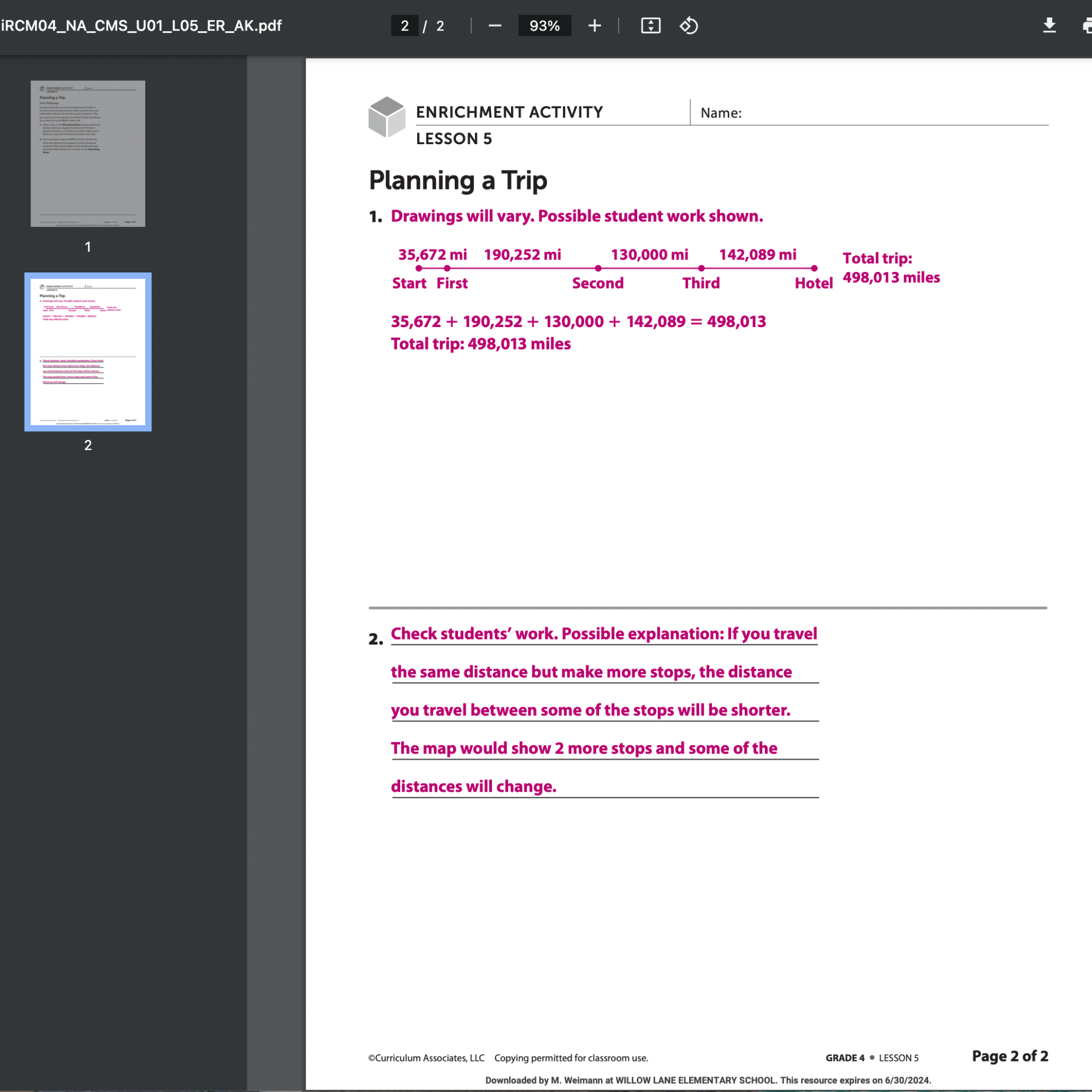
My first stop on developing math enrichment lessons is to check out the iReady Teacher Toolbox for ready-made resources that I may build upon. Curriculum Associates, the makers of Ready Math, has developed an enrichment assignment accompanying nearly every lesson. These are worksheets that can be printed for students to work on independently. You can push the assignment out digitally via Google classroom, too. The Ready Math team has provided a “Teacher Version” that contains answers; Even potential answers to open-ended questions, so that teachers know what to expect!

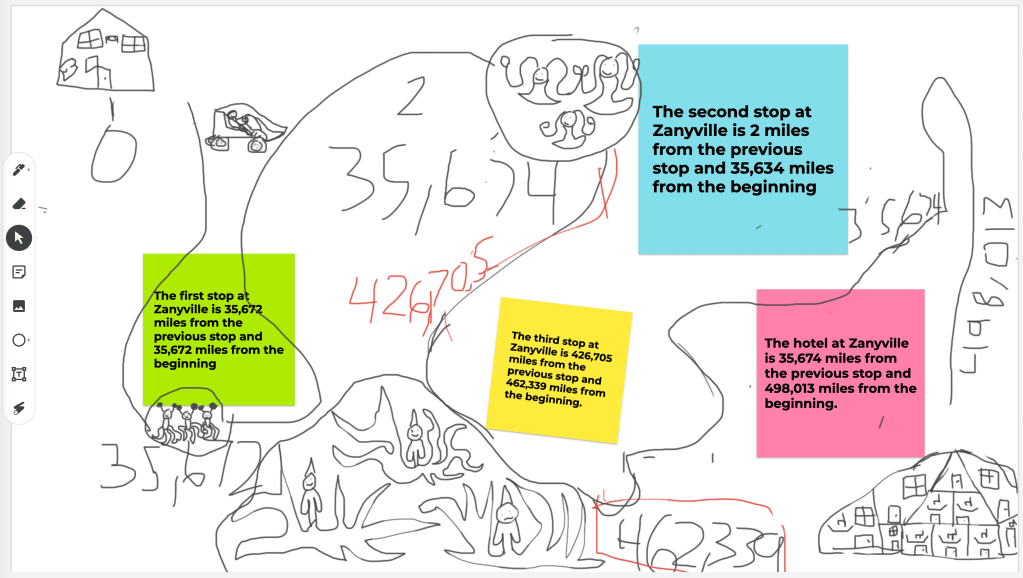
For this lesson, I took a screenshot of an iReady enrichment assignment, and used it as the background of a Google Jamboard. I like Jamboards because my students can draw and write on their iPads. They can create new blank slides, as well as duplicate the one with the instructions on it. It is easy for me to make a template, and then create a copy for each student through Google classroom.   

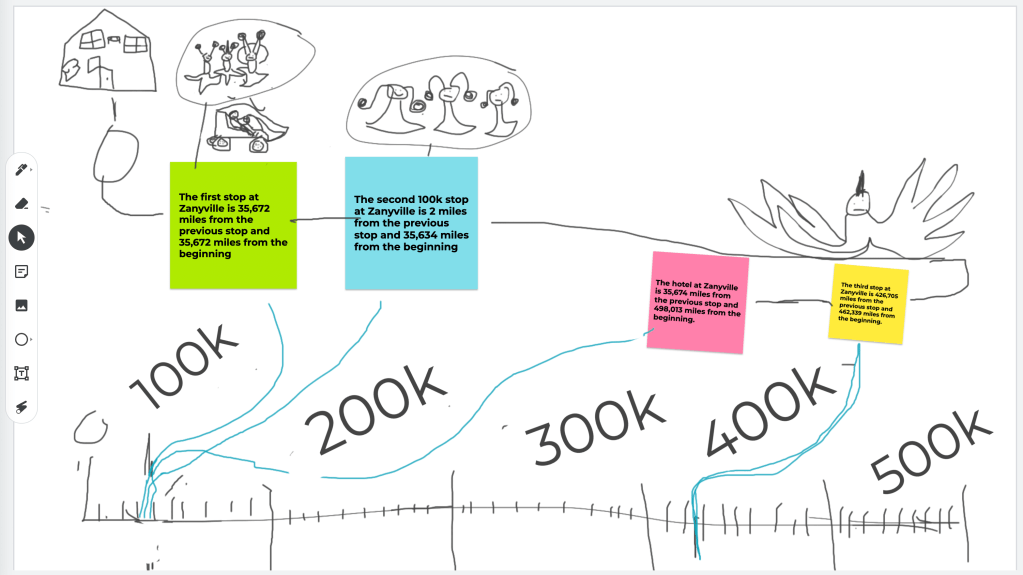
This zany lesson, “Planning a Trip,” had students pretend to explore an imaginary planet, Zanyville. It introduced gigantic numbers and was very open-ended. I included some more instructions that I shared orally, when I initially rolled out the project. “You must tell me the number of miles from the beginning of the trip where each of the stops happen. Also, you have to provide the distance between the stops.” Students were instructed to use “sticky notes” in Jamboard to share this information. They showed their work on other slides.
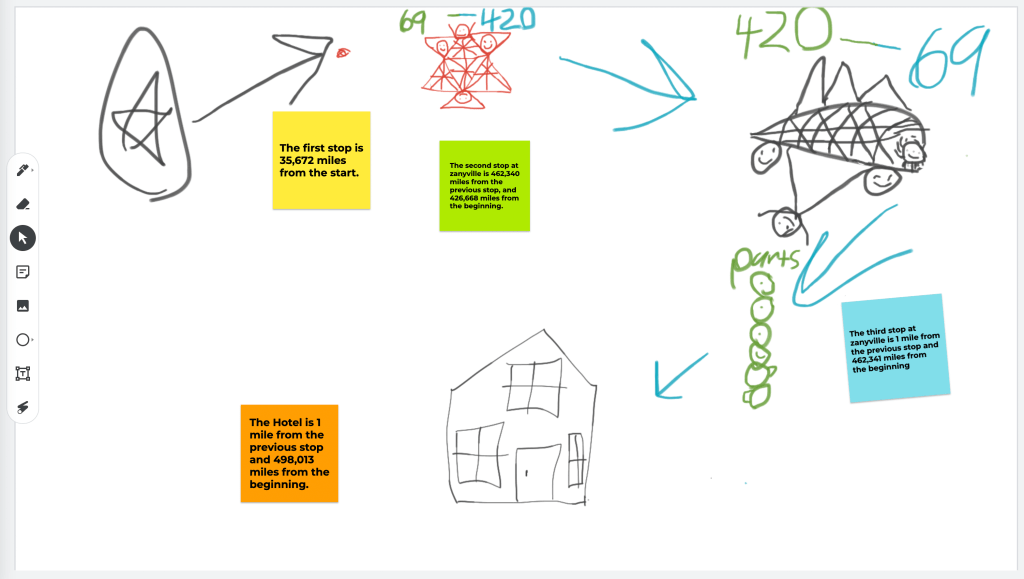

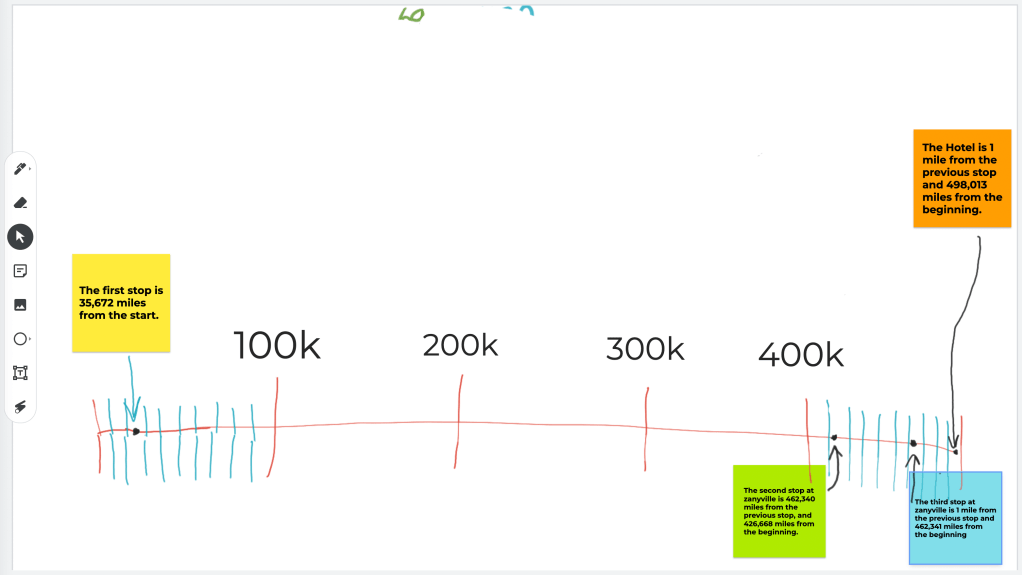
The 4th graders worked hard and were engaged in making their maps. Only, the maps were grossly disproportionate. Some students made the third stop only “one mile” from the end of the trail, but placed it a fifth of the distance from it along the route they drew in their Jamboard. In actuality that distance would represent tens of thousands of miles! It is true that I did not instruct students to partition their maps with accuracy, but when I witnessed the misuse of proportion, I saw a fertile opportunity for learning. Enter, STEAM!

My vision for math enrichment is to dig into each concept, finding riches that deepen the understanding of my students.

The next time that I met with the 4th grade math enrichment students, I taught them proportionality. There weren’t any Ready Math lessons on this, but it fulfilled my mission for the enrichment group perfectly! My vision for enrichment is to deepen students’ understanding on math concepts. We do not rush ahead or necessarily “do more” math. I try to present novel ways of using the concepts that students are learning in the classroom. Sometimes, lessons include real-world problems, using the math that they are learning to perform a task they will most likely encounter some day. Other times, we may play a game that requires students to view the numbers in a unique way. In this instance, I wanted my enrichment students to learn about the relationship (ratio) between numbers.
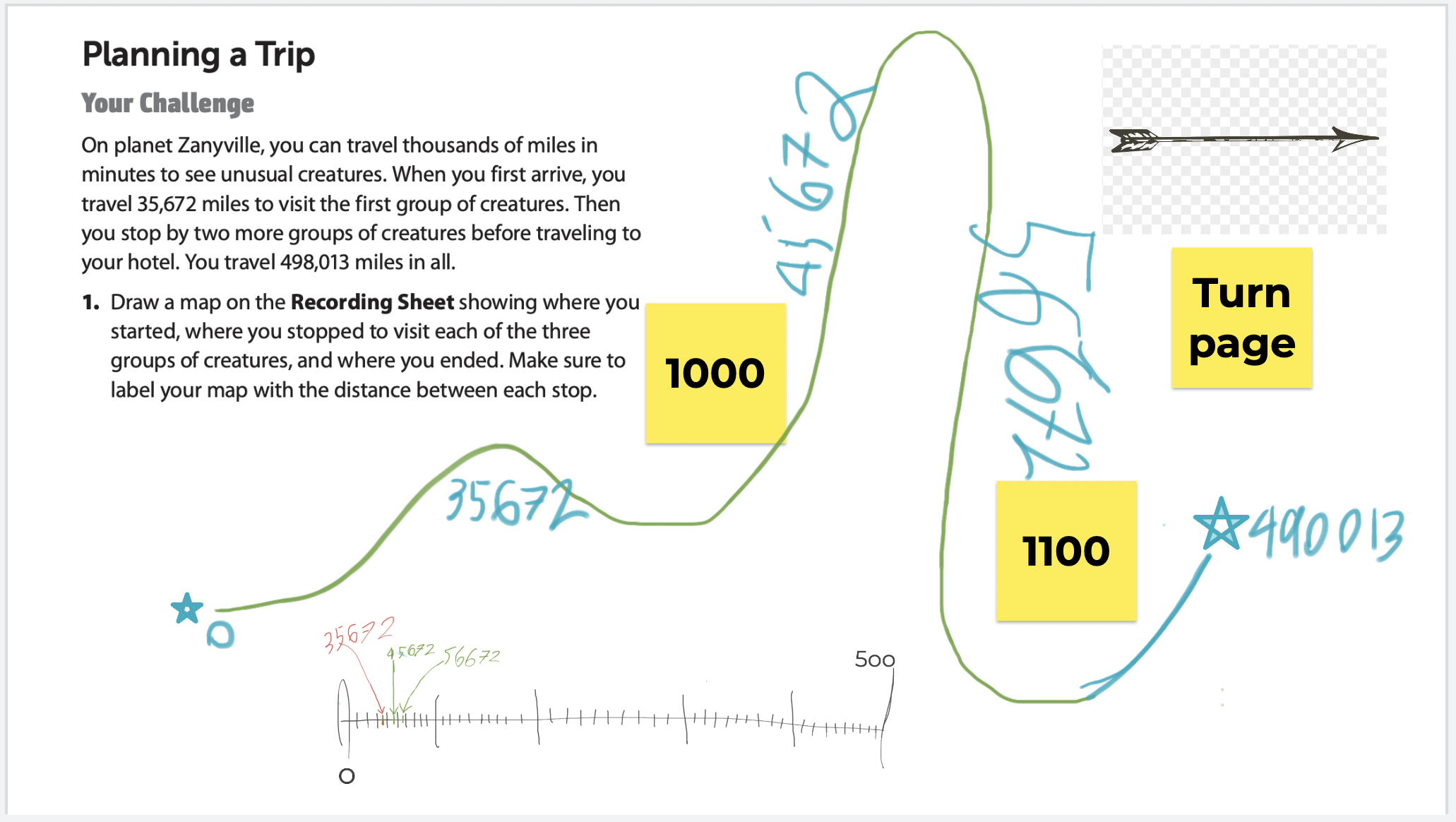
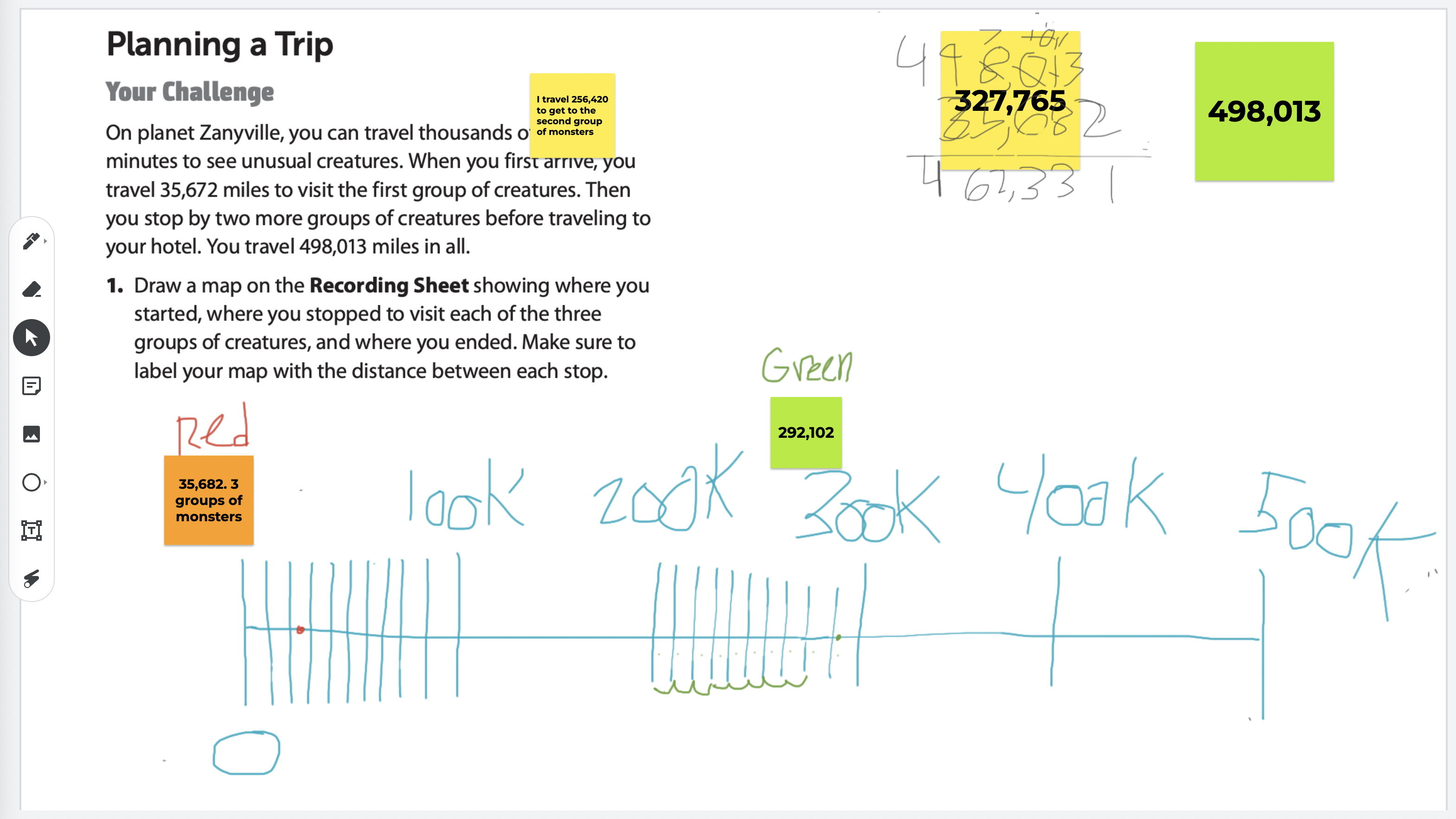
I modeled partitioning a space on the whiteboard. With students’ input, I placed numbers in appropriate places on the makeshift number line. After a short lesson on this, I had students revisit their “Planning a Trip” lesson from the previous week. They were to make a number line and show where each stop would happen. Their Google Jamboards showed excellent progress in understanding this concept.

From Enrichment to Gifted Instruction

This is where the lesson took a turn from enriching math understanding to present problem-solving and higher-order thinking through gifted instruction. In order to illustrate the disproportionality of the original maps, I’d have the gifted 4th graders use one of their own to display an accurate account of the journey.

How would we do this? I would lift the trail from the map. The trail would become a rope that could rise up off of the map. This would allow my gifted students to account for extra mileage and figure out how someone may have covered the distance of tens of thousands of miles, but look, from only glancing at a two dimensional map, as though they had only hiked a handful of miles. My plan was for the fourth graders to learn about topography.

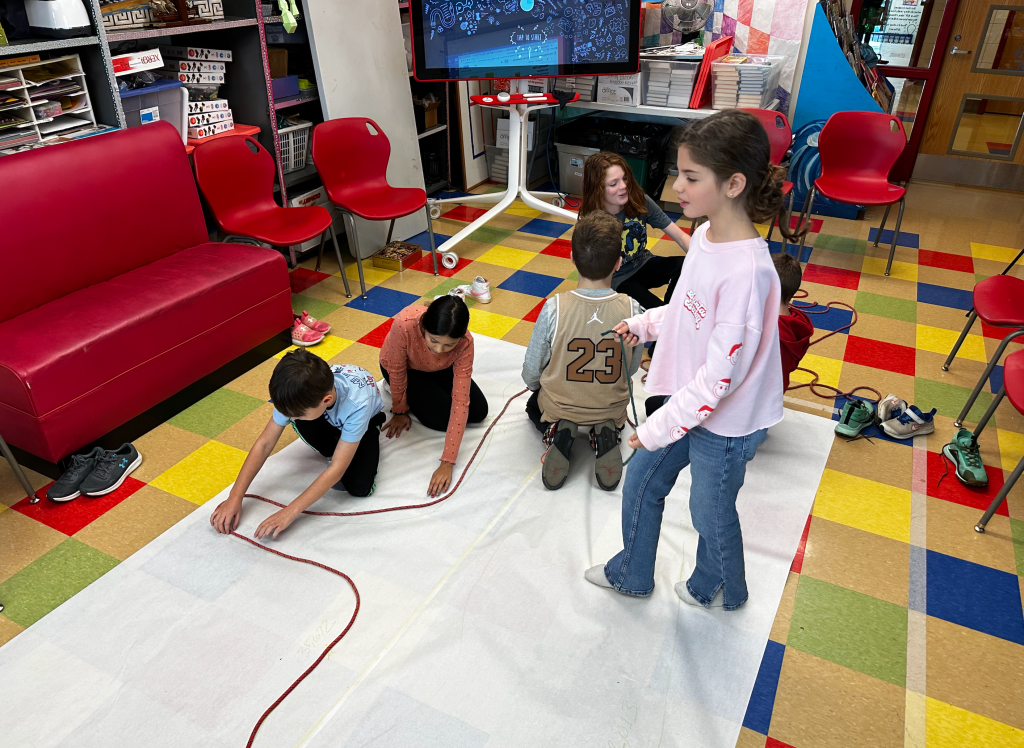
I gave my students a rope that was about 50 feet long. Their initial task was to tie pieces of yarn onto the rope symbolizing stops on the trip. They used what they had learned from the previous math enrichment lesson to do this.

“If the entire trail was 498,013 miles (this was on the planet Zanyville, remember), and the first stop was only 35K miles from the start, you couldn’t mark it halfway along the journey!” I reminded them. 

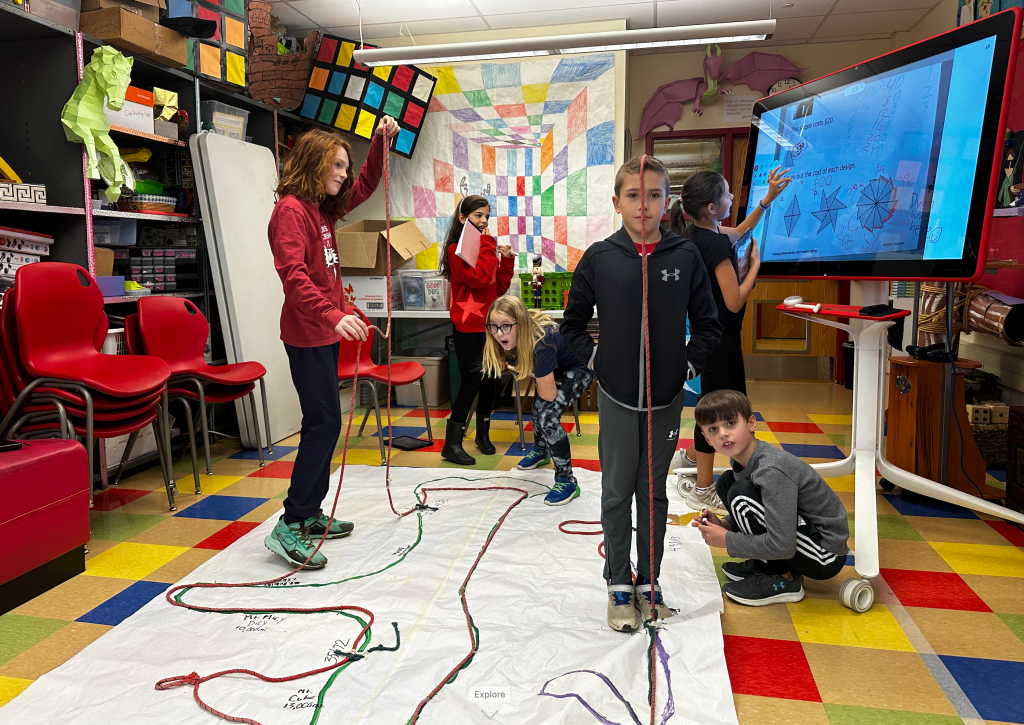
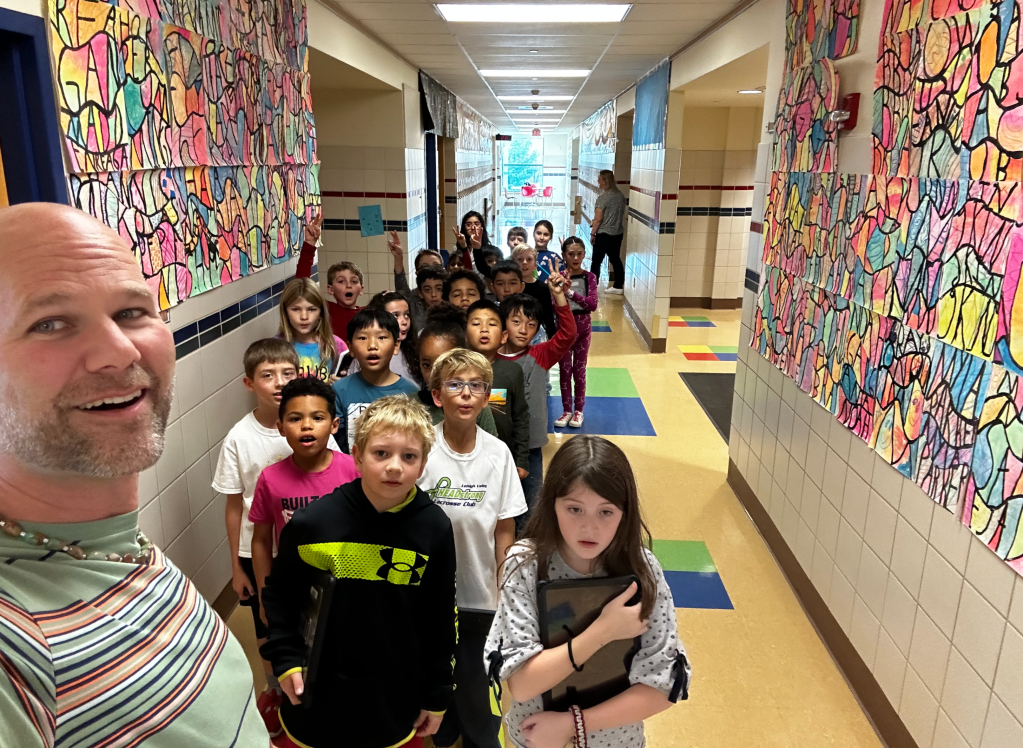
We brought the rope into the hallway, so that we would have plenty of room to #STEAM. The first thing my students did was section the rope into five equal parts. It being a 50 foot rope, each of the five sections was ten feet. As it turns out, the tiles in the hall were one foot wide, so each one symbolized ten thousand miles, nicely. Once we had some reference points, we figured out where each stop would be and tied a piece of yarn to represent the place. 

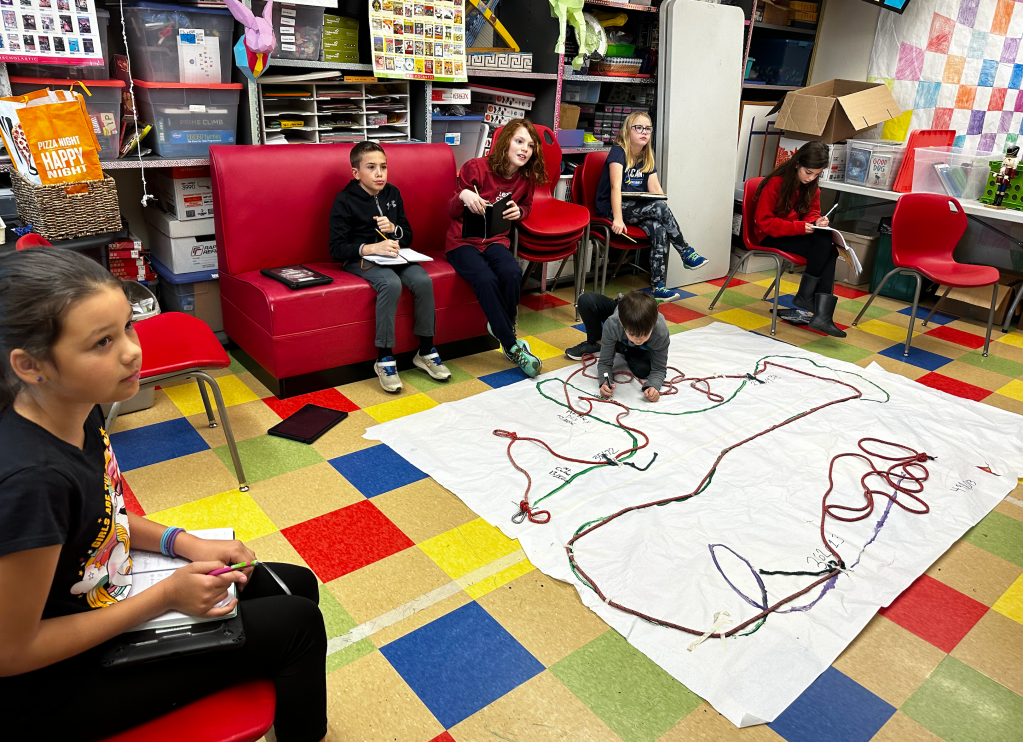
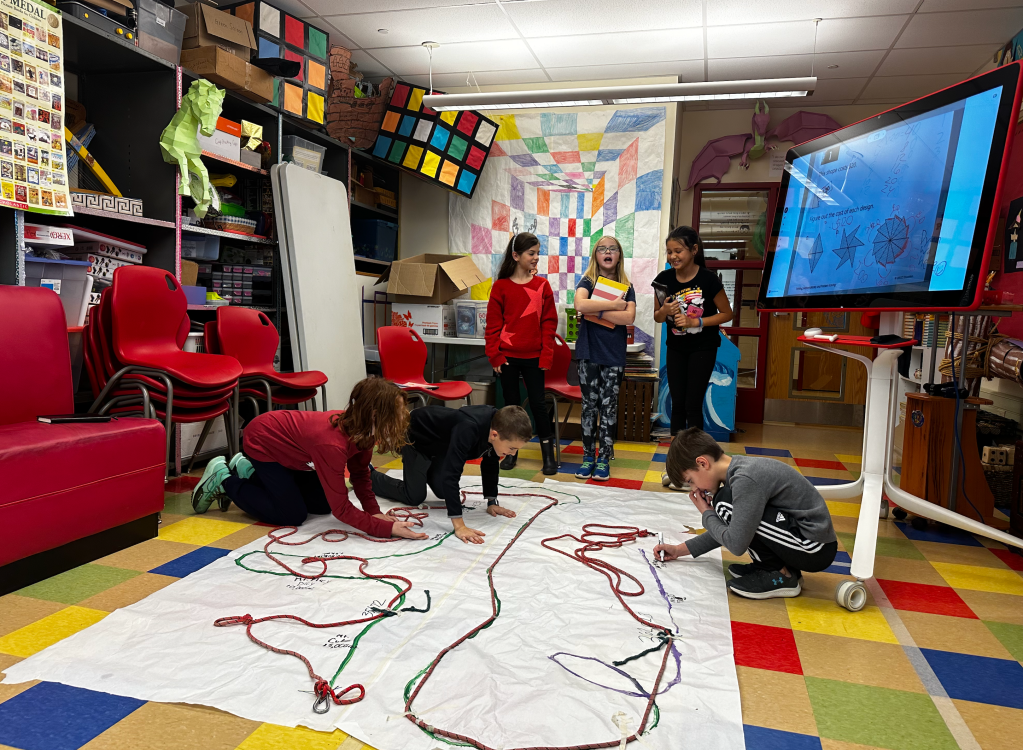
I then took one of the disproportionate maps that one of the gifted students had drawn, and I enlarged it onto poster paper that covered a large portion of the classroom floor. Next, we placed the rope showing our well-proportioned stops onto the map. We taped the pieces of yarn to the stops drawn on the map. There were huge portions of extra rope between some of the stops, and it was too short in other places. 

I asked my students to “Imagine that this rope isn’t a rope, but a journey. Someone actually did travel these miles, and they traveled along the route that is represented on this map,” I told them. “How could this be?” Their first idea was that the “journey” coiled around and around; As in, the traveler had actually walked in circles. “There is a loop drawn on the map,” I pointed out. “You should assume that the line drawn on the map is the exact path the person traveled.” I wanted them to discover the concept of elevation on their own. 

“The journey (they were very keen on calling the rope ‘journey’ and yelled at me when I mistook it for ‘rope’;) goes up!” several students shouted in unison. Feigning surprise, I encouraged my students to show it. I told them to make it happen. “Elevate the rope to show traveling up off of the paper.”

Watch the time-lapse of my 4th grade gifted students creating a model of their journey.

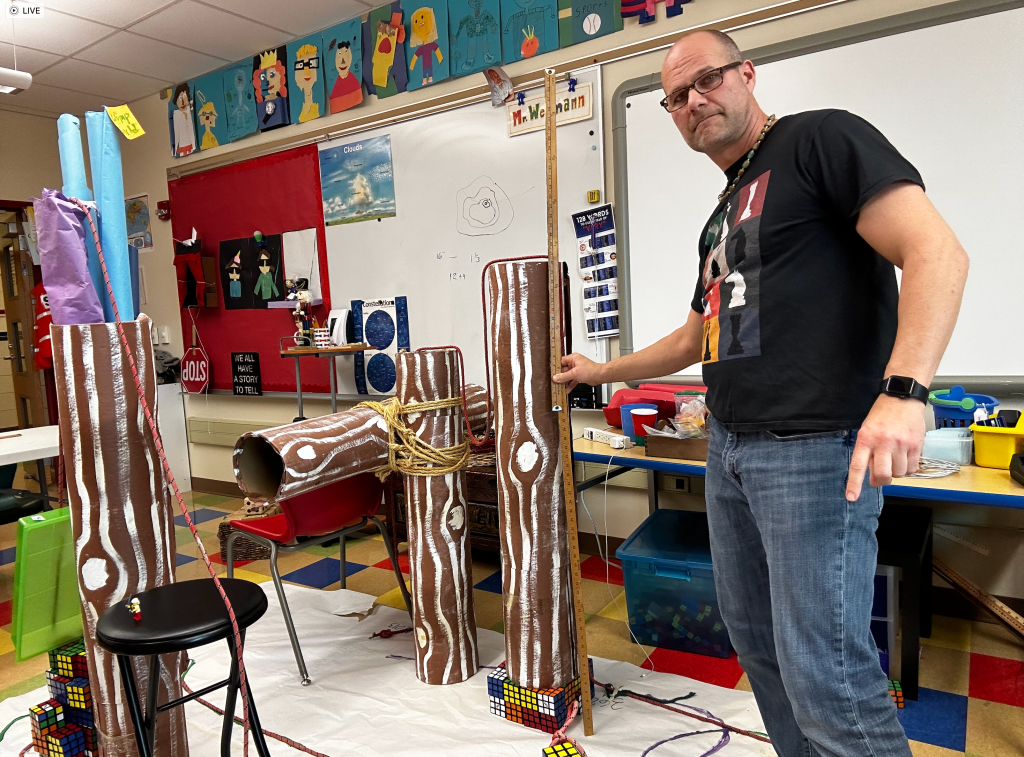
The students started grabbing everything within reach to raise their “journey” off of the paper. I gave them a few parameters: They could use anything in the room, other than my personal things. It had to follow the line of the map. The journey has to stand independently. “It can’t need you to hold it.” I heard the students mentioning how much fun this was several times, as they stacked Rubik’s cubes, built structures out of KEVA planks, and draped rope Journey over the 4’ high faux pilings I’d made for another project.
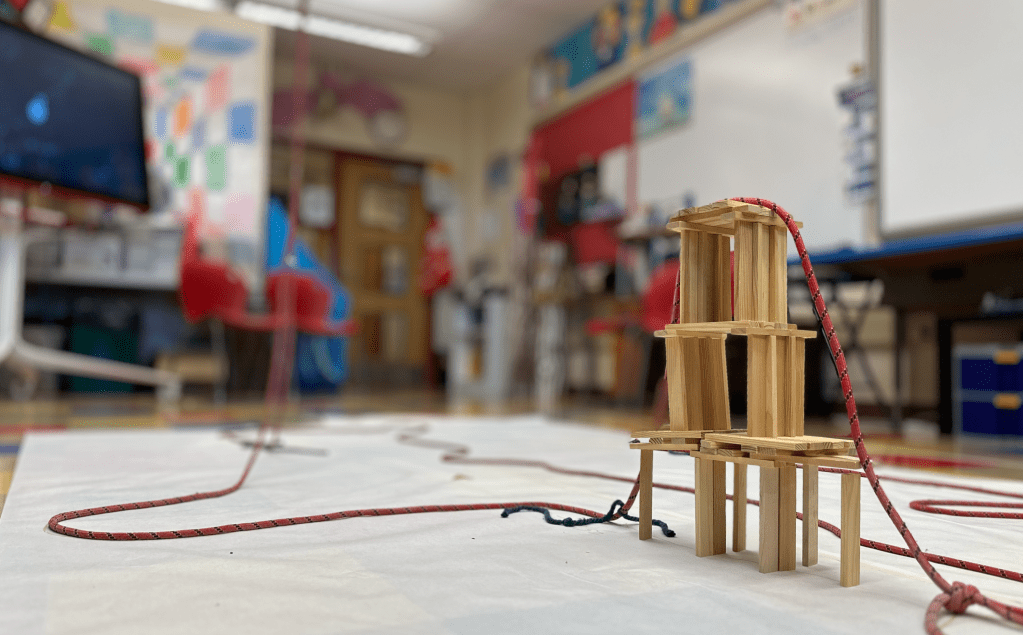
After finishing, I asked “How could we show these mountains on a two-dimensional map?” This is where topography enters the scene. Before exploring the topic, I had the gifted students brainstorm ways to display three dimensions on a flat piece of paper. They came up with drawing small images, like triangles symbolizing mountains. Information in a key was paramount. I showed them some maps that had varying colors used to illustrate elevation. They liked that idea. Finally, I introduced contour lines. These are drawn around the mountains, and show the incline of the slopes.

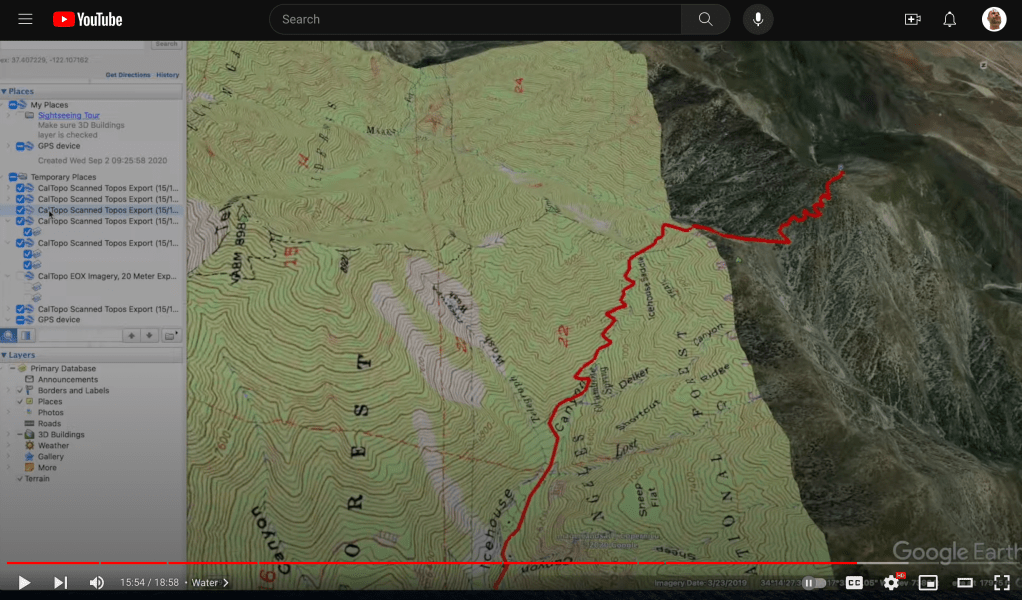
Once I did my best to explain how contour lines worked, I showed my students a video (above) made by HikingGuy.com. In the film, “Hiking Guy” takes a two-dimensional, topographical map and imports it into Google Earth Pro. He overlays the topographical map onto the exact geographical area that it represents. With Google Earth in 3D mode, the Hiking Guy swivels the view, so that you can see the depth of the mountains and valleys. We were in awe of the effects. I could have told my students that a contour interval is the amount of elevation between two contour lines on a given map, but seeing it displayed via three-dimensional modeling drove the concept home.

Next, it was time to collect some data to use in our map-making. We used yardsticks to measure how tall our mountains were. (I would have used centimeters as the measuring increment, in order to keep with everything scientific using the metric system, but since the Ready Math assignment had started the project off with “miles” on Zanyville, we kept to the standard system.) Before clearing away all of the materials elevating our journey, we marked the beginnings and ends of each mountain along the route on our map. In this way we would know the edges of the bottoms of our mountains for drawing contour lines.

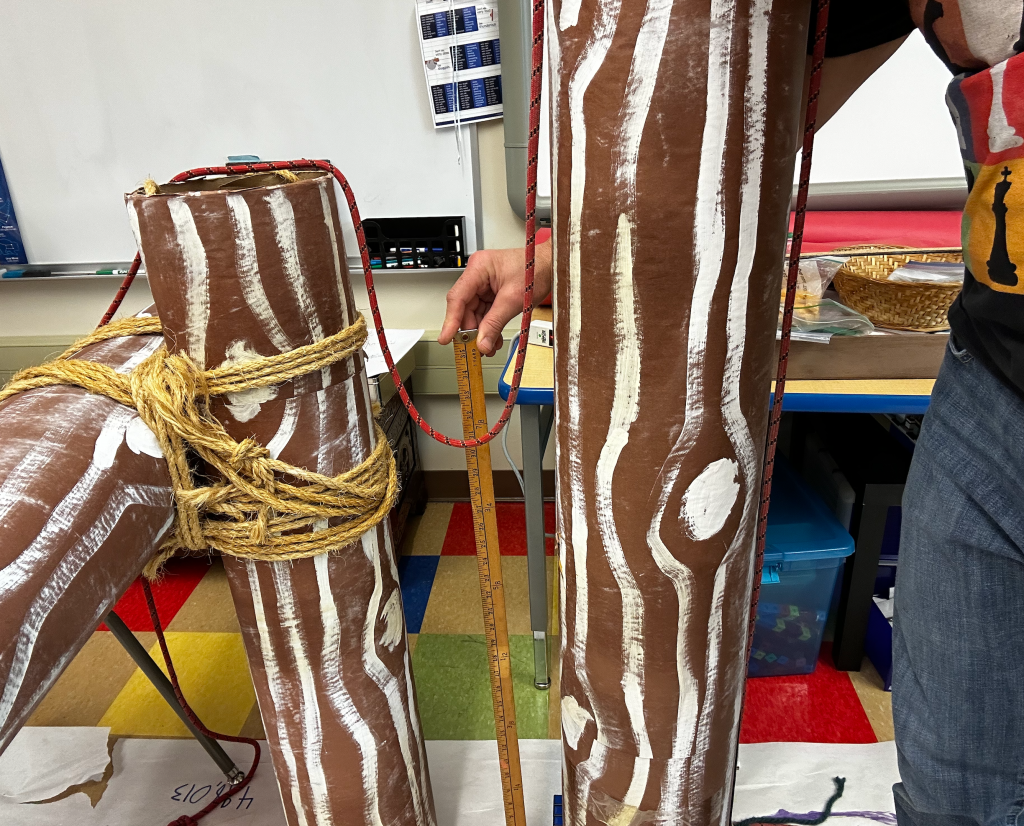
Prior to drawing our contour lines, we needed to figure out what our contour interval would be. The first thing we did was figure out the height of each mountain, according to tens of thousands of miles. If a mountain is only nine inches high, as was Mount Rubik’s (we named all of our mountains), and a foot (12 inches) represents ten thousand miles, what is the elevation of the summit? We figured out that nine inches is 3/4 of a foot, so we concluded that our nine inch mountain was 3/4 of ten thousand; or 7.5 thousand miles high. The taller mountains required us figure out how many feet fit within the total number of inches. Some rounding was used, and we came up with some valuable summit information that was transferred to the paper map.
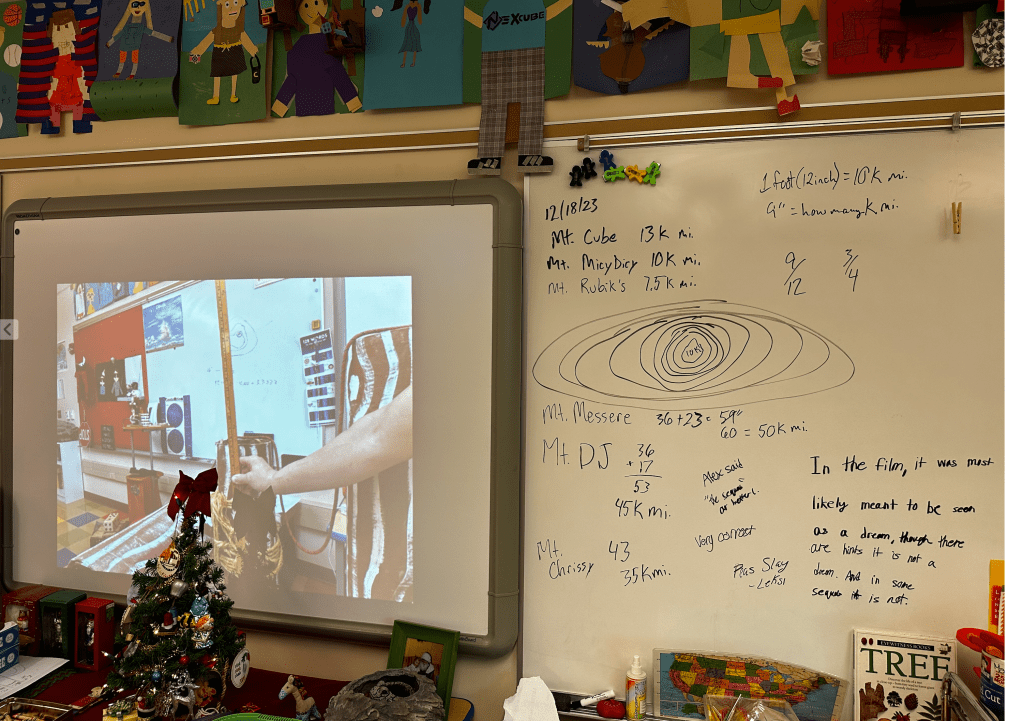
Now for our contour interval. How much elevation should each space between contour lines represent? We want the lines to be meaningful, but too many would make the map cumbersome to produce as well as read. We took each of our summits and found a number that was doable.
STEAMing Up Your STEM

Believe it or not, including art with the traditionally scientific fields of STEM has been mildly controversial. “The focus of STEM is developing rigorous math and science skills through engineering. How can you focus on other subjects (such as art) without losing the mission of STEM or watering down its primary purpose?” (Jolly, 2014). People who think this way are trying to isolate the left side of the brain (Pietrangelo, 2022). They imagine that opening STEM up to the arts would allow right-side brain activity to infiltrate and weaken STEM, but Jolly (2014) points out that this is viewing it all backwards. Art is already used in engineering, product design, creative math, and out of the box science. Strengthening our artistic use of STEM will make all four subjects so much more powerful.

Slow cookers like crock pots use lower heats to cook food over longer periods of time, deepening flavors and breaking down meat muscles, so that food becomes soft and tender (2022). A pressure cooker, on the other hand, cooks meals much faster. This mechanism has a seal that helps maintain the pressure within it. Steam builds up and pushes into the meats and other ingredients, breaking down the foods to make them tender, as well as infusing the flavors. You may not have tons of time to teach a STEM lesson. Use art to make the learning more memorable.

Saunas are small rooms that are heated up to 160 Fahrenheit. The health benefits of sitting in one of these hot beds for a short amount of time include clearing the pores of your skin, relaxing muscles, and burning calories, as well as increasing blood circulation (Hussain & Cohen, 2018). Add some water to the hot rocks in these wood-paneled spaces, and you have yourself a steam room. A steam room can help clear ones sinuses, loosen joints, and repair broken skin tissue (Johnson, 2023). [One thing to watch out for in a steam room is dehydration. It may seem ironic to dehydrate when surrounded by so much water, but the heat will cause moisture to leave ones body. Make sure to drink plenty of water and keep your time limited.] Using art in your lessons can add health benefits to your teaching. Students who favor their creative right side brain work might remember the lesson more. The artistic element could clean out misconceptions for visually-oriented students.

The difference between STEM and STEAM is as subtle as sauna vs steam room and slow cooker vs pressure cooker. I’d say that teachers are most likely using some art in their STEM lessons… I can also imagine a STEM teacher feeling pressure to utilize art which could lessen the lesson. Does titling teaching “STEAM” allow for art, promote its use, elevate art to STEM prominence, or simply point out the fact that it was there all along?

I like to think of art as the glue that holds the Science, Technology, Engineering, and Math together. I’m surprised we could see out the windows; There was so much STEAM happening in our classroom!

Enriching the Enrichment

A lesson that I began in the middle of this long mapping of a “Journey” project involved slope measurement. I thought that figuring out the value of the angles of the mountains would be useful. As it wasn’t helpful in completing the drawing of our map, I dropped it after spending only a little time on it. The information was very interesting, however, and I can foresee using it in on a slightly different angle of the lesson; Switchbacks.

Our Journey would not have gone straight up the sides of the mountains. A switchback is when a trail travels at an incline, but also more parallel than perpendicular to the mountain’s rise. After a short distance, the trail will “switch” directions and zig zag up the side of the incline. This means that the hiker will walk a much longer distance in order to get to the top of the incline, but it is an easier hike. What does this mean for our Zanyville trek? The journey, being its given length, will not go up as high; This will lower the peak or summit of each mountain. But, by how much?

Students can explore steilhangs, learning more about earth’s geography. Furthermore, they could research the differences between Earth and other planet’s geographies. 

I had students conduct a scientific examination through dropping small plastic cubes on top of one another to form a miniature naturally formed mountain. They were not allowed to touch the mountain with their hands. What was the angle of elevation? We placed a ruler parallel to the side of the slope and used a protractor to measure the angle of elevation. It was about 15 degrees. 

It will require some advanced geometry to recalculate the distance from the base of the mountain to the summit, given new measurements of switch back angles and lengths between directional changes. I might incorporate these elements to the lesson when I do it next year. It’s time to wrap this up.

Finally, I would like to see my students graph the elevation of the trip. Between zero miles and 498,013 miles, where did the trail rise and fall, and how much? 
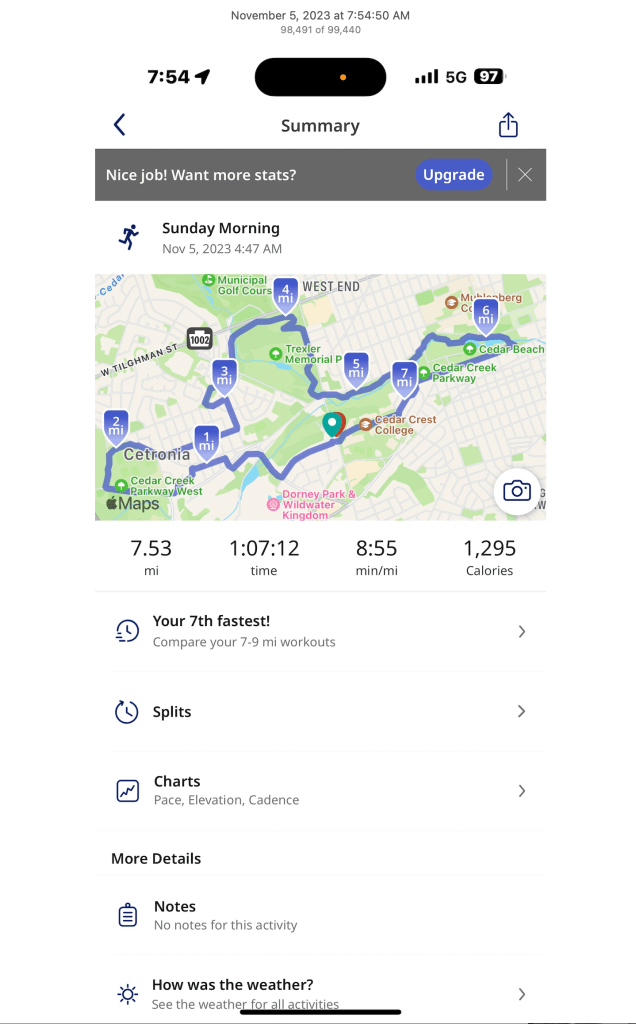
I use a running app that uses GPS to track my progress. It calls out my splits at five minute intervals. It also provides charts showing variations in my speed, cadence, and elevation. I want my students to create an elevation chart similar to the one from my running app. It ought to display where the traveler would begin and end hiking up/down mountains, as well as how high the peeks were.

Here’s a spectacular video displaying a taste of the elevation I experience on my runs in the Lehigh Valley, PA.

Sources:

Hertz, M. (2016, February 1). Full STEAM Ahead: Why Arts Are Essential in a STEM Education. edutopia . https://www.edutopia.org/blog/arts-are-essential-in-stem-mary-beth-hertz#:~:text=In%202006%2C%20Georgette%20Yakman%2C%20a,the%20traditional%20STEM%20curricular%20areas.  

Hussain, J., & Cohen, M. (2018, April 24). Clinical Effects of Regular Dry Sauna Bathing: A Systematic Review. National Library of Medicine. https://www.ncbi.nlm.nih.gov/pmc/articles/PMC5941775/#:~:text=Facilities%20offering%20sauna%20bathing%20often,%2C%20stress%20management%2C%20and%20relaxation.

Johnson, J. (2023, December 7). What are the benefits of a steam room?. Medical News Today. https://www.medicalnewstoday.com/articles/320314

Jolly, A. (2014, November 18). STEM vs. STEAM: Do the Arts Belong?. Education Week. https://www.edweek.org/teaching-learning/opinion-stem-vs-steam-do-the-arts-belong/2014/11

Pietrangelo, A. (2022, May 9). Left Brain vs. Right Brain: What Does This Mean for Me?. healthline. https://www.healthline.com/health/left-brain-vs-right-brain

slow cooker vs pressure cooker: what are the pros and cons. Farmison & Co. (2022, November 11). https://www.farmison.com/community/blog/pressure-cooker-vs-slow-cooker
Lock Up the Scary Self-Criticism Creature

Have you ever wanted to do a project, but there was something preventing you from getting started? Maybe you desired to create something crafty, like a birdhouse. Perhaps you were interested in starting a remodeling project on your own home!

Of course lack of funds or ignorance in the area of woodworking could hold you back, but how many times is it really our own inner dialogue that keeps us captive? As I prepare to start my gifted students down the road of writing a novel, I had the idea to clear their paths of mental blocks right out of the gate. Instead of witnessing my students being tortured by inner demons telling them they’re not good enough, “You’re too young,” “You don’t have any good ideas,” and the like, I decided to preempt these messages with a little mini lesson about fear. 

The first thing I did was I had my 5th grade gifted students brainstorm things that frightened them. We discussed ideas like dying and scary people breaking into their homes. Clowns and aliens (the outer space kind) were mentioned. 

Whenever a student presented something that they were scared of, I had them dig deeper. “What is scary about death? Everyone and everything experiences it.” These ideas gave them pause. We talked about the idea of not wanting to feel pain. Also, there is the whole unknown-ness of it! One student professed that if only he could go wherever you go after death and then come back, he would feel better about it. Wouldn’t we all! 

That idea reminds me of a fun Kurt Vonnegut book; one of his last. In “Timequake” (1997) Vonnegut has his favorite character, Kilgore Trout, repeat a large portion of his life after there is a “timequake” which brings all of existence back in time from 2001 to 1991. Kilgore dies in 2001, and he knows it. Because of this he is afraid of nothing. He knows that there isn’t anything that can hurt him. It’s a mind-bending book exploring free will and determinism. I highly recommend it (too grownups). 

Without mentioning Vonnegut by name, I discussed some of these ideas with my 5th grade gifted students. We also talked about “why” someone breaking into your home was so scary. “Your home is the most secure place in your entire life,” I suggested. “The intrusion of a person intent on causing harm introduces more than just fear of losing valuable possessions. It would be a violation of privacy, the destruction of the mental constructs of security one builds up around your place of residency. If your home is not safe, what is???” 

Clowns. Why are clowns so scary? They have that painted on smile, but we all know that no person can be happy all of the time. Also, it is so hyperbolic that it appears grotesque. The idea that someone could be feeling something completely different under such an absurdly happy look is disconcerting; creepy!

Perhaps the laughing clown is a metaphor for being “laughed at.” To be mocked or ridiculed is frightening. 

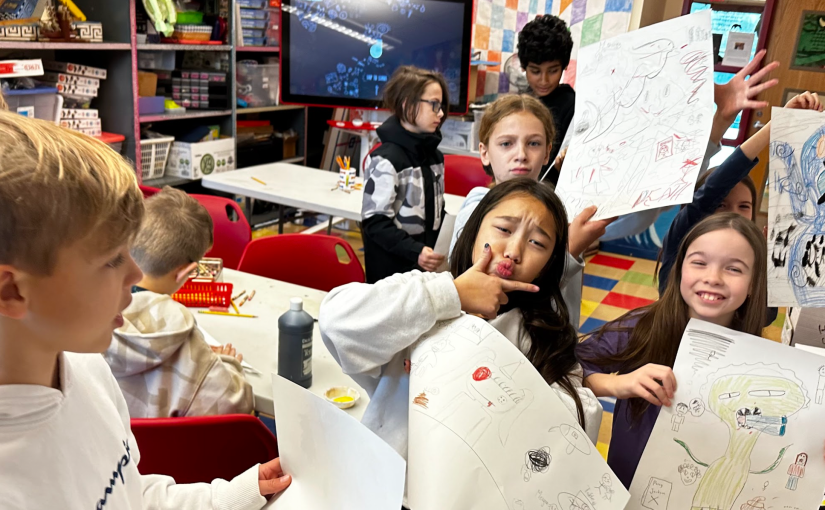
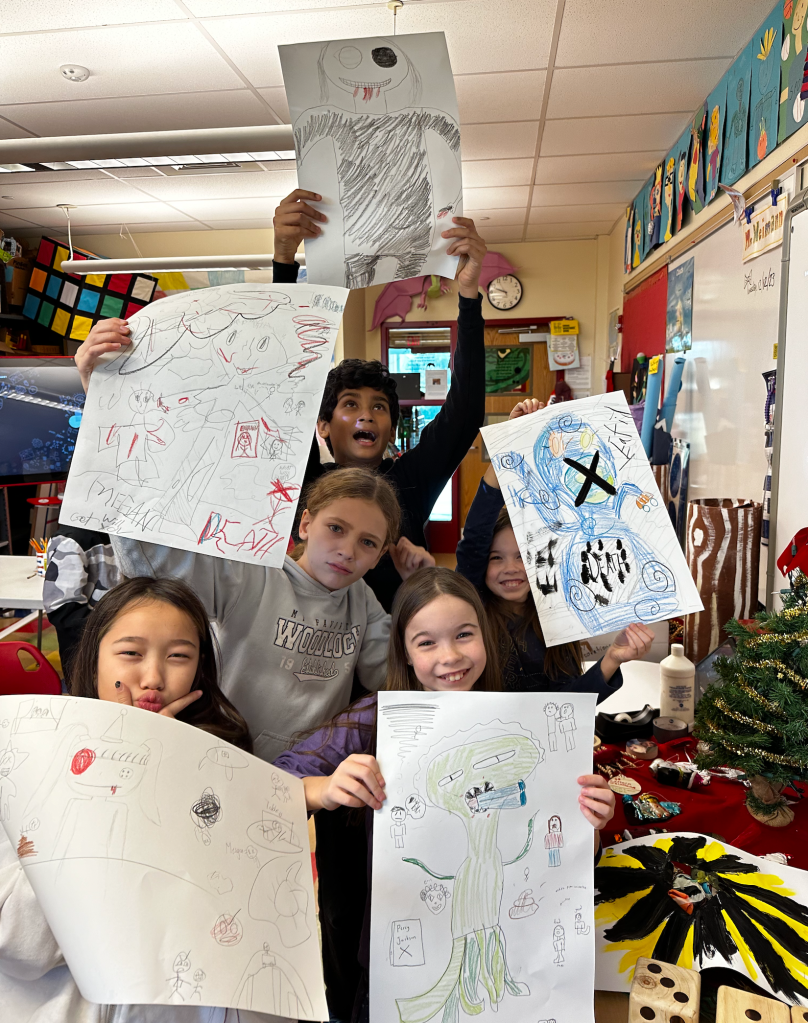
After our mini discussion about things that scare us, I instructed my students to make a work of art that displayed something that scared them. I was sure to inform them, “This is not meant to be beautiful. It isn’t for display, and no one is ever going to see it.” I wanted them to let go of their imaginations. Capture their fear on paper. They worked uninterrupted for several minutes. 

Then, I got everyone’s attention and explained the project further. “What you are making is a monster.” I paused, so that students could reimagine what they had been working on.

I tacked my talk. “Right after winter break I had planned on us beginning to write our novels,” I informed my 5th grade gifted students. “As I was looking through lesson plans that Mrs. Dweck (my predecessor) had used in the past, I found a Google document that was 116 pages long that she had shared with novel-writers. Mrs. Dweck would share this doc through the Google classroom, so each student would get his or her own copy of it. They had to read it, and add information to it. Mentors would comb through the document, finding and commenting on your work.

“One hundred and sixteen pages.

“I was afraid this was too much, too long, too independent… I was scared.” The looks on my students’ faces were fearful. What is about to happen? They were wondering. Teachers aren’t supposed to be scared! 

“You might be scared, also. Maybe you are afraid this project will be too much work for you. You could very well worry that you won’t have anything good to write. It is common to feel insecure about the quality of your writing. And then, there is this dungeon; a pit of despair; that writers fall into called Writer’s Block… That can be a looming fear, even when you aren’t trapped by it.” 

I took a breath and waited for the fears to quiet down. “What we are going to do is take these fears; these monsters of doubt, hesitation, worry, insecurity; and, we are going to lock them away. I am going to give you a few more minutes to add to your artwork, and then I’m going to collect them. I’m going to put them into a locked cabinet. This cabinet is locked with a key. I am going to take the key and file it down, so that the points are no longer available for unlocking. Your monsters of fear will be trapped in there forever!”

The students enjoyed drawing, coloring; some even added paint to their creations. A student who hadn’t drawn anything talked about simply stabbing the middle of his paper with a pencil. I spoke over the din of the room and explained, “These monsters are symbols. An empty piece of paper is actually ingenious because it symbolizes not having anything to say!” 

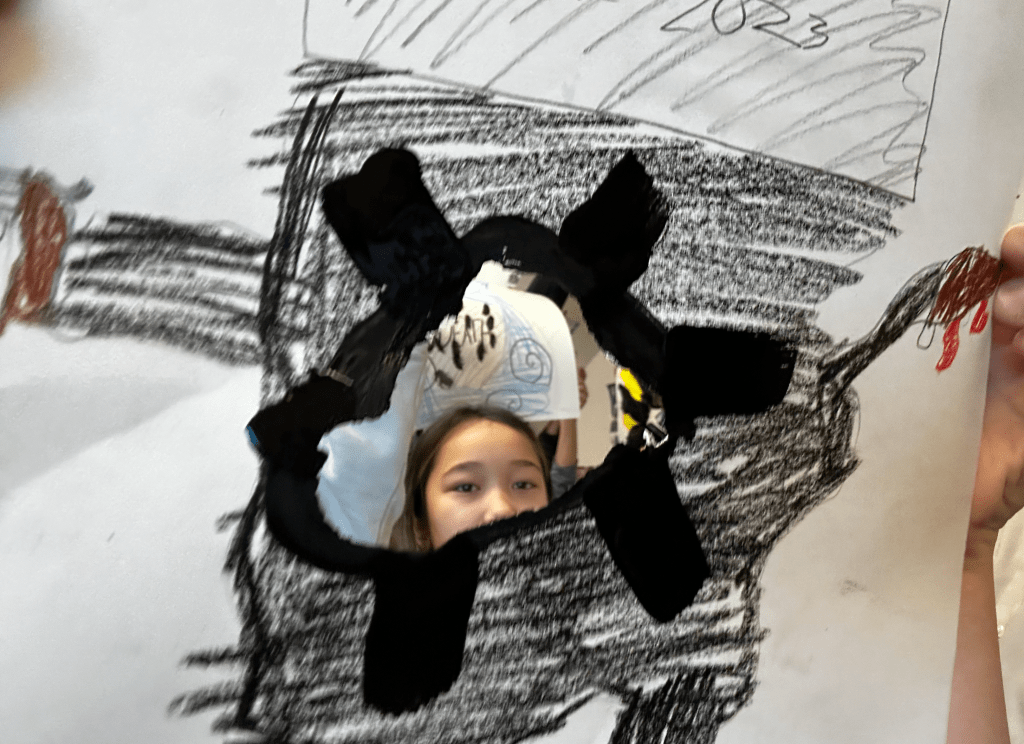
I had been working on my own artwork, while the students created. I had them guess what my fear was. I had taken a piece of every color of construction paper from a box of scrap papers and bunched them into balls. Then I taped them all together to make a sphere. Next, I tore a hole in the middle of the same kind of paper that my students were using. I folded the triangles of the hole in. I used yellow paint to make lines that traveled from the opening in the center to the outer perimeter of my paper. Without waiting for the yellow to dry, I used black to fill in the space between each yellow line. I used black construction paper to hold my colorful construction paper ball in place, at the center of my hole. The black construction paper was stapled to the painted paper, and my creation was complete. 

I asked my students what they thought it was. Not only did they understand that it was a black hole, but they knew that the colorful construction paper was matter being sucked into it. I explained to them that adults have so many different responsibilities that suck our attention and time away. “I am afraid I won’t have what I need to be able to write. I am continually protecting my writing time and wrestling mental thought away from the pull of the black hole of life,” I told them. “I frequently find good ideas escaping me.” I pointed to one of the colors in the center of my artwork. “That right there was a great story idea. I thought of it this morning, while I was on crosswalk duty. Now, it’s gone! It got sucked into the black hole of the bell ringing, my reentering the school, coming up here, getting out the supplies for this lesson… All gone!” I made a grown, illustrating the pain of loss of that great idea that will never be remembered. So dramatic:) 

“It’s time. Bring your scary creations over here. Mine is joining yours.” I led them over to a filing cabinet that I had recently cleaned out. We placed our artwork into the bottom drawer. They were really into discussing how it would be locked and what would happen to the key. 

Now that our fears have been locked up, we can be free to create. When a student tells me that he doesn’t know what to write, I can tell him that he is listening to the monster that we locked up. “Don’t. It isn’t true. You have tons of things to say. They might not all be just right or work with your story, and that is okay. Just get something into text. Don’t worry about what it sounds like, how much sense it makes, or whether it even fits. You may or may not keep and use it. You will probably need to fill in some details to make it work. That’s okay. What isn’t okay is entertaining that fear. Don’t give your monster audience. Ignore it and write; Write about being afraid of not having anything to write! But, write.” 

Math Games: Dessert for Dinner?

What if you could produce a dessert packed with protein and healthy nutrients; I’m talking even more beneficial than a typical meal. Would you serve this delectable dish for dinner every day? My conclusion may surprise you.

Last week was Parent-Teacher-conference-week at my school. Students had half-days, and families either visited the building or used virtual conferencing tools to converse face to face with educators. This was the very first time that I bounced around from teacher to teacher, visiting the conferences of my gifted students’ parents. While there are many ideas that I could comment on, the one that stands out most was from the parent of one of my math enrichment students. 

The family has a third grader who is gifted, and that is why I was attending the conference. But, his little sister, who is in first grade, attends my math enrichment lessons, and it was something that she said that got me thinking. Her parents told me that they asked their daughter what she did in math enrichment class, and she told them, “We play games.” 

“Is that all?” I imagine them pressing, being the good communicative parents they are. Yup, is the first-grade answer:) 

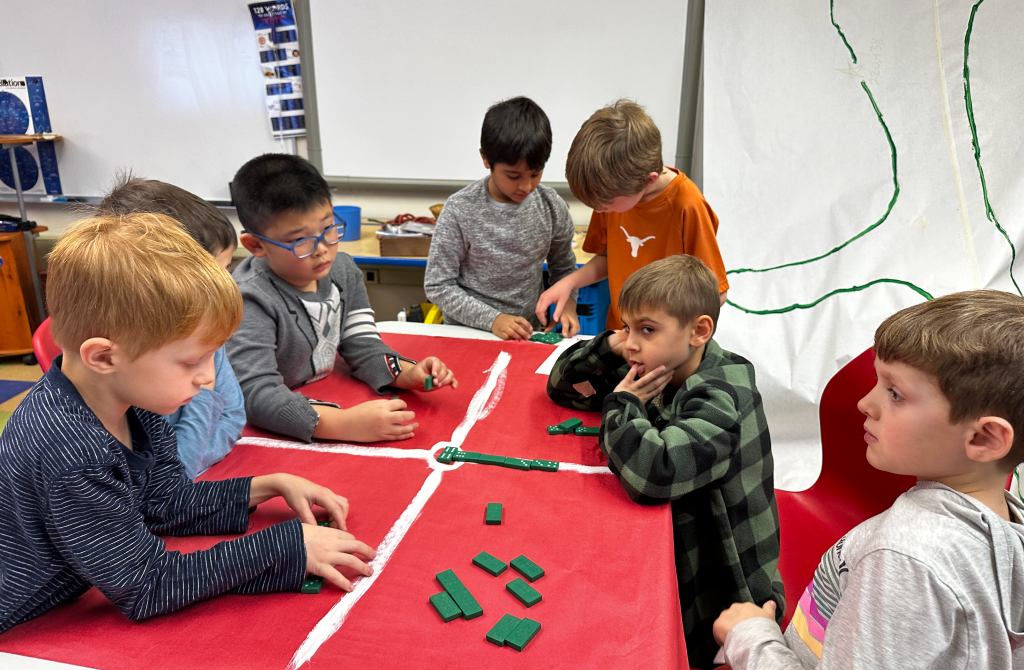
This is a recent pic of 2nd grade learning to play Dominos.

I laughed when I heard their tale. I explained to the parents that I was teaching the first graders Dominos. After defending the fact that there is a lot of mental math and problem-solving, there was some light banter between parents and the regular ed teacher about only knowing the stacking and tumbling side of Dominos. 

Because their gifted third grader had already experienced lessons showing the critical thinking development of Dominos, it wasn’t necessary to get too defensive. They were “on board” with my use of games for strengthening math skills. But, the idea of my lessons being categorized definitively as nothing more than games gave me pause. Initially, I was perfectly okay with tricking students into learning through having fun. What teacher would turn down that strategy? “Can we have some more math enrichment, please!” the students whine. “Um… Yes!” every math teacher in the world would utter. 

Then I thought about the idea of turning everything into a game. Wouldn’t that be wonderful for the students? But, would it be healthy? Hmm… 

This is where the thought experiment at the top of this blog originated. I was musing over my math lessons being perceived as games, and I dreamed up the analogy of only eating dessert. Prepare to enter a rabbit hole of research. I’ll try to keep it palatable😉

History of Dessert

Asking “Why does dessert even exist?” feels a little like questioning the purpose of gold or jewels. Isn’t it obvious? It’s awesome! 

Believe it or not, dessert did not always exist, however. Similarly to gold and jewelry, it was discovered, and has evolved over time. The French are responsible for turning entremets into dessert (Gerson, 2019). Before there were sweets to end a meal, entremets were served as “interval” dishes, literally “between-foods” courses (Teppen, 2015). They were meant to cleanse the palate. They may be sweet, but not necessarily. 

Eventually, a final course of fruit, called le fruit, was formalized (Gerson, 2019). Only, before serving it, the table must be completely cleared. This cleaning of the table was called desservir, the French verb for “to clear.” More than tasting wonderful, the original final course of fruit developed into something lovely to gaze upon. Some desserts even consisted of “Elegant metal and glass structures holding whole apples or plums. Other times, meticulously crafted sugar figures became the center of dessert displays, and might not be eaten at all. Dessert specialists in the eighteenth century were supposed to understand architectural design and be capable of replicating it in sugar paste” (Gerson, 2019). 

These creators of dessert, as it came to be known around the time of the French Revolution, when the Bourgeois assimilated the term, were originally more like artists than chefs. Maryann Teppen (2015) writes of an entire battle scene, complete with tiny sugary soldiers with guns and canons, that told the story of Louis XV’s demise crafted out of sugar. It is hard to imagine your dinner table being cleared; plates, napkins, silverware, and foods being “dessert-ed” away; only to be replaced by an elaborate, sugary scene of violence that you feast your eyes upon but don’t touch!

Modern dessert serves a different purpose. BreezeMaxWeb (2022) suggests it psychologically signals the end of eating. Consuming a small, sweet treat at the conclusion of a meal might communicate to the body and brain that we are all done, and there is no need to nibble superfluous snacks. The End. 

A practice that I began a couple of years ago has helped me lose some weight and become more healthy; I will eat an apple at the end of every lunch. Many years ago I heard that apples help clean your teeth, and apparently there is some truth to that (Apples: Dental Hygiene Facts, 2017). Once I’ve eaten my apple, I cannot/will not eat anything else. I don’t want to undo my teeth cleansing. This has helped me de-snack my afternoons.

Let me reintroduce the concept of math games, here. Could a game be used to transition from one course of subject matter to another? Would playing a game cleanse the cognitive palate, and prepare students for something completely different? Of course! Would this be an appropriate way to signify we are done with the subject? I think so.

Delayed Gratification (Deferred Satisfaction)

How many parents use dessert as a reward for finishing a well-balanced meal? That treat is the ribbon at the end of a race. Some contests require more work and take longer, but when getting to the game of a lesson is the goal, students may trudge longer, work harder, and persist through all kinds of problems. Those students who finish first might learn patience through having to wait for their peers to catch up with them before the whole group can consume the dessert of a lesson together. 

Self control. Training. Conditioning. “If I let you eat this piece of cake, do you promise to gobble up all of your peas and carrots without complaining?” doesn’t just sound silly. I probably don’t have to tell you that this is an ineffective reward model;) 

But, what if the dessert is carrot cake? What if the dessert is healthier than the dinner? Then what? “Eat all of your cake, or you won’t be given any peas…” Wait, what?!

Is there something to be said for learning to crunch through cardboard in order to earn cake? According to a longitudinal study spanning 40 years (Casey et al., 2011), learning and practicing self control early on in life can lead to better academic performance, less behavior problems, and even higher SAT scores. Casey and company (2011) describe in their paper, “Behavioral and neural correlates of delay of gratification 40 years later,” some ways kids can curb the pull of stimuli by learning cognitive control. There are mental strategies and tricks that people can use to provide buffers, dampeners, and walls to contain and maintain self sovereignty. Students may never learn or develop these important skills if they are never asked to wait for anything.

Through reading this research I wondered if teachers, themselves, are bypassing the delay of gratification when they jump right into games to teach. What educator looks forward to grumblings from their students? I propose that most  would prefer praise of pupils happy with pedagogical practices over the squabbling of scholars required to earn a fun activity. Are we educators partaking in dessert before dinner when we teach with games?     

Dessert Before Dinner

Before we beat ourselves up too much, let’s bring our metaphor along with us as we explore a couple of Jamarillo’s fun list of 11 Reasons to Eat Dessert First (2023). This may initially seem like a self-serving exercise, justification, or defensive maneuver, but hold on. Jamarillo raises the point that food can sometimes be a serious psychological hangup. “When we have disordered eating, we can often develop food or meal fixation.  Dessert is one of the most common food items restricted. This can lead to binge restrict cycles and disruption of hunger cues” (2023). 

Is it possible for students to develop “learning disorders” by experiencing “binge-playing” with learning games after enduring unnecessarily long restrictions? Just as Jamarillo (2023) suggests that dessert-first-eating can help overcome eating disorders through stimulating hunger, tapping into nostalgic memories, practicing navigation of bodily needs versus wants, and learning to respect cravings, beginning a lesson with a learning game can help students who struggle academically to open up to pedagogy.  

One thing more, and this might be a great way to end this blog, Jamarillo (2023) ends her short article with the fact that dessert is an ambiguous course. It can be a sweet, but doesn’t have to be. Fresh, raw fruit could serve as dessert. Pies, pastries, a tiny chocolate or candy, sweetened veggies, and yes, of course cake can all constitute desserts, whether eaten at the beginning of a meal, middle, or end. 

In conclusion, my first grade student may imagine all she does is play games during math enrichment time, but this learning dessert is rich with problem-solving proteins, mental math nutrition, and healthy higher-order thinking! With the short amount of time I have with my students, I have to make my challenges tasty. And, I’m okay with that;)

Sources

BreezeMaxWeb. (2022). Why Is Dessert Important After Eating Food?. Casa Romana Sweets. https://casaromanasweets.com/why-is-dessert-important-after-eating-food/#:~:text=When%20you%20eat%20dessert%20after%20your%20meal%2C%20it%20signals%20to,moving%20after%20you%20eat%20it.  

Casey, B. J., Somerville, L. H., Gotlib, I. H., Ayduk, O., Franklin, N. T., Askren, M. K., Jonides, J., Berman, M. G., Wilson, N. L., Teslovich, T., Glover, G., Zayas, V., Mischel, W., & Shoda, Y. (2011). Behavioral and neural correlates of delay of gratification 40 years later. Proceedings of the National Academy of Sciences, 108(36), 14998–15003. https://www.pnas.org/doi/full/10.1073/pnas.1108561108 

Cherry, K. (2023, November 5). The Meaning of Delayed Gratification: Deferred Satisfaction and Its Rewards. Very Well MInd. https://www.verywellmind.com/delayed-gratification-why-wait-for-what-you-want-2795429 

Apples: Dental Hygiene Facts. Summit Dental Health. (2017). https://summitdentalhealth.net/apples-dental-hygiene-facts/  

Gershon, Li. (2019, August 21). The Invention of Dessert. JSTOR Daily. https://daily.jstor.org/the-invention-of-dessert/  

Jaramillo, S. (2023). 11 Reasons to Eat Dessert First. Peace and Nutrition. https://peaceandnutrition.com/11-reasons-to-eat-dessert-first/  

Miller, K. (2019, December 30). What Is Delayed Gratification? 5 Examples & Definition. Positive Psychology. https://positivepsychology.com/delayed-gratification/  Tebben, M. (2015). Seeing and Tasting: The Evolution of Dessert in French Gastronomy. Gastronomica, 15(2), 10–25. https://doi.org/10.1525/gfc.2015.15.2.10

Enriching Extension Activities: Grinch Escape Room

Ready Math has an enrichment activity for nearly every math lesson. These are usually accompanied by a worksheet. The papers can be printed, photocopied, and distributed for students to complete during independent time. The worksheets have thorough instructions on them, sometimes with examples, so that students can manage the assignment without teacher help. 

In the “Teacher Toolbox” you can find an array of tools for each lesson for every grade. I like to start off with checking out the “Extend” ideas and adapt them to meet my students’ needs.

The idea is for students who’ve attained mastery of the subject to apply their skills to slightly more challenging tasks. It’s nice for the teacher to have something concrete to look at after the student is done. This evidence of work and proof of advanced mastery can be shown to parents and back up grades on report cards. 

One problem with this is that students aren’t always thrilled about being rewarded with a worksheet when they understand and are good at a math concept. It’s helpful for a teacher to introduce the worksheet. They can spice up the assignment with some extra enthusiasm. It might be helpful to pave the way for success with a check for understanding of the assignment. Perhaps the teacher could introduce a twist to the pre-made project, including an additional step or task.

When I am preparing an enrichment activity, I try to provide an opportunity to use the math concept in a real world scenario. We all remember the age-old question, “When will I ever see this in real life?” uttered with a groan and eye-rolls. This is my aim: Show students situations where their math lesson would actually be found. 

Another goal of mine is to help students grow their thinking muscles. Perhaps there isn’t a clear use of Pythagorean’s theorem in everyday life, but it can be used to sharpen geometric and algebraic understanding! Puzzles are great for this. 

I recently used one of Ready Math’s enrichment assignments to challenge a group of fifth grade students. The lesson/worksheet looked a little like busy work; It involved adding and subtracting four-digit numbers with decimals. You needed to be handy with the math to complete the task with accuracy, but I didn’t see any way that the student would be richer having completed the assignment. 

One of the first things I do when attempting to turn a pre-made assignment into an enrichment activity is see if there is some bit of information or number that can be taken away. Can I remove something, and the students still figure out the answer? 

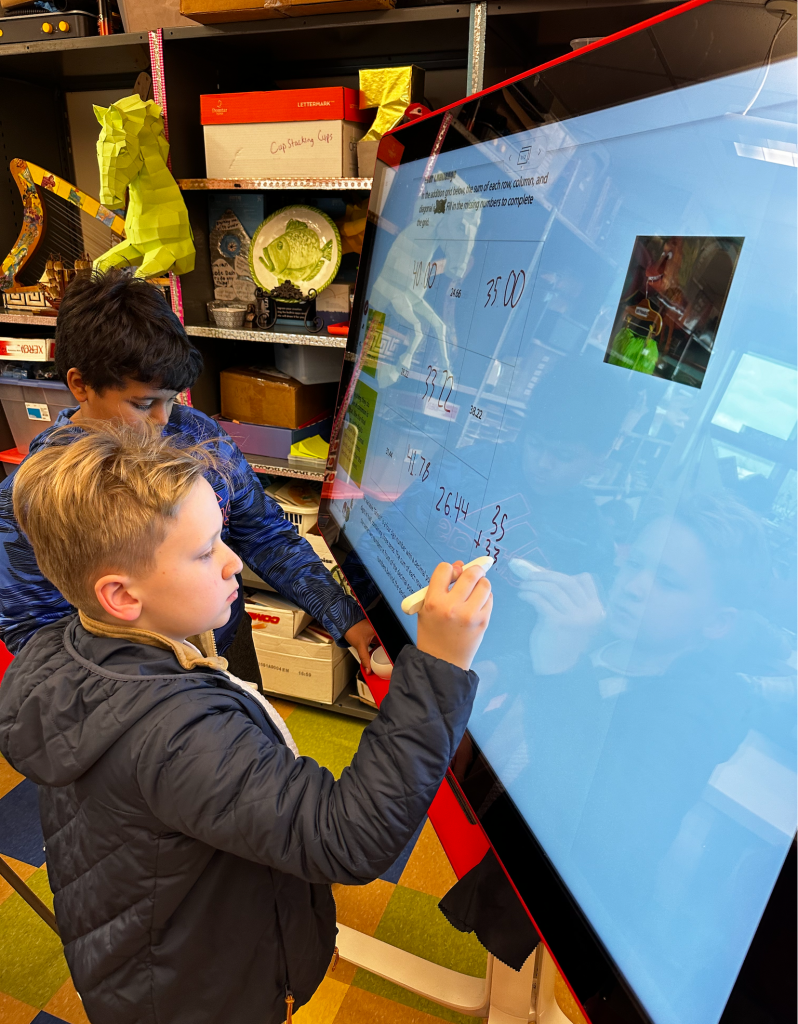
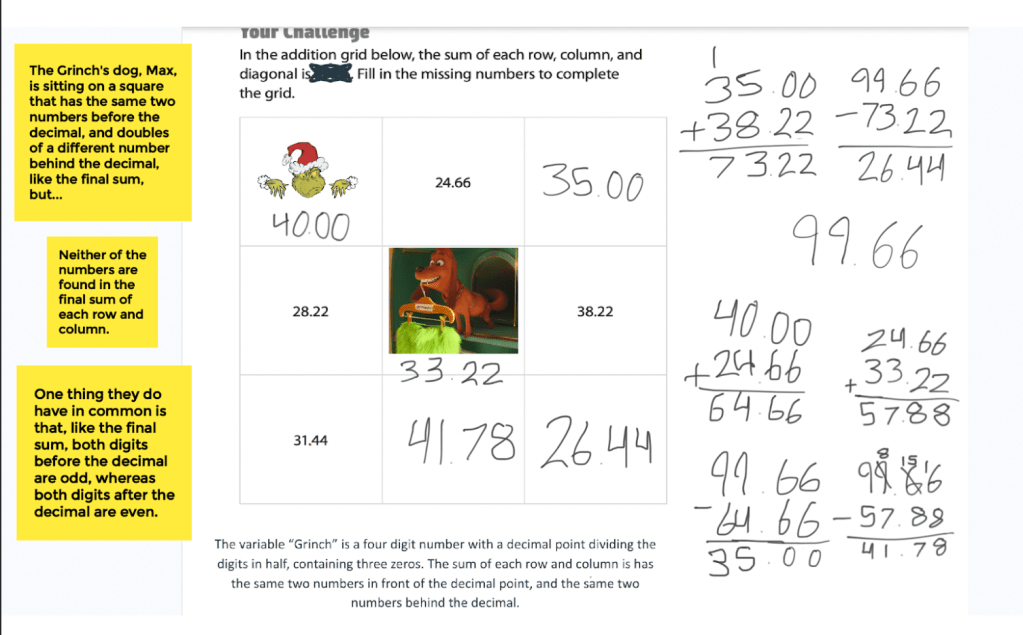
The assignment that I was looking at was a three by three grid with some boxes filled in and others blank. Every row and column, as well as the diagonal lines crossing the center square, all add up to the same number. The worksheet tells the students what the shared sum is. Can I remove that final answer and students still figure out what numbers would go in the boxes? 

I tried it out in my journal. The way I saw it, there’s no way around having at least two unknowns. I could ask the students to figure out multiple correct answers; sums of every row and column, but this kind of activity stretches beyond enrichment and requires gifted thinking. That is a topic for another blog; the difference between enriching math and providing gifted instruction. 

I tried playing around with the numbers in my journal.

Still liking the idea of removing the sum that all of the numbers share, and making students really dig for the gold of their lesson, I decided to limit the unknowns by providing parameters. I began writing these into hints or clues. Then, the lesson morphed into a type of riddle. I left gaps in the clues, so that students would have to address a few empty boxes in order to solve the entire grid.

As the project evolved, it struck me that I could pretend the problem was a lock that prohibited the class from leaving the room; It facilitated an escape room sensation. This would be the way that I presented the whole problem! I’ve been wanting to explore the use of escape rooms at school. This could be a great start. 

I prepared some more clues for bits and pieces of the four digit numbers within the grid. I put an image of the grid into a Google Jamboard. Then, I copied the riddles and pasted them into “sticky notes” that got spread out around the grid. I themed the whole thing with Grinch, and it was ready for “production.” 

The fifth graders loved it. When I told them that they were stuck inside the Grinch’s lair, their faces lit up! “The Grinch, that big ole meany went and scribbled over the sum that we need to solve this grid. He left us several riddles to figure it out. You can’t leave the room until you do.”

Everything was going great… Until… One of the students had actually completed this particular worksheet in the classroom, as an extension activity. My heart instantly sank. Did the Grinch steal my Christmas? Luckily, I’m pretty good on my feet, and I told them that we can still use this whole activity in order to learn how to make up our own riddles and clues, so that we could develop another, future escape room that other students could have to solve. Everyone was cool with this new plan.

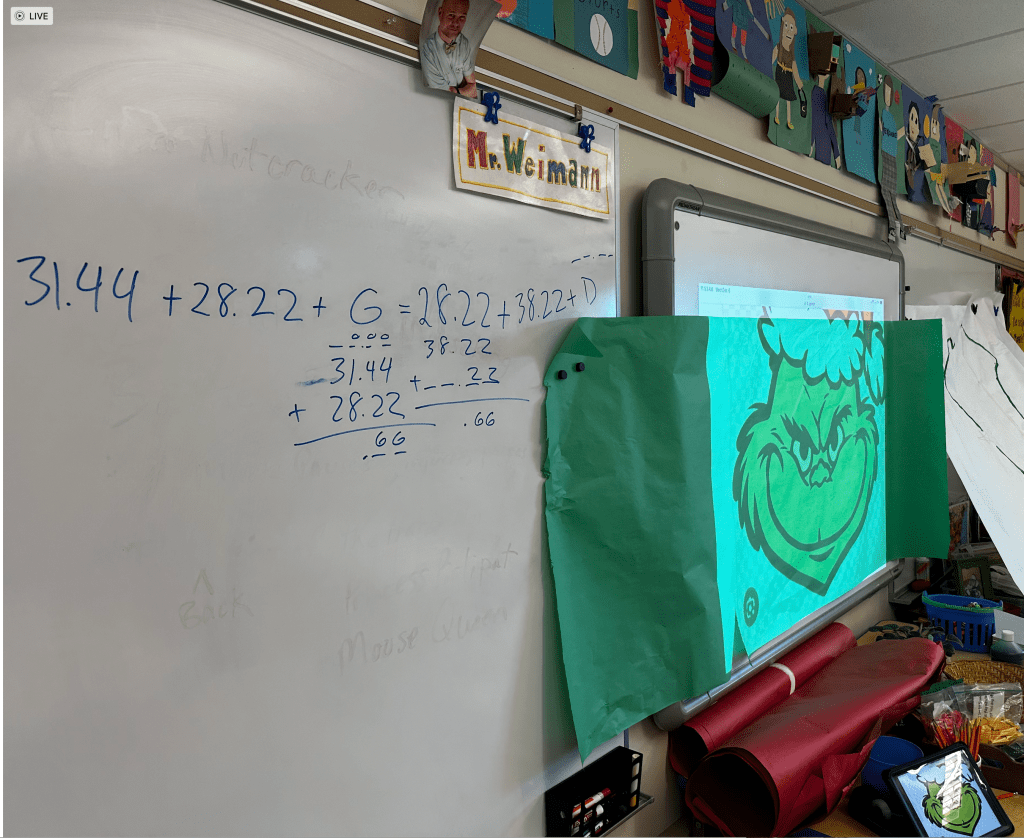
I wrote an equation on the board, using as much information as was available. Then we filled in missing pieces with information from the clues. I showed them how they could do this on their own in the future! It was still fun.

We continued exploring the clues, now with a new purpose. Granted, we were working backward, since we already knew the final answer, but that was okay because the students were able to see how the clues functioned. I showed them the way you can start with an answer, analyze the number’s attributes, and make up hints that color and shade the number, without giving it away. They seemed to like it, and we still had to do some adding and subtracting of four digit numbers containing decimal points! 

This lesson wasn’t over when this group of students left, however. The way fifth grade math enrichment works in my school, I meet with a different group of advanced math mastery fifth grade students in afternoon. I told the AM students to not tell the afternoon math students the answer, just in case none of them had completed this particular assignment. Then the Grinch let them out;) 

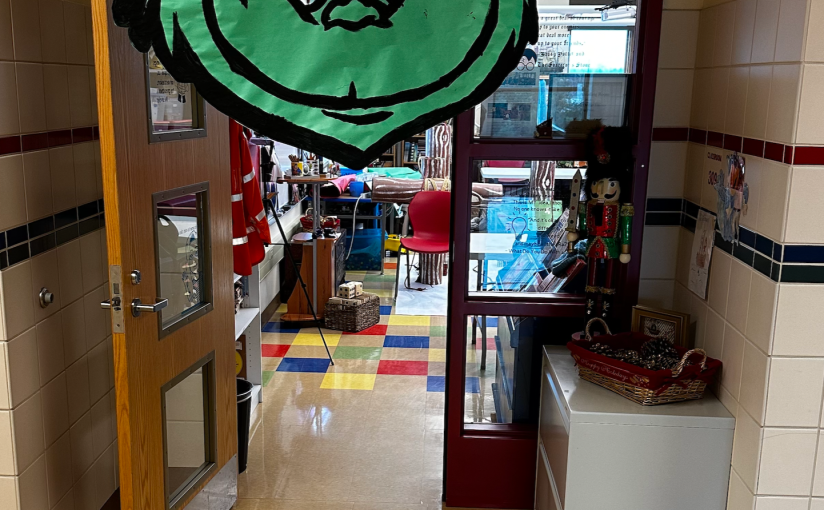
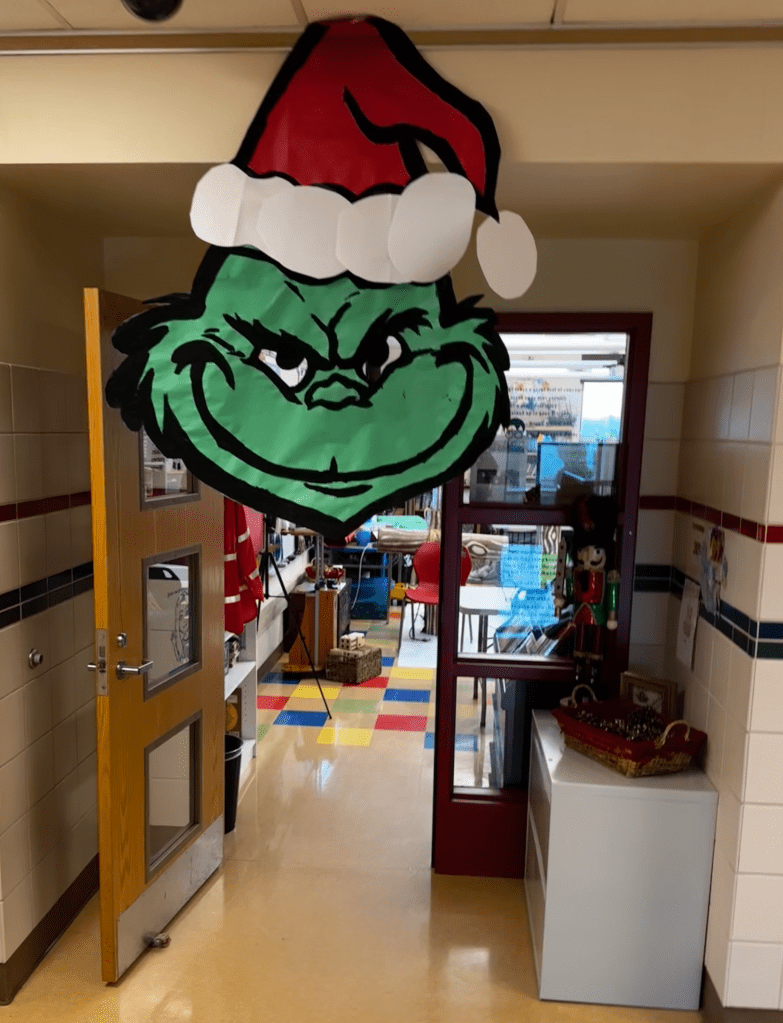
Between the groups, my fourth grade gifted students painted a giant Grinch face to hang up over the door. That was fun.

When the afternoon students entered the room, I pitched the escape from the Grinch’s Lair idea the same way I had with the morning crew, but with the understanding that they may already know the answer, like the first group. One student of the eight or so kids had done this assignment and knew the answer, but he was a good sport about keeping it a secret. 

Since I had thoroughly examined the entire riddle with the first group, I was well-versed in the clues and could easily present them to this final class. I let them wrestle with the ideas. As it turned out, you could figure out the final answer before getting all the way through the final clue. That was interesting to learn. The experience was pretty fun, and they got plenty of practice adding and subtracting numbers containing decimals. 

I’m definitely looking forward to making more lessons containing clues and using the escape room scenario to encourage tension and motivation! It was really nice to have a pre-made template from Ready Math to build from; or, more accurately take away from. But, in the future, I’ll have to be careful about assuming kids hadn’t used the lesson before. 

Multiple Enrichment Opportunities: Multiplication and Compatible Numbers with 3rd Graders

The idea underlying math enrichment is to deepen the understanding of math concepts that advanced students have already mastered. I began meeting with the top math students from each grade level (K-5) a few weeks ago, and I started off my introductions with this definition of enrichment. I didn’t want them to expect to go farther in their math skills, surpassing their peers. I also didn’t want them thinking that they were “above” their classmates who did not join me for this enrichment time. Rather than looking down from the mountain tops, we would dig in; We are in search of the riches (from en-rich-ment) that can only be found by looking beyond the ordinary teaching of math skills.

The challenge to myself is to find novel ways to show the use of math skills. I want the students to see that what they learn in the classroom is very necessary. Even if you never, ever have to use Pathagoream’s theorem, being able to use a formula correctly and understanding why is extremely valuable. 

An example of this is my lesson on multiplication for 3rd graders. Having completed an “Understanding Multiplication” lesson weeks earlier, and learning facts for multiplying zero through ten, I wanted to have students use these ideas creatively. I came up with a lesson that shows a way adults use multiplication all of the time without even realizing it!

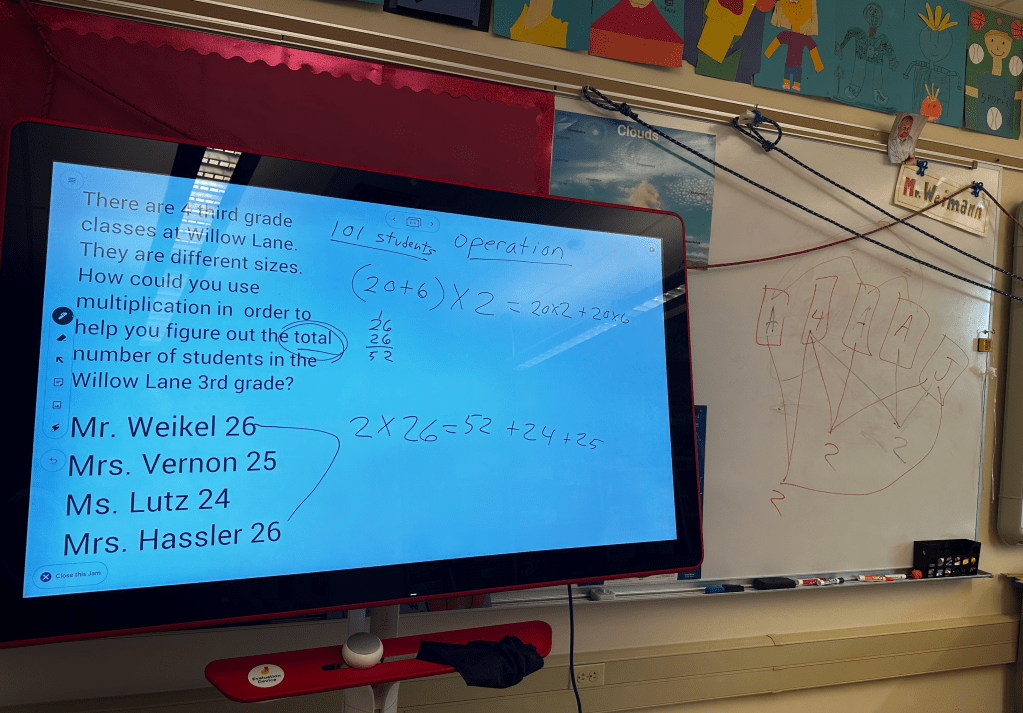
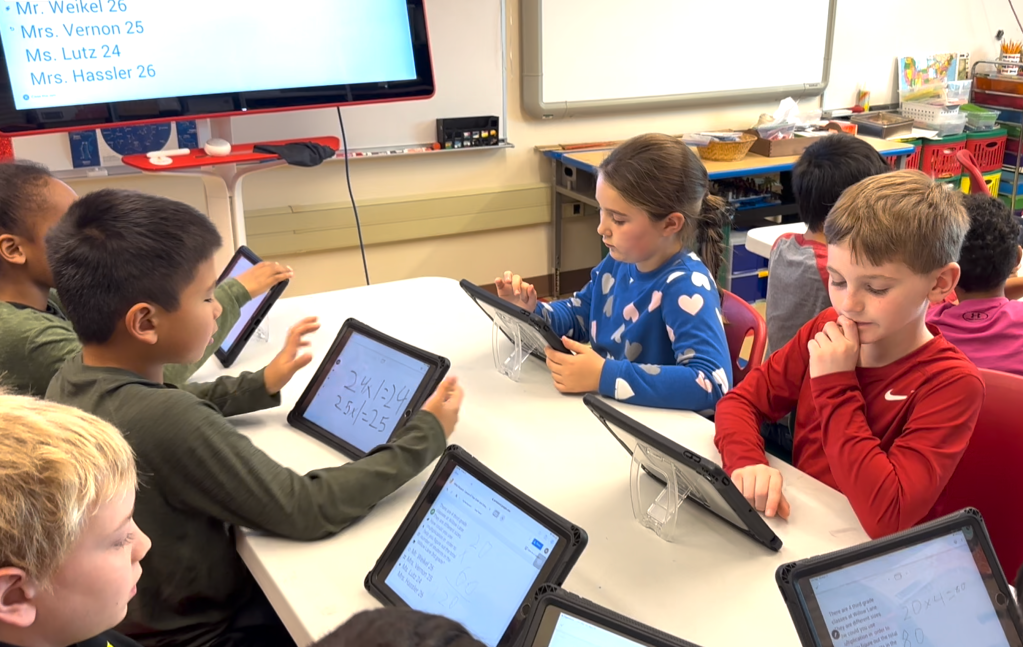
There are four 3rd grade classes. Each one is very close to 25 students. How many students are in 3rd grade? Adults immediately know that there are about 100 kids in the 3rd grade. How? We instantly know that 4 X 25 = 100. Easy-peezy. But, there are a few things going on behind the scenes. We, grownups, are already rich in the knowledge of four 25s equaling 100, due to decades of dollars and quarters! Also, we know to use the compatible number 25 when numbers are close to it. Third graders have been taught how to round, but they don’t know that it is okay to completely change numbers into “easy to use integers” (compatible) for simplifying computations!

I told them that they could simply add all of the numbers together, first. That way they know what they are aiming for. But, they have to show the use of multiplication to complete the problem.

As always, I wasn’t going to just come out and tell them all of this. My math enrichment students had to dig for it, en-rich-ing themselves. I gave them this math problem. 

It has to do with them, which is fun. The numbers are accurate. I looked them up on the school’s database. These are the names of the actual third grade teachers. 

I read the problem to the enrichment students. Then, I asked them, “What is this problem about?” After the students identified the topic of third-grade population, we discussed what the goal was. You have to provide the total number of students, but there’s a catch; “You have to use multiplication to do it!”

When I walked the students through the Important Information; the data that will be used to solve the problem; I paused to point out some key elements. The students noticed the multiple 26s. I showed them that there was something else they all had in common; They were all in the twenties. There were multiple numbers with a two in the tens. 

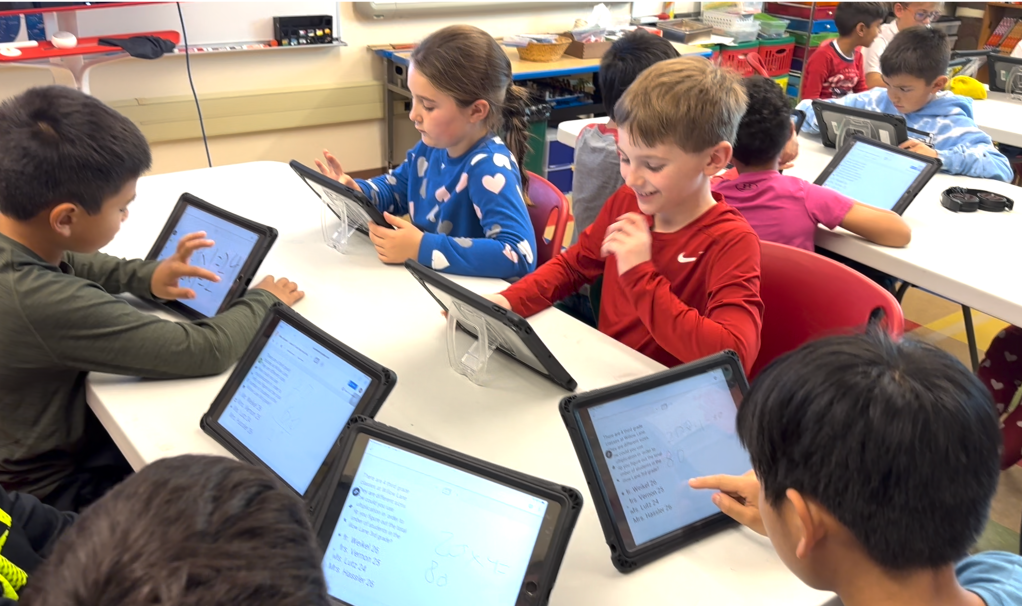
Finally, it was time for the students to do their work. “Dig in!” I had put the word problem into a Google Jamboard, so I could make a copy for each student in the Google classroom that I’d shared with the enrichment students. They were able to write on the Jamboard, using their iPads. I walked around and witnessed the digging. It was awesome to see the variety of computations. When students told me that they were done, I showed them how to duplicate the Jamboard slide, erase their math, leaving the word problem, so that they had a new work space to solve the problem in a new way. 

After letting the students wrestle with the word problem for several minutes, I had students share their calculations. One student multiplied the totals of class sizes by 1 before adding them all together. “Does this meet the parameters of the problem?” I asked the class. Yes. “Is this useful, though?” No. The student had only done this after I told them to come up with multiple ways to solve the problem. I was glad they had, because it was an opportunity to point out making math work for you. “Multiplication is a way to simplify math, believe it or not,” I told them. “Can you multiply 20 times 4 in your head?” Yes; see? I reviewed with the group that multiplying anything times 1 is the identification principle. It simply tells you what you are working with; “One times Dominic, means you have one Dominic” 😉

I had students share their Jamboards on the classroom Googlel Jamboard, so we could witness the different ways to use multiplication. I was impressed by a few students breaking apart bigger numbers before multiplying. Only a couple of students recognized the closeness of the class sizes to the number 25. This presented a teachable moment, and I shared the vocabulary/math concept of compatible numbers

After this, our time was up. I mentioned that time, like money, presents some compatible numbers. “What is 4 times 15?” I asked the class. When no one answered immediately, I asked, “How many fifteens are in an hour?” They knew this to be four. “So… four 15s makes up one hour… ?” 

Sighs and “ah has” could be heard. “If you have a few numbers that are near fifteen, could you use fifteen as a compatible number for multiplication?” Hmmm… 

Average Salt Consumption: 5th Grade Math Enrichment

In the excitement of beginning a 5th grade math enrichment club I created a math problem that may have been a bit extreme. I wanted to use something from real life, make it challenging, and leave my students thinking. 

Photo by Castorly Stock on Pexels.com

The topic I settled on was sodium; specifically, our salt intake. What 5th grader can resist paying attention to a life and death lesson? They may have already heard about salt consumption severity, but if not, they will! This should make the lesson stick. (see “Explanation” of The Power of Contrast.) As it turned out, I was right. Not only did a few of the 5th graders understand the dangers of salt, but some knew that too much can negatively affect your blood pressure. 

In order to increase the cool-factor of the lesson, I explained the importance of salt in conducting electricity throughout your body. I did this by asking them which is more dangerous during a lightning storm, swimming in a chlorinated pool or a salt water pool. Salt is a much better conductor of electricity than regular, clean water. They were energized by this new information. (For a very easy to read article about salt’s necessary functions in our bodies, check out “Pass the Salt: Sodium’s Role in Nerve Signaling and Stress on Blood Vessels” by Abbey Bigler-Coyne. And, here is an awesome, short read about salt’s dangerous properties during lightning storms: “Ask the Physicists: Swimming in a Lightning Storm“)

I knew that the 5th graders had been working with decimals. I thought it would be fun to make a problem that had them wrestle with decimals in more than one way. We would average our salt intake. 

First, I did some research. According to the American Heart Association, humans would ideally consume 1,500 milligrams (or less) of salt per day. Written in decimal form, this translates to 1.15 g.

American foods are loaded with salt, and our favorites are the worst! For lack of time, I did not burden my math enrichment students with too much detail. They had no trouble understanding what foods are super salty. They mentioned French fries, hot dogs, and chicken fingers. Then, we discussed foods that didn’t seem salty, but definitely had some, like ice cream. 

This set me up for presenting my word problem: While the human body needs some salt (only around 500 mg), too much of it can be harmful. It is recommended to consume around ½ of a teaspoon or less per day. A half of a teaspoon of regular table salt measures about 1.15 grams. 

Some foods are notoriously more salty than others. In the interest of being healthy, one might try to consume less salt on days surrounding heavy intake periods. 

Look at the data to the right. How many days will this person need to consume only 1 gram of salt in order to bring their average down to 1.15 grams per day?

How It Works

Before going over the problems with my 5th grade math enrichment students, I taught what it means to find the average of a few numbers. I pretended that the students had taken a quiz, and I wrote some fake scores on the board. What was the average score? It isn’t necessarily the middle of the range (distance from smallest to greatest). I had written 10, 8, 5, 6, 8, 4, 0. (They insisted that someone get a zero; Rude! I suggested that the zero was probably due to the person failing to put their name on the quiz, and couldn’t get any credit;) 

There were two 8s. That might pull the average up. “You use an algorithm to find the average, and it can adjust,” I explained. I showed them how you add all of the numbers together, and then divide by the number of scores. “There’s more than one 8, so that should cause the average to weigh heavier on the higher end of scores. But, then the zero is going to drag the average down.” 

“It is like tug of war,” I explained. “The higher the scores, the more the rope gets pulled in that direction. If there are more low scores, the rope begins to go to that side.” 

We played with the numbers, changing them a few times. I showed how, when you raise a few grades, the average goes up. I had students make predictions. 

Next, I showed the 5th grade math enrichment team our word problem for the day. I read it to them, and then asked them our Ready Math questions that help us understand word problems:

  1. What is this problem about? A. Salt; Adjusting the average consumption.
  2. What are we asked to find? A. The number of days necessary to significantly decrease our average amount of salt consumption.
  3. What is the important information? A. The amounts of salt we consumed over the weekend, our goal, and the amount of salt we will allow ourselves to eat until we reach our average goal.
  4. And finally, what are you going to do? A. Continue figuring out the average of the three weekend amounts, combined with ones (1 gram per day) until you reach an average < 1.15 g.

They understood the story of the problem. We ate way too much salt over the weekend. Now, we feel the need to eat extra healthy to make up for it. 

I walked the class through one or two tries: “If you consume only one gram of salt during the day after the weekend, what happens to the average?” We added up the number of grams, and then divided by the four days in question. 9.61 ÷ 4 = 2.40, still too high.

I had placed the word problem in a Jamboard. When I pushed the lesson out to my 5th graders via their new 5th Grade Math Enrichment Google classroom, I made a copy for each. I let them wrestle with the numbers on their own for a few minutes. I showed them how you can “duplicate” a slide in Jamboard, so that all of the important numbers and word problem get carried over to another clean workspace. I wanted them to try the math a few times, showing me their work. 

I caught a few of them trying to average the three days of the weekend. I told them that this was unnecessary, because we already know that every single day of the weekend was way over our end goal of 1.15 g! “You can go ahead and practice averaging, but this won’t get you to our goal: Finding the day we don’t have to limit our salt intake to only 1 gram.” 

After a while, I wrote the weekend numbers on the dry erase board: 2.56, 3.08, and 2.97. Then I said, “What if you eat only one gram of salt for the next ten days?” I drew ten ones next to the first three numbers. “In order to find the average, you first add all of the numbers together.” I drew plus symbols between every number. “Next, you divide by the number of weights.” I walked them through dividing 18.61 by 13. “The average intake would be 1.43 grams per day. This is still too high, so we have to continue eating only one gram per day a little longer.”

We hadn’t found the answer by the end of our time together, but that was okay. This time of math enrichment was meant to provide teaching that they can bring back to class and use on their own during independent work time. I had hoped that some of the students would continue working on their salt word problem throughout the week, when they finish their other work. 

A few students seemed excited about finding the accurate number of days as they left the classroom. They told me their tries and expressed surprise at not finding the answer yet. I told them to keep going. It was out there!

I found out later that a few students expressed to their math teacher that the problem was a little too hard. This inspired me to include the next part of this blog; The explanation. 

I chose 1 gram to be the new amount that the person consumes each day because you could eliminate one of the steps from the algorithm for solving averages, if you used increments of ten days. More than erase the step, you do it mentally. We already did ten days in class. That wasn’t low enough. Next, try 20 days. If you remember that the three days from the weekend is 8.61 g, all you have to do is stick a two in front of it! Then put a two in the tens place of the number you are dividing by; 23 (twenty more days + the three weekend days). At this point, it would be best to use a calculator to figure out the long division. (I never said that you couldn’t. I modeled using long division, but once you leave the classroom… 😉 Just show your work!! Write down what you did. Document each try, the answer you got, what you did. Be a scientist about it. 

Once you find between what two tens your answer falls, you can begin narrowing your work further. 28.61 ÷ 23 = 1.24 (twenty days of 1 gram of salt per day); 38.61 ÷ 33 = 1.17 average grams of salt per day; close, but not there yet; 48.61 ÷ 43 = 1.13 We made it! …But, we only ate one gram of salt for more days than necessary. We overshot our goal. In order to figure out the exact day, we could go back one or two days at a time. Maybe try the middle; 35 days. 

One student messaged me within the 5th Grade Math Enrichment Google classroom, seeking clarification. She had taken notes on my example of ten days, and couldn’t remember why we added the ten to 8.61. I messaged her back, and a couple of days later, she had it! This student not only figured out the answer, but showed me all of her work. It is beautiful and impressive. 

In addition to this incredible success, however, I am pleased to share that some of the students were still mentioning the problem to me in the hall, days later. A student whom I see riding his bike when I monitor the crosswalk in the mornings queried if anyone had solved the problem, and we talked about possible solutions. I told him that it was more than 30 days. He couldn’t believe it. 

Congratulations to this amazing student! She did it. Great job!

The Power of Contrast

You take a photo. They never capture what you see! You want others to identify something in the photo, so you try to edit it. The subject in the photo is dark, so you lighten the image. This makes the whole thing brighter. It is still difficult to make out the significant features that separate your subject from others. 

Contrast 

“Contrast in photography is the visual ratio of different tones in an image. This difference is what creates the textures, highlights, shadows, colors and clarity in a photograph” (Shramenko, 2017). Contrast is what sharpens the features. When you increase the contrast, you make lines darker and lighten the spaces around them. They stand out more. 

Contrast “means more than just a play of light and shadows. It’s the difference between the tones, colors, and textures of a photo. This technique can convey interesting and deep stories in the frame in the best way” (Shramenko, 2017).

Contrast is found in literature, as well. It’s what gives stories their life. It’s the spark that animates Doctor Frankenstein’s assembly of dead flesh, and turns it into a monster. Contrast energizes narrative. The dryness of Oklahoma, contrasted with the imagined juicy grapes of California, spurs the Joads to sell nearly everything and hit the road. Contrast shows action. It identifies what to pay attention to. There are many things happening in any given text, but the friction between two opposites will heat-up a story. The conflict between light and dark, colorful and colorless, strong and weak, dull and exciting, good and evil, rich and poor commands attention! (Literary Devices, 2013)

I’ve been reading a smart and funny book with my fifth grade gifted students; “The Strange Case of Origami Yoda” (Angleberger, 2010). In it, a seemingly half-witted 6th grade boy provides what usually turns out to be incredibly wise advice, albeit through a weird, hand-made finger puppet and silly voice. The boy’s name is Dwight. His finger puppet is Origami Yoda.

5th Graders apply their origami skills to napkin-folding.

In addition to learning some of our own origami, I had my students research the history of the ancient art form. I didn’t know this before, but the art of paper folding used to be limited to the wealthy, due to the high price of washi (origami) paper (Georgia Tech, n.d.). It was used in religious rituals and formal ceremonies. Eventually, as paper became more affordable, origami became an increasingly available activity. Still, people needed the time, intellect, and patience to learn the art. 

This got me thinking about Dwight and his origami finger puppet. At the beginning of the story, it is explained that Dwight made up his Yoda origami on his own. He took one of the most common materials from the school setting and turned it into something extraordinary. No one else in the text produces any artwork, let alone origami! And, Dwight doesn’t stop with a paper figure; He places it on his finger and gives it life. 

Dwight is the opposite of popular, but through Origami Yoda he is extremely influential, and therefore powerful. Many students who wouldn’t give Dwight the time of day want to talk to Origami Yoda. They present questions and respect Yoda’s answers. The same characters look down on Dwight as king dweeb. 

Toward the end of the book, an adversarial character (Harvey) makes his own Origami Yoda. In contrast to Dwight’s, Harvey’s is well-made. That is because Harvey, unlike Dwight, looked up professional directions online. Supposedly, Harvey’s imitation of Yoda’s voice, from the Starwars movies, is a better imitation, too. But, Dwight’s Yoda is truer to the spirit of Yoda. Dwight’s Yoda uses the force… the force of creativity and originality. Harvey’s is more closely related to the clone-like, clean, black and white storm troopers from the movie series than the swampy, wrinkly, green, old creature of the planet Dagobah! 

In addition to this obvious contrast between two characters and their crafts, there lies several more subtle contrasts. Harvey constantly pushes his opinions onto everyone else, whereas Dwight has people approach him, imploring his. Dwight does not seem to try to get others to believe in his Yoda. Harvey needs to kill everyone’s belief in the finger puppet. While Harvey narcissistically uses his Yoda to hurt Dwight, the true Origami Yoda is primarily concerned with helping people. Harvey freely admits to giving his origami voice, but Dwight pretends that it isn’t him talking; Origami Yoda is a separate entity from the person whose finger he rests. The differences go on and on! 

As I reflected on all of the subtle and overt contrasts within the story, the idea of origami being a pastime of the wealthy contrasting with Dwight’s social poverty hit me. I thought about contrasting elements of everyday life. Why are holidays special? They are “holy days,” set apart from others. They are only as special as we make them. For some, all we do is acknowledge that it is a special day; Flag Day. Others demand time off, arts and crafts, and even parades! A meal is made special when we cook food we normally wouldn’t, or too much food, or invite special guests to share it with us. Do you use unique dinnerware to serve the food? (As I write this, Thanksgiving is right around the corner!) 

When I was in college, I worked at a fine-dining restaurant. Among other things, we folded white cloth napkins into fans for every place setting. When patrons left the table, we would replace napkins with folded, clean cloths. It was that kind of establishment. 

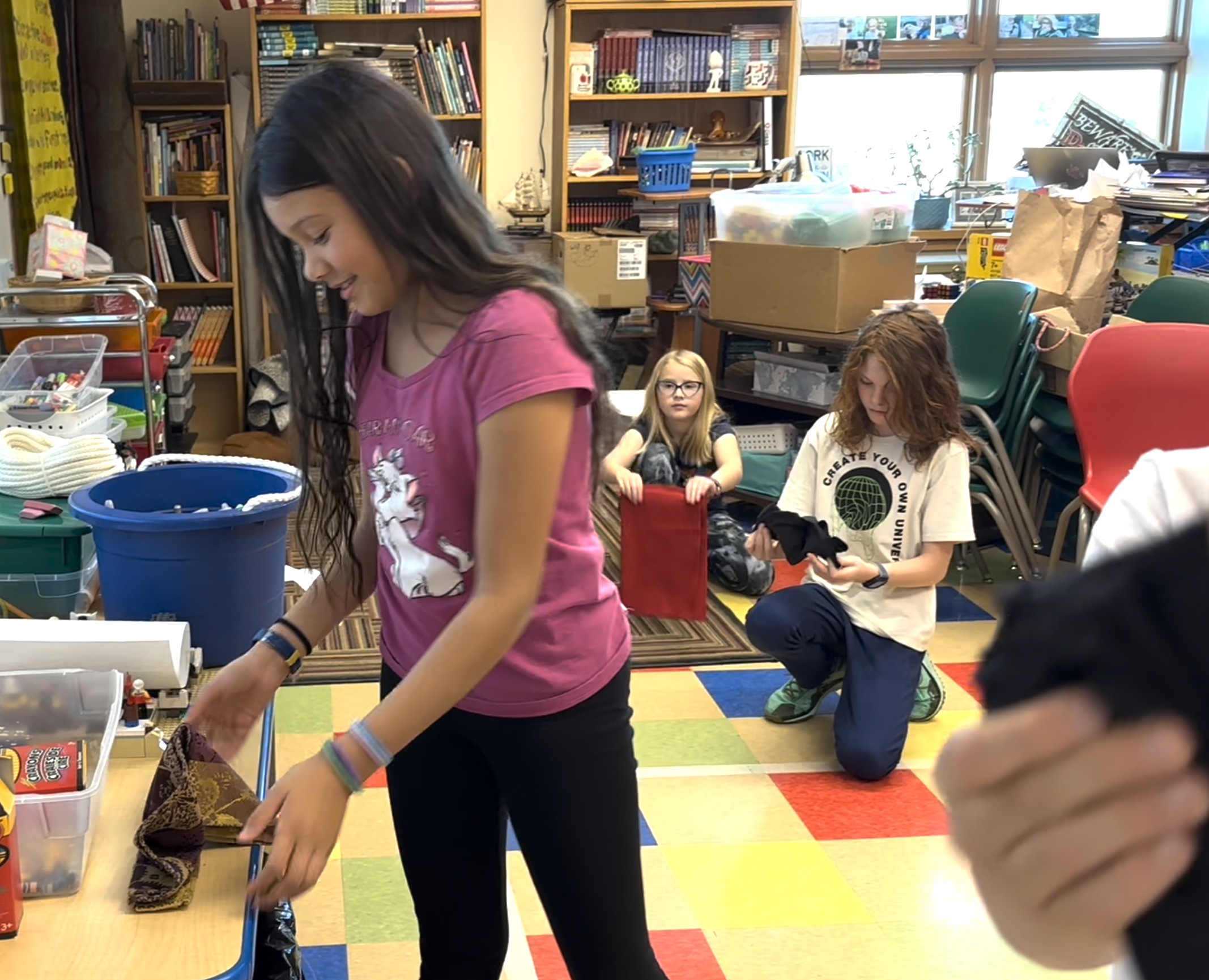
I was remembering this art of napkin folding while researching origami. I brought some cloth napkins into the classroom to show students how to fold them into fans, so that they could dress up their next holiday meal. 

As I folded the napkins to display on a cheap, plastic table for my students, it brought to mind a picnic lunch in a park. What makes that kind of activity so romantic? It is the contrast between eating a well-prepared meal, complete with plates, silverware, folded napkins, and drinks on the ground with nothing but a blanket shielding you from dirt, insects, and nature. The meal is out of place. You are bringing two otherwise foreign entities together. That is romantic. The greater the contrast between the elements, the more romantic. 

Explanation

When you are attempting to bond two surfaces together, it is often recommended that you rough up one of or both surfaces before applying adhesive. Why? This is because when you “unsmooth” a surface, you provide more surface space for the adhesive to attach. You may not be able to see them, but tiny ridges are produced all over the surface; microscopic mountains and valleys that almost double how much area there is for the bonding agent to grab onto. 

This is a metaphor for what happens when authors create contrast between their characters, settings, conflicts, eras, etc. By roughing up the character with differing, even exaggerated traits, appearance, name, hobbies/interests, the author helps the character stick in the reader’s mind. It deepens the essence of the character. The more contrast, the more powerful this bond becomes. 

Warning

Of course, you must make sure that there are enough common elements for a reader to cognitively grab onto. If you rough up a surface to the point that the thing you are gluing has been sanded away, there won’t be any point in gluing. Likewise, if you make your character or setting so different that no one can even imagine it; as in it does not have enough things in common with what readers are familiar with; they can’t mentally grab hold of the idea. It will slip through their cognitive fingers and be lost. Provide enough connections to real life; experienced life; but cut deep lines where the character looks different from everyone else in one or two features, walks with a limp, smells like formaldehyde, snaps his fingers constantly, greets every single person with a high five, wears flip flops even in the snow, has an affinity for bugs, and so on. 

The napkin folding that I brought to the classroom was connected to origami in that it was folding, and it produced a work of art. The folded napkin is unnecessary. And, you are more likely to see it in a fancy place. It was different from origami in that the napkins do not hold their shape the way paper does. But, because of this you can easily fold and refold the napkin without a crease affecting it. Paper is plentiful, but a cloth napkin is more rare. There is a balance between contrast and familiarity.

Students ought to remember the napkin-folding experience (it will stick) because it was similar to creating origami, and it will be extra memorable (the bond will be stronger) because folding napkins during school was a weird activity. 

Dear Students,

And now, having read this lengthy explanation for why I brought cloth napkins to school and taught you how to fold them into fancy fans for food decor, I hope I have provided the adhesive that will make this activity not only stick in your mind, but become useful as a tool for teaching the power of contrast. Good luck creating just the right amount of it in your writing.   

Sources

Angleberger, T. (2010). The strange case of Origami Yoda . Amulet Books.

Georgia Tech. (n.d.). Kinetic Joy: Basic Principles of Paper Engineering. Robert C. Williams Museum of Papermaking. https://paper.gatech.edu/kinetic-joy/history-origami  

Literary Devices. (2013). Contrast. Retrieved November 16, 2023, from https://literarydevices.net/contrast/ 

Shramenko, S. (2017, May 29). Understanding Contrast in Photography. Skylum. https://skylum.com/blog/understanding-contrast-in-photography

Influence is Power

My daughter Scarlet is almost 12 years old. She’s a “Tween.” For a while I’ve been wrestling with knowing when to let her make her own decisions, versus my telling her what to do. I’ve noticed that the more Scarlet has a say over what is happening, the more motivated she seems to be when completing a task or participating in an activity. We see this in our classrooms everyday. Teachers give their students tasks to choose from. Our goal is for them to work independently.

Children feel powerless, and this feeling may cause them to act out.

Is independence synonymous with autonomy? Scarlet and I explored the definition of autonomy with sidewalk chalk. It means “Self-governance.” This is quite different from simply “working by yourself,” independently. Do teachers strive to empower students to govern themselves, or are we simply trying to get them to work quietly?

What is power? Are power and control synonymous? 

I’ve been mulling over the idea of power for a long time. I’ve read several books on the subject. I’ve discussed it with Scarlet. We read a book for kids together. Power is a subject that is explored, lost, earned, used and abused in every story, book, movie, play, and poem. I want Scarlet to feel and be independent; I want her to feel powerful. What does that mean? Am I saying that I want her to have a lot of power? What is power?

One of my favorite activities to share with Scarlet is read alouds. My fondest memory with my late mom was her reading to me. She read classics like “A  Wrinkle in Time” during long car rides, and we labored over the vocabulary in “Swiss Family Robinson,” sitting in bed at night. Is this a novel or a botany book? I remember wondering! We gritted through it, and the experience bonded our relationship and a love of reading.

Scarlet is reading on her own now. She is becoming autonomous. Have I lost power over her? Does it just shift?

I’m proud to continue this family tradition with my daughter. The other day Scarlet and I finished reading a book together. If I were to say, “What do you want to read next?” I would be putting power in Scarlet’s hands. I’d be empowering her. She knows that we are not going to read any ole’ book that she suggests, however.

There are limits; Parameters. If she were to say, “Let’s watch Sponge Bob Square Pants,” I could point out the fact that I asked what we were to “read” next, not “watch” next. Her decision must fall within the parameters of text. Am I being controlling by fencing in her choices?

Could she choose a graphic novel? Yes. There is a lot of text in most graphic novels. Some argue that you read the pictures, and illustrations tell their own story. Could she choose a book that was far below her reading level for us to read together? Yes, as long as it contains text, and even some books with only pictures could be considered “readable.” However, just as I would guide Scarlet away from choosing a book that was too difficult to understand or one that had grownup situations in the plot, I’d steer our read-aloud away from texts that were too simple, also. 

The term steering, providing guidance through suggestions, makes me think of the word “influence.” This term originates in medieval latin influentia which means “flow into” (2020). When you are causing thoughts and decisions to flow in a particular direction, you are influencing them; you’re being an influencer. Teachers do this all day long when they get conversations back on track. “Let’s return to the topic at hand…” a teacher suggests. They just put up a barrier, prohibiting the stream of students’ thoughts from meandering in other directions.

The more influential you are, the more powerful you are. Having the ability to move people’s thinking is powerful. I think we can all agree that a  person with the authority to command others to stop an action or require them to do something is a person of power. Can an influential person have more power than a person in a position of authority? On the flip side of that coin, can an authority figure “un-influence”? 

Going back to the concept of influence controlling the flow of water, what is more powerful, a pressure-washer whose motor pushes water at 3,500 pounds per square inch, or gravity? The pressure washer not only creates an astounding force behind the water it pushes, but there is a wand that has a trigger, so the water can be turned on or off. Is the pressure washer influencing the water?

That might sound like a silly question, but when you apply the analogy to “influencers,” and imagine a person wielding information, you can see that influence can be very forceful. Social media companies have built almost literal engines that limit and force users to view information (posts) tailored for them. “On social media platforms, algorithms are mainly designed to amplify information that sustains engagement ” (Brady, 2023).

In the same way water dripping on the same surface over and over for hundreds and thousands of years will affect a hole right through even the hardest rock, people cannot withstand constant influencing on a specific subject forever. And then, put the power of the media and other influential sources behind those ideas, and you’ve got yourself a pressure washer of information!

A term that has been popularized in recent years is saying an idea has been “weaponized.” This means that someone is using a concept; usually one that would typically be benign; in a negative way against someone else. They have turned what would be a gentle drip of an idea into a harmful stream of thought. “This is sometimes referred to as cognitive hacking” (Wigmore, 2017). You could try to shield yourself from the onslaught of weaponized influence, but you might need to simply remove yourself from the strong stream of information, if it is too overwhelming. If you find yourself drowning in a river of ideas that are too deep and wide to navigate, get yourself a raft, climb out, and find a shore, even a hill to climb up. 

Some people put a lot of effort, money, time, and resources into diverting, changing, and even hiding information, so that their audience does not get influenced by it. These people are wielding power over others’ thoughts in a way that has been termed gaslighting. This nefarious behavior is hard to spot yourself. It usually requires someone observing it happening to a victim. Basically, if someone is trying to convince you of something that you know to be false, or they seem to be working at discrediting your system of judgment, generally, they may be attempting to gaslight you. Get help. Explain to people outside of your situation what is happening. Find people who will support your personal mental autonomy. 

My good friend, the late Julia Dweck, was an extremely influential person in my life. What gave her so much power?

Controlling the thoughts of others, or a more subtle and polite way of putting it might be “influencing others’ opinions,” is only one form of power. This might seem like a dark subject, but if you are not thinking about power, others will lord it over you. Do not be vacuous. Also, water may be clear, but if you get enough of it in the same place, it can block out the sun. Those same ominous rain clouds might save your life if you are a farmer experiencing a drought or firefighter looking for help battling a wildfire. Context matters. Who you allow to influence you, and how much you allow them matters.

A person who influenced my teaching and thinking a lot was Julia Dweck, the gifted teacher from my school. She and I shared opinions, teaching styles, likes and interests. If Julia recommended a book, I would be more likely to read it than if someone else did. One that of the books that Julia suggested I read was “Circus Mirandus” by Cassey Beasley. This book explores the theme of influence as power more clearly than most. It has an illusionist who alters characters’ perceptions. And then, there is another character who is bent on accumulating and abusing immense power over others (birds and people) through both magic and persuasion. Autonomy gone bad. It is very thought-provoking.

I plan to write a few blogs exploring power; What it is, how it is used rightly and wrongly, how to help those around you have it (empower), and how to protect (shield) oneself from those who are using theirs against you. I hope you join me on this journey of thought. 

Sources:

Brady, W. (2023). Social Media Algorithms Warp How People Learn from Each Other. Scientific American . https://www.scientificamerican.com/article/social-media-algorithms-warp-how-people-learn-from-each-other/

influence. Online Etymology Dictionary. (2020, April 2). Retrieved August 12, 2022, from https://www.etymonline.com/word/influence

Wigmore, I. (2017). Weaponized Information. Eye on Tech; Tech Target. https://www.techtarget.com/whatis/definition/weaponized-information  

Math With Chess

“How many more squares is White attacking than Black?”

This problem was awesome on a few fronts. Students had deciphered a Morse code message that shared a short sequence of chess moves written in algebraic notation. They played out those moves and discovered that one player had a huge advantage over the other. “How much of an advantage? Be specific. Can you put a numeric value to the advantage?” 

It all began with my preparing a lesson for chess club. I was going to teach club members about gambits. I researched the more common gambits and landed on the Smith Morra Gambit. I found a succinct video on Youtube that explained the gambit. While watching the video, I wrote down the algebraic notation. 

But, I wouldn’t just give them the chess code to learn the gambit; I decided to have my gifted students decode the code! My fifth grade gifted students were the first ones to see the code. They had only dabbled with decoding Morse messages. 

I had used Morse Code Translator to change the chess play sequence into dots and dashes. Rather than writing the number of the move; This was going to be confusing enough as it was; I decided to change the colors of the moves. White’s moves were turned to white dashes and dots. I made the background of the text box green, so that you could easily see the white and black codes. I put an image of my code, along with the Morse Code alphabet and accompanying numbers onto a Google Jamboard. The fifth grade gifted students were on it the moment they walked through the door. 

The two things that I shared with the fifth graders was that the slanted line (/) separates the words; In this case it broke up the moves, but I did not explain that. I told them nothing about the actual message. The second thing that I pointed out was where each letter or number’s code ended. The translator that I use makes it much easier and faster to produce Morse Code, but sometimes it is difficult to locate the space between each letter/number. After pointing out these two key factors, I stepped back and watched the struggle. 

Right away I heard a couple students divvy up the White and Black “words.” I was glad to hear the idea of collaboration. I wondered how long it would take for someone to understand that these were not actually words. The very first coded move was e4, the most popular opening move in all of chess. I heard a few people verbalize bafflement, but several recognized the move, “It’s chess!” someone shouted. 

I didn’t help them with any of it. At least one student knew enough to be able to read most of the algebraic notation and make sense of the moves. Of course I had a chess board and pieces handy, and we set up a game. I let the students figure out the sequence of play. When they came to the gambit on the second White move, I stopped them to explain what a gambit was. This was good practice for my chess club lesson that afternoon. A couple kids would get a double lesson, but that was okay. They could be my co-teachers! 

“The word gambit is closely related to gamble. It means taking a risk. A chess gambit happens when one player offers up a peace as a sacrifice in order to draw an opponent into a trap or sequence of moves that would benefit the aggressor (the one offering the gambit). Do you capture the sacrifice or risk the piece taking your own?” 

I had the fifth graders play through the short sequence until Black’s pawn was captured. Black had accepted the gambit, capturing the initial White pawn placed on d4. White offered up another pawn on c3. When Black captured that, White might feel a little on edge, because now there is a Black piece threatening the second rank of the White team! It is so close to attacking the Queen!! 

Before any more damage can be done, White captures with the Queen-side Knight, Nxc3. White has lost two pawns, while Black is only down one. If you were to only count points, it would appear that Black has the advantage, being up a point. A mere glance at the board should show even a novice player that White is in a much better position!

I explained to the fifth grade gifted students that the best thing to do at the beginning of a game of chess is to control the middle of the board. With that criteria, everyone can easily see the trap that Black has fallen into. There is a White pawn left sitting on the initial e4 square. And, now a Knight is “developed,” backing up the e4 pawn and attacking four more squares (b5 and d5 as well as a4 and e2).

The fifth grade lesson stopped there, but my fourth grade gifted students got a treat. It only took seconds for them to figure out that the Morse Code message was algebraic notation for a chess game. When I heard some groans, I told them, “The first to solve the riddle can play me in a game of chess.” Now, the heat was on. I set the board back up in the middle of a table while my students grappled over letters and numbers seemingly unrelated to one another. 

We worked through the Smith Morra Gambit sequence the same way I had with fifth graders. I had the fourth graders figure out the algebraic messaging. They figured out that the Xs meant a piece had been captured. I had to explain that the “d” in dxc3 meant that the capturing pawn had come from the d file. After explaining gambits and discussing the advantages and disadvantages of the board we were left with, I played a blitz round of chess against a pair of students.

Third grade was next, and these students are not only classy, but they are some of the hardest workers I’ve witnessed. Their grit knows no end. I presented them with the same problem. They labored through decoding my Morse Code message. We played the sequence out. I taught them what a gambit was, and we discovered the significant advantage that White was left with. But… Then I was hit with a question that I liked so much that I recorded it on video so that I would remember it: “We know that White has the advantage, but how much of an advantage? Can we put a number to it? How many more squares is White attacking than Black?” 

Not all of my third graders know how to play chess. I taught the team how each piece attacks. “How many squares is the King attacking?” I asked. I showed them how it moves. The answer was two squares. “How many squares are the Bishops attacking?” We looked at their lines of attack. I showed them the squares that the Queen attacked, including the Black pawn on d7. We went over how a pawn attacks diagonally and the way a  Knight moves. Then I set them loose.

A few floundered, so I guided them to make a T chart. “Let’s do one color at a time,” I suggested. “Also, how about we focus on only one piece?” We carefully counted all of the squares that the Black pawns were attacking (12). Then we counted up the Knights’ attacks (4).

Next we moved on to White. There was an empty square next to the White Rook, so that counted as an attacked square. We continued counting until we covered every piece. I missed a couple of the the Knight’s attacks, but Gray got my back. She caught my mistake, and we corrected the calculation.

In the end, we discovered that White was attacking 43 squares to Black’s 16, way more than twice as many! So, was the gambit worth it? I’d say so. And, what could Black do differently to limit the massive advantage? Don’t fall for it. Don’t take the gambit. Push forward or ignore, but definitely think ahead.

Worm Burning: A Mental Math Game

John Burger, second grade teacher extraordinaire (2012)

When I first began teaching, I had a mentor who was amazing. He taught second grade, and it was a calling more than a career. His name was John Burger. Rather than do Social Emotional Learning (SEL) lessons, he was SEL. Everything he taught had emotional and social lessons woven throughout it. Like myself, education was a second career for John. He had been an engineer before becoming a primary school teacher. More than the money, he was doing this because he believed in it.

In addition to John’s unique way of teaching, he used some teaching tools that I liked so much that I adapted them into my own repertoire. One was readers theaters. I have shared a few blogs about those in the past. Another was mental math games

The mental math games were designed to make math fun and exciting. They are a great tool to use on the fly, because students don’t use paper or pencils. They should do it all in their head. Some of the games require critical thinking. Some rely on short-term memory and problem-solving. Others practice rote memory math facts. 

One of my favorites comes with a story. John liked baseball, and each year, when he introduced this game to his second graders, he would tell them, “When a baseball is hit really hard, and instead of it going up into the air, it is a line drive, straight over the grass… If a worm were to stick his head up out of his hole just at that moment, it would get its head burned by that cruising missile of a baseball! This is called worm burning.” There would be all kinds of gasps as kids pictured a worm being scalped by a wizzing baseball. Then, in his soft, understanding style of sharing, John would explain how the game works. “I’m going to say a bunch of numbers, and I will tell you what to do with them in between. You have to try your best to keep up. I’ll go slow in the beginning, but then I will begin to speed things up. When I stop, you tell me the answer that’s in your head.”

“You have to keep the answer at the front of your brain.” Sometimes I lose it and have to stop.

The mental math game is fast. The teacher will use single digit numbers and a variety of operations, keeping track of the answer until the worm burner has run its course. When the teacher stops saying numbers and operations, students have to raise their hands with whatever answer they are left with. I have my students show me their answers with fingers; They raise the number of fingers that they think is the answer. The teacher (or student; I’ll have kids try it when they get good at it) who is sharing the math must keep the final answer under 10. 

I often teach students this game at the beginning of the year and use it during whole-group bathroom breaks or times I need to keep students quiet. We get really excited when we know the answer and/or get it right, so it is hard to be completely silent. I remind students that they ought to only raise the accurate number of fingers. I praise students who do this well. 

You change up the difficulty of the digits and speed by which you say them to adjust so that more students can participate. The students who are more fluent with their facts are affirmed as math whizzes, and that’s just the way it is. “Good for them. The rest of you can study and memorize your facts just the same.” I have witnessed students work on learning their facts and gradually move up the ranks in Worm Burning, until they became competitive with the best of the burners.

I usually try to do a few that everyone and anyone can get. You can weave in a couple of tricks, like multiplying the whole thing by zero. Then everyone gets in on the answer. It gets everyone to at least pay attention and listen. Also, the Polite Pirates perk right up when they hear me say, “subtract 99 or 98” because they know the going answer before that was probably 100, and we are back to only 1 or 2, respectfully. I’ve had lost souls jump back into the game at that point. It’s fun to see them grab ahold of confidence as they celebrate success.

Sometimes, but not always, I will go back and walk the class through the Worm Burn. I’ll demonstrate keeping the answer right there at the front of your mind. Often, the Worm Burn is so fast or long that I can’t remember all of the steps. The successful students are usually proud to help me remember, though.

Math Enrichment

Photo by Pixabay on Pexels.com

Later on in the year I will introduce larger numbers that can be tricky. For example, I will have students multiply 25 by 4. “I don’t know that!” they’ll cry out. 

“How many quarters are in a dollar?” I’ll ask them. 

“Oh…” They get it, and then I will do a bunch of worm burners incorporating twenty-fives. 

Photo by EVG Kowalievska on Pexels.com

Another number I’ll throw in at some point is fifteen. “Three fifteens is the same thing as three quarters past the hour. How many minutes is that?” I’ll explain after stumping my students. Sometimes I’ll use alternative words like “dozen” or “double that” to keep things interesting.

By the end of third grade I would be throwing fractions into the mix. It’s a great way to cement the understanding of denominators dividing numerators. I will get the Worm Burn to the number 24, and then say, “What is a third of that?” Or, maybe I’ll start off with “Three fifths of fifteen (9), plus three quarters of four (3), divided by six…” and so on. Pause just enough so some students can get it, but not so much that others blurt out the answer. And, don’t make it so hard that no one gets it!

Gifted

This year I have transitioned from being strictly a third grade teacher to the gifted support teacher for kindergarten through fifth grade of my school. I was sharing the game of Worm Burning with my third grade gifted students, when I saw an opportunity to bring the math to the next level… and then some.

I never write the Worm Burn on the board. But I foresaw a unique teaching opportunity here.

I told my third graders about a trick that I often use in order to keep the numbers straight and maintain a going answer in my mind; I will use the answer in the next operation. For example, “Two times three, plus six…” I added the six to reinforce in my own mind that the product of two and three was six. I never write the Worm Burn on the board, but in going back to show this trick further, I wrote out the sequence of operations from a previous Worm Burn. This introduced the idea of squaring a number, which then lead to teaching exponents.

Then I thought about how different Worm Burning was from using Order of Operations. And, out comes PEMDAS! We were already talking about exponents!

I started out with a simple Worm Burn, “One plus three, divided by two, times seven, minus four, divided by five, plus one…” The answer is three. I wrote the burn on a Google Jamboard and showed the sequence of math. Then I told my students that if I were to do this math properly, the answer would be completely different. They were intrigued. “What do you mean, properly?” they wondered. I wrote the acronym PEMDAS on the board.

When we followed the rules for order of operations, our answer was much more complicated. With the help of Siri, we were able to divide numbers that didn’t have obvious answers. How do you divide three by fourteen? Is that even possible? Well, if you have three boxes of cereal, can fourteen people have some? How much of all of the cereal would each person get? Ask Siri.

The final answer came out to -.5858, which was really weird. They were unfamiliar with decimal points, let alone negatives. It was an eye-opening adventure.

From Worm Burning to diving down a rabbit hole of increasingly complex math concepts, my gifted third graders were happy to transition to reading about everyone’s favorite vampire rabbit, “Bunnicula,” and take a break from arithmetic.