
What if you could produce a dessert packed with protein and healthy nutrients; I’m talking even more beneficial than a typical meal. Would you serve this delectable dish for dinner every day? My conclusion may surprise you.
Last week was Parent-Teacher-conference-week at my school. Students had half-days, and families either visited the building or used virtual conferencing tools to converse face to face with educators. This was the very first time that I bounced around from teacher to teacher, visiting the conferences of my gifted students’ parents. While there are many ideas that I could comment on, the one that stands out most was from the parent of one of my math enrichment students.
The family has a third grader who is gifted, and that is why I was attending the conference. But, his little sister, who is in first grade, attends my math enrichment lessons, and it was something that she said that got me thinking. Her parents told me that they asked their daughter what she did in math enrichment class, and she told them, “We play games.”
“Is that all?” I imagine them pressing, being the good communicative parents they are. Yup, is the first-grade answer:)
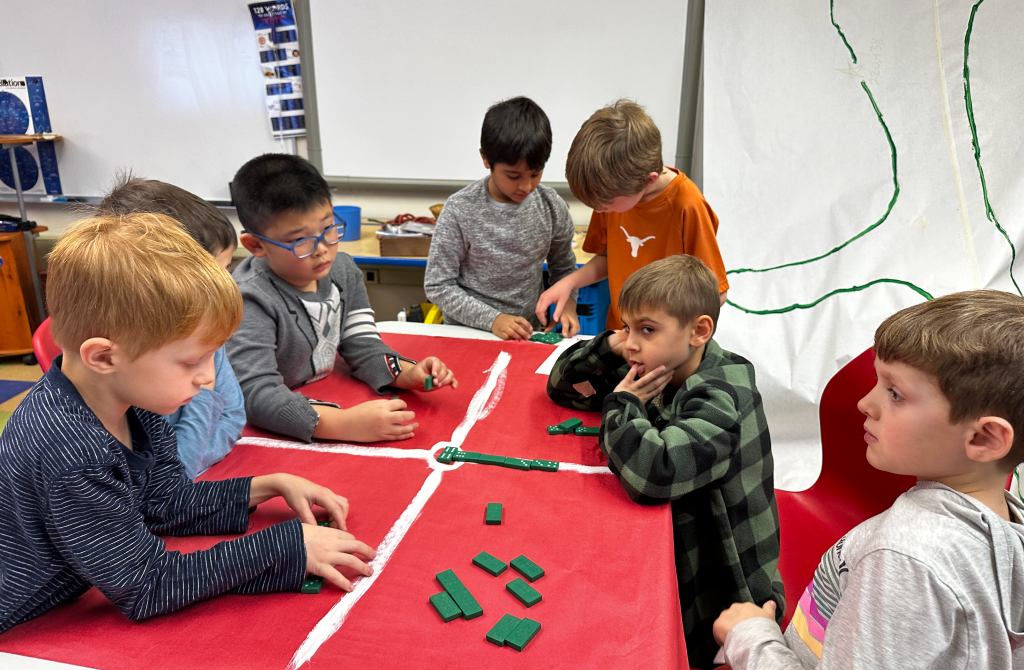
I laughed when I heard their tale. I explained to the parents that I was teaching the first graders Dominos. After defending the fact that there is a lot of mental math and problem-solving, there was some light banter between parents and the regular ed teacher about only knowing the stacking and tumbling side of Dominos.
Because their gifted third grader had already experienced lessons showing the critical thinking development of Dominos, it wasn’t necessary to get too defensive. They were “on board” with my use of games for strengthening math skills. But, the idea of my lessons being categorized definitively as nothing more than games gave me pause. Initially, I was perfectly okay with tricking students into learning through having fun. What teacher would turn down that strategy? “Can we have some more math enrichment, please!” the students whine. “Um… Yes!” every math teacher in the world would utter.
Then I thought about the idea of turning everything into a game. Wouldn’t that be wonderful for the students? But, would it be healthy? Hmm…
This is where the thought experiment at the top of this blog originated. I was musing over my math lessons being perceived as games, and I dreamed up the analogy of only eating dessert. Prepare to enter a rabbit hole of research. I’ll try to keep it palatable😉
History of Dessert
Asking “Why does dessert even exist?” feels a little like questioning the purpose of gold or jewels. Isn’t it obvious? It’s awesome!
Believe it or not, dessert did not always exist, however. Similarly to gold and jewelry, it was discovered, and has evolved over time. The French are responsible for turning entremets into dessert (Gerson, 2019). Before there were sweets to end a meal, entremets were served as “interval” dishes, literally “between-foods” courses (Teppen, 2015). They were meant to cleanse the palate. They may be sweet, but not necessarily.
Eventually, a final course of fruit, called le fruit, was formalized (Gerson, 2019). Only, before serving it, the table must be completely cleared. This cleaning of the table was called desservir, the French verb for “to clear.” More than tasting wonderful, the original final course of fruit developed into something lovely to gaze upon. Some desserts even consisted of “Elegant metal and glass structures holding whole apples or plums. Other times, meticulously crafted sugar figures became the center of dessert displays, and might not be eaten at all. Dessert specialists in the eighteenth century were supposed to understand architectural design and be capable of replicating it in sugar paste” (Gerson, 2019).
These creators of dessert, as it came to be known around the time of the French Revolution, when the Bourgeois assimilated the term, were originally more like artists than chefs. Maryann Teppen (2015) writes of an entire battle scene, complete with tiny sugary soldiers with guns and canons, that told the story of Louis XV’s demise crafted out of sugar. It is hard to imagine your dinner table being cleared; plates, napkins, silverware, and foods being “dessert-ed” away; only to be replaced by an elaborate, sugary scene of violence that you feast your eyes upon but don’t touch!
Modern dessert serves a different purpose. BreezeMaxWeb (2022) suggests it psychologically signals the end of eating. Consuming a small, sweet treat at the conclusion of a meal might communicate to the body and brain that we are all done, and there is no need to nibble superfluous snacks. The End.
A practice that I began a couple of years ago has helped me lose some weight and become more healthy; I will eat an apple at the end of every lunch. Many years ago I heard that apples help clean your teeth, and apparently there is some truth to that (Apples: Dental Hygiene Facts, 2017). Once I’ve eaten my apple, I cannot/will not eat anything else. I don’t want to undo my teeth cleansing. This has helped me de-snack my afternoons.
Let me reintroduce the concept of math games, here. Could a game be used to transition from one course of subject matter to another? Would playing a game cleanse the cognitive palate, and prepare students for something completely different? Of course! Would this be an appropriate way to signify we are done with the subject? I think so.
Delayed Gratification (Deferred Satisfaction)
How many parents use dessert as a reward for finishing a well-balanced meal? That treat is the ribbon at the end of a race. Some contests require more work and take longer, but when getting to the game of a lesson is the goal, students may trudge longer, work harder, and persist through all kinds of problems. Those students who finish first might learn patience through having to wait for their peers to catch up with them before the whole group can consume the dessert of a lesson together.
Self control. Training. Conditioning. “If I let you eat this piece of cake, do you promise to gobble up all of your peas and carrots without complaining?” doesn’t just sound silly. I probably don’t have to tell you that this is an ineffective reward model;)


But, what if the dessert is carrot cake? What if the dessert is healthier than the dinner? Then what? “Eat all of your cake, or you won’t be given any peas…” Wait, what?!
Is there something to be said for learning to crunch through cardboard in order to earn cake? According to a longitudinal study spanning 40 years (Casey et al., 2011), learning and practicing self control early on in life can lead to better academic performance, less behavior problems, and even higher SAT scores. Casey and company (2011) describe in their paper, “Behavioral and neural correlates of delay of gratification 40 years later,” some ways kids can curb the pull of stimuli by learning cognitive control. There are mental strategies and tricks that people can use to provide buffers, dampeners, and walls to contain and maintain self sovereignty. Students may never learn or develop these important skills if they are never asked to wait for anything.
Through reading this research I wondered if teachers, themselves, are bypassing the delay of gratification when they jump right into games to teach. What educator looks forward to grumblings from their students? I propose that most would prefer praise of pupils happy with pedagogical practices over the squabbling of scholars required to earn a fun activity. Are we educators partaking in dessert before dinner when we teach with games?
Dessert Before Dinner
Before we beat ourselves up too much, let’s bring our metaphor along with us as we explore a couple of Jamarillo’s fun list of 11 Reasons to Eat Dessert First (2023). This may initially seem like a self-serving exercise, justification, or defensive maneuver, but hold on. Jamarillo raises the point that food can sometimes be a serious psychological hangup. “When we have disordered eating, we can often develop food or meal fixation. Dessert is one of the most common food items restricted. This can lead to binge restrict cycles and disruption of hunger cues” (2023).
Is it possible for students to develop “learning disorders” by experiencing “binge-playing” with learning games after enduring unnecessarily long restrictions? Just as Jamarillo (2023) suggests that dessert-first-eating can help overcome eating disorders through stimulating hunger, tapping into nostalgic memories, practicing navigation of bodily needs versus wants, and learning to respect cravings, beginning a lesson with a learning game can help students who struggle academically to open up to pedagogy.
One thing more, and this might be a great way to end this blog, Jamarillo (2023) ends her short article with the fact that dessert is an ambiguous course. It can be a sweet, but doesn’t have to be. Fresh, raw fruit could serve as dessert. Pies, pastries, a tiny chocolate or candy, sweetened veggies, and yes, of course cake can all constitute desserts, whether eaten at the beginning of a meal, middle, or end.

In conclusion, my first grade student may imagine all she does is play games during math enrichment time, but this learning dessert is rich with problem-solving proteins, mental math nutrition, and healthy higher-order thinking! With the short amount of time I have with my students, I have to make my challenges tasty. And, I’m okay with that;)
Sources
BreezeMaxWeb. (2022). Why Is Dessert Important After Eating Food?. Casa Romana Sweets. https://casaromanasweets.com/why-is-dessert-important-after-eating-food/#:~:text=When%20you%20eat%20dessert%20after%20your%20meal%2C%20it%20signals%20to,moving%20after%20you%20eat%20it.
Casey, B. J., Somerville, L. H., Gotlib, I. H., Ayduk, O., Franklin, N. T., Askren, M. K., Jonides, J., Berman, M. G., Wilson, N. L., Teslovich, T., Glover, G., Zayas, V., Mischel, W., & Shoda, Y. (2011). Behavioral and neural correlates of delay of gratification 40 years later. Proceedings of the National Academy of Sciences, 108(36), 14998–15003. https://www.pnas.org/doi/full/10.1073/pnas.1108561108
Cherry, K. (2023, November 5). The Meaning of Delayed Gratification: Deferred Satisfaction and Its Rewards. Very Well MInd. https://www.verywellmind.com/delayed-gratification-why-wait-for-what-you-want-2795429
Apples: Dental Hygiene Facts. Summit Dental Health. (2017). https://summitdentalhealth.net/apples-dental-hygiene-facts/
Gershon, Li. (2019, August 21). The Invention of Dessert. JSTOR Daily. https://daily.jstor.org/the-invention-of-dessert/
Jaramillo, S. (2023). 11 Reasons to Eat Dessert First. Peace and Nutrition. https://peaceandnutrition.com/11-reasons-to-eat-dessert-first/
Miller, K. (2019, December 30). What Is Delayed Gratification? 5 Examples & Definition. Positive Psychology. https://positivepsychology.com/delayed-gratification/ Tebben, M. (2015). Seeing and Tasting: The Evolution of Dessert in French Gastronomy. Gastronomica, 15(2), 10–25. https://doi.org/10.1525/gfc.2015.15.2.10

 The Captain of Class