
It’s October, and the second graders in my school are learning the basics of solving word problems. The arithmetic is super simple single-digit algorithms. Likewise, the stories couching the numbers are unadorned with character development, setting, or plot. Time for some #MathEnrichment!

My idea was for the 2nd grade gifted students to write their own word problems. Before creating our own, I thought I’d model some. I wanted to provide some math that was challenging, but doable, albeit with my help. As it turns out, my math riddles had the second graders perplexed to the point of paralysis.

It wasn’t just the numbers. Somehow, I’d forgotten what Ready Math had taught me! There is a specific way to read word problems. Even the smartest of the smart; kids who can wrestle with and make sense of the math; won’t be able to decipher what is being asked of them if they aren’t taught how to comprehend what is going on in a math story. It is like an Olympic runner being dropped into the middle of a forest and expected to sprint to the finish line that she can’t even see.

Like an idiot, I dragged my students through my word problems, doggedly showing them what the numbers were doing. They were good sports. When I let them write on the Google Jamboard, they perked up. In the end, they left my room with number hurricanes storming their cerebrals. I was left to pick up the mess of math misconceptions strewn about the streets of seeming failure.
That was last Friday. Over the weekend I remembered; There is more to solving a word problem than crunching numbers! The Ready Math curriculum instructs teachers to have the students use a 4 step approach to solving word problems. When you break the process down this way, it is much more manageable.
- First, read through the word problem and decipher what the story is about. Don’t worry about the numbers. What is the topic? Are we talking about reading books or alien monsters that can control your actions with their minds?
- Next, identify the important information. What are the tools you’ll need to fix this problem? Don’t be fooled into thinking that unnecessary numbers or information will be needed. Sometimes there are superfluous facts stirred into tricky math stories to trip you up!
- Before doing any math, you must figure out what you are asked to find. (This step might come second. I can picture needing to know the end goal prior to identifying the important info.)
- Finally, we begin doing some math. Show all of your work/thinking.
There’s a fifth or bonus step that I told my 2nd grade gifted students about, that has to do with communication. Just like we include publishing in the “Writing Process” and the “Scientific Method,” we are not done solving our word problem until we share the answer. Make sure to label the numbers with whatever unit of measurement or name of thing you are talking about!
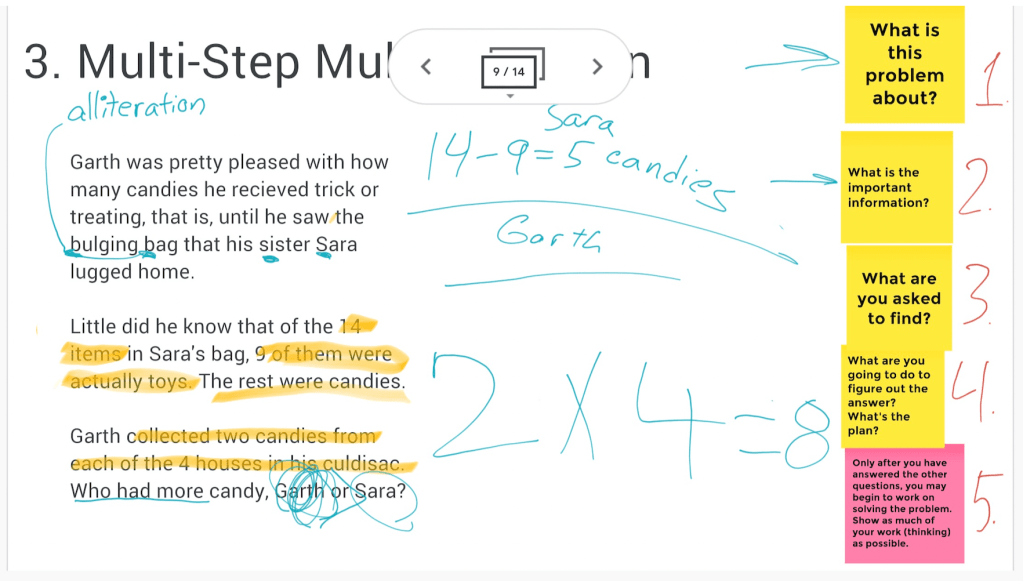
Tuesday morning, the day after Indigenous People/Columbus Day, we were back at it with more challenging word problems. When I first showed my students this Jamboard, I had the “sticky notes” layered on top of the word problem. As we read and discussed what each one meant, I moved them to the sides and shrunk them, so that they all fit on the right for reference. Only then, did we read this word problem.
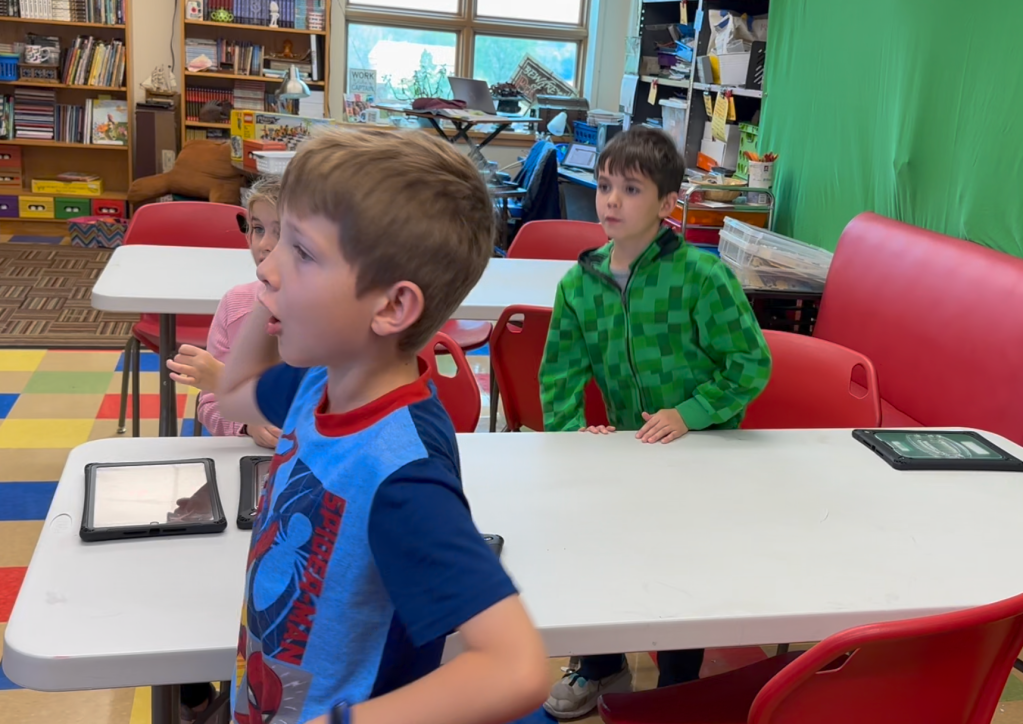
My 2nd graders kept yelling out numbers, like there was a contest for who could solve the problem first. It was humorous to tell them that every single number that they would say, no matter what it was, would be wrong. This was perfect for drawing their attention to step 3. “What are you asked to find?”
“Are you supposed to provide a number as an answer?” I asked my students. This got them thinking. And, even after solving how many candies each kid had, they still needed to compare the numbers in order to really finish the problem. It wasn’t enough to just know how many each had.

Once we had successfully solved our Trick or Treat word problem, it was time to make up our own. Before getting creative, we decided on the numbers and operation. We would have the mathematicians subtract seven from twenty.

I wanted to include everyone’s ideas. That is why the math story has flowers named after a student’s pet bunny, a main character named “Kid Pineapple, robots, laser blasts, and lots of the word “stinky” in it. Ha ha. We had a figurative blast coming up with our story.
We look forward to making up and writing down many more for our other 2nd grade friends to solve… The Ready Math way.

 The Captain of Class
2 thoughts on “Creating Word Problems: Math Enrichment”