A Class of Heros

Everyone is the “hero” of his own story. No matter what happens, the teller comes out on top. The classy teacher will know this, appreciate the mindset, empathize with each student’s self-centered, egocentric view of the world, and use it to foster classy heroes, rather than megalomaniacal monsters.

IMG_1049
Technology Heroes: I am in “awe” of how my students technology. They are my heroes.

Have you ever heard of someone putting a person in his/her “place”? This person uses the mask of teaching a student a lesson to vent emotions. Could this be any less classy a concept? A student is disrespectful. The teacher feels like the student would act more honorably if he/she understood his/her “place” in the construct of school hierarchy. So, the teacher, an educated grown up, belittles the youth through verbiage, discipline, or even just a look/body language (ignoring the student). The only thing that this unclassy adult is doing is showing the naturally narcissistic youth how to be truly disrespectful.

The classy teacher redirects. Instead of belittling an already little kid, build him up by showing him what a hero would do. It isn’t because of the “rules” that we don’t yell out in class. That isn’t a classy thing to do. Heros don’t interrupt. “This is what you want to do next time…”

What is a hero? The hero is a person others idolize; For kids, that is themselves. A hero is someone people look up to because of accomplishments (Cipriano, 2014). A mediocre basketball player is not as heroic as the one who leads the team to victory. Ancient civilizations made up stories and created their heros, the gods. The United States of America lavishes heroism on George Washington.

A hero is someone people connect with in order to feel better about themselves. George Washington, the father of our country, lead a rebel, underdog army to victory over the greatest military in the world! Identifying with this hero fosters pride in country and therefore person for being a citizen of that country.

Treat each student like he or she is a hero… They are… in their own minds. Help them achieve their personal greatness by assuming their hero status.

Another thing that forms people into heroes is overcoming adversity (Cipriano, 2014). The survivor of calamity is a hero to others. “I could never have done that; I would never be able to put up with that; If that had been me I wouldn’t have conducted myself nearly as classy…” An easy way to help students become the heroes they already believe themselves to be is by providing “opportunities of challenge”. When I tell my students the expectations for lining up, I make it nearly impossible for kids to do. Then I pretend to be “in awe” of the students who can actually do it. These kids are then seen as heroes from a lineage of class beyond human capability. Without making my expectations seem (they must be somewhat obtainable) unfeasible, there would be no hero. The hero can do the impossible.  

A misconception: Some teachers have the philosophy that their students all have A’s until they start doing things wrong or losing points. That is not what I am talking about. The line isn’t perfect until it isn’t.

Don’t treat students as if some day they will eventually do something great. Help them grow into their greatness by believing in them. They already believe in themselves. Build their belief into something constructive; something worth adding to. Good luck creating a class of heroes.

Cipriano, R. (2014, July 8). What Is a Hero. Retrieved June 18, 2018, from https://www.huffingtonpost.com/rob-cipriano/what-is-a-hero_b_5560441.html
Classy is Behaving “Purposefully”

Before school the other day, I was called to the office to help with something or other. The bell rang while I was there. When I went to walk up to my room, it was a little late, and I was joined by one of my students who eats breakfast in the cafeteria. This student isn’t a fast walker, but he kept up with me as I quickly maneuvered between and past meanderers.

IMG_8026
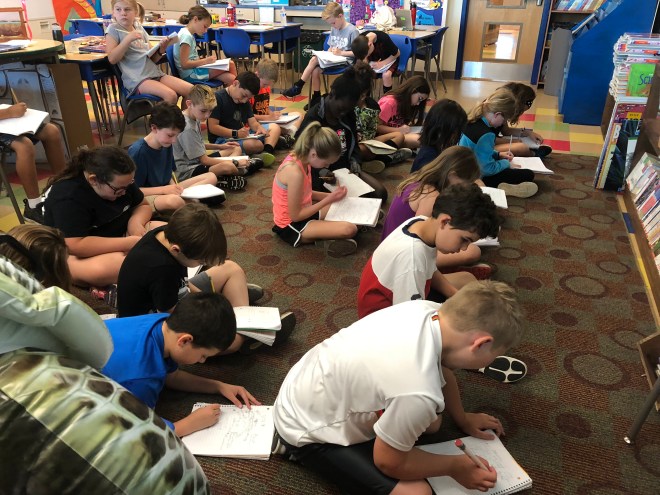
Purposeful Writing: Students Provide Examples of Purposeful Behaviors

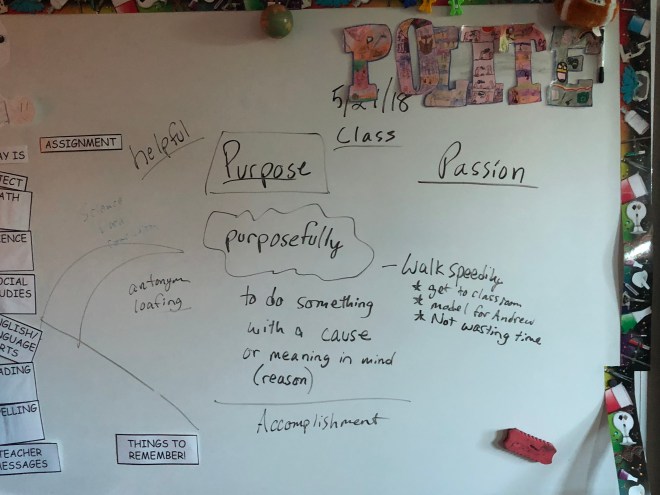
As I lead this student to walk faster than he would have, I thought about how I typically walk, and how that differs from most students. I walk purposefully. After the announcements and taking lunch count, I explained this to my class. To do something purposefully means to do it with a cause, meaning, or reason in mind. You have a purpose for doing it, and that goal drives you to act a certain way. Acting purposefully is classy.

“To an observer, it may simply look as though I walk speedily, but there is more to it than that,” I explained to my class. I was moving quickly in order to get to the classroom as soon as possible, because I wanted to see my students. It is common for me to walk quickly because I interpret moving from one location to another as down-time; unproductive time. “Finally,” I concluded, “I wanted to model for my breakfaster how one might maintain a pace that will enable him to have enough time to unpack, fill in his Assignment Book Page, and begin a morning work choice… all before the announcements.” They chuckled because the boy from my story is often seen finishing these tasks during my introductory lesson of the morning.

The antonym of purposefully would be “lazily” or behaving as though your task was meaningless. If teachers want well-behaved, classy kids, we will need to make sure that our lessons are full of meaning and purpose. Following this logic, it can be expected that a group of students performing a task that has no or little value, would not do it purposefully. Rote  repetition breeds misbehavior. By definition, repetition is UNthinkingly doing something over and over; like a machine. Give students something to think about, and you are giving them purpose.

Also, in order for this to work, students must comprehend the purpose of the task they are given. I constantly tell my students to sit up straight, but I give them several reasons, none of which contain the phrase, “Because I said so.” Did you know that standing straight, in addition to looking classy, promoting health, clearing airways, etc., actually makes you more “Powerful” (Cooper, 2013)? What kid doesn’t like that idea?! Even when I occasionally have my students practice something that might require repetition, I supply a reason that encourages them to try to improve upon the task with each successive attempt.

After explaining this concept to my class, I asked them to come up with their own examples of doing things purposefully. Discussion included brushing one’s teeth. You can just run the toothbrush over your teeth and use up enough time, so that your parents think you did a thorough job, or you can actually brush them in such a way that you relieve them of  debris and plaque. Gingivitis is a painful, expensive gum disease that 60% of 15-year-olds should have prevented, but didn’t (Dowshen, 2015).

A funny example that I related to was eating. There was a slight misunderstanding of purposeful activity when a girl suggested eating the right food. I re explained the concept of behaving purposefully, before telling the students that I often find myself so engrossed in my work that I don’t realize my hunger until I am famished. Then I get angry that I have to stop and consume some nutrients. It is irritating because, as an adult, I have to find food, which means putting my project on hold, going to a restaurant or store, finding what I want, paying for it… You get the idea! This takes up valuable time; The time is only as valuable as what it was being used for, however. It is important to participate in activities that have meaning, purpose, and hold value. When I finally have my food, I devour it like a Velociraptor.

I had my students write down their examples and draw pictures of someone behaving purposefully. They also drew a picture of what it would look like if someone performed the same task purposelessly. We had fun sharing those with each other to close the lesson.

Two things in closing: First, sometimes it is classy to walk slowly. The classiness comes from the reason for the behavior. It would not be classy to speed walk through a museum. This is a place where you should take your time to ponder artwork. You cannot do that quickly. Secondly, I am often struck by the paradox that I am supposedly a classy person, who writes rather sloppily on the dry erase board. Isn’t messy penmanship unclassy? Not necessarily. If my purpose was to model perfect handwriting, then, yes, my scrawl would be less than classy, to say the least. However, I am usually modeling taking notes, when I write on the board. I only write what I think students should take down in their spiral notebooks. The speed I use, which prohibits beautifully crafted letters, demonstrates what it is like to jot down ideas while listening. Along these lines, I rarely ever write complete sentences on the board. Parents often complain about their child’s penmanship. This is the last thing that I would focus on as a teacher. Why do doctors messily fill in prescriptions? Is it because that is what doctors do, or is it because they fill in a million, as long as the pharmacy can read it, it works, and their time is used better speaking with and looking at patients? So, parents, would you rather a creative composer, or a very neat transposer?

IMG_8039

Cooper, B. (2013, November 21). The Science Of Posture: Why Sitting Up Straight Makes You Happier And More Productive. Retrieved May 25, 2018, from https://www.fastcompany.com/3021985/the-science-of-posture-why-sitting-up-straight-makes-you-happier-and-more-product

Dowshen, S., Dr. (Ed.). (2015, January). Taking Care of Your Teeth. Retrieved May 25, 2018, from https://kidshealth.org/en/teens/teeth.html