
The other day my elementary school had an assembly. When it was over, a fourth grade class was left with no teacher. She had attended a meeting that was running over. Since I didn’t have a class at the moment, I decided to bring her students upstairs for her. As we waited in the fourth grade classroom for the teacher to return, I wondered what I would do to maintain a semblance of sanity. I decided on a game centered on behavior: The One-Room Schoolhouse Game.
When the teacher, accompanied by an instructional assistant (IA), entered the room, they couldn’t believe their eyes. Every student was sitting up ramrod-straight. Every single eye was trained on me. The IA verbally queried, “What is happening in here?” She was incredulous. I was in my element.
Educators are show(people). We are either putting on a performance to attract the attention of our students. Or, we are ringmasters, making sure the mayhem stays within the bounds of 42 foot diameters (the official size of a circus circle).

There are many ways to perform, but methods for maintaining order is more limited. Many years ago I came up with a unique way to do both at the same time.
When the IA, who had seen the game in action, entered the faculty room at lunchtime, she practically burst with enthusiasm, announcing to the other teachers what she’d seen. Some of the staff members wanted in on this game of good behavior that students seem to enjoy. I explained the rules to them. Since then, I’ve had a couple of teachers ask me to share with their classes how the game works. I’m more than happy to oblige.
Then, I searched my blogs to see if I’d written about The One-Room Schoolhouse Game. Unbelievably, I hadn’t! So, here goes.
It began many years ago. I brought my 3rd grade class of “Polite Pirates” (what I called my group of students) on a field trip that visited several historical sites around our area, all in the same day. It was a fast-paced adventure of a field trip, running from one stop to another, practically assaulted with information.
We began the day at Trout Hall, the original house of the Allens, the family that founded Allentown, Pennsylvania. The building is staged to look like it had during the Revolutionary War era. A tour guide led us around the house and explained many interesting facts.

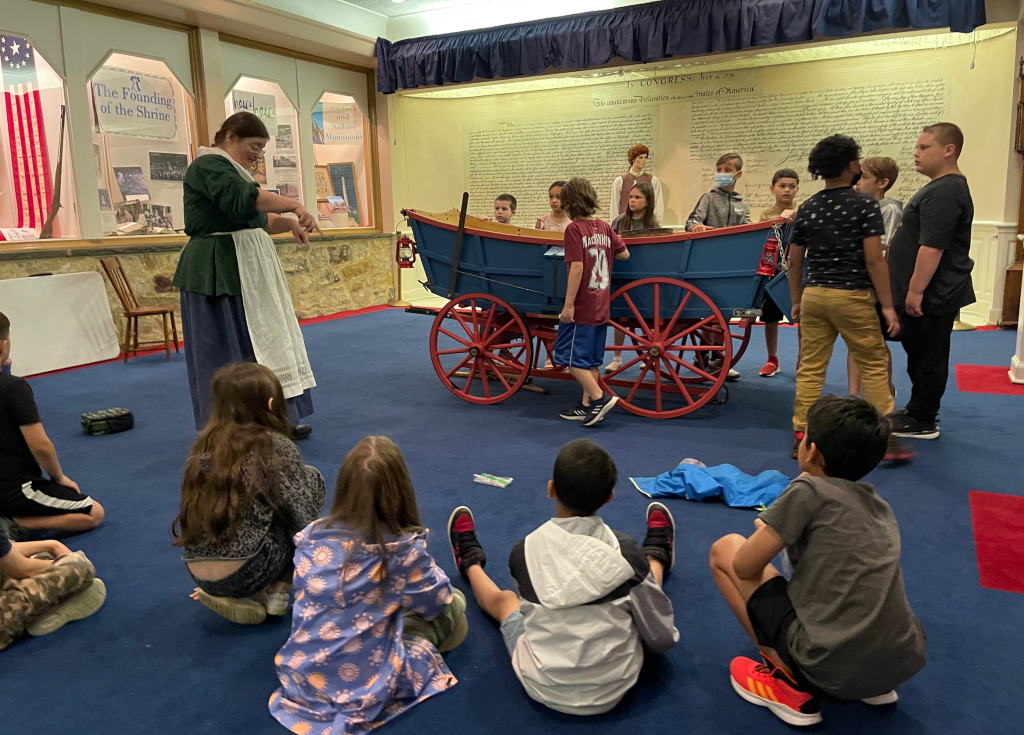
From there, we traveled only a few blocks away, where the Liberty Bell had been housed during a portion of the Revolutionary War, hiding it from the British. The Liberty Bell Museum has a life-size replica of the original bell, a slightly smaller than lifesize model of the wagon that would have carted the famous bell, along with several others from Philadelphia to our town. They have a nice mural and story display that they show. They also provide a favorite feature of every field trip; a gift shop! This is where I acquired my famous “One-Room Schoolhouse” bell. It is a mini replica of the Liberty Bell.

The final stop of the day was an old school building that was preserved to look the way it had when it was used as a one-room schoolhouse as late as 1956. The Claussville Schoolhouse is where I learned the practices that what would turn into the rules of my One-Room Schoolhouse Game.
A tour guide walked us through what it would be like to go to school one hundred years ago. Every grade, from first through eighth was taught in that one room! Because of this, the school master had to be very strict.
I explain all of this nowadays when I introduce The One-Room Schoolhouse Game. Believe it or not, me acting like a big meanie is one of the more fun aspects of the game! Students love tempting me to pretend to yell at them. Suffice to say, this is far from my typical conduct.

The Game
Now you know where the idea for the game originated, let me explain how it’s played. I introduce the game on the very first day of school. It contrasts the comfortable social/emotional learning (SEL) environment that I foster and points out how nice I actually am.

Right off the bat, I talk about what school was like a hundred years ago. Because there weren’t any buses, schools only serviced local communities. Every kid walked to school. The building housed every grade, from first through 8th! A teacher was responsible for managing lessons for eight grades, all at the same time. And, there was only one teacher. They could not afford to have any disorder or misbehavior, so the teacher was very strict.
“There were many rules for doing things. First of all, the students had to sit up straight.” As I say this, I morph into a very serious, demanding persona. Every student whom I have ever shared this game with has always straightened his/her posture at this point. “There is absolutely NO talking.” I look around the room, daring students to even think about speaking out loud without being called on. The students are loving this. They are on pins and needles, waiting to see who might get into trouble. I have transformed into a scowl-wearing, grumbly ogre of a teacher.

Power of Role-Play
The tension mounts as I walk around the room. I might at this point explain some of the primitive punishments that would have been used during the days of the one-room schoolhouse. It’s not impossible for me to slap a ruler onto a desk to really amp up the mystery of the experience. (Of course, I make certain all of my students understand that corporal punishment is unacceptable in connection with education… but, that is how it was.)
Once I have my students good and primed, it’s time to share the rules of the game. When they are called upon, they are to stand, push in their chair, name the person or persons they are addressing, and make their statement in a complete sentence. I always make it clear that they are to “Refer to me as Mr. Weimann, or Captain Weimann if you’re classy, and you wants to be classy! If you are answering a question, and the information is pertinent for your classmates to pay attention to, you say, ‘Captain Weimann and fellow classmates…’ If there is another adult present, and your answer would benefit that grown up, you say, ‘Captain Weiman, Ms. so and so, peers and/or fellow classmates…’ You get the idea.” We practice this a bit.

That’s pretty much it. I throw in some variations or additional rules throughout the year to keep the game interesting and fresh. One day I might go crazy about neatness, causing everyone to clean up their desks and the floor around their work spaces. Another day I could go nuts about hearing them breathing. They love it, the more extreme and just beyond grasp the parameters are. A really fun one is pretending to be the mean one-room schoolhouse master and prohibiting all smiling. They practically burst, but work so hard to meet the requirement!
The trick is to do the game just enough, both in the number of times you play it and how long it lasts. It slows everything down; the making kids stand up, push in chairs, reanswering because they forgot to say who they were talking to or didn’t use a complete sentence.
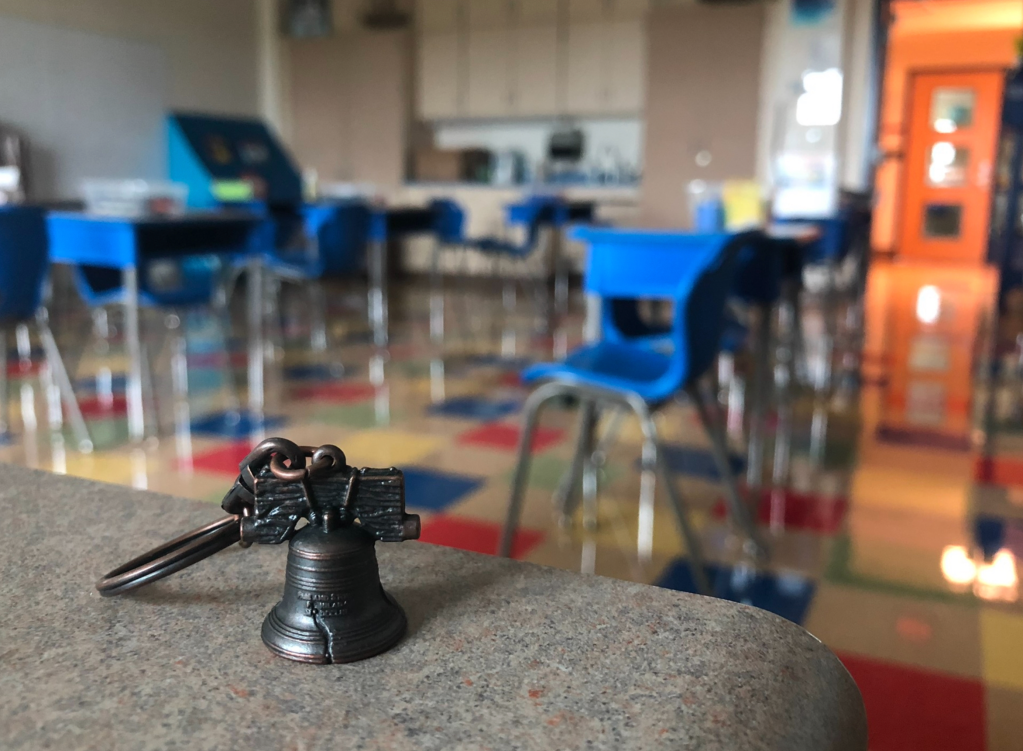
The students love the game, though. They usually beg me to ring the bell, for I explain that the tiny bell that I got on that very first field trip to the Claussville one-room schoolhouse has magical properties. Whenever I ring it; and only when Mr. Weimann rings it; we are magically transformed into a one-room schoolhouse. This, of course, is a huge part of the game.
Sometimes, I will pretend to be unhappy with what is happening in the room, and “threaten” to ring the bell. The class will gasp in mock shock. If I do ring it, they all groan and moan, as if they were just strapped into straight jackets against their wills. …But, they quickly sit up straight, quiet down, and see who the big, mean school master from the past will pretend to pick on first. They are always disappointed when we return to the humdrum of contemporary time, and I turn back into fun, loving Mr. Weimann.


Back to the Future
This game is like “The Floor is Lava,” in that no one gets hurt, it’s all just pretend, and it amps up the excitement of an otherwise typical walk-through-the-park day. It is perfect for jazzing things up right in the middle of mundane stuff. A little ring of the bell commands everyone’s attention to both behavior and their tasks at hand.
I had no idea how different the 4th grade class that I was sharing the game with was acting, but their teacher and the accompanying instructional assistant recognized that something unique was going on. Rather than explain the game, myself, I allowed the teacher to call on students, who nearly burst with pride to show off their new skills.
It took a couple of kids to get all of the rules out, but once I felt comfortable that the teacher understood what was going on, I was free to leave the past. On my way out I whispered, “I’d wait a couple of minutes before ringing that bell. Ride it out;)”
You don’t want the game to go too long. Fatigue can set in. For the game to be fun, it has to be special, so don’t play it too often or too long. Let the students petition for it a few times, and then surprise them after returning from lunch or in the middle of a multiplication game. Use it for a transition to another lesson. Above all, have fun.
 The Captain of Class