Ready Math has an enrichment activity for nearly every math lesson. These are usually accompanied by a worksheet. The papers can be printed, photocopied, and distributed for students to complete during independent time. The worksheets have thorough instructions on them, sometimes with examples, so that students can manage the assignment without teacher help.

The idea is for students who’ve attained mastery of the subject to apply their skills to slightly more challenging tasks. It’s nice for the teacher to have something concrete to look at after the student is done. This evidence of work and proof of advanced mastery can be shown to parents and back up grades on report cards.
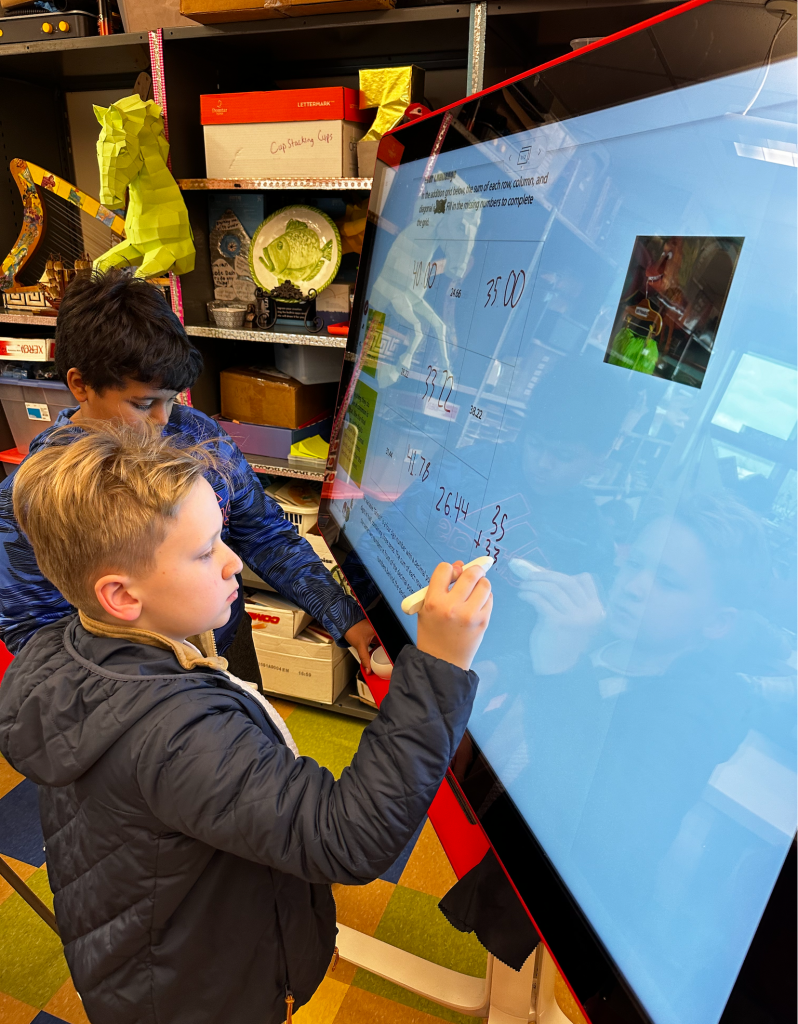
One problem with this is that students aren’t always thrilled about being rewarded with a worksheet when they understand and are good at a math concept. It’s helpful for a teacher to introduce the worksheet. They can spice up the assignment with some extra enthusiasm. It might be helpful to pave the way for success with a check for understanding of the assignment. Perhaps the teacher could introduce a twist to the pre-made project, including an additional step or task.
When I am preparing an enrichment activity, I try to provide an opportunity to use the math concept in a real world scenario. We all remember the age-old question, “When will I ever see this in real life?” uttered with a groan and eye-rolls. This is my aim: Show students situations where their math lesson would actually be found.
Another goal of mine is to help students grow their thinking muscles. Perhaps there isn’t a clear use of Pythagorean’s theorem in everyday life, but it can be used to sharpen geometric and algebraic understanding! Puzzles are great for this.
I recently used one of Ready Math’s enrichment assignments to challenge a group of fifth grade students. The lesson/worksheet looked a little like busy work; It involved adding and subtracting four-digit numbers with decimals. You needed to be handy with the math to complete the task with accuracy, but I didn’t see any way that the student would be richer having completed the assignment.
One of the first things I do when attempting to turn a pre-made assignment into an enrichment activity is see if there is some bit of information or number that can be taken away. Can I remove something, and the students still figure out the answer?

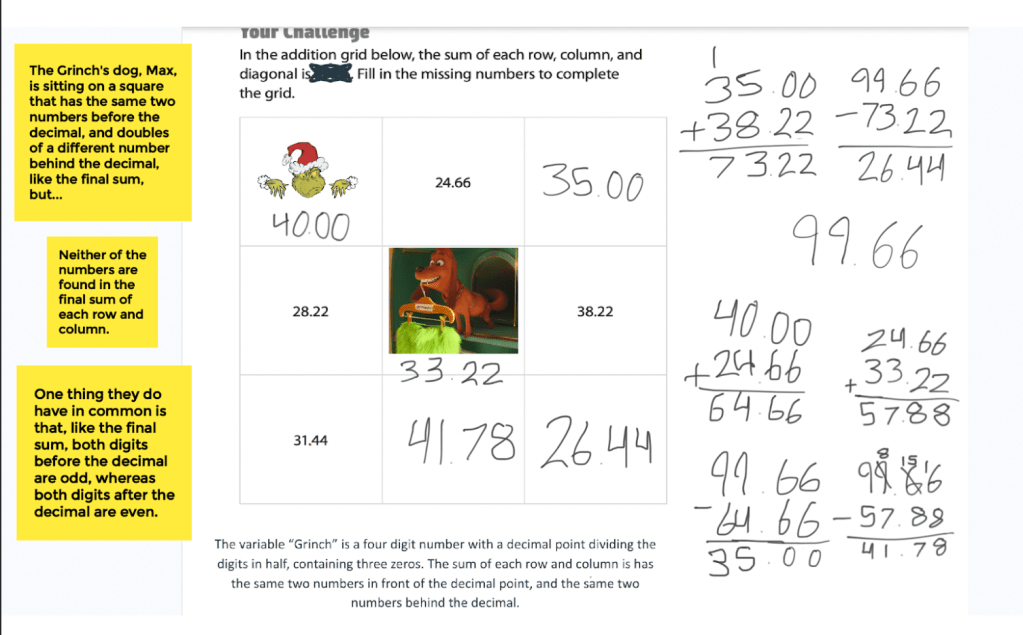
The assignment that I was looking at was a three by three grid with some boxes filled in and others blank. Every row and column, as well as the diagonal lines crossing the center square, all add up to the same number. The worksheet tells the students what the shared sum is. Can I remove that final answer and students still figure out what numbers would go in the boxes?
I tried it out in my journal. The way I saw it, there’s no way around having at least two unknowns. I could ask the students to figure out multiple correct answers; sums of every row and column, but this kind of activity stretches beyond enrichment and requires gifted thinking. That is a topic for another blog; the difference between enriching math and providing gifted instruction.

Still liking the idea of removing the sum that all of the numbers share, and making students really dig for the gold of their lesson, I decided to limit the unknowns by providing parameters. I began writing these into hints or clues. Then, the lesson morphed into a type of riddle. I left gaps in the clues, so that students would have to address a few empty boxes in order to solve the entire grid.
As the project evolved, it struck me that I could pretend the problem was a lock that prohibited the class from leaving the room; It facilitated an escape room sensation. This would be the way that I presented the whole problem! I’ve been wanting to explore the use of escape rooms at school. This could be a great start.
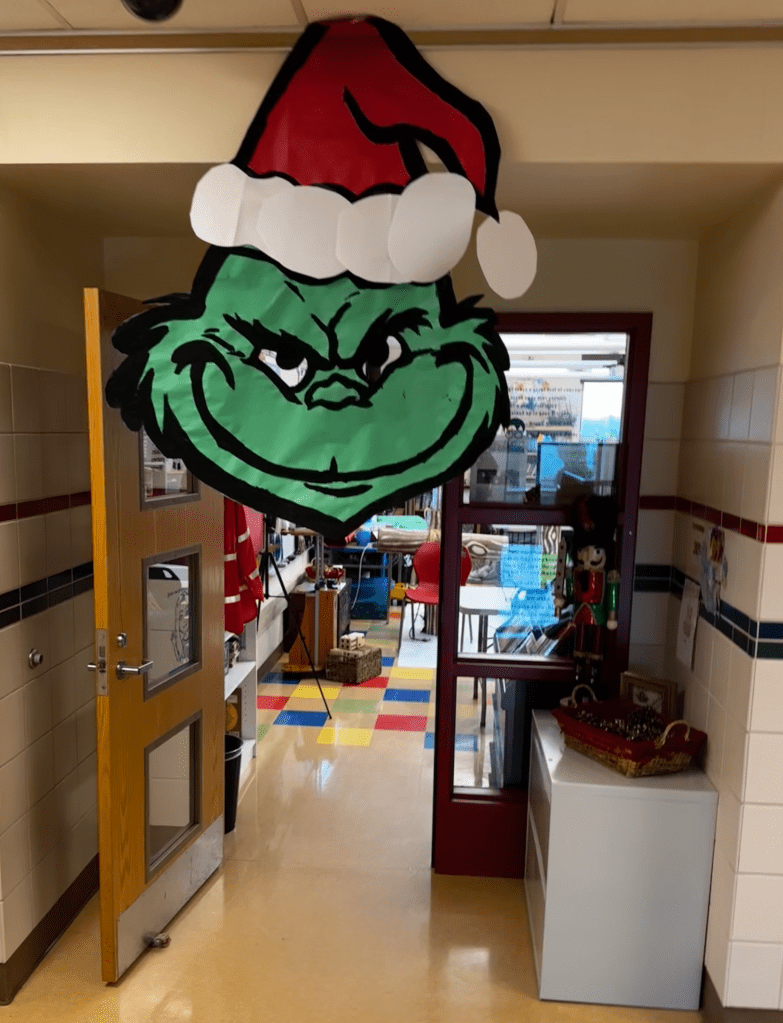
I prepared some more clues for bits and pieces of the four digit numbers within the grid. I put an image of the grid into a Google Jamboard. Then, I copied the riddles and pasted them into “sticky notes” that got spread out around the grid. I themed the whole thing with Grinch, and it was ready for “production.”

The fifth graders loved it. When I told them that they were stuck inside the Grinch’s lair, their faces lit up! “The Grinch, that big ole meany went and scribbled over the sum that we need to solve this grid. He left us several riddles to figure it out. You can’t leave the room until you do.”
Everything was going great… Until… One of the students had actually completed this particular worksheet in the classroom, as an extension activity. My heart instantly sank. Did the Grinch steal my Christmas? Luckily, I’m pretty good on my feet, and I told them that we can still use this whole activity in order to learn how to make up our own riddles and clues, so that we could develop another, future escape room that other students could have to solve. Everyone was cool with this new plan.
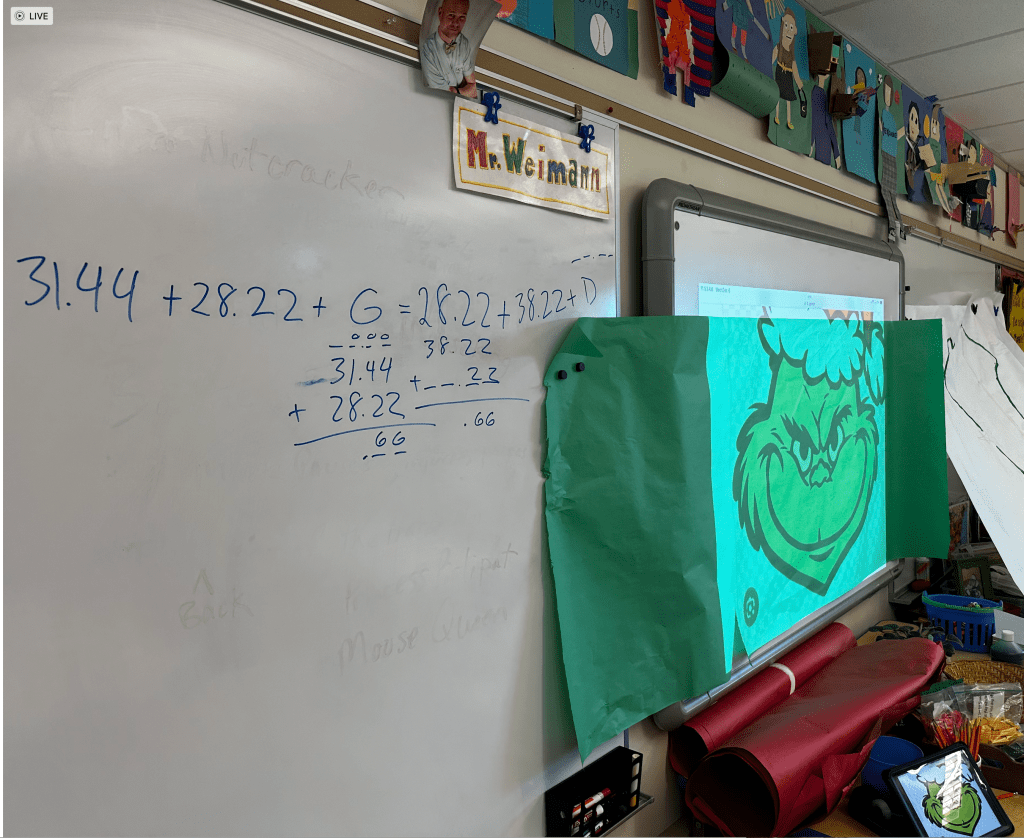
We continued exploring the clues, now with a new purpose. Granted, we were working backward, since we already knew the final answer, but that was okay because the students were able to see how the clues functioned. I showed them the way you can start with an answer, analyze the number’s attributes, and make up hints that color and shade the number, without giving it away. They seemed to like it, and we still had to do some adding and subtracting of four digit numbers containing decimal points!
This lesson wasn’t over when this group of students left, however. The way fifth grade math enrichment works in my school, I meet with a different group of advanced math mastery fifth grade students in afternoon. I told the AM students to not tell the afternoon math students the answer, just in case none of them had completed this particular assignment. Then the Grinch let them out;)
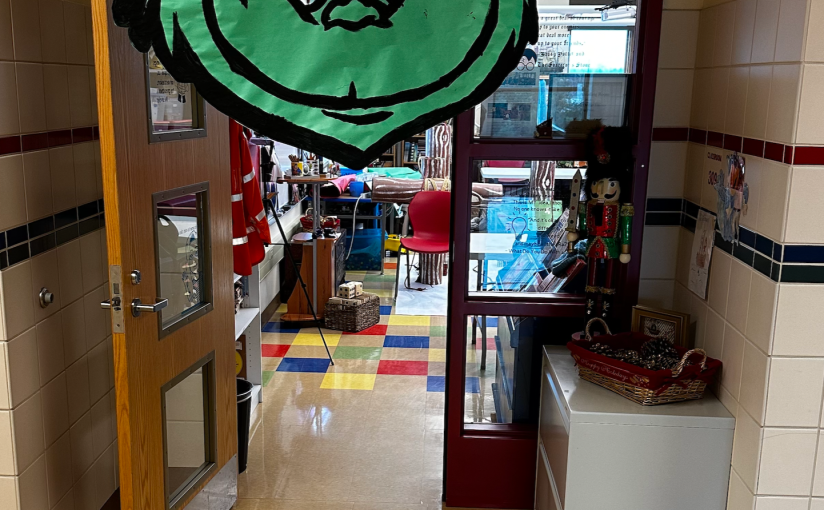
Between the groups, my fourth grade gifted students painted a giant Grinch face to hang up over the door. That was fun.
When the afternoon students entered the room, I pitched the escape from the Grinch’s Lair idea the same way I had with the morning crew, but with the understanding that they may already know the answer, like the first group. One student of the eight or so kids had done this assignment and knew the answer, but he was a good sport about keeping it a secret.
Since I had thoroughly examined the entire riddle with the first group, I was well-versed in the clues and could easily present them to this final class. I let them wrestle with the ideas. As it turned out, you could figure out the final answer before getting all the way through the final clue. That was interesting to learn. The experience was pretty fun, and they got plenty of practice adding and subtracting numbers containing decimals.
I’m definitely looking forward to making more lessons containing clues and using the escape room scenario to encourage tension and motivation! It was really nice to have a pre-made template from Ready Math to build from; or, more accurately take away from. But, in the future, I’ll have to be careful about assuming kids hadn’t used the lesson before.



 The Captain of Class