

Yesterday, I had the privilege of attending a one-day conference hosted by Curriculum Associates, the company that produces the lessons that I use to teach my students math. During a whole-group general session between breakouts a few different leaders from the company got on stage to share some ideas. One of them was Kenneth Tan. He was in charge of speaking about some new ways of interpreting the data that diagnostic assessments provide.
He did a nice job making meaning from graphs and charts. One of the things that Kenneth shared caused me to remember a lesson I’d taught my 1st grade math enrichment class the day before.
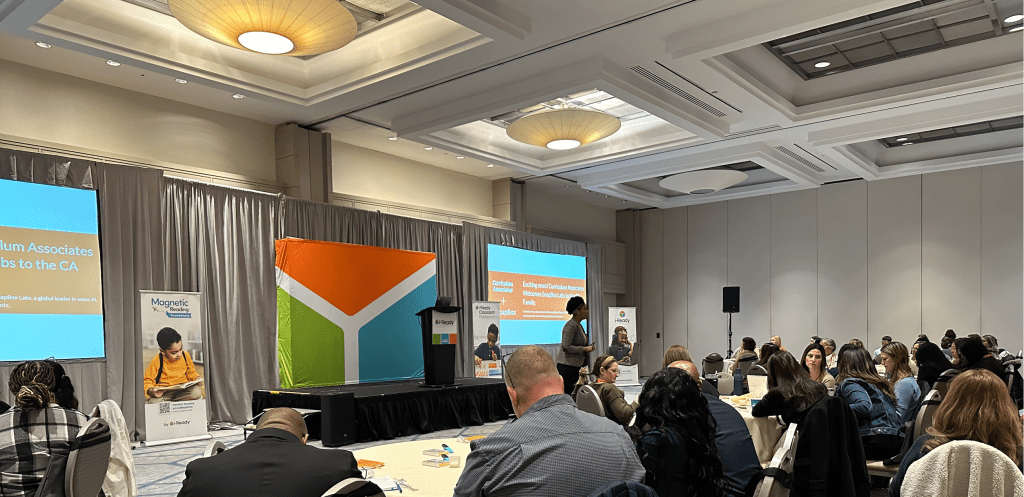
He had an image appear on the huge screen at the front of the room. It was a grid with around 12 or 16 seemingly random words in boxes. The audience was asked to try to remember as many words as possible. I figured there was a catch, and I took a couple of seconds to glance over the entire grid, getting a feel for the words. Were there any connections that could be helpful?
Just as I realized that the collection of words contained not only nouns and verbs, but adjectives and articles as well as prepositions, the image disappeared! I tried to quickly string together any words I’d remembered, forming a sentence, no matter how silly.
The speaker probably knew his audience was smart enough to think of this trick and, either to limit their success or to save time, switched slides from the grid of random words to one containing the sentence that I’d tried to piece together. Kenneth Tan remarked that data is only as helpful as it is meaningful. I liked the analogy.

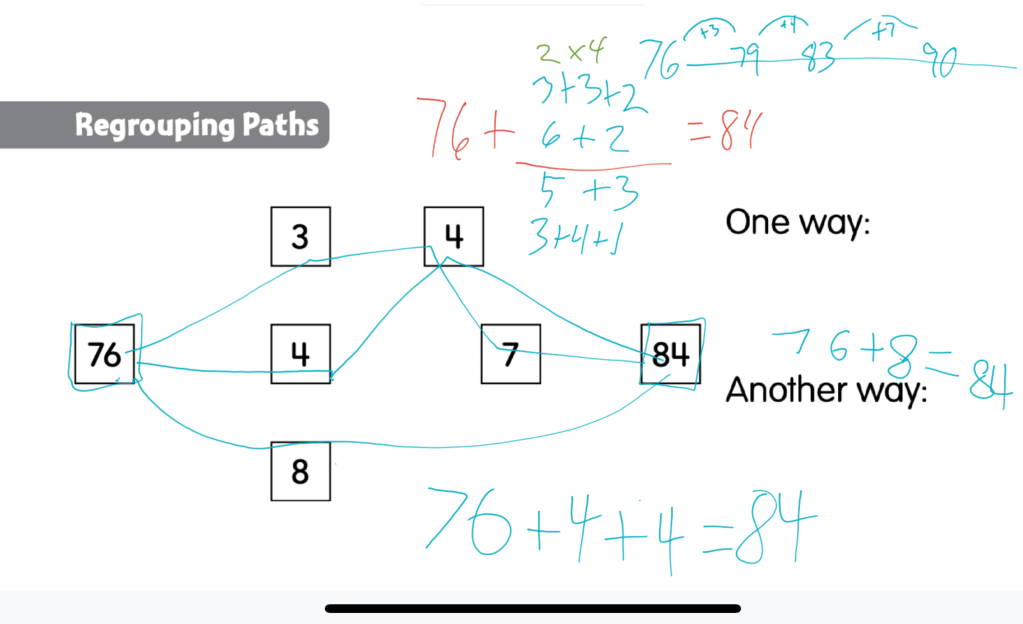
The idea of connecting words made me remember my first grade math enrichment lesson from Monday. In that lesson, I had students join single-digit numbers to grow a double-digit number from the left side of the image larger and larger, until it eventually equaled the double-digit number shown on the right. This lesson was straight out of the Ready Math Teacher Toolbox (Lesson 20).


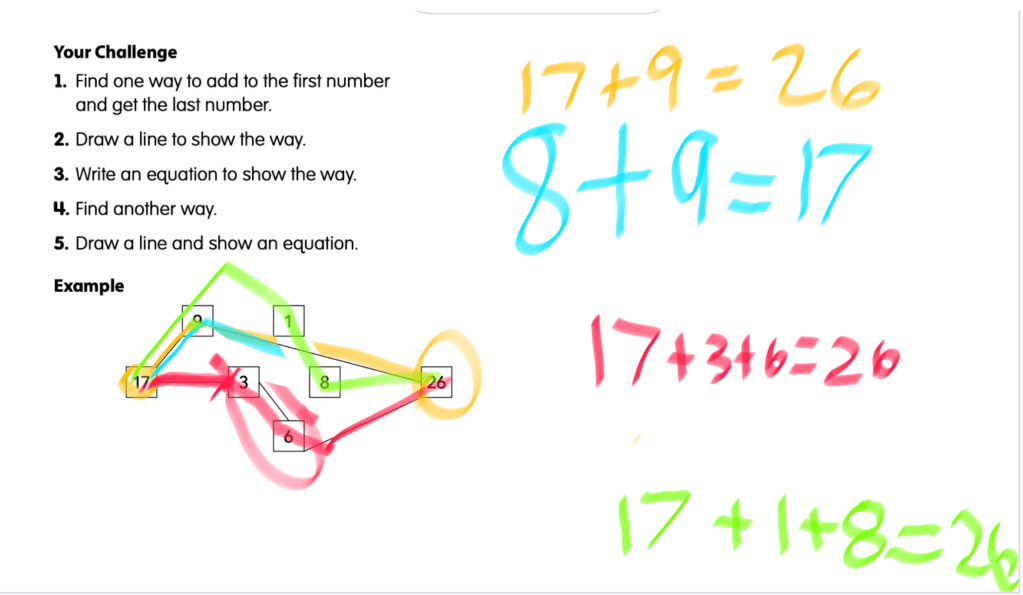
Typing out the process makes the lesson seem more complicated than it was. As you can see from the image, Ready Math had numbers in boxes. Some were double-digit, and some were single-digits. The double-digit numbers flanked the single-digit numbers. Students had to leap frog across the boxes with numbers to get from one double-digit number to the other, and the trip should create a balanced equation. Ready Math had an example that made the task plain as day.
The activity was an instant hit! Among other things, we discussed the relationship between the numbers. The 17 needed a nine to get it to 26. There were several ways to make nine, using the numbers that were available. We talked about combinations of numbers that could not work, and why, as well. One student (the blue line and numbers) wanted to go from 17 to nine, and then visit eight. Either they wanted to try something different, or they had recognized that eight plus nine equals 17. I let them try it, but they realized that the path would not “land them on” 26. They would over shoot their goal.
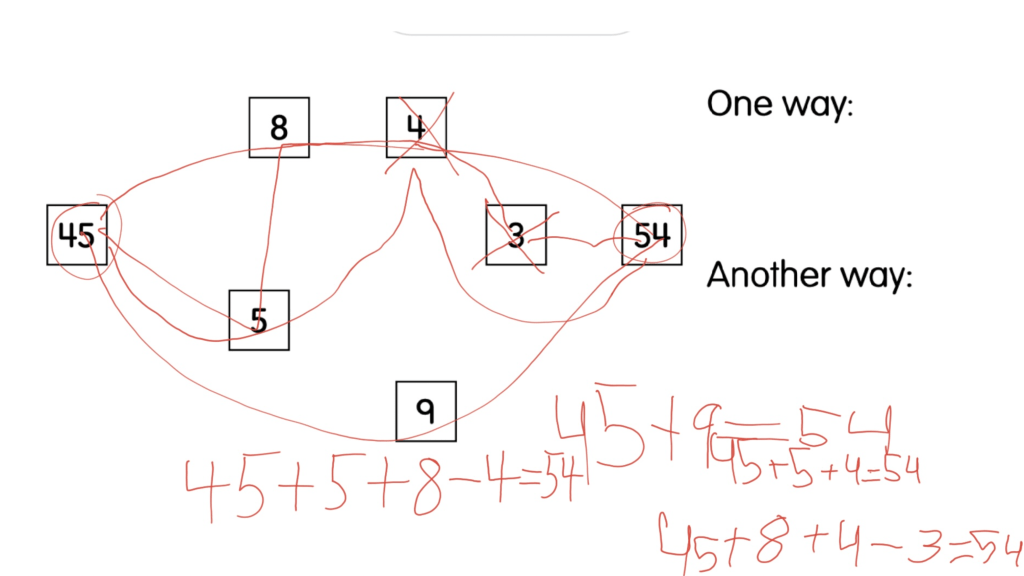
The Ready Math enrichment assignment had a few diagrams with varying numbers. I had different students come up to the Google Jamboard to draw paths and write equations that demonstrated getting from one double-digit number to the other.
I showed the first graders that every equation for a diagram had some parts that were the same. The first number, the double-digit number, was always the same. And, the sum, the double-digit number on the other side of the equal sign is the same for each. It is the middle addend(s) that change. To illustrate this fact, I drew two boxes in the middle of the equation. These symbolized the boxes from the diagram that held single-digit numbers. When we had finished working through the numbers that were available, we came up with some others that weren’t shown.
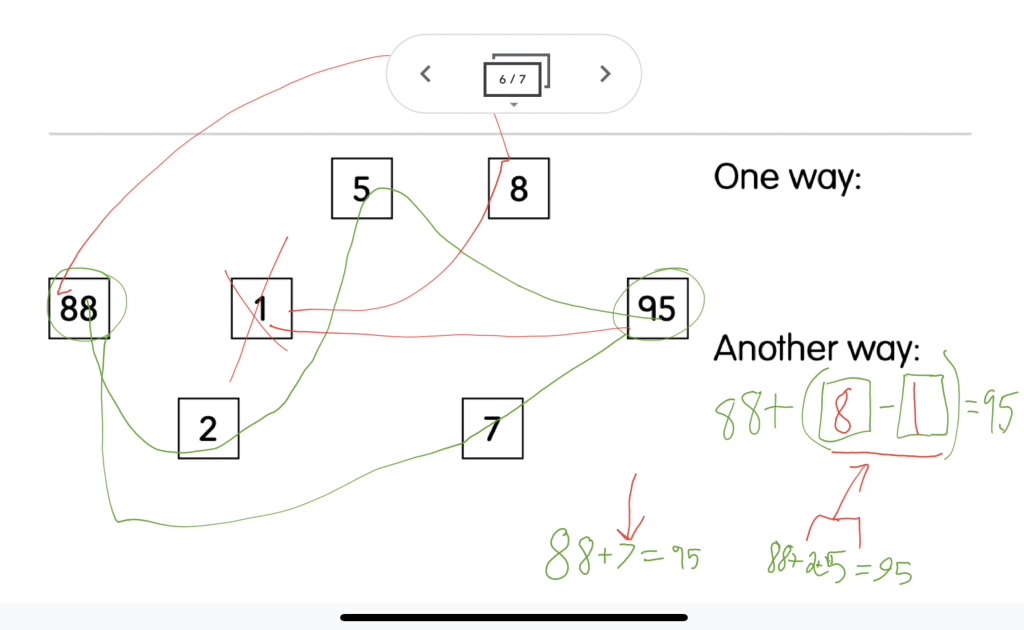
Then things got really interesting. The first graders felt bothered when one of the diagrams had numbers that were not being used. The starting number was 88, and we had to get to 95, a difference of seven. One of my students drew a line from the 88 to an eight. That would put the running total up to 96, one past the goal of 95. Rather than tell the student that he was wrong, I asked if there was anything that he could do to “Balance the Equation.”

With a little help from his friends, the first grader decided to change the operation from addition to subtraction between the single-digit numbers. In this way, he was able to incorporate the last unused number, a one. Sure, one had to be “taken away” in order to complete the algorithm accurately, but at least he was valued worthy of a place in our equation!
More than adding and subtracting, this was a lesson in making connections and building relationships between numbers. Finally, finding balance between the two sides of the equal sign is not just algebra. It is a life skill.
 The Captain of Class