
A couple of weeks ago I was introducing the game of Dominoes to my 5th grade gifted students when one of them grumbled that they would rather play Math 24. I did not take offense because I understood why he felt that way. This student is good at Math 24. He already knows how to play it. And, the gifted program practiced it a lot last year, so he was used to doing it. Dominoes was new. It seemed overly-simple. Luck is involved, so you are not completely in control of your success.



If you don’t know what Math 24 is, I’ll explain. The typical game (There is more than one version.) involves cards with four numbers on them. You have to use all four numbers in order to create 24. You can use any operation; addition, subtraction, multiplication, and/or division. There are difficult, medium, and (relatively) easy cards.
The way the game works is a group of students will sit around a table, and a card will be placed in the middle. The first student to find the algebraic expression to create 24 taps the card. If they can describe the process of acquiring 24 from the four numbers, they get to keep that card.
There are Math 24 competitions. Our school has done very well in the past. Although I plan to allow time to play/practice Math 24, so that we do well again this year, I want my students to experience more. There are other math games in the world.
One of the reasons I like Dominoes is because of how old it is. Created in China around 1300AD, our current Domino game was adapted in Europe, where it received sixes and its name. You see it played all over the place by senior citizens. It is a relatively simple game that involves mental math to add mostly single-digit numbers. There is strategy involved, because you want to get rid of all of your Bones before your opponent. You can find Bones (game pieces) in any game room, recreational or community center, and most toy stores.




When my student complained, I assured him that we would work on Math 24, but I also pointed out some of the game’s weaknesses. I don’t think that these 5th graders were used to this; How could a teacher be in any way negative about a teaching tool? Weren’t they all sacred? “Can you play Math 24 with your grandpa?” I asked.
“We could teach older people how to play…” These students are in the gifted classroom for a reason. I can easily imagine them dragging a box of Math 24 cards around with them and spurring on the elderly of retirement communities to rekindle their number sense.
I really like Math 24. It greases the wheels of the computational side of the brain. When you play it, you look for patterns and relationships between numbers. One must have speedy mental math recall of multiplication and division facts, motivating students to memorize their basic math facts.






I stuck up for the game of Dominoes. “Yes, it may be simple, but you were unable to solve the word problem that I had presented,” I reminded him. This was a big part of why he had grumbled. I don’t think that my gifted students are used to NOT being able to figure things out. As I made my points in favor of learning Dominoes, a couple of students got on board with my thinking. One student jumped out of her chair and came to the front of the room to deliver an impromptu speech about how Dominoes is better than Math 24. As she wrapped up, a Math 24 supporter yelled, “Objection!” He was interested in providing a rebuttal. And, this is when I channeled the energy into a formal debate: Math 24 versus Dominoes.
I drew a T chart on the board and had students do the same in their gifted journals. We wrote a few pros for each game in the corresponding sides. I told the students to come up with more on their own. “Don’t just write down ideas that support your side,” I warned them. “Imagine what your opponent will argue. This way you can combat their reasoning. You will have to come up with attacks to weaken their position. It will be easier if you can preempt what they might say.”
With that, they were gone. Back to regular ed, they went, new and exciting plans for the future swirling through their heads.
I’ve done debates with The Polite Pirates (my 3rd grade students) before. They have gone well, but the one thing that I struggled with is the conclusion. Normally, I curate the debate so that both sides are pretty even. Then, in the end, I declare it a tie;) Everyone whines and complains, but we all go home content. I tell them that both sides won, as well as myself, because, “You all worked so hard and got so much out of the experience.”
This time, I wanted to try to make the debate a little more formal. If I expected my 5th grade gifted students to work at thinking and planning their arguments, I should do my due diligence and deliver an acceptable format with a point system. I searched online, and found a blog about classroom debates that offered some good tips.
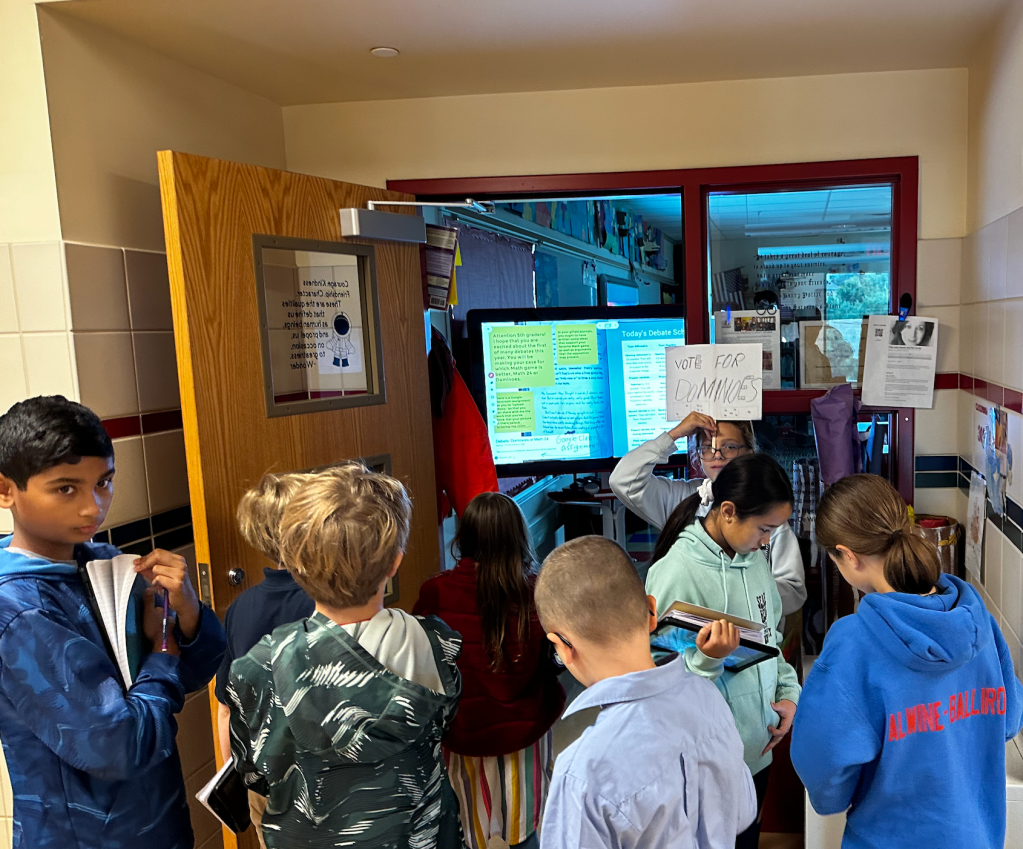
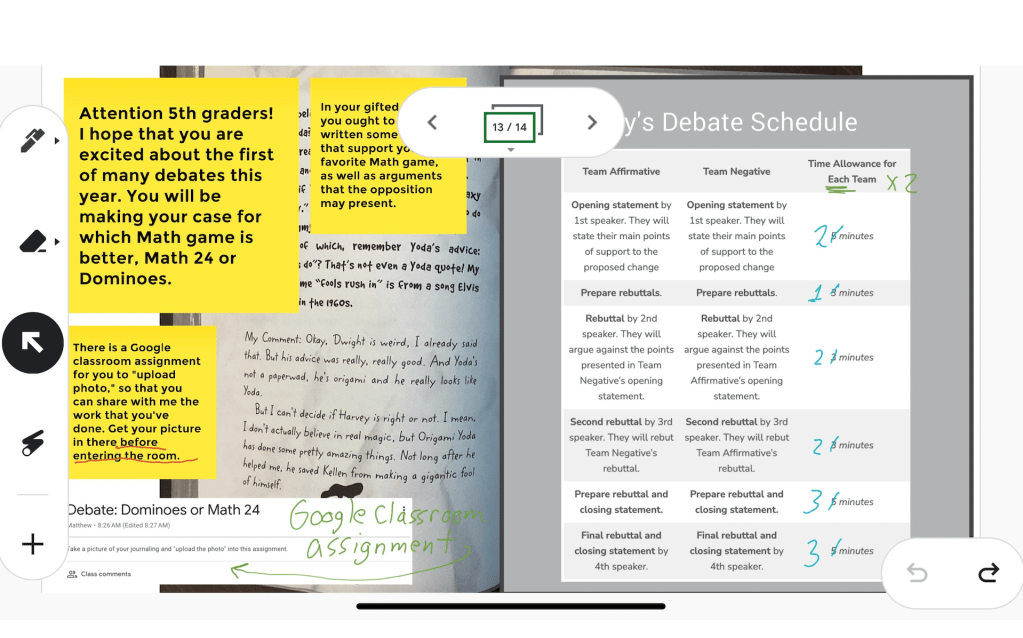
The morning board the next day told them to take a picture of their journals and import it to the Google Classroom assignment I’d just posted. When I arrived at the doorway, after AM car duty, some students were writing in their journals. Others were following directions and taking pictures. I didn’t let the 5th graders enter the classroom without some kind of photo uploaded to the assignment. They could take a picture of what they’d copied from the board the day before. That was acceptable; Not ideal. I praised students for their effort, not the quality of their content. (This will be the topic of a future blog.)
I quickly went over the schedule for the debate. The times were modified to fit within our abbreviated class time. (I have my gifted students for just 40 minutes.) Then I went over the things that could earn points. After securing nods and thumbs-up signaling everyone was in sync, we had our opening statements. The Dominoes team went first. They had written an opening statement that two girls delivered in front of the class. Wearing cool sunglasses, their theme was that Dominoes presented an opportunity to have fun and practice problem-solving in a casual, low-stress style.

Next came the Math 24 team. They came prepared with props, images to share via the classroom projector, and excellent points. In addition to some of the basic differences between the two games, the Math 24 team brought up the idea that the Bones of Dominoes can come from literal bones of elephants. Many sets of Dominoes are made out of ivory, which means… “By playing this game you are supporting the killing of elephants.” Gasps were audible.
When Team Math 24 was finished we were scheduled to have a one-minute “Prepare for Rebuttal” time, but there was a lockdown drill. This ate up the last of our time together. I told everyone that, instead of one minute, you have one day.
The day-long break turned into an entire weekend! When I walked up the stairs after finishing car duty Friday morning, the hallway was empty. Fifth grade had gone on a field trip. A couple of girls came to my room later in the afternoon, after everyone had returned, to ask if we could still have the debate. Because I pull students from several classrooms, and I hadn’t spoken with those teachers, I had to say no. “We will debate on Monday,” I told them. “Do more research. Produce strong rebuttals to the arguments that you heard in the openings.”
They were ready on Monday. The first thing that I did was replay the opening statements that I had recorded with my phone. Everyone was glued to the screen, listening for weaknesses. Team Domino got to go first, since their opening statement was first. They focused on the idea of cost. This was one of the points made by Team Math 24, in their opening statement. “There is more than one kind of Math 24 game,” they are argued. “If you want to play with integers and fractions, you have to pay more.” When it comes to ivory Bones, “You don’t have to buy a Domino set that was made out of ivory, and just because some are ivory, doesn’t make the whole game evil!”
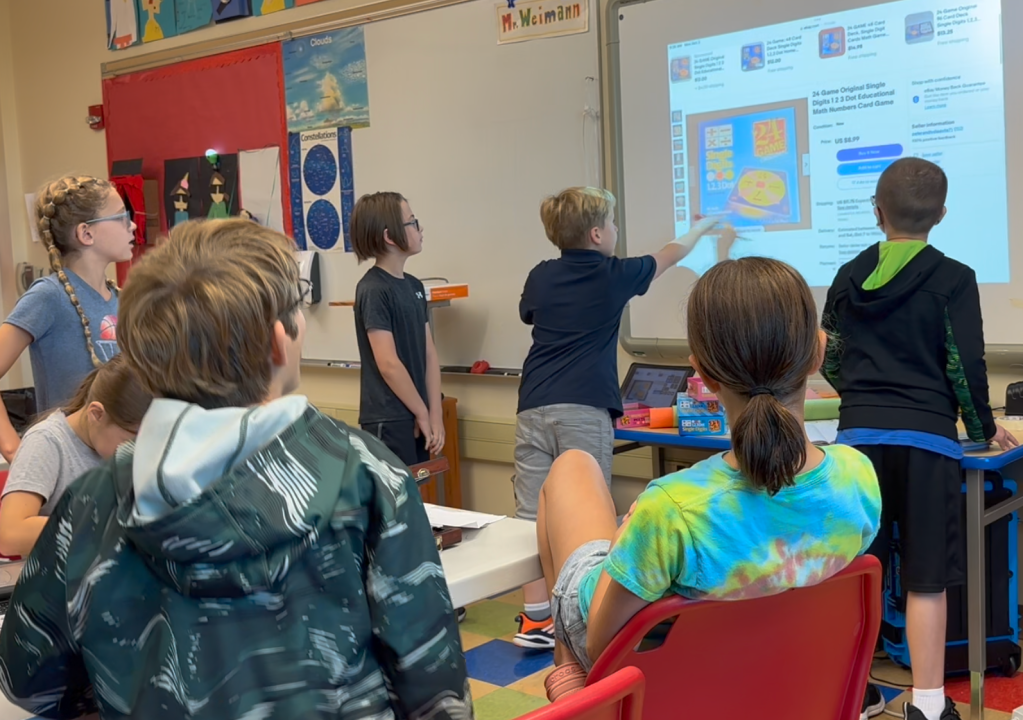
When Math 24 came to the front of the room, they were in attack mode. “Dominoes has too many rules, and doesn’t require anything more than simple addition, and a little bit of multiples,” a student suggested with zest. As far as the cost was concerned, he screen-mirrored images of Dominoes and Math 24 sets from the Internet. It seemed to me that the price difference was minimal.
Both teams did an excellent job involving everyone. Different students took turns talking, and they seemed to really listen to one another during planning breaks between sessions.
Some students representing Team Domino got up to refute the monetary attack. They showed more images that made it appear you could get either game for the same price, thereby neutralizing that argument. That seemed smart to me; Like, move along. New topic, please.



No can do. Math 24 people then got up and accused the Domino team of sharing “sale prices.” This was very entertaining for me to sit back and watch. The students were animated and passionate, but they were behaving civil and being respectful. It genuinely seemed like they were enjoying this playful debate about topics that were not life and death. Math 24 ended their time with the idea that someone could accidentally buy a set of ivory dominoes. Okay, possible, but that does not make the game inherently wrong to play.
Finally, it was time for closing statements. The twins tackled delivering the concluding remarks for Team Domino. They mentioned prices, but focused more on the fact that Math 24 is all about computation, speed, and therefore stress. Dominoes is geared toward problem-solving. They pointed out that because the game is common, you are more likely to find it at a friends’ house or game room.
The Math 24 students had what I thought was a thoughtful rebuttal to the attack of stress-inducing play; You could increase the time of the game, relaxing the mood of play. It isn’t impossible to experience a casual, friendly game of number-crunching. Their idea of a box of Math 24 cards having 96 different cards in it, while a Domino set has only 28 bones fell flat, because the computational-quizzing cards can only be used one way; once and done. Whereas Domino games can be played in endless variations.
We had used up nearly every minute of our time together. Before dismissing my 5th graders back to their regular ed classrooms, I praised their inclusivity; teams did a wonderful job of including everyone. I commented on how well-mannered they all were. And, of course, I loved the thoughtful points that were made. “I do have a critique, however,” I warned. They braced for impact. “Everyone got stuck on the price war.” I saw looks of understanding and acceptance on faces. “You kept coming back to how much each game cost, even after someone from Team Dominoes rightly pointed out that they both basically cost the same amount,” I pointed out. “It is easy in a heated debate, when emotions are high, to not think as clearly. That is why I wanted to mention this. As an outside observer, it would have been more powerful to move away from prices and focus on play.”
Thinking back, I wonder if my students focused more on the price of the games because it was the most tangible concept to debate. It came with pictures and concrete proof. You can’t argue that five dollars is more money than ten! This point did not carry any weight, however, because I already own plenty of both games.

More than who won, students wanted to know which math game won. “Which game will we play, Dominoes or Math 24?” they asked me Tuesday morning. We worked on preparing to make videos to share with Columbia University, instead. I wanted to compose this blog before announcing a winner. Little did they know that we’d be playing plenty of both throughout the year!

 The Captain of Class
One thought on “Dominoes Versus Math 24; A Debate”